Home Blog Page 1454

London Mission will be expensive: Soaki

0
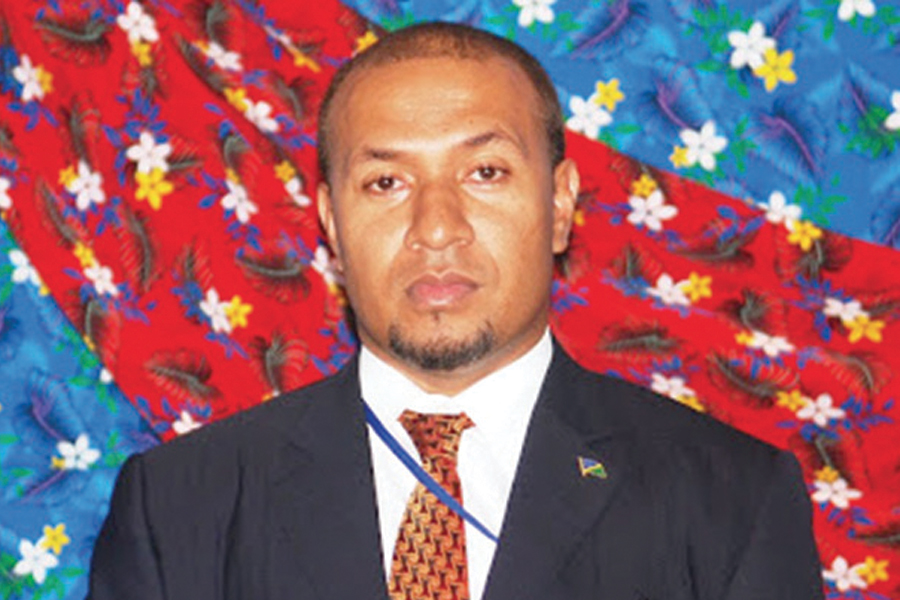
MFAET Deputy Secretary, William Soaki

By Mike Puia

MFAET Deputy Secretary, William Soaki

MINISTRY of Foreign Affairs and Eternal Trade (MFAET) Deputy Secretary, William Soaki, says the country’s diplomatic Mission that will officially opened in London, United Kingdom, next month will be very expensive to run.

Mr Soaki revealed this when staff of the MFAET appeared before the parliamentary Public Accounts Committee (PAC) last week.

He said the country has missions overseas, and in Europe, but they are as not expensive compared to the London Mission.

Prime Minister Rick Houenipwela will officially open the Mission next month, even though it has already been in use.

Soaki confirmed their Ministry had bid for $5 million under its budget submission for this year but the government only allocated $1 million.

The Ministry so far has $3 million to cater for the London Mission. There is concern the limited budget for the Mission would prevent it from fully discharging its work.

The London Mission is expensive because the country meets all the costs ranging from office cost to rental and entitlements for people who will work in the Mission.

Compared to our other missions, they (missions) got support from international organisations that cater for rental and other costs which reduces their operational costs.

Soaki said the London Mission will be expensive but there is political will to see it opened.

He said the country expects to reap many benefits from the London Mission especially through its bilateral with the United Kingdom.

Hope for farmers

Hon Bodo Dettke MP (RIGHT) infront of the container filled with 1,000-litre IBC of Noni juice bound for Brisbane tomorrow

North-west Guadalcanal MP Dettke makes maiden export of multi-million dollar Noni product

By Alfred Sasako

Hon Bodo Dettke MP (RIGHT) infront of the container filled with 1,000-litre IBC of Noni juice bound for Brisbane tomorrow

NORTH-WEST Guadalcanal MP Bodo Dettke is today standing taller than the rest of his Parliamentary colleagues, opening a potential revival for the nation’s stagnant economy.

While uncertainty looms larger over the passage of the 2018 National Budget this week – the source many constituencies rely on for their funding – Hon Dettke was yesterday busy overseeing the loading of 20 tonnes of Noni juice being exported to Australia.

The consignment leaves for Brisbane tomorrow. It is the first of 40 tonnes of juice extracted from organic Noni fruit which were bought from North-West Guadalcanal farmers.

The juice is being stored in 1,000-litre Intermediate Bulk Container (IBC), which is accepted internationally for carrying such goods.

“Today Noni farming is taking North-West Guadalcanal Constituency by storm,” Mr Dettke proudly told Island Sun yesterday as he looked on while his workers prepared the first container for shipment.

“This is the sort of thing we as Members of Parliament should be doing to help our rural people,” he said.

This week Dettke was “invited” by the Government to help other MPs grow Noni.

“The problem I have with the government is that they are all anti-development. Every single piece of imported equipment you see here we had to pay duty and yet this is to help the rural people.

“We had to drop coconut production and potatoes because it has become very expensive. We were never given duty exemptions and yet the government keeps talking about rural development,” Dettke said.

Bernard Garo, the head of the newly-formed Farmers’ Association described as “a revolution” what Noni farming is doing in North-West Guadalcanal.

“This is the beginning of a revolution. And it is the women who are leading this revolution, which in a few years could transform the rural North-West Guadalcanal into the richest area in Solomon Islands,” Mr Garo, who initially was cynical about Noni farming when Dettke first talked about it, said.

Dettke said. “I was not so sure myself about it all when we first started. But now I am surprised at the speed Noni farming is taking in my Constituency. If the government can put money in this endeavour, I tell you this country will take off in no time.”

Return on investing on Noni farming is huge.

Samoa which controls 50 percent of the market, for example, Noni export brings in about USD2 billion annually to that country’s economy.

Dettke said Solomon Islands can become the number one Noni producing country in the Pacific. It is estimated that one Noni tree can produce 13kg of fruit per month on average.

That means that one hectare of Noni farm of 1,600 trees can produce 20,800kg of fruit per month. At the current roadside price of $3 per kilogramme, the return to a farmer who owns one hectare is $62,000 a month, he said.

Western provincial assembly convenes  

0
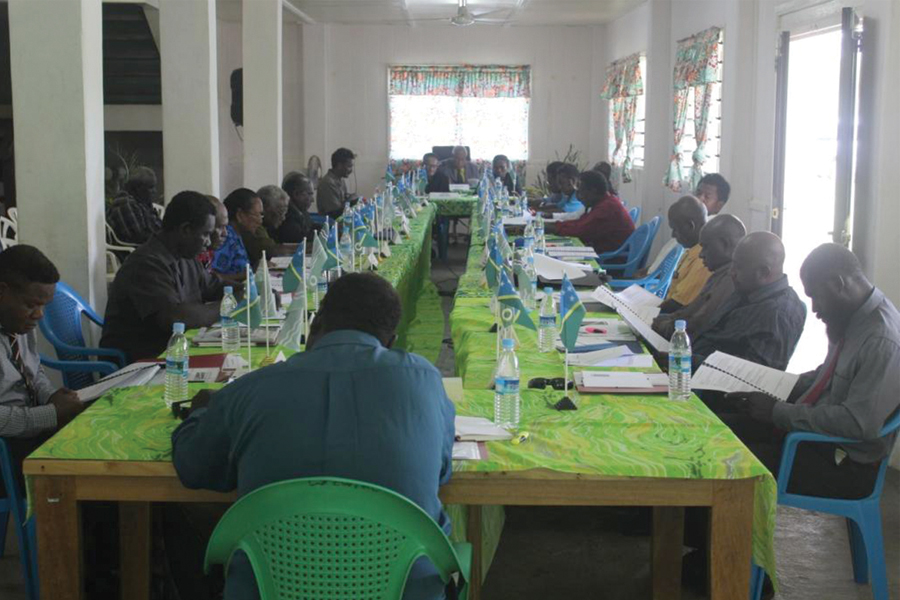
Western Provincial Full Assembly debating on the Western Province 2017/2018 supplementary appropriate (No.1) bill 2017/2018

BY ALFRED PAGEPITU

GIZO

THE Western provincial government has convened its first meeting of the second Provincial Assembly which is currently underway at the Western Provincial capital town in Gizo, starting yesterday.

The house yesterday recapped on the minutes of the previous meeting, and received presentation from the Provincial Public Accounts Committee and extensively deliberated on the 2017/2018 Supplementary Appropriation (No 1) Bill in the presence of the Clerk to the Assembly, Kevin Paia and Provincial Speaker, Hon Richard Tekifono.

Premier Wayne Maepioh in his opening address pointed out that the executive government tries to maximise revenue receipts during the 2017/2018 fiscal year as indicated by revenue outturn of SBD$8,247,543 million against expenditure outturn of $7,760,675 million.

“Surplus of $486,868 is transferred to fund capital expenditure items as denoted in the budget document.

“The golden principle of balanced budget is adhered to in this regards and we spend what we earn, indeed we made surplus.

“We have come thus far through consultation/dialogue and perseverance.”

Maepioh said the progress prevailed because all of us have shouldered on the responsibility to progress the desires and the wishes of our people in Western province.

“Politically and administratively, together we have strived, to move this province forward with equal participation, inclusive decision making and wider consultation.

“The Western Provincial government continues to expand public resources for the purpose of planning, consultation and dialogue with important stakeholders, with the overall objective to deliver services to our people.”

He said that such expenditure are provided for under the appropriate ordinances and the management of such expenditure is provided for in the public finance management Act 2013 and the provincial financial management ordinances.

“If the need arises to increase budget supply, then these are prerequisite the legal tools to regularising the needs and my Executive government has done this through this supplementary appropriate Bill 2017/2018.”

RSIPF prepares to graduate 70 recruits

0

BY LYNTON AARON FILIA

SEVENTY recruits of the Royal Solomon Islands Police Force (RSIPF) will swear in as new probationary constables on Thursday, March 29.

This follows five months of stringent training.

Police Commissioner Mr Mathew Varley said, “It’s a very important day for the RSIPF to welcome new its members to the police force.”

He said the officers will be posted in Honiara, Guadalcanal and other provinces as well.

“It is also a very significant step forward in strengthening the police force.

“We were working on their trainings for the past five months, they been working very hard to trained during Christmas festive season away from their families.

“I can certainly tell you they are looking forward to getting out to the community in serving the people of Solomon Islands,” Varley said.

East Bugotu community on audio recording training

0
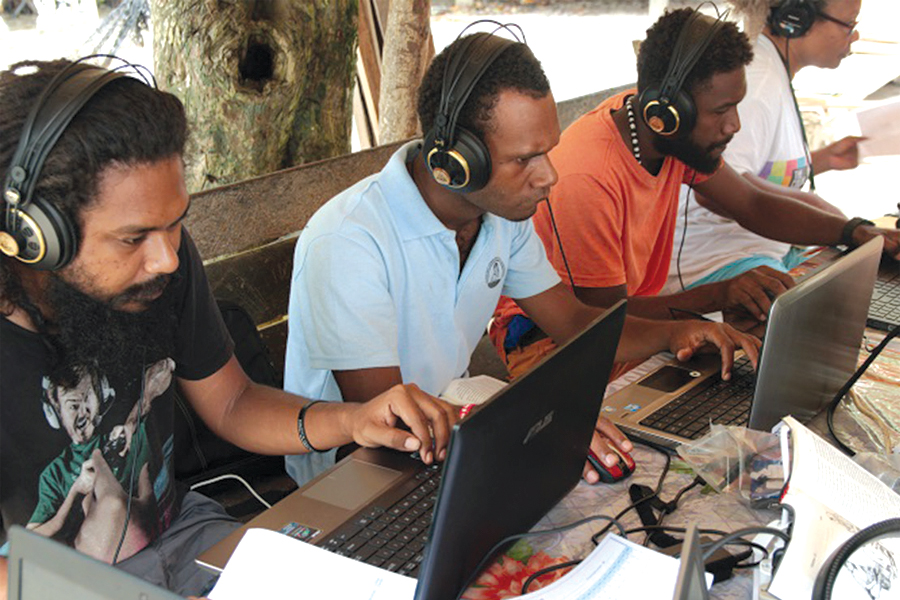
Captured photo of partcipaants during audio training.

BY MAVIS NISHIMURA PODOKOLO

A series of trainings on audio recording for Bible translation was held at the East Bugotu, Nagholau community in Isabel province.

The organisation who spearheads the training is Solomon Islands Translation Advisory Group (SITAG) and Bible Translation Literacy Partnership, Solomon Islands (BTLP-SI).

The workshop started from March 6-21, 2018 with communities namely East Bugotu and Siasigara of the Nagholau constituency.

One of the female community leaders, Mrs Kathrine Gnochro who is also coordinating the programme in her district and province, said she believes recorded scriptures will help the people of Bugotu understand the word of God through their own language.

“I believe that the audio scripture recording will rally help the people and the generations of Bugotu speakers to hear the word of God through their own language and even those who did not know how to read and write can able to listen through the audio to fully understand what the messages in the scripture,” she said.

Mrs Gnochro also thanked the team which assisted them in the language audio recording.

Facilitators of the training include one from Germany, another form West Timor Indonesia and Mr & Mrs Lauren Runia from the United States.

Cocoa and chocolate festival 2018 set for April 30

0

BY LYNTON AARON FILIA

SOLOMON Islands Cocoa and Chocolate Festival is set for April 30 – May 5 and will involve chocolate-makers and buyers from the United Kingdom and Oceania.

The festival is spearheaded by the Strongim Bisnis Programme, Pacific Horticultural and Agricultural Market Access Programme (PHAMA), Ministry of Agriculture and Livestock, ADRA, CEMA and RDP.

According to the team, the festival will showcase Solomon Islands’ cocoa to boutique and fine flavour chocolate-makers and cocoa buyers from the United Kingdom and Oceania.

Main highlights for that event is to promote country’s cocoa quality in a form of competition for Solomon Islands cocoa farmers and processers.

The competition is open to all cocoa farmers who properly ferment and sun-dry their cocoa.

Visiting chocolate makers and cocoa buyers will judge the competition.

“This is a chance to show premium market cocoa buyers the quality of your cocoa,” the team said.

CEMA Chief Produce Inspector Mr Patterson Siliota said currently they are giving out forms and sample plastics to interested cocoa farmers across the country.

They encourage local farmer who are interested to collect forms at CEMA office.

To local farmers in the provinces, Siliota said they will provide further materials and send them out this week.

So far, Siliota said they have not received any entry from local farmers yet.

To enter the competition, local farmers are required to send an entry form and one 5kg sample of sun-dried cocoa beans to CEMA in Honiara (only one sample per producer).

Participants make sure samples are received by CEMA no later than 4.30pm on Wednesday, 25 April 25, 2018.

1st prize – international cocoa trade visit valued at SBD60,000

2nd prize – goods to the value of SBD12,000

3rd prize – goods to the value of SBD8,000

West passes $8m supplementary budget 2017-18

0

BY ALFRED PAGEPITU

GIZO

The Western Provincial Assembly has passed its 2017-18 supplementary budget yesterday.

The approved amount of $8,247,543 was derived from internal and external revenue sources, and had been used over the past six months on recurrent and capital subheads.

Western province minister for finance and treasury, Lester Saomasi yesterday said that the belated budget is now tabled before the Chamber based on the Provision of Provincial Government Act Sect 36 (3).

He says the passage of this ordinance should assist in the process of regularising funds that had already been received and expended over the past six months.

Mr Saomasi said the continuous uncertainty surrounding receipt of certain revenues along with others previously not anticipated in all, warrants yesterday’s presentation of the Western Province 2017/2018 Supplementary (No.1) bill.

“Tabling a supplementary bill by any Government could be a Signal of commendable or questionable performance depending much on the nature and level of expenditure to be regularised.

“In our case certain expenditure were poorly managed, some were under estimated thus resulting in notable over runs following increase in the level related activities.

“Whilst others were included in pursuance of specific executive resolution which unfortunately had to be halted awaiting the outcome of the next provincial and national elections.”

He said concerted effort was mounted to pursue some of these revenue to counter the level of aggregated expenditure noted in the December 2017 report.

He added that the provincial executive was mindful over the number of divisional programmes awaiting funds in the treasury department.

The effort was undertaken to ensure funds are made available to push them through before the 2017/18 financial year lapse.

He said that the bill clearly spells out specific subheads and related sums expended so far which the assembly was required to approve.

Rural market venders dream of a proper lodge when in the city

0
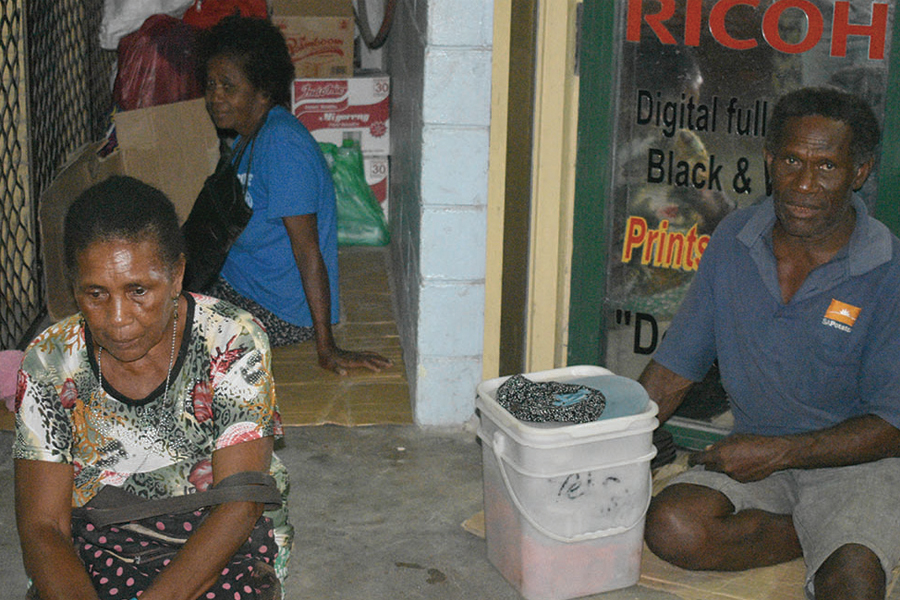
Market venders lodging at Point Cruz.

BY GEORGINA KEKEA

“WE have our people living in town but we are embarrassed to go to their house after market hours because we don’t want to impose on them especially since life in town is very hard,” says Peter Sela from Gela.

The number of people sleeping in public places have risen considerably, especially after Honiara City Council (HCC) has disallowed market venders to lodge at the Honiara central market.

Peter Sela, a fisherman from Gela in Central islands province, sells fish at the Honiara Central market and when Island Sun caught up with him, he was spending the night along the walkway of the National Provident Fund (NPF) plaza.

Sela hails from Sandfly and his village is called Ravu. Sandfly passage, the channel between big Gela and Sandfly Island is a destination for divers and snorkelers and boasts some of the best white sandy beaches in the country with clear crystal water.

However life is not as pristine for him as one would thought it would be coming from a place as beautiful as Sandfly.

People like Sela have to leave the comfort of their beautiful homes to spend the night in harsh and humbling conditions like this in search for money.

After a day’s work whilst some of us go back to the comfort of our homes to lay our weary heads to rest, these villagers don’t.

“Sometimes we lie in our boats at the Yacht club beach whilst other times like tonight, we come to this place to hide from the rain and wind,” Sela said.

Mothers, wives, women and girls are also amongst those seeking shelter under the rooftop of these public buildings.

“We should have left already in the afternoon but because our produce just got sold out in the evening, it is already late for us to leave so here we are waiting for daylight to come quickly so that we can be on our way,” Sela’s cousin, Lydia Durai said.

Whilst the global trend now focuses on women and girls having a private space, for these women, they surely have missed out on that and do not seem to mind at all.

“We sometimes go for a day or two without a proper shower and us sometimes we put that off till we are in the comfort of our own homes,” says both the men and women. Last time central market used to allow their taps for them to use but not anymore, they say.

They revealed that for dinner they usually have bread and taiyo and should they have access to hot water, they might have a cup of coffee or tea to keep them warm during cold nights.

However going to and fro daily just to enjoy the basic necessities one needs only at home is an exercise deemed very expensive for them.

Though the distance from Honiara to Gela is not far, (a couple of hours at least) the women usually hire a boat to bring their produce, costing them $600 a trip.

So it is eminent that they sell all their produce before they make their trip back home.

Some of them usually spend a night or two and on a weekend, when they don’t go back home, they also attended church programs same as when they would be back in their home villages, no matter what.

“We attended Palm Sunday church service at the All Saints church. We just got up from our resting place here and then we walked over to All Saints to take part in the service,” the women said.

Whilst the reason for them to spend the night in public places might not be a good one, there is not much they feel they can do about it.

Peter Sela says for one, their wantoks reside far from the city and more so, they also don’t want to intrude on their privacy.

“We do not want our people to think that we are here to finish their food or contribute unnecessarily to the increase of their water and electricity bills because cost of living is very expensive these days.

“Not only that but some of our wantoks and the people we know reside far from town and as you can see, we also have a lot of stuff that we buy so it is best we stay close to our departure area,” Sela said.

Meanwhile, he says there is so much they wish their government would do for them.

“If we sell our produce back home, who is going to buy them? We don’t have much economic activities back home and even Tulaghi is not an economical hub.

“We don’t really need the money but our children does. Back home we don’t need to buy for food.

“Everything is free but we need money for our children’s education and our other obligations that is why we have to make these sacrifices.

“If we have businesses and good infrastructural development in our province, then we don’t need to come to Honiara,” Sela said.

He continued to say that they wish government would step in to alleviate some of the problems from them.

“Even to buy a small plot of land to build a dormitory for us to spend the night when we come to town would be better.

“That doesn’t mean that it has to be free but at least a dormitory that charges us a reasonable amount, like $10, or $20 a night.

“Like now, when we have women with us, we men don’t get to sleep much but to keep watch over our relatives.

“We only have a proper sleep when we arrive back at our home village,” Peter Sela said.

Currently market venders from all provinces are faced with the same dilemma when in Honiara.

Rape accused to appear in court

0

BY JENNIFER KUSAPA

THE case of a 64-year-old man from Isabel province alleged of raping a nine-year-old girl in 2015 will appear in court today.

The old man on this case is facing three counts of rape under the Amendment (sexual offence) Act.

The allegation said the man raped his 11-year-old grand-daughter on several separate occasions at different locations in the West Maringe District of Isabel

The incident was reported to Buala Police in which the old-man was arrested and charged for allegedly raping his granddaughter at Tirotue Settlement and Ghozoruru in the Hovikoilo Ward on different dates between December 31, 2015 and February 7, 2018.

The prosecution alleges that the old man and the girl were from the same village.

Office of the Director Public Prosecution appears for the crown.

My response to Ngati’s claim

0

DEAR EDITOR, first I wish to request that you do not confuse your readers and the general public by keep referring to Reginald Ngati and his group as the President and executive of SINUSA.

In case you do not get what I said earlier, the SINUSA election held on October 31, 2017 in which Reginald Ngati’s Executive was voted in was declared Null and Void. This simply means Reginald Ngati does not have the mandate to remain as the President of SINUSA and his group to command the leadership of SINUSA as of February 21, 2018.

Whilst I fully acknowledge the concerns raised by Reginald Ngati on the need to improve the on campus living and learning environment at SINU to his expectations, I am at the same time surprised that he failed to also acknowledge the vast improvements that have taken place over the past five years since SINU attained its university status. These include the current and planned academic and physical infrastructure developments at SINU’s three campuses. I invite your readers to come and see for themselves.

If Ngati and his group failed to see these changes then either they are still in their sleep or are just too proud and ignorant to acknowledge these. It would be unfair on the part of Reginald Ngati and his group to say that we have not done anything about the hostels, kitchen and even the student services in the past three years. For information of your readers, I have provided below what has been achieved/done over the past three years for the students at SINU.

We have Refurbished the Institute of Maritime hostels at Ranadi Campus, renovated 5 boys hostels (P2-08, P2-09, P2-10, P2-11 & P2-12), Girl’s Hostels P2-17 all at Panatina Campus. Tenders for Girl’s Hostels (P2-03, P2-04, P2-05 & P2-06) at Panatina Campus are due and in fact Property Section is continuing with Minor Repair & maintenance works. We also have done works to Boys Hostels & Girls Hostels at Kukum Campus up to 2017. Due to SIG financial Cash flow towards end of 2017, no further planned works were carried out as we were advised by our Finance Department not to start any new works due to the cash flow problem. This includes works to the Kitchens at Kukum and Panatina Campuses. Our main issue with these repairs and maintenance work is that most of the buildings dated back to HTI/SITC and SICHE days and so renovating them can be a challenge. Also, these hostels have deteriorated due to ‘no care’ attitude by the students themselves.

The design of the student Centre Complex at Kukum Campus was completed in 2017. We were hoping to put out the Tender for Construction in the first quarter of 2018 but did not proceed as the balance of funds from the 2017 SIG Development grants are yet to be released to us. This proposed Students Centre Complex when completed will house the Students Welfare Office and the day students’ common room and other ICT and photocopying facilities and amenities for students’ use.

The designs for the extension of the Kukum Library has been completed and is awaiting tender for construction/availability of funds. Once completed, it will enhance more space for students comfort in the library.

We are not aware of any complaints about the water quality and students have been having access to running water.

We have constructed a student ablution block for day students at Panatina Campus between room 9 & 10 in 2017. We have also arranged for the construction of a students’ ablution block attached to the Panatina Library in 2017. This is also already completed and is ready for students’ use.

Amongst the on-going projects at SINU are the Panatina Complex currently being constructed at Panatina Campus and the School of Natural Resources and Applied Sciences (SNRAS) building complex at Kukum Campus. These building projects when completed will not only increase the intake/acess to SINU but will also contribute to providing a conducive teaching and learning environment at these university campuses.

We are currently engaging an architect to design the refurbishment of the X-SMITRI (Malaria Lab) building at the eastern end of the Kukum Campus which is currently an ‘eye sore’. This building when completed will provide extra facilities for the School of Nursing and Allied Health Studies (SNAHS). Again tender for construction is pending availability of funds.

To ensure security of staff, students and visitors to the university, we have installed street lightings at parts of Kukum Campus and Panatina Campus and this work is still ongoing and should be fully completed this year 2018.

Also, the fencing of the Kukum and Panatina Campus boundaries are still in progress despite the challenge of having to deal with fellow citizens who encroached and squatter along the university borders.

Work on the fencing of part of the Ranadi Campus is completed. Work on the entrance, access road and car park and security lights at the Ranandi campus is progressing and will be completed soon.

With regards to the issue of access to ICT facilities for students, SINU has at Kukum Campus one students’ general computer lab (67 PCs) opened to all students of SINU. It opens 7.00 am – 8.00 pm Monday – Friday, inclusive.

In addition, we have students’ computer labs in schools: 2 x SBM (30 PCs each), 2 x STMS (10 + 15 PCs), 1 x Nursing (17 PCs), 1 x ITH (9 PCs), 1 (old) x SNRAS (new lab with 40 PCs soon to be installed – waiting for room), 1 x Fisheries (30 PCs) and 1 x SOEH (30 PCs). Further, 100 PCs earmarked (in store) for Panatina general lab awaiting room to be ready.

A policy on internet quota system for all staff and students is awaiting approval from the Council before it can be implemented.

In addition, SINU provides free students’ email and internet services for all registered students.

We would like to say that most works are ongoing and in 2018, we will facilitate the designs for new Students Hostels and other student requested facilities including students sporting facilities, such as gym, basketball and tennis courts etc.

Lest Ngati and his group forget, there is a limit to what we can achieve given that SINU is solely dependent on the annual SIG grants and Development Budgets for its academic programmes and infrastructure developments.

Otherwise, if they are so concerned about the issues raised in their strike notice, why didn’t they first raise them with the Managers responsible for the university Properties, ICT and student’s welfare or even raise the issues directly with me?

Issuing strike notice for boycott of classes will not achieve anything and is counterproductive. If students go on strike, their lecturers will still receive their pay regardless. It is the students themselves that will suffer by missing out on their classes and on their chances of education at SINU.

Donald Malasa

Pro Vice-Chancellor [Corporate]

Solomon Islands National University