New LOC established to oversee running of the problem-plagued 2018 Solomon Games
BY ROMULUS HUTA
THE dark clouds hovering over the most-anticipated 2018 Solomon Games in Rennell and Bellona Province this year may soon be out of sight.
This follows the establishment of a new Local Organising Committee (LOC) for the Games last week.
The newly-appointed LOC will be racing against time in the coming months to try and get things organised in order to see it through success in due course.
Renbel Provincial Assembly member Bernard Taungaika was appointed as the Chairperson and will be assisted by experienced sports administrator Nick Hatigeva as Vice-Chair.
Willy Tuha is the new treasurer while Golden Kiloko will take up the role of the General Secretary or the Games Chief Executive Officer (CEO).
A total of 10 members were added onto the LOC where they will be heading various areas pertaining to the games’ hosting.
They are Hon. John Teno, Jefter Tuhagenga, Hilder Tango, Aron Nasiu, Stewart Baiabe, Onyx Teno, Vaelyn Maitaki, Stewart Seuika, Lungu Kiloko (Renbel Provincial Sport’s Coordinator) and Willy Kaunga (Renbel Provincial Deputy Secretary).
The new LOC was appointed to carry on ahead with the vital task left behind due to other hindrances which led the event to naturally soak up declining hopes of whether Renbel will deliver the country’s biggest sporting event on their home soil or not.
Months ago, responsible authorities were eager to see the games get underway with success this year but are not satisfied with how preparations were previously done in Renbel.
They even planned to shift the games from Renbel back to Honiara.
The new LOC had already proposed a date and other realistic details for the Solomon Games, however, they are pending an official announcement which is expected to be issued for public knowledge within the coming days.
The other details also include how many sports the games will feature.
Meanwhile, Central Province successfully hosted the previous edition of the Solomon Games in 2013.
Raphael Le’ai displaying his individual awards won during last year’s Oceania Youth Futsal Tournament in New Zealand.
BY ROMULUS HUTA
Raphael Le’ai displaying his individual awards won during last year’s Oceania Youth Futsal Tournament in New Zealand.
THE national under-18 futsal team head coach says Raphael Le’ai is one of their biggest assets as they head into the final months of preparation for the 2018 Buenos Aires Youth Olympic Games in Argentina.
With a record of 34 goals from six matches hauled in during last October’s Youth Futsal Qualifiers in New Zealand, the youth futsal team head coach Stanley Puairana remains doubtless of the young lad’s abilities and believes that Le’ai can lead Solomon Islands further into the competition in October.
Puairana told SunSPORTS that Le’ai’s consistent eyes for goals has recently made him to be one of the country’s most-wanted players.
This follows his involvement with the current youth soccer side in the conventional (11-aside) code where they have also included him into the roster for September’s Oceania Under-16 Oceania Championship in Honiara.
“Raphael told me he wanted to play for both codes. But it is up to the management to make this decision.
“He is one of the country’s upcoming strikers at the moment and we must make sure the decision he will take or we will make favours him.
“Raphael will join us on our trip this month to Australia and upon his return; he will team up with the 11-aside national under-16 to go another tour to Japan in July.
“Raphael is an important aspect toward the country’s campaign in October’s Youth Olympic Games in Argentina and so as will carry the hopes of Solomon Islands during the Oceania Under-16 Championship in Honiara in September.”
Le’ai’s other two fellow team members also share similar situations. They are striker Frankster Rukumana and defender Leon Kofana.
The national under-16 soccer coach Stanley Waita said he would like all three players to join them in their training camp due to be held in Japan next month.
“They are some of our key players. We will need them to come with us to Japan.
“Solomon Islands want to qualify for the world and we need them,” Waita said last week.
GAMBLING in the form of card games, guised as fundraising is rampant in Gizo, and this is irking concerned residents who are questioning their provincial authorities why this is being allowed to happen.
There are also rumours that provincial politicians have granted licence for public fundraising to certain individuals only.
A Mr Andrew Koke yesterday said that this is not in line with the games and lottery act.
He says that there other groups who need the opportunity to raise funds such as schools, church groups and community groups.
But, they cannot because the licences have been given to other people.
“A number of groups around Gizo continue to entertain illegal card games all over Gizo.”
He said the games and lottery act has a committee which puts guidelines on certain period of time.
Koke calls for the TPS to facilitate enquiries or set up office in Gizo to monitor these public running card games daily.
He advises the new Western provincial government to seriously address this issue.
This paper understands that Provincial Secretary (PS) Jeffrey Wickham had suspended rasing money through card games within the province on September 4 last year.
The suspension follows card games contravening section 14 and 15 of the gaming and lottery Act.
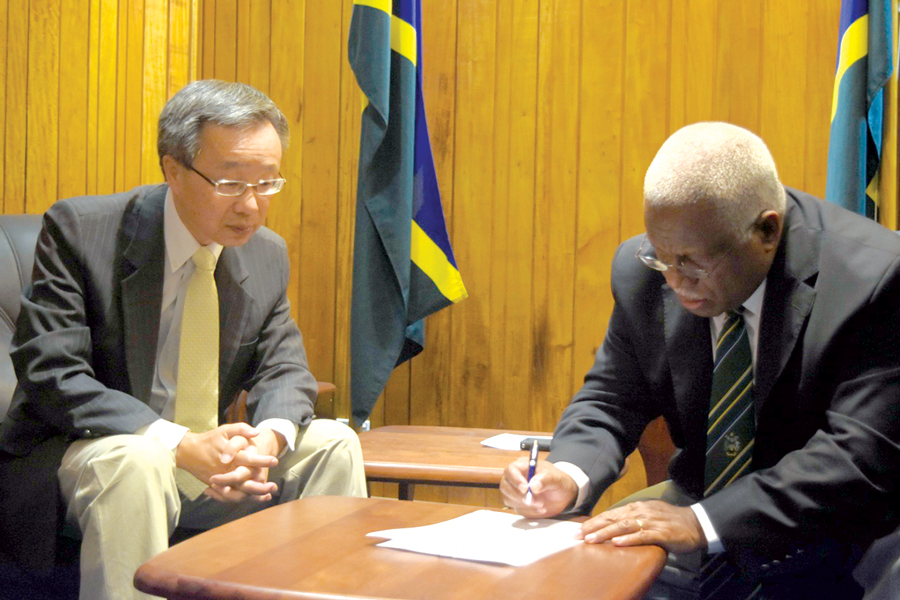
Prime Minister Rick Houenipwela signs one of the funding documents as Ambassador Luo looks on. Photos by PM press secretariat
IN a positive sign for diplomatic relations, Taiwan has offered to help the Solomon Islands build a sports stadium for the 2023 Pacific Games being hosted in the country
Following reports that a private delegation of government officials from the Solomon Islands had made a surprise trip to Beijing on June 16, the Prime Minister of the Solomon Islands recently gave a direct message of thanks to the government of Taiwan, in a positive signal for diplomatic ties between the two countries.
Prime Minister Rick Houenipwela of the Solomon Islands, speaking to the General Assembly of the Pacific Games Council (PGC) on Monday June 18, said that the Solomon Islands would like to specifically thank the government of Taiwan for pledging their assistance to the country ahead of the 2023 Pacific Games.
Houenipwela was quoted by Inside the Games, as saying “I am happy to announce to the PGC that the Government of Taiwan have given my Government an assurance it will assist my country to build a main stadium for the Pacific Games. We welcome this and are very thankful to our donors.”
The Prime Minister was speaking to the PGC to give a progress report on the country’s preparations for the event. Houenipwela has reportedly taken direct ministerial responsibility for ensuring the games are a success.
“We are committed that all the requirements for the sporting facilities will be built well in time for the 2023 Pacific Games,” Houenipwela was quoted as saying.
From the Prime Minister’s remarks it appears Taiwan has made a considerable effort to assist the Solomon Islands achieve that goal, by offering to construct the primary venue for the Games, a 12,000 person capacity sports stadium located in Panatina, a suburb of the capital Honiara, reports Inside the Games.
An athletic track is also reportedly included in the venue plans. Several other facilities are also called for according to reports, but it is unclear what role, if any, Taiwan will have with the other facilities.
Currently the 2023 Games are expected to be held June 14 to 28.
Hopefully, the offer of Taiwan to construct the stadium, and the Prime Minister’s statement of gratitude before the PCG suggests that diplomatic ties between Taiwan and the Solomon Islands will remain stable for the foreseeable future.
THE population in Honiara has risen drastically since the last census in 2009. With the next census expected to be held next year, the increasing number of urban drifters should be a cause of concern for the government.
Every year Solomon Islands have on average an annual growth rate of 2.3 percent or an increase of 10,661 people per year.
For Honiara alone, the total population in the last census was 64,609. The amount would have increased further by now. For the local water authority, according to their 30 year strategic plan, Solomon Water provides water services to 58,000 people in Honiara and surrounding areas in Guadalcanal.
Now there is a higher demand for water and the local water authority is still a long way to go in supplying water for the increasing population.
In informal settlements, most people are living without piped water.
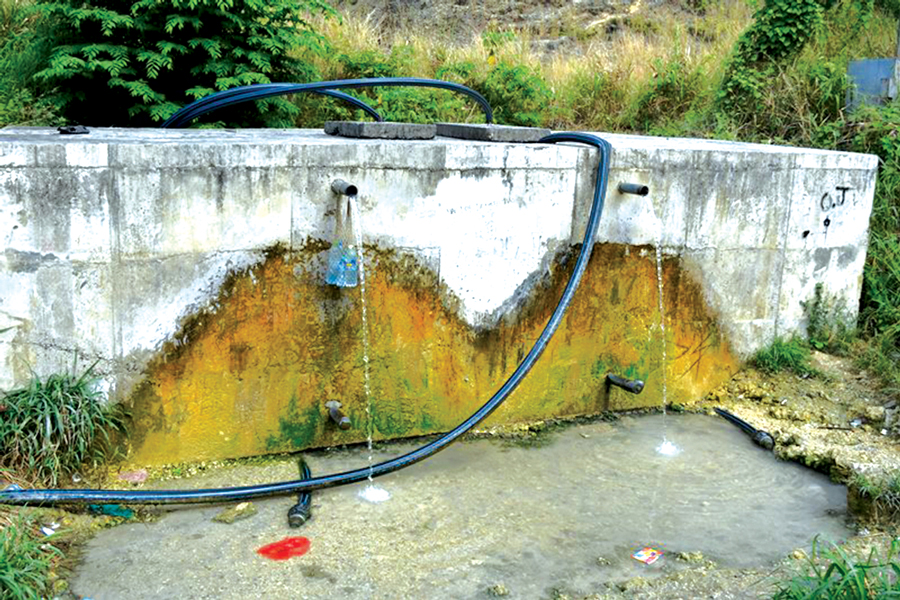
Island Sun recently went to Mamulele Community in east Honiara and saw firsthand the dire situation of people’s access to piped water. Comprising of hundreds of families, the community’s access to water is only to two stand-alone water pipes alongside the road. This is where the men, women and children of this community bathe, wash and fetch water for drinking.
Miss Florence Benny from Mamulele community was keen to speak to Island Sun and told us about their situation. She said water to these two stand pipes are sourced from a dam further up.
“The water supply is provided for us by an Asian owned company. We are lucky that the company does not charge us any fee for the use of water”, she said.
She said people as far as green valley also come to their area for water.
“The demand for water is increasing, therefore we call on the responsible authority to address such issue as it will lead to future problems for this community”.
The community in Mamulele that has no access to Solomon Water’s services however hopes to have water piped into their homes in the near future and had expressed their gratitude to the Asian Owned Company that had assisted them with their basic need.
Meanwhile Solomon Water on the other hand is optimistic that they will ensure Solomon Islands have a stable, healthy and safe urban water and waste water supply for the next 30 years.
During its launch of the 30 year strategic plan earlier this year, Solomon Water’s Board Chairman Phil Bradford says the work plan is an ambitious foundation for the organization’s future.
“The work we’ve set ourselves to achieve over the next 30 years is ambitious, and I’m more than confident we will achieve what we’re setting out to do. The outcome will have a positive impact on everyone’s lives”.
“The plan will help us to focus in on where our attention needs to go, so we can continue to provide a great service to our current and future customers.
Meanwhile Solomon Water’s General Manager (GM) Ian Gooden has said the 30 year plan gives them a clear direction for the future.
“Most of the work is about maintaining and developing not only our networks, pump stations and natural resources to deliver clean, safe, healthy water, but it’s also about developing our people and their capacity as well to deliver on our ambitious plan. The most important and urgent requirement is to secure more water for Honiara which will otherwise be subjected to rationing again in a few years due to its rapid growth.
Government too on the other hand is obliged to fulfill its role as a member of the United Nations. In 2015 the Sustainable Development Goals (SDGs) came into the picture with SDG 6, ‘clean water and sanitation’ a must for nations to achieve. By 2030, member countries of the UNs are expected to achieve the target goals set out in SDG 6.
On the whole, by 2030, all Solomon Islanders should be able to access clean water and sanitation.
THE MFMR collected more revenue than projected in the budget for the last five years to 2016 averaging 51 percent more over that period.
The above statement was expressed in Ministry of Fisheries and Marine Resources’ (MFMR) Business Plan (2018-2023).
In relation, MFMR mentioned that the growth in the actual revenue collected peaked in 2015 when it collected 73 percent more than the projected budget figure for that year.
The business plan explained that the difference between actual and budgeted revenues was the result from the ministry’s intentional decision to lower revenue estimates to mitigate risks associated with higher estimations.
“The MFMR has, in the last two years to 2016 collected $593 million for the Solomon Islands government. The MFMR will continue to provide effective services to improve and increase its revenue collection for the government”, said MFMR.
Moreover, a recurrent issue for MFMR is not being able to access appropriate financial resources on a timely basis for it’s recurrent and development expenditures which has constrained effective delivery of services, fisheries programs and projects.
However the ministry has expressed that it wants to alleviate this issue so it can improve on the current revenue collections for the government as well as to implement fishery programs and projects to increase revenue collection and promote social and economic benefits in all provinces throughout the country.
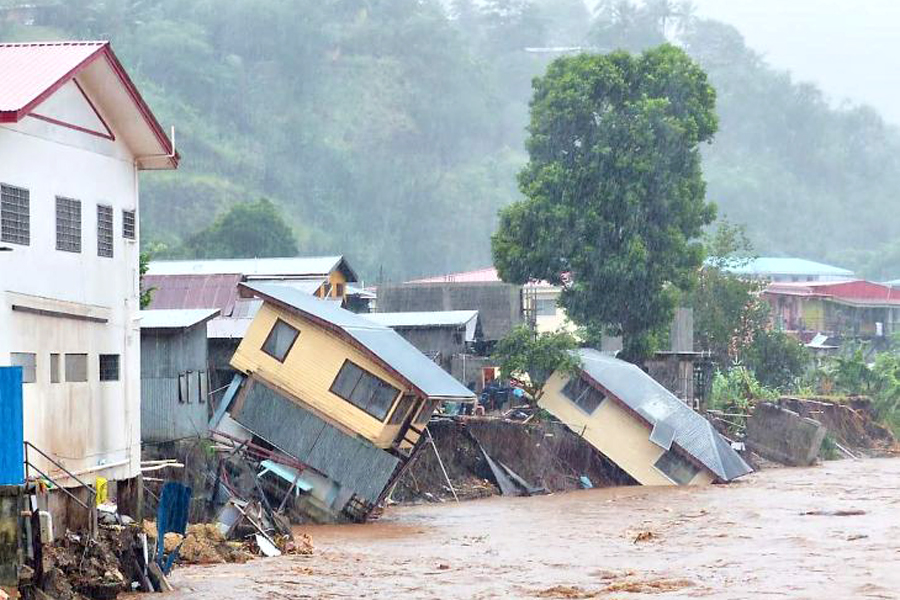
Deforestation consequencies….photo taken during the April flash flood at the mataniko bridge-China town
BY ELLISON.T.VAHI
Deforestation consequencies….photo taken during the April flash flood at the mataniko bridge-China town
SMALL Island developing states around the world faces a range of specific development challenges, now complicated by the emerging adverse impacts of climate change in rising sea levels, more variable and unpredictable rainfall, and more intense extreme weather events.
According to a report from the Solomon Islands Water Sector Adaptation Project, shows that Some communities in Ontong Java, Reef Islands of the Temotu Province, Lau Lagoon of Malaita Province, Roviana Lagoon in the Western Province and Santa Catalina of Makira Province to name a few have already experienced their root crops, such as taro, dying due to salt water intrusion.
As the nation’s future depends on its capacity to adapt to and mitigate the impacts, Local capacity is also key.
Solomon Islands communities are exposed to a number of natural hazards, worsened by climate change, such as coastal erosion, sea level rise, drought, heavy rainfall and flooding.
The impacts are multiple and interconnected. For instance, there are communities living along the coastlines and on low lying islands/atolls who, due to rising sea levels, are facing increased coastal erosion, inundation and salt-water intrusion. This impacts their fresh water supplies, a serious problem, especially when communities depend on the groundwater sources for drinking.
These issues can also greatly affect food and land security, soil fertility and the livelihood of the community as a whole.
Furthermore, drought is a major hazard for communities that depend primarily on rainfall. When there is none or little water available, this greatly affects people’s health and impacts public health safety.
The most obvious reason is that Solomon Islands is situated in the tropical region prone to natural disasters. Our people, our places and our systems are rendered more vulnerable due to a weak economy, limited access to basic services, different levels of education and the isolation and fragmentation of islands.
The capacity for communities to survive natural hazards varies across the country, affected by these factors.
Hence, the climate and weather is shifting as rainfall patterns vary and are unpredictable with more intense heavy rain in a shorter period has caused flooding and landslides.
Not enough technical capacity and, often, financial limitations makes it challenging to implement programs addressing climate change.
A lack of public awareness and understanding of climate change is another barrier. Whilst, awareness and education programs for government, communities, schools, institutions are really important to building capacity and improved decision-making.
Recognizing the seriousness and urgency of addressing climate change impacts the establishment of a National Climate Change Policy 2012 – 2017 was an important step forward in supporting the implementation of adaptation in communities. The policy reflects the Government’s engagement in ensuring climate change initiatives are guided and implemented accordingly.
Relevant ministries such as the Ministry of Environment, Climate Change, Disaster Management and Meteorology (MECDM), the Ministry of Mines, Energy, and Rural Electrification (MMERE), and the Ministry of Agriculture and Livestock are supporting climate change adaptation programs such as of the Solomon Islands Water Sector Adaptation Project focused on securing sustainable water supplies, sanitation and hygiene and the Strongem Waka lo Community for Kaikai project which helped local communities manage climatic pressures on food production.
The Government is also investing in Automatic Weather Stations nation-wide, to collect data for weather forecasting and early warning systems, as well as awareness campaigns in both rural and urban communities, considered to be essential to disaster preparedness.
UNDP works with Solomon Islands Government ministries to implement adaptation programs like SWOCK, UN REDD, ‘Building Resilience of Health Systems in Pacific Island Least Developed Countries to Climate Change’ and SIWSAP. With support from global funds such as the Adaptation Fund and the Global Environment Facility – Least Developed Country Fund, these programs work at the national, provincial and community levels, rolling out new or improved infrastructure, providing trainings and building sectoral capacity.
These investments help protect the livelihoods of our communities to adapt to climate change impacts.
MINISTRY of Fisheries and Marine Resources (MFMR) will actively focus on five strategic areas in quest to successfully communicate their mission statements, services, activities and achievements to it’s array of audiences.
This was expressed in the ministry’s Communication Strategy (2018-2020) which was recently launched and is linked to the current MFMR (2017-2019) strategy.
The ministry will work on fisheries policies, fisheries management, operational plans and functional services, staff, development programmes and projects and partnerships.
Under the fisheries policies, MFMR expressed that they will continue to develop, review and update policies for the orderly management and development of fishery operations including offshore, inshore, provincial and aquaculture.
In relation, based on these policies, the policy, planning and legal division along with MFMR’s communication officer will identify key policy messages to use in communications.
Moreover, in fisheries management, operational plans and functional services, the ministry said its tactic would be updating commercial operators about existing requirements and changes through paper and electronic means and during the application for new and renewed fishing licenses.
In terms of staff, MFMR highlights that they are the best and cost-effective means of communicating information given their consistent contact with customers, stakeholders and partners thus staff who are well informed and trained to deal with the media will help project the vision of MFMR.
Henceforth, the ministry expressed that it will organise and deliver a number of media and public relation trainings for all MFMR staff.
On grounds of development programmes and projects, MFMR has been working with key stakeholders, partners and various communities throughout the country to promote and deliver programmes and projects to enhance community fisheries livelihoods.
Additionally, in the scope of its development programmes and projects, the ministry stated that their role in all these projects and any progress made will be clearly communicated so their partners, donors, the national government and people of Solomon Islands are regularly and well informed.
Furthermore, the Fisheries and Marine Resources ministry voiced that it values its partnerships with national, regional and international bodies to date and the potential they bring for the future thus seek to communicate its services and the support it can provide to sustainable development of the country’s fisheries sector through established national, regional and international forums that include the Fisheries Advisory Council, the Chamber of Commerce and the Seafood Industry Working Group established by PHAMA.
CENTRAL Province Siota Provincial Secondary School (PSS) students and Staff have arrived in Honiara, kick starting their school rehabilitation fundraising programme this week on Monday.
Two night shows have already taken place at Gilbert Camp and one at Kukum Market Area yesterday during the day being a success so far according to their aim said the school’s Principal.
A walkathon is to take place on Thursday starting from Kukum to Pt Cruz and to be ended at White River around 9am to 1.30pm in the afternoon.
“We thank the Honiara City Council (HCC) Clerk for allowing us to carry out our fundraising within HCC’s boundary,” said Siota PSS Principal Fr Patterson Tako, guiding the school students during this school break with Mr David Rubaha who is the Team Leader and one of Form Six (6) Teacher’s of the school.
“There is plan to perform on Thursday at the Solomon Islands Port Authority (SIPA) but we are yet to get confirmation from the Chief Executive.”
It is understood that the school group will be spending one and a half week reaching mid next week in Honiara as more updates will be made known.
“So far the programme carried out is going according to plan as we want more ex-Siota students especially to come out and give their full support to their former school’s strive,” said the School Principal.
He said for further inquiry to the school’s programme, the school group can be contacted through his mobile phone, (8562711).
Recently during one of their fundraising held at Tulaghi raising more than $14,000, the School Chaplain for Siota, Fr Tony Ubara, explained while waiting for the Education Authority of CIP to help the school’s maintenance and other much needed areas to be addressed, they are fitting in their programme’s ways to address their school situation as soon as possible.
“There is the need to quickly improve classroom buildings, dormitories, Staff houses and other buildings by repainting them and doing small repairements needed to be done to help us be in a conducing learning environment.
“Not only the buildings but focusing on improving other areas as well,” said the School Chaplain.
The fundraising is said to include selling of foods, entertainments and as well as other performances to take place in Parishes that is yet to be confirmed according to Fr Patterson Tako.
Siota PSS Principal speaking to Island Sun yesterday adds in making a strong appeal to the school’s family, to support the school towards driving for its rehabilitation programme.
“We need strong support to further improve our Provincial Premier School which is for our children’s sake,” expressed Fr Tako.
ONE of the big initiatives now is to eliminate malaria according to Solomon Islands Prime Minister Hon Rick Houenipwela.
The PM said this at his Press Conference after returning from visits to Australia and New Zealand.
“This is in line with the Asia Pacific Leaders Malaria Elimination Target of 2030 for the elimination of malaria,” said the PM.
The PM elaborated that this was something they signed when he was in London this year discussing with Australia to support them towards the elimination of malaria.
“This includes working together to tackle the health crisis on non-communicable diseases (NCD’s) that is said to be accountable for the majority out of every ten (10) deaths in the country,” said the PM.
“NCD’s is a very big problem for Solomon Islands being an area to seriously look more into.”