Home Blog Page 1289

Bishop Sahu congratulates newly ordained priest

0
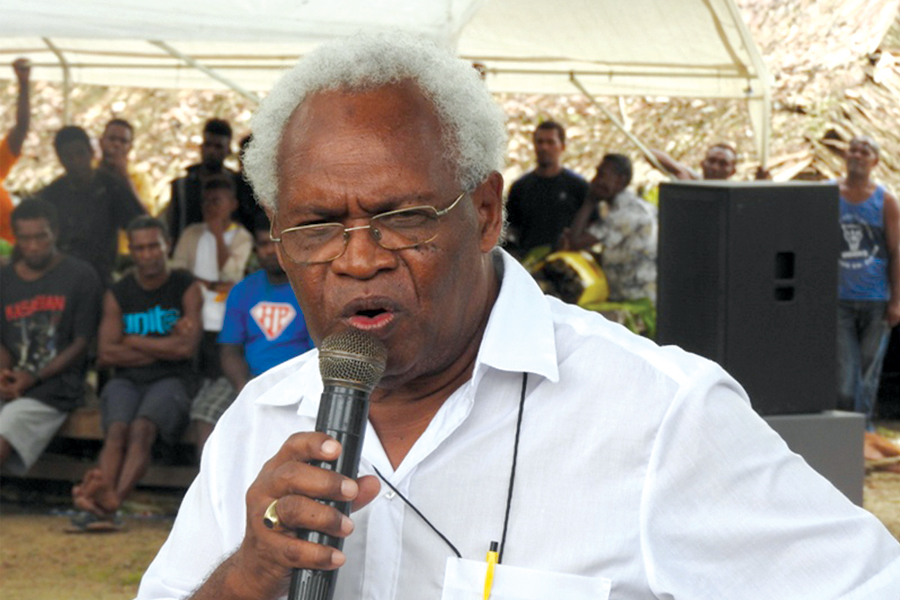
Anglican Diocesan Bishop of Malaita Diocese Bishop Sam Sahu.

BY GEORGE MANFORD

AUKI

Anglican Diocesan Bishop of Malaita Diocese Bishop Sam Sahu.

ANGLICAN Diocesan bishop of Malaita, Bishop Sam Sahu has congratulated newly ordained priest Fr Derrick Taka on his coronation last Sunday.

In his remarks Bishop Sahu said, “What is our responsibility as Christians, we are to serve our living God with all our strength, heart, mind and soul.

“Nominalism is one of the foremost issue raised in our churches today.

“We must renew our spiritual lives and love God more than anything in this world.

“Our purpose is to serve God faithfully and to do his work accordingly, bishop Sahu revealed.

“Today we mark this very important occasion where the Anglican diocese of malaita welcomes a new member in the priesthood ministry in the Anglican Church.

“He is to lead God’s flocks and build their faith on the almighty God our saviour.

“The church today did not encourage the 50-50 life bases but our lives must be submitted to God fully.”

He calls on all Christians to pray and encourage one another ‘as we continue to serve our God as we the pilgrims of this Christian journey’.

Fresh water supply for Haukona village soon

0

BY SAMIE WAIKORI

AUKI

HAUKONA village in central highlands of Are’are will soon receive its water supply under the RWASH programme.

Chief Environmental Health Inspector of Malaita Province, Ms Gloria Siwainao told this paper that materials for construction of the new water supply are on site as work is expected to commence soon.

She said yesterday that as part of the work a team from her office will leave for Haukona village very soon for a week of pre-construction workshop training to the villagers.

Siwainao said the training is purposely to let the villagers understand their responsibilities or role they expect to play during and after the execution of the project.

She said the training is very important as one main focus area it looks at is to allow villagers to manage the project.

Siwainao said they will largely look at sustainability of the water supply project to maintain its value or usefulness in a long run.

She said there were scenarios been experienced by her office that sustainability is very lucking with many water supply projects in the province.

Adding that as a result people usually tend to seek assistance for maintenance of their water supply sometimes not really long after the completion of the project.

Siwainao reiterated that the training was very important as it will allow those will benefit from the project to understand their responsibility on the project.

She said the workshop is expected soon and as a long as it completes the implementation of the water will begin.

Siwainao said Haukona water supply project was one among three other water supply projects her office expects to complete this year.

She said the other projects were, a water supply for Riaa’oa’o village in East Are Are and Elite village in Small Malaita.

Siwainao said the project was funded EU through the RWASH programme under the Ministry of health and Medical Service.

Health and medical services for women and girls

0

BY ALFRED PAGEPITU

GIZO

WESTERN province needs to improve access to health and medical services for women and girls in the province, according to a report.

According to the Western Province Women’s Empowerment and Transformation policy report, the province had 95 percent health coverage until 2015 and then where on average, 28 percent of health facilities in the province were closed.

Limited number of trained health workers including specialised doctors, the number of health facilities needing repair, lack of necessary medical equipment, poor conditions of health workers houses, inadequate funding targeting health services has deprived women and men of the province access to basic health services.

Therefore, due to cultural norms and expectation including gender roles of women and men, women tend to have more concerns and face more barriers to accessing basic health services and even more so for women living in the rural areas.

Problems reported by women in accessing health facilities range from concern that there will be no female health workers about 60 percent of rural women compared to 51 percent of urban women.

Communication training for Red Cross volunteers in Auki

0
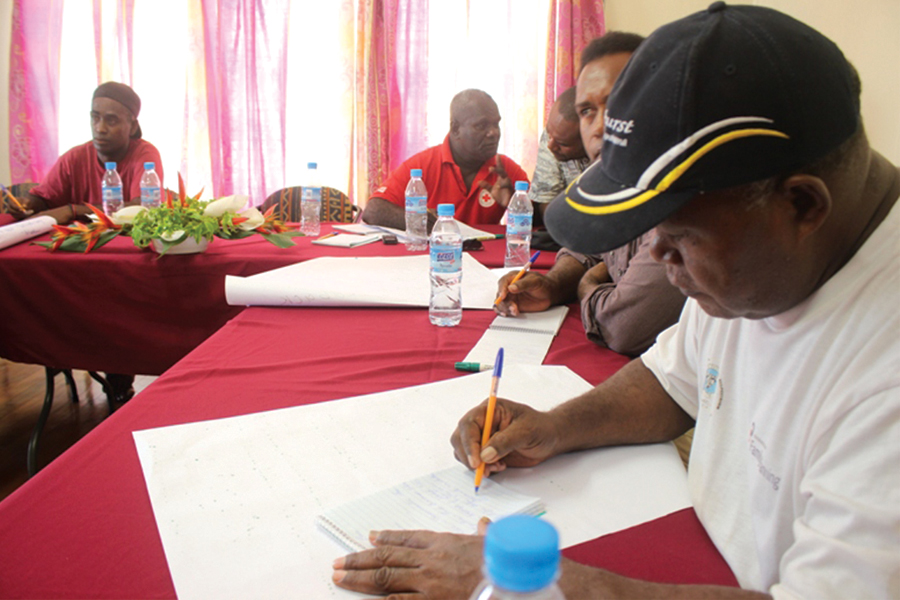
Some of the participants attending the communication workshop yesterday in Auki.

BY SAMIE WAIKORI

AUKI

Some of the participants attending the communication workshop on Monday in Auki.

RED Cross volunteers in Auki, Gizo and representatives from various stakeholders in Auki have gathered for a two-day communication training in Auki.

The training is mainly to teach and enhance the volunteers’ communication skills and knowledge to tell better stories during the course of their work.

Communication Manager for the International Federation of Red Cross, Ms Hanna Butter said in her presentation yesterday that it identified that there was a need for volunteers to have better skills and knowledge of storytelling.

She said the reason was that Red Cross volunteers usually on the site with people during or after the times of disaster.

Adding there were lot of good stories on what the people experience with the disaster and potential effects they might expect as a result of the disaster that need to be told.

However, Ms Butter said in order for the volunteers to tell good human disaster stories, they need to have proper skills and knowledge on how to make effective stories.

“So a brief detail of the training is to teach the participants how to pick and lookout for better stories, how to make or write it and finally how to communicate the stories.

“Because Red Cross volunteers are very important with the humanitarian work they provide during the course of disaster.

“And they can make good stories with the first-hand information receive or witness that need to communicate to people,” she said.

Butter reiterated that the training was to encourage participants with good communication skills and knowledge to do good communication or telling good stories during time of disaster.

The training started on Monday and will end today.

Disqualification of members

0

BY ELLISON VAHI

FORMER speaker for Makira Ulawa Province Mr Kaea Goldie has voiced concern on regarding to Provincial gov’t act section 15 sub clause F, G and I, with regards to the disqualification of members.

Speaking to the Island Sun, Kaea said that by looking at the section (15) has shown a very very silent resignation.

He said that with Common sense it has clearly state that once these people wants to enter National or Provincial, they must resign from their sits, because they are holding public offices.

He adds that What really or has practised since then is that provincial member in particular, once they intend to contest for the national or provincial election, they just walk in without resignation and whilst once they lose the election they then still return to their sits.

Kaea further voiced that if provincial assembly members are holding public office, ‘why did they not resign before joining the election?’

Kaea calls on to the ministry of home affairs to ensure that provincial assembly members who are intending to contend election must resign their sits before contending for the national elections.

Church of Melanesia eyes more training centres by 2020

Diocesan secretary of the Anglican Diocese of Malaita, Anthony Maelasi.

BY GEORGE MANFORD

AUKI

Diocesan secretary of the Anglican Diocese of Malaita, Anthony Maelasi.

THE vision for year 2020 of the Anglican diocese of Malaita (DOM) is to be self-reliant concerning its development plans and visions.

Education is one of the priorities that the Anglican Diocese of Malaita is focusing on by introducing more schools in the regions within Malaita province.

This was said in a statement by the Diocesan secretary of the Anglican Diocese of Malaita Mr Anthony Maelasi during the ordination programme at Fiu last Sunday.

Maelasi said a new secondary school will be established soon at Ilikata land in central region in Malaita province.

He said plans have been already in place towards the establishment of this new secondary school and will be own by the diocese of Malaita.

“It becomes a national project of the Solomon Islands government under the ministry of education,” Maelasi said.

He also said three rural training centres (RTC) will be introduced in the northern region, eastern and southern region according to the DOM plans and visions for year 2020.

The idea is to introduce more skills training in those RTCs for school dropouts.

Maelasi also announces that DOM is currently working in partnership with the community of the sisters of the church (CSC) to set up its centre in Auki especially to address the social issues that are affecting the church today.

“We will continue to establish this initiative to create a better and a happy environment to all Christians.

“As we work along this journey with our visions and plans our commitment to our God will be most important both in our spiritual and physical developments.”

9th SINU talk on reform federal constitution of SI

0

BY MAVIS NISHIMURA PODOKOLO

THE Solomon Islands National University (SINU) ongoing initiative of dialogue will have its 9th   talk centered on reform federal constitution of Solomon Islands.

The speaker who will be speaking on the matter is Mr Angikinui Francis Tekatoha.

The talk will base on his research carried out in relation to Federal constitution of Solomon Islands, analysis of research data on the federal constitution drafting process and the draft constitution substance is informed by a post- modern framework.

The post-modern framework emphasises reform which seeks to replace the current Unitary Constitution with one firmly anchored in traditional cultures and governance;

This is basically a ‘Home-Grown’ Constitution which rejects the current modernistic structure of government and removes it from the knots of colonial concepts.

Mr Francis holds a Bachelor’s degree in Public Policy from Victoria University of Wellington in New Zealand (1990) and a Master’s Degree in Cultural Anthropology from London University, Goldsmith College in the UK (2002).

Currently he is working on a PhD research proposal which focuses on the reform federal constitution of the Solomon Islands.

The event will be held tomorrow, 5-7pm at the Kukum Campus Lecture Theatre.

Makira Ulawa to celebrate women’s week with action plan

0

DEAR EDITOR, in order to fully compliment upcoming Women’s Week celebrations, the President of the Provincial Council of Women, Mrs Jessica Ngere, has informed me of a detailed and comprehensive plan for activities to be held in Makira Ulawa Province during August to November 2018.

The idea behind the plan is to better empower women and for them to respond to socio-economic challenges faced by women in the province and to encourage women to take leadership and to make decisions at all levels in society.

I wish Mrs. Ngere well with the well thought out training programme and very much hope the outcomes will see the women of Makira Ulawa Province better informed, more encouraged and more empowered than ever before.

Yours sincerely

FRANK SHORT

Hydroponic crop cultivation in old shipping containers

0

DEAR EDITOR, as a follow-up to recent articles I have written to your newspaper on hydroponic farming methods I believe could usefully be undertaken in the Solomon Island to provide jobs, exports and improve livelihoods if adopted on a commercial scale with either SIG or foreign investment, I came across a very interesting promotional feature on Linkedin which I am happy to share with your readership.

Here is what the feature read (quote)

I would suggest any interested parties take a look at the website which I have mentioned.

“Make your farm inside refurbished old used shipping container. Retrofit 40-foot-long shipping containers and turn them into farms that yield as many leafy greens as 5 acres of farmland using very less water. 25 gallons of water a day is all it needs. Climate controls and LED grow lights also help nurture crops including butterhead lettuce, baby kale, Italian basil, and arugula with a wasabi-like kick. 4000 heads of lettuce can come from a single farm every 10 to 12 days. They grow from seed to full maturity in 30 days whereas outdoor farming takes at least 60 days. Containers can be placed near to the distribution/retail centers to save travel on supply chain. With an additional 2.5 billion people expected to live on planet earth by 2050, along with increased environmental stresses, productive farmland shrinking and a population migrating to cities, efficient urban farms have the opportunity to help feed the world. Reference TerraFarms, Local Roots.

Watch https://lnkd.in/f32ZVrN

Yours sincerely

Frank Short

Foreign direct aid to SI delivering tangible outcomes

0

DEAR EDITOR, over the weekend I was gratified to read from a press release issued by the OPMC that medical drug supplies have started to arrive at the National Referral Hospital (NRH) and deliveries made to several Honiara Medical Clinics.

It was good to read too that the SIG had offered to help neighbouring Papua New Guinea (PNG)with stocks of medical drugs and supplies as PNG, also, has been undergoing a similar problem with shortages of essential drugs and medical supplies.

According to a news item broadcast by Radio New Zealand last week, Daru General Hospital in Papua New Guinea’s Western Province was on the verge of shutting down due to a critical shortage of medical supplies.

The hospital serves a province of over 200,000 people, where the capital Daru has a high number of people with tuberculosis.

The governments of Australia, New Zealand and the Republic of China (Taiwan) have all been instrumental in helping the SIG overcome the recent shortages by offering supplies and with transportation of essentials and are thanked for such timely assistance.

In the course of looking at what I tend to term ‘direct aid’ I noted a statement to the media issued by the Acting Australian High Commissioner in Honiara last week

In that statement the acting High Commissioner wrote, in part, “The Australian Government is committed to supporting the Solomon Islands Government to deliver health services to the people of Solomon Islands.

“Australia will provide up to AUD47.8 million as direct budget support to the Ministry of Health and Medical Services over the period 2016 – 2020 to support the delivery of health services including the purchase of drugs and medical supplies. The Solomon Islands Government is responsible for the administration of these funds.”

The Australian Government also has a somewhat different form of Direct Aid Program which is a flexible small grants program funded by Australia’s aid budget, aimed at supporting small scale development projects with tangible outcomes.

Areas for DAP support cover community health, education, sport, rural development, capacity building, governance, human rights, gender equity, indigenous, youth, environment, agriculture, disaster relief and small scale infrastructure.

An example of DAP support in very recent years was the provision of AU$17,000 for kitchen equipment and training to the Solomon Islands Red Cross Special Development Centre.

Examples of direct aid having tangible outcomes received from the Republic of China (Taiwan) in most recent months, I would cite as having including practical farming advice and nutritional educational training and a specialist medical team’s visit to the rural communities in Malaita.

The promised gift of US$1 million for a solar power project to benefit the Solomon National University and the promised aid to the Solomon Islands Ministry of Environment and Meteorology and the National Department of Disaster Management will also result in tangible benefits when fully delivered.

New Zealand’s aid program to the Solomon Islands is helping to reach sustainable growth, improve the quality of education and make communities safer.

Yours sincerely

FRANK SHORT