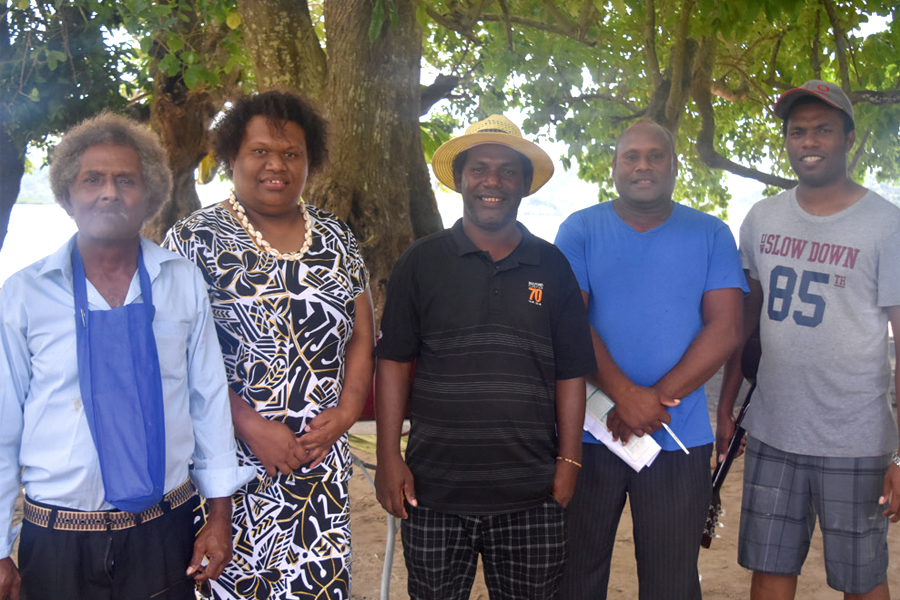
The Managing Director of Imperial Travel Service, Ender Rence, and the
hardworking committee behind the Pana Festival coinciding with the 2018
Independence Cruise last week Friday
BY BARNABAS MANEBONA
MS Ender Rence the Managing Director of Imperial Travel Service would like to thank everyone who contributed to the success of the recent 2018 Independence Cruise Pana Festival.
The Imperial Travel Service Managing Director and her team appreciate the help of the Haroro community in Ngella for their hard work and desire to deliver such a great show from the root vegetable locally known as Pana being significant to their culture.
“We would like to thank the Tulaghi Police who made sure there were no incidents as well as ensuring all of our guests’ safety.
“A big thank you to the media outlets continuous support who reviewed our product and took the time to come along and witness it firsthand starting from the beginning.
Local women of Sandfly at Big Ngella marching with coconut leaves woven baskets filled with Pana to showcase them during the 2018 Independence Cruise Pana Festival at Haroro
“This includes Telekom (the only business house that had a stall at the Pana Festival venue) for their bearable coverage for both visitors and Imperial Travel Service to promote the Festival via social media. Without their fantastic services we would not have been able to reach all of our sponsors as well as sell our tickets through their coverage,” said an appreciating Ender.
“Second to the last, thank you to all of the volunteers who helped on board the cruise ship, without them, this cruise would have never happened. They gave up their time for nothing more than the experience itself.
“Thirdly, to business houses namely Solomon Star for giving us special offer promoting the Pana Festival, 8th Note printing for their service, Sunday Isles newspaper for endless support, Tropical Aluminium and Glass, Solomon Islands Chamber of Commerce for promoting the Pana Festival to their members and Fair West Shipping for giving us their best boat for our cruise.
“Finally, we’d like to thank all of our guests including locals, the Korean community, Philipino community, Chinese community Fijians and the Ethono Australian Team who were also here for the MACFest.
The fourteen (14) different varieties of Pana (root vegetable) being showcased during the recent 2018 Independence Cruise Pana Festival at Ngella, Haroro Village. It is the first time for such event to take place at Ngella, an island that has a unique cultural style of extra cultivating Pana from the normal process to another four stages, making it usually harvested almost every month throughout the island
“This cruise would have not been so successful without you all. We appreciate the proud behaviour you all displayed. We hope to offer another cruise next year, and we are sure with the help of all those mentioned above, it can be a greater success than this year! Thank you all.”
It is the first time for such event to take place at Ngella, an island that has a unique cultural style of extra cultivating Pana process from one main garden to another reaching four stages, making Pana usually being harvested almost every month compared to the usual one way process of waiting for it to be harvested after every six to seven months practised in other provinces of Solomon Islands.
Second from Left, Ms Ender Rence the Managing Director of Imperial Travel Service and the hardworking Haroro Pana Festival local committee recently at the ‘2018 Independence Cruise Pana Festival’ in Ngella, celebrating the country’s 40th Anniversary. PHOTOS BY MANEBONA BARNABA
The soil in Ngella also plays a significant role to the root crop’s fast style of harvest. Each family gardens of Pana from Ngella’s traditional style of extra cultivating it will only be harvested after three months. But because all gardens are not made during the same time is why Pana is harvested almost every month throughout Ngella.
Because of the nature of how Pana provides food and other areas of support for the people of Ngella more than Kumara or Tapioca in comparison is why Pana is treated with very special respect by indigenous Ngellarians. They handle and treat it as their baby being the most valuable root crop to present culturally in occasions such as visitations by high ranked people or paying bride price.
From this reason is why Ngella people see that it is important for them to showcase the significance of Pana in their culture as well, with a vision in contributing to Solomon Islands showcases of unique diverse cultures for the outside world knowledge.
Imperial Travel Service Managing Director Ms Ender Rence during the 2018 Independence Cruise Pana Festival. PHOTOS BY MANEBONA BARNABAS
BY BARNABAS MANEBONA
Imperial Travel Service Managing Director Ms Ender Rence during the 2018 Independence Cruise Pana Festival. PHOTOS BY MANEBONA BARNABAS
AS part of their continuous Improvement plans, Team Imperial of Imperial Travel Service would want to hear feedbacks regarding the last event they organized namely the ‘2018 Independence Cruise Pana Festival’.
Being the first Pana Festival held at Ngella to showcase the root vegetable’s significance to Ngellarian’s culture coinciding with the Independence Island Cruise, recent guests feedback will be very helpful for their team as they are starting to organize for the next Pana Festival and cruise said Imperial Travel Service Managing Director Ms Ender Rence to Island Sun.
“Please email [email protected] for all your feed back to help us improve in the next.
“By this you are helping us to grow and support the rural community for an inclusive economic growth and NOT only in terms of government policies to target the Sustainable Development Goals as well,” explained Ender.
She reminds that on the recent Pana Festival, the Haroro community had depended entirely on Imperial Travel Service for financial support to get things from the ground.
Guests during the 2018 Independence Cruise Pana Festival enjoying their time to taste the different recipes of Pana being prepared and displayed by the people of Ngella
“From the warriors and flower girls, the houses, shelter stalls, stage supporting the village committee and all those comes with a huge cost to make the event memorable.
“We do not have support from donors or the government to host a fancy show so we tried as much as possible to make the show as simple as possible to cut costs. So in whatever short fall or mistakes we did, we are so sorry.
“Since we are a small business trying to support inclusive economic growth for all, we promise we will do our utmost best to do better next year with your feed backs. And, we will try as much as possible to get some support this time round from donors and the government to help organise the next event (Pana Festival) since we have already proven to the world that it is ‘POSSIBLE’ without nothing or small funds.
“Thank you from the Imperial Travel Service Management.”
ACCORDING to a UNDP report which outlines proposed best practices, financial and economic instruments for Solomon Islands to implement it’s REDD+ Readiness Roadmap, four cross cutting areas that could either attract separate funding or be developed with funding from other projects, have been identified.
Significant to the implementation of the roadmap, the four areas are forest governance, tenure security, gender equality and stakeholder engagement.
UNDP has stressed that forest governance can be related to the development of a national strategy for REDD+ but also indicated that while there are opportunities to seek funding to develop the national strategy, it is worthwhile to remain open to any other funding opportunities that could bring about positive changes in forest governance.
In terms of tenure rights, the report emphasized that due to the complex customary land ownership in the country which often involves multiple “kastom” systems the process of identifying tenure rights may be triggering conflict and be near impossible.
“Therefore, seeking funding for clarifying tenure rights, while effective in other countries is not recommended in the case of Solomon Islands”, said the report.
Gender equality is another cross cutting issue which UNDP sees relevant for REDD+, particularly in terms of social safeguards.
The report stated that the issue of gender in the sphere of making progress with gender and women’s empowerment principles as part of other projects and linkages could attract funding and benefit the REDD+ process.
Further stressed was that engaging stakeholders is important for REDD+ in forming partnership for sustainable forest management and to engage forest dependent and indigenous groups that often are excluded from decision making processes.
“Funding for other projects that involve communities and sustainable management of natural resources could also further the stakeholder engagement processes that are considered important for REDD+”
“It is therefore recommended to identify potential funding, possibly as part of other projects or efforts that could make progress with the engagement of stakeholders”, said UNDP
WHILE most of us enjoyed a good night’s sleep at home, the road construction work to bring us comfort while travelling in our vehicle continues into the night.
As of June, the overall progress of the project is 74 percent complete.
Since the project commences there has been no accident reported on the jobsites with safety at work sites for both workers and the general public is paramount.
So far there has been no serious environment related issues except the issue of dust.
Here the workers are carrying out construction work along the Fisheries Highway.
Exodus, a local that work night shift says they usually want to finish off before sunrise.
“Before traffic starts to get heavy,” he said.
The Kukum Highway project is projected to complete by November 2018.
Road work at nightRoad work at KukumRoad work at Kukum on Sunday night
VOIS Blo Mere Solomon (VBMS) in partnership with the Pacific Centre for Peace in Suva is organising a workshop on conflict sensitising at the All Saints parish conference room in Honiara.
Speaking with the Direct of Vois Blo Mere Solomon Josephine Teakeni said the workshop will run for four days and will mainly base on conflict sensitizing as well as mediations, reconciliations and restoration of justice.
Teakeni uttered invited participants will be from women of peace groups, Civil Society Organisations, women’s group, church based groups, Non-governmental organsaitions and community leaders.
The workshop will be facilitated by VBMS and Pacific Centre for Peace officers.
And it will starts today at 8.30am and will end with a peace visual on a Thursday.
IN the government’s budget outlook for 2018, a lot of health support comes from External support.
The Solomon Islands 2018 budget is supported by donors, ie; Australian budget support of $76.6 million for health services, EU $24.0 million to MHMS, Global fund $10 million in support to operations in the MHMS, Joint United Nations $1.6 million to support operations in MHMS, UNICEF $3.2 million in support to operations in MHMS, WHO is providing $2.2 million, UNPF $2.6 million, Family Planning Australia, $0.1 million to MHMS, Fred Hollows (Australia) $0.2 million to support eye related programmes, Healthy lifestyle promotion fund $3.5 million to MHMS, KOICA $1.5 million to GP Health service, Republic of China $6 million.
With so much support geared towards Ministry of Health and Medical Services (MHMS) it is just incredulous that we are facing a shortage of medicines and supplies because of the procurement process.
While there is so much money and budget support from external donors, we continue to face problems in the health sector.
What is wrong?
The delay in procurement shouldn’t be an excuse.
Procurement is standard procedure. Solomon Islands as a country has a standard Essential Medicines List (EML) and currently there are less than 500 EML that Solomon Islands orders annually.
With standard procedure such as purchase of pharmaceutical drugs, then there shouldn’t be a problem.
The MHMS has a National Procurement Plan and Annual Tender Guideline.
This document sets out the framework by which procurement is undertaken by the National Pharmacy and Services Division and also establishes step by step plan on how to undertake an annual tender from budgeting and planning through quantification and bid evaluation etc.
Who is not doing his or her job?
The procurement processes for government in buying goods and services is clearly stated for everyone to see.
Procurements of more than $100,000 and up to $500,000 are required to be approved by a Ministerial Tender Board.
Procurements in excess of $500,000 must be approved by the Central Tender Board.
The issue of procurement should have been clarified and/or persons NOT doing their job should be removed or disciplined.
DEAR EDITOR, last week it was reported in the Island Sun newspaper that the Solomon Islands Government and the United Nations Development Programme (UNDP) had concluded a three-year project which resulted in a set of commitments towards environment issues in the country.
In his address at the project closure workshop, Dr Culwic Togamana said a key threats to the natural environment was unsustainable resource harvesting through legal or illegal logging and mining.
He also mentioned threats such as large agricultural developments coupled with widespread subsistence farming, as well as climate change.
Dr Togamana added, “In realization of those threats repeated calls had been echoed over the years for sustainable and proper management of our environment and resources.”
“This has led to some awareness and researches being conducted to help gauge and support communities interested in seriously considering sustainable management of their resources.”
Dr. Togamana went on to say (quote)
“The SIG has been collaborating with international partners and local organizations to try and address the threats.”
“The ratification of Multi-Lateral Environmental Agreements (MEAs) such as the Rio Conventions— UNFCCC, UNCBD, UNCCD being examples of the international collaboration.”
He said domestically, amongst others the SIG had enacted key laws such as the Environment Act and its regulations and the Protected Areas Act.
Also, important policies had been developed and endorsed by the cabinet, he added. “The key ones cabinet endorsed included the Climate Change Policy, the National REDD+ Readiness Roadmap, the Climate Change NAPA, and the NBSAP.”
“However, a challenge people face, currently, there is a huge gap between how those laws and policies have transpired to the provincial or rural level,” he commented.
“Provincial Governments and rural populations do not even understand the purposes of the laws and policies which weaken their ability to actively participate in utilizing or implementing them.”
Looking at the trend, Dr. Togamana said there is a need for nationwide awareness.
The UNDP Country Manager, Ms Azusa Kubota, also speaking during the closing workshop, said the project showcased many incidents of the on-going collaboration between the UNDP and the Solomon Islands Government.
She explained despite the project having lapsed there would continue to be collaboration between the SIG and UNDP to address the significant global environmental issues such as climate change, biodiversity loss and land degradation.
She reportedly said, “One of the key objectives of the project is to increase public awareness and understanding of the conventions through the REDD+ process.”
She added that resulting from a partnership with the Solomon Islands National University and the Government; the project had developed a Resource Text Book and Teachers Guide.
Given the view that the current laws mentioned by Dr.Togamana are not being understood and consequently not be properly enacted, I would hope that the Resource Text Book and Teachers Guide will be put to effective and immediate use to increase public awareness of both the threats to the natural environment and the important steps needed for protection.
I have always been puzzled why it is that some traditional resource owners have not been encouraged over the years to have considered sustainable management of their forest resources by having set up saw milling operations which allows the forests to be properly managed and knowing a single tree can earn approximately 20 times more by milling it than selling the log to a logging company.
By obtaining such high returns the forests could be properly managed for generations.
Saw milling processing by local communities has higher benefits than large scale logging, resulting in much less environmental damage and such operations are far more sustainable in respect of the future availability of forest resources.
While it is acknowledged that the concept of nature has rights, the people have stewardship over the many natural resources in the Solomon Islands and it is vitally important for increased environmental protection and awareness of all the laws introduced to protect and safeguard the environment now and in the future and they are understood and properly enforced through willing and cooperative measures.
As stewards of our land we have the moral obligation to protect our natural resources for future generations to share and to benefit from all our richness of flora and fauna.
DEAR EDITOR, against the backdrop of recent talks to establish a long-term vision for the future with a functional national security policy I believe an elderly mother from Malaita Province had some words to say over the weekend which, to me, highlighted one of the most neglected security concerns at the core of national unity and economic prosperity, the lack of rural development and job creation that has beset the country for the last 21 years to my knowledge.
Indeed the analysis of the current security threats facing the nation, as outlined at the workshop to consider a national security policy for the future, were no different to the threats that I spoke about in 1998 and threats that were later highlighted in a Security Review undertaken by the Australian Government, at the request of the Solomon Island Government, at my urging in mid-1998.
Rural development and trickle down job creation has been left behind by successive governments for far too long
Speaking to the media from Auki on the eve of the 40th independence celebrations, Maria Teikui, used words which I believe are words most people would want to say to the government of the day.
She reportedly said (quote)
“The government needs to redirect much needed economic development activities to rural centres in Solomon Islands.
“To me, the country’s 40th year of independence is another time for current leaders to remember past achievements.
“I believe that if the government concentrated on redirecting economic development down to rural centres in Solomon Islands, government services will reach every Solomon Islanders equally,”
She reportedly went on to add that the lack of economic development in the rural areas in Solomon Islands had forced young people to leave their communities to search for jobs in Honiara.
Mrs Teikui added –
“This is a pull -factor that the government needs to redirect and consider, by creating strategies that rightly targets the interest of young people.
“Nowadays, I see most young people are interested in going to Honiara, where they think they can find a decent job.
“This has caused less participation of youths in the development of rural communities nationwide.
“Leaders should take up full responsibility to providing equal government services to all citizens.
There was no talk in the past of a “Bottoms Up” approach to rural development but nothing materialized and if national security is to be reviewed then rural development and localised job creation must no longer be sidelined.
I would like to suggest that the SIG consider Community Based Integrated Rural Development Centres to confront the challenges of low economic infrastructure, development, job creation and biodiversity loss through the participation of rural communities in a variety of sustainable livelihood activities.
Rural communities in the Solomon Islands have endured too many decades of economic marginalization and lack of basic social services.
Thailand has offered help to the Solomon Islands Government in the past and I would encourage the SIG to seek the help of the Royal Thai Government to learn about the success of Thailand’s Population and Community Development Association which created many Community Based Integrated Rural Development Centres since the 1980s to deal with the concerns and needs of the rural population and obtained much success to the satisfaction of many communities.
THE REDD+ roadmap aims to prepare Solomon Islands to be REDD+ ready by 2020.
This was expressed in UNDP’s “Integrating Global Environment Commitments in Investment and Development Decision Making Project Solomon Islands” report.
The report highlights what REDD+, a UN programme, aims to accomplish in the Solomon Islands.
UNDP stated that the vision of REDD+ in the country is to establish a sustainably managed forest sector which supports rural livelihoods, maintains the quality of the environment, contributes to national socio-economic development and to reduce levels of emissions from the forest sector.
All the more, key policy areas for REDD+ identified by the roadmap include; reducing impact of commercial agriculture, sustainable management of forests, reforestation, afforestation and plantation, forest reserves and protected areas.
Three phases of the Solomon Islands national REDD+ roadmap are REDD+ scoping, piloting capacity development and reform and scale up activities.
The Solomon Islands government ratified the UNFCCC in 1994 and used the platform to battle domestic climate change.
From 1994 to 2016, regional partnerships were strengthened to combat climate change and there was also the establishment of communication and reporting channels with UNFCCC.
On top of that, national policy and key programme areas like agriculture, water and sanitation progressed as well as the development of the “Solomon Islands REDD+ Readiness Roadmap 2014-2020” under the UNREDD Programme (United Nations Programme on Reducing Emissions from Deforestation and Forest Degradation).
Paul Labukode [R] and Peter Sagaru walk out of Vancouver International Airport after receiving their 24 month's work permit under GP-CITREC partnership. Photos from Canadian Government Communications
CANADA’s Dairy Industry Workforce was further strengthened yesterday following the arrival of two more workers under the Canadian International Training & Education Corp (CITREC) Guadalcanal Province (GP) partnership.
GP -CITREC Worker’s Peter Sagaru & Paul Labukode touched down at Vancouver International Airport where they received a two-year work permit to be employed as Dairy farm workers in Chilliwack, British Columbia.
“We are so pleased to be in Canada. We just can’t get to start working and sending money back home,” both Sagaru and Labukode said.
CITREC Chairman Ashwant Dwivedi hands over work permit to the newly arrived GP-CITREC workers at the Vancouver International airport. Showing off their work permits are Paul Labukode (Left) and Peter Sagaru.
CITREC Chairman Ashwant Dwivedi announced that the number of workers from GP into Canada is set to grow.
Dwivedi told a Canadian media conference that “We at CITREC strongly believe that the best way we can fight unemployment and poverty in parts of Solomon Islands is by empowering people of the Solomon Islands, and creating employment opportunities for the people in country such as Canada where foreign workers make significant part of Canadian workforce”.
“This is something we have been successfully doing through our partnership between Guadalcanal province and CITREC and soon we will include other provinces of the Solomon Islands that will be benefiting from the same arrangements.”
Sagaru and Labukode, while being granted their work permits, were greeted into Canada by Immigration and Border officials.
“We welcome you both from Guadalcanal province into Canada and we are pleased to see that you are here to work. I hereby under Canada’s Immigration act grant you a work permit for 24-months to work for your employer named hereto in your work permit,” Immigration official said.
Soon after receiving their work permit both workers were handed over their Canadian medical insurance which immediately covers them for their medical insurance in Canada.
Sagaru told CITREC Chairman Dwivedi that he is excited to be in Canada.
“Just like my other colleagues who are already in Canada, I will always work hard and make my province and Solomon Islands proud,” Sagaru said.
Labukode said that he is also looking forward to the opportunity especially when salary paid in Canada is much higher then what people in Solomon Islands receive.
“I have been waiting for this opportunity. I would always be checking with the Guadalcanal education office as to when I will be travelling. Finally, my dream has come true. I thank the province of GP and CITREC for this opportunity,” Labukode said.
Dwivedi reminded the newly admitted workers that while in Canada they must be on their best behaviour and they must always perform beyond the expectations of their employers.
“You must always remember that your actions will have immediate and long-term effect on the people of Guadalcanal and Solomon Islands. You have been issued with a 24-month work permit, this should tell you that your employer has confidence in your ability.
“You must maintain this confidence and the expectations of your employer and perform to the best of your ability,” Dwivedi said.
Dwivedi further told the workers that drug and alcohol use has no place during their employment term in Canada.
“I remain confident that you will work to the best of your ability and prove to your employer that their choice of having you as their employees was the right choice,” Dwivedi said.
“I must also remind that as part of remittances accord each month from your net pay you will be sending money back to the Province of Guadalcanal.
“These funds you will be sending will be used to further build province. You must remain committed,” Dwivedi said.
Paul Labukode [R] and Peter Sagaru walk out of Vancouver International Airport after receiving their 24 month’s work permit under GP-CITREC partnership. Photos from Canadian Government CommunicationsDwivedi also encouraged the workers to send money back to their family in the Solomon Islands.
“When you send money back to your family in the Solomon Islands you are just not helping your family but the economy of Solomon Islands as well. I encourage you to use your funds wisely. Save and share with your family in the Solomon Islands,” Dwivedi urged the newly arrived workers
Dwivedi further said that he believes that by the end of next year the number of Solomon Islands nationals that are expected to work in Canada will significantly grow as more provinces are joining the programme.
“Canada’s foreign worker benefit is one of the best that is enjoyed by Guadalcanal workers. We in Canada treat our workers as family. And so far, our Guadalcanal workers have continued to show their dedication and commitment to their Canadian employers,” Dwivedi said.
Canada has started to issue Guadalcanal workers with 24-month work permits. Canada’s employment opportunity comes with Canadian standard wages, medical and housing, where a significant cost, housing is paid for by the Canadian employer. Employees under the contract only pay $30 a week in rental cost.
Also, employers pay for return air fare for the workers as part of their arrangement under Canada’s employment regulation. The airline ticket cost is not deducted from employee salaries.
“Our Canadian benefit under the foreign worker program is something that is widely talked about. When we have our workers from Solomon Islands they are also covered under the Workers Compensation insurance.
“This gives both the employer and employee a piece of mind that should worst ever happen there is workers compensation that will ensure that the employee is fairly compensated,” Dwivedi said.
He further said that Canada’s medical insurance also provided full medical coverage to these workers.
“As long as these workers remain in Canada they are covered under the medical insurance which ensures they have access to medical care that may arise,” Dwivedi said.
Last week it was announced that Solomon Islands National’s who are Job Ready graduates of the Canadian International Training & Education Corp (CITREC) programme from Guadalcanal have been included in a new stream of employment which includes employment in Canada’s Food Processing sector.
Also included in the pilot project will be the province of Makira-Ulawa, which has recently been added to list of eligible provinces alongside the Province of Guadalcanal as part of the labour mobility partnership with Canada.
Furthermore, this opportunity will also be extended to any province that will partner with CITREC.
Speaking on the achievement, Dwivedi said that “Solomon Islands and the people of Guadalcanal have created a very strong trust among Canadian employers through their performance that is helping to create more opportunity among many sectors across Canada.
“Guadalcanal people and province must be congratulated for their leadership in area of creating partnership with Canadian employers”.
He also said that Solomon Islanders dedication, good nature and work ethic are very well credited for by the Guadalcanal workers who are presently in Canada under GP-CITREC partnership which is resulting in more employers
During the presentation of documents to the two workers bound for Canada last week in a statement Guadalcanal Province’s Minister for Education Lazarus Rima had also reminded the two Canada bound workers that when they arrive in Canada his province only expects the best from them and that they must uphold their commitment to the Canadian employer.
“I want to remind you that you both represent your families, community, province and Solomon Islands as a whole. I only expect the best from both of you. Remain committed and dedicated and make Guadalcanal and Solomon Islands proud,” Rima said.
Rima has also reminded the two Canada bound workers to be good ambassadors and display their identity as responsible Guadalcanal people.
“Also let me remind you that when you touch down on Canadian soil you must be willing and ready to be follow Canadian law. You must always uphold the laws of Canada to your benefit and interest,” Minister Rina said.
Guadalcanal Finance Minister Amaziah Keith Rubo said that the GP-CITREC partnership is growing and that he wants to see the programme grow further.
“Therefore, you all act as important persons towards our partnership with Canada. As our partnership has already started to yield financial benefit we at the Guadalcanal government remain committed to see the human resources aspect of the program grow as well,” Rubo said.