POLICE in Auki, Malaita province, have arrested and charged a 31-year-old male in relation to a wounding incident at Sarawasi logging camp, small Malaita on October 11, 2018.
It is alleged that the incident is connected to a land dispute relating to logging.
“It will be alleged that in the early hours of October 11, 2018 the accused went over to the victim’s residence,” says Provincial Police Commander Malaita Province Superintendent Timothy Apaesi.
“It’s alleged that as the accused approached the victim he struck the knife on the victims back.
“Then he struck again and wounded the victim on both hands as the victim tried to defend himself.
“People in the community were alerted and they stopped the accused from further attacking the victim.
“They assisted the victim to Afio clinic for medical assistance. They reported the matter to Police through the Police Communications Centre in Honiara.”
The report was dispatched to Auki Police and Police attended to the report the next day where the accused was arrested and an investigation carried out.
“I want to thank community members at the Sarawesi Logging Camp for responding to the incident before the police arrived and working closely with my officers on the investigations,” says Apaesi.
The accused is facing a count of attempted murder and was yesterday taken to court for remand applications.
The victim is an Asian and has been flown over to Australia for medical attention.
WORK of the civil society organisations (CSO) continued to be praised and appreciated in all aspects of the country, but certain members of Parliament (MP) are now questioning their integrity and some of their outreach programmes held recently.
MP for Shortlands Hon Chris Laore.
Member of Parliament for Shortlands, Chris Laore is concerned over the manner in which some of the CSO groups, particularly, the National Council of Women, has been conducting its awareness programmes, most of which he described to be very ‘anti-MP’.
The group along with representatives of other civil society organisations were out in some of the provinces last month, with a mission to give civic awareness to the rural people on women issues, including women in leadership.
But the concerned Shortland MP told Island Sun that the groups are ought to be questioned as they were moving around with female intending candidates, using the CSO banner as a platform to advocate election agenda on behalf of those women.
More so, he added, the group’s recent trip to the Shortlands was for an intending candidate in his constituency, under the CSO banner, using information to bring disrepute to his image.
Laore shared that while he is happy to see women participate in the formal electoral system, he is concerned that the women advocacy group’s agenda has gone a bit too far off the mark, which he felt was going too deep into how the constituency is running its affairs and development programmes.
The MP said he has no problems with organisations going around making civic awareness programmes on behalf of women in politics and their leadership potentials in the country, but thought that the nature of these outreach activities have gone beyond their mandates.
The Shortlands MP who had just returned from his constituency shared that he was shocked to have learnt of the manner in which the NCW General Secretary Acting, Casper Fa’asala, was carrying out his programmes, which he said was clearly targeting current MPs – for the interest of women candidates within their circle.
Laore who was also questioned by a group of women from Shortlands on how he had used the funds given to his constituency under various ministries under the RCDF programme, suggested that these were the outcomes of what the CSO groups, particularly, the woman advocator, has intended, which he expressed to have no problems with as all the records are with the responsible ministries.
He then claimed that the NCW head has intended to bad-name him so to create the potential to display a picture for their woman intending candidate, which he thought the authorities should carefully look into.
“Is this a civic awareness programme or a campaign strategy they are using to target the MPs under the umbrella of such a very reputable organisation like the National Council of Women?” Laroe questioned.
He also questioned if these activities were done under exempt of the Minister of Home Affairs because he claimed, were obvious campaigning.
He further questioned if the head of the NCW delegation to his constituency was mandated under the Ministry of Women, Youths, Children and Family Affairs, which he thought would not have gone beyond approved agenda if it was so.
The Shortland MP however stressed that if these women in his constituency that questioned him were genuine enough in their calls as concerned electorates, he suggested that the constituency office is there to consult with, so as the Ministry of Rural Development and other relevant ministries, where all the records of fund usage are available.
“These are constituency matters and so these women if they are genuine about their concerns, should have approached the constituency office for answers, or even the ministry responsible. Otherwise, these are all part of the intentions orchestrated by these CSO groups and their women intending candidates,” Laore said.
The matter raised is also something some constituents of the Malaita Outer Islands (MOI) constituency have shared, suggesting that while some elements of the groups are being genuine with their agenda, others are actually hiding under the umbrella of the CSO to push the agenda on behalf of their women candidate.
Like it was in the Shortlands, the NCW representative was also alleged to have accompanied another woman intending candidate for MOI and electorates have also expressed the same concerns, regarding the nature of the groups’ Civic awareness programmes, which they thought was very much campaigning.
But a follow up with the Ministry of Women, Youths, Children and Family Affairs revealed that the NCW is one of their key partners in the implementation of government policies relating to youths, families and women, but have not mandated for them to use such strategy if they were true.
Ministry Officials explained that these groups can be exempted under the umbrella of the CSO and the Ministry, to carryout election civics, raise awareness on issues such as women in leadership and politics, and other issues to highlight the potentials of women in the country.
“But not to discredit or have programmes done in the manner that is directly linked to influencing electorates and bad repute any members of parliament,” a senior official who wished anonymity explained.
Also commenting on this, Solomon Islands Electoral Commission officials explained that they support the works of the CSOs in their outreach activities throughout the country, in the form of availing trainings on the election processes, but not on the grounds of training them how to lure votes or similar activities.
Commission officials however warned that any form of awareness activities related to election, must be done within the boundaries of the Electoral Act, and therefore any activities deemed campaigning in nature are illegal and should be discouraged, or people might get penalised.
Meanwhile, when contacted, the Acting General Secretary of NCW denied accompanying the woman candidate to Shortlands, despite claims his trip was funded by the intending candidate.
Fa’asala briefly explained that the awareness was based on the bulk amount of funds to constituencies through Constituency Development Fund (CDF) that was highlighted in the Transparency Solomon Islands (TSI) Report on the development fund.
He said his return to the constituency, which prompted the complaints, was done after the women of the constituency requested for awareness on CDF and related constituency funds
The General Secretary (Ag) then suggested that those unhappy MPs should however see this as an opportunity to go down to the constituency and explain to electors on the details of what was highlighted in bulk sums of the funds.
He however clarified that in the Malaita Outer Islands, the awareness on CDF was done by TSI based on their report analysis on the much talked about funds, but denied holding similar programme like he did in Shortlands.
“My trip to MOI was basically to do a short list analysis on the constituency to draw up profile for the woman intending candidate, in preparation for her campaign platform during the campaign period,” Fa’asala explained.
Fa’asala was unable to respond to most of the claims and allegations made but confirmed that he will be making a full reply statement on this in our next issue.
A North Guadalcanal Chief has voiced his disappointment in Guadalcanal Provincial Government (GPG) over its inability to pay for their student’s tuition fees at SINU.
Chief Benedict Garimane says he is quite disappointed and angry when he saw that GP Education Authority owes $8million to the country’s local university.
He said GP Education Authority should prioritise spending on the province’s Human Resources.
He said GPG has been able to prioritise spending on the province’s human resources to Canada.
“Why shouldn’t they do the same for our local university?” he questioned.
Garimane said these are the same human resources that the GPG Premier was referring to when he spoke highly of the CITREC programme.
“If they are be able to spend money to meet the graduate’s expenses to Canada, they can be able to spend money for the students to complete their studies at the Solomon Islands National University (SINU),” Garimane said.
He said GPG should set its priorities right, and urges the Guadalcanal Education Authority to pay up its debts at the SINU.
SOLOMON Islands is yet to see what real freedom and liberty means, according to President of Malaita Ma’asina Forum (MMF), Martin Housanau.
Addressing those who attended an annual general meeting on October 8 at the National Museum Auditorium, he stressed on the above sentiment.
Housanau stated that although we have gained independence in 1978, we are yet to achieve political and economic freedom in our country.
He said important sectors in our economy like cocoa and copra are taken over by foreign companies, even mining and the list goes on.
Housanau mentioned that we talk about the Rural Constituency Development Fund (RCDF), but see no tangible developments in the constituencies.
In relation, he stated that being independent means being able to make our own decisions as indigenous Solomon Islanders regardless of province so long as one is a leader.
Housanau expressed that unfortunately since independence every decision that has been made by our political leaders is determined by donors.
“That is not political independence,” he said.
Housanau voiced that our leaders must have the courage to make decisions for us.
THE Government is planning to ban the import of rice, blaming Non-Communicable Disease (NCD) for its drastic action, it was revealed last night.
Rice, which has become a staple food for Solomon Islands families, cost an estimated $400 million a year in imports.
Sources told Island Sun last night that the planned ban would begin with imposing higher taxes on rice imports, which would lead to increases in the price of rice sold locally.
It is not clear when the new taxes would kick in, but sources said it would almost be immediate.
“This is because the Government believes eating rice contributes to the spread of infection from Non-Communicable Disease (NCD). One way to discourage this is to impose higher taxes on imports of rice so that people eat less rice,” the sources said.
The sources said the matter was discussed between Prime Minister Rick Houenipwela and his Deputy and Minister for Finance and Treasury, Manasseh Sogavare, in recent days.
“Both agree that the way to combat NCDs is to impose higher taxes on rice so that it would be difficult for families to buy it.”
The news comes amidst fresh revelation that some Members of Parliament have been using a foreign-owned barge to transport goods bought with CDF grants from JQY Enterprises Ltd.
“These cargoes were being moved by this barge under cover of darkness from Alligator Creek,” eyewitnesses said.
The barge is said to be owned by a company called AAA, which many believe is a subsidiary of JQY Enterprise Ltd.
Each time the barge comes to Alligator Creek all the MPs whose consignments are being sent would arrive there, one eyewitness said.
“High profile MPs are involved. They would be at Alligator Creek until midnight when the barge sails before they go home,” the eyewitness said.
The eyewitnesses said this had been going on for quite some time.
Meanwhile the new MP for Gizo/Kolombangara Lanelle Tanangada is expected to be sworn in as Minister for Youth, Women and Sports this week. She replaces Ms Tuki whose election was declared null and void in the court of disputed returns.
Landowners seek justice for environmental damages to ecosystem
BY GEORGINA KEKEA
SEA boundary owners of Sabunu on Vangunu Island in the Western province are very disappointed with the government.
In an article to Island, the group of rural people say government is hesitant to prosecute a logging company that had discharged toxic waste into their sea.
In or around March this year, they claim that a logging company, renowned in Western province for poor environmental practices, was responsible for the illegal discharge of large amounts of waste oil as well as toxic waste metal pollutants.
The illegal dumping of fuel was witnessed by numerous members of the Sabunu tribe. Witnesses say that during the transfer and loading from the log pond of timber felled by the company onto their boat the MV Portland, waste fuel and scrap metal were dumped, in order to clear space and ballast for logs.
Spokesman for the owners of Sabunu, Reverend Bulaid Leto, said the thick slick of oil and waste that was intentionally and illegally released from the ship has continued to wash up on the shores of the surrounding coastline in the months that have followed, causing serious damage to the reefs and ecosystems within that area.
After being unable to confront the responsible companies for compensation, the Sabunu owners took their grievance to the relevant government institutions charged with monitoring compliance with environmental laws.
To their grievances, both government institutions issued a letter to the Camp Manager of the company.
In August 29 this year (2018), Environment Director in the Ministry of Environment urged the company to address the claims by resource owners.
In the letter he wrote, “Waste oils and thus marine pollution have been witnessed floating around the marine environment there for several days. I understand that the issue has been brought to your attention in the past and that you are aware of the incidents”.
Last week when contacted by Island Sun to verify the information, Director Joe Horokou says there is nothing much the government can do when it comes to compensation for the resource owners.
“The incident happened almost six months ago and the resource owners just came to us recently with their claim. We need to have evidence of such claims.”
Horokou said now it is too late for them to do any assessment and whether the assessment will be justifiable as the toxic waste might not be visible anymore.
At the same time Acting Director SIMSA has issued a letter to the company advising the company to clean up any remain of discharged oil reported and to consider the resource owners claim.
Under the MARPOL Convention of the International Maritime Organisation, which Solomon Islands has acceded to, Annex 1 of Marpol 73/78 prohibits the discharging of oil into the sea anywhere around the world except oily bilge water discharge through an Oily Water Separator (OWS). The convention is part of Solomon Islands Shipping Act of 1998 where a spot fine of USD$500,000 is the initial penalty for known cases of contravention of Annex 1.
The resource owners of Sabunu said they will seek legal assistance from the Public Solicitors Office to ensure this environmental crime does not go unpunished because they are not satisfied with the letters issued by the government institutions.
Island Sun has not been able to confirm whether the resource owners have received compensation from the logging company accused of discharging the toxic waste.
It is understood that the compensation would be cheaper for the company than the USD$500,000 spot fine.
GLOBAL warming, long in the media forefront, has recently become a thought-fuelled debate.
Recent efforts by such international, and interrelated, organizations as the United Nations Environmental Program, the World Meteorological Organization, and the Intergovernmental Panel on Climate Change (IPCC), have helped create essential standards for discussion, clearly establishing the present and anticipated effects of global warming. Although the spread of tropical storms due to higher temperatures may be more important for Pacific Islands, a greater threat is the long predicted rise in sea levels.
According to the IPCC, sea levels will rise between 0.3 and 1.0 meters by 2100, with a best guess estimate of 0.5 meters. This would double the number of world populations at risk from flooding with a 1.0-meter rise, the number triples. For the smaller island nations, especially the low-lying atolls, where nearly all land is within a few meters of sea level, rising seas cause storm damage, freshwater contamination, and flooding, if not total inundation. Increased coastal erosion worsens flood risk by endangering natural protective features such as sand dunes, mangroves, and barrier islands. Others claim that the Pacific rises less than two millimetres a year. According to Wolfgang Sherer, director of Australia’s National Tidal Facility of Flinders University and part of a Pacific-wide sea level monitoring program, blames the 1999 submersion of two uninhabited islands in Tarawa, Kiribati on localized overuse of freshwater under each atoll, not on global warming caused by industrial nations.
While the Pacific Islands are united in their desire for further anti-emission measures and protective aid, larger industrial nations, have yet to implement already agreed upon reforms.
Researchers frequently cite insecure data in order to de-link sea levels and flood damage from global warming.
One important limitation on the South Pacific Forum’s voice is its exclusion from the Antarctic Treaty System (ATS). Signed before many of these states had achieved independence, ATS gave control of the Antarctic to 43 nations and limited its development to scientific research. Scientists have recently informed foreign ministers from the ATS countries that the West Antarctica Ice Shelf is poised to slip into the ocean, causing a rise of six meters in their lifetimes.
This would mean the total loss of the Kiribati, the Marshall Islands, Tokelau, Tuvalu, and Tonga, as well as large swaths of the Cook Islands, Micronesia, Fiji, French Polynesia, and the Solomon Islands.
Counter measures for flood protection include population and crop relocation to higher ground uncontaminated by salt water. Mitigation, creation of flood ways for drainage, and development of more stable rice crops are all projects currently underway in endangered areas.
While many believe that reducing the adverse effects of natural disasters should be addressed as part of sustainable development programs, the fate of many Pacific nations is uncertain enough to discourage the same foreign investments that would be needed to prevent damage.
The Pacific Islands are not the only areas threatened by floods. Sixteen of the world’s largest cities with populations of more than 10 million are located in coastal zones, and coastal populations are increasing rapidly worldwide.
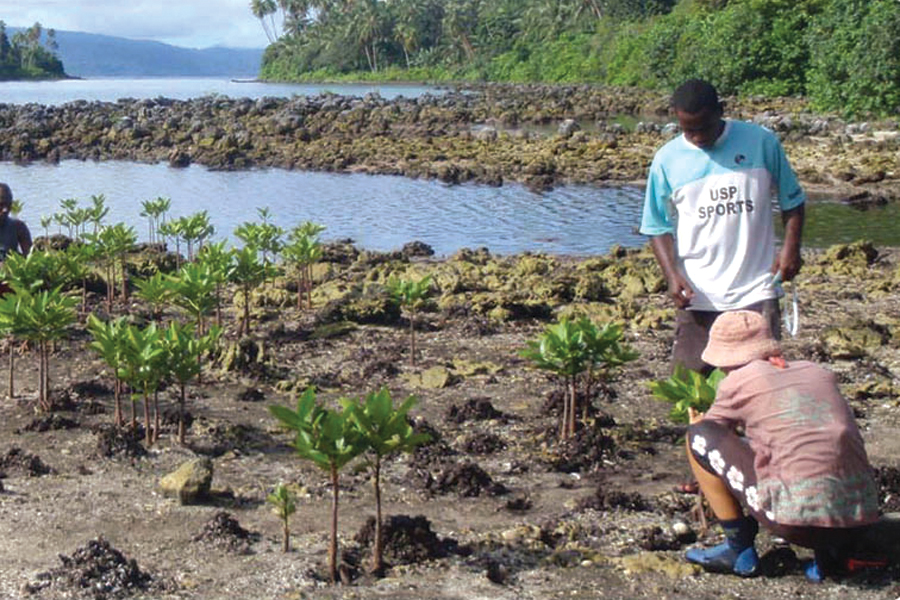
Plant mangroves to protect coastline from erosion.
BY GEORGINA KEKEA
Plant mangroves to protect coastline from erosion.
STUDIES in communities on climate change issues found that communities need to have the strength to confront the issues collectively.
In a study in communities in Roviana, it was found that people need to work together when it comes to adaptation to climate change.
The report found that some communities in there are highly vulnerable to sea level rise with more than half of the village land, inundated if the sea level rises by 50cm.
In a booklet by the Pacific Adaptation Strategy Assistance Programme project in the Solomon Islands, it speaks on the issues of climate change in Roviana.
The lagoons of Roviana and Vonavona are said to support human populations for 15,000 years already.
The history in tribal warfare, religious diversity, WWII, high rainfall, tectonic uplift/subsidence and tsunamis has made the human and ecological communities strong and resilient.
However an assessment conducted more than five years ago found a number of issues are now reducing this strength and making the Roviana area more exposed to climate change.
Changes in weather observed over recent years by community members and recorded in the PASAP project includes more rain, unpredictable seasons, more wind and hotter temperatures.
For its marine life, Roviana has a healthy and diverse marine ecosystem that contains 920 hectares (ha) of coral reefs, 1495ha of seagrass, more than 5000 ha of sparse seagrass and corals amongst sediment, rubble, rocks and algae.
However, coral bleaching and disease is already impacting Roviana and will continue to increase with climate change.
“Nusa Hope Marine Protected Area (MPA) the most well enforced reserve is the only MPA that has less bleaching and disease surrounding reefs. More coral disease and bleaching on offshore reefs compared to the lagoon”, the report said.
Another finding from the project also revealed that lagoon areas experience less disease/bleaching because lagoon corals naturally experience big temperature of changes.
“The actions needed to safeguard the marine ecosystem in Roviana includes protection of herbivore populations that are required to maintain coral reef health, new marine reserves including connections between coral reef, seagrass and mangrove ecosystems as well as protection of lagoon passages as corals there are resistant to temperature fluctuations”, the report said.
While there are also other issues raised, the issue of drinking water is one that needs community support.
Access to clean drinking water is an essential requirement for healthy communities.
However the report found that sea level rise will cause salt water to come into low-lying groundwater wells, making them unsuitable for drinking.
Also community water supply from streams with a forested catchment and from wells located away from the coastline will be very important for the people there.
With these findings, it is important for the Roviana people to keep healthy forests in water catchment areas and not to allow logging operations within 200m of streams or anywhere in water catchment areas.
“Maintain a diversity of water sources (rainwater, wells, stream supply)”.
Whilst some of the factors are externally driven, many can be addressed at the local level through community based adaptation.
The report says through a consultative process, they have been able to identify local actions that will re-enforce existing community strengths.
Actions includes strengthening of marine ecosystems by improved management of mangrove ecosystems, protection of coastal ecosystems through limitation of removal of mangroves adjacent to villages and coconut plantations as well as practice good gardening.
“Better land use planning to limit agroforestry encroachment onto garden lands, training in soil fertility improvement methods, documenting traditional knowledge of garden practices and bushfoods for future generation”.
The report on climate change issues in Roviana calls for greater cooperation from the people there and encouraged them to look after their resources properly.
For Solomon Islands, sea level has risen by a massive 8mm per year since 1993. Temperatures continue to rise since 1951 by 0.15 degrees Celsius per decade, leading to more hot days while the country also experience extreme rainfall days. The storms are also said to be less frequent and more intense.
DEAR EDITOR, Jay Bartlett, Board Chairman of the Solomon Islands Chamber of Commerce and Industry (SICCI) made a statement at the official launch of the Young Entrepreneurs Council Solomon Islands (YECSI) at the Mendana Hotel in Honiara on Friday October 12, 2018, which I fully endorse.
He was quoted as having said, “To take full advantage of Solomon Islands’ youthful population we need to make decisions on education, training, policy and programs particularly by building job-relevant skills that support entrepreneurship and innovation.”
Mr Bartlett went on to add, “It is important that we fully understand the population situation we face and the implication it poses for socio-economic growth and development,”
“As a country we currently face a serious skills deficit needed to support economic growth and we need to reconfigure the training supply system that is demand responsive.”
Importantly, in my view, Mr Bartlett said, “Our youth demand our efforts, time and investment and the time to act is now.” Source: Solomon Star news.
In my desire to aid the growth, education and arts training of the youth, with a special interest in seeing the early creation of a National Youth Orchestra, I would appeal to the SICC as well as YECSI and the two Ministries of Women, Youth and Children Affairs and Tourism to help me get a NYO off the ground and to see it prosper and grow in the months and years to come and so prove beneficial to the needs, talents and aspirations of the young people that need “our efforts, time and investment”.
DEAR EDITOR, it is very rarely that I wake up, scan through the daily news reports and instantly feel like celebrating.
Today is the exception because after many months of writing to advocate the acquisition of a CT scan for the Solomon Islands National Referral Hospital (NRH) I came across this wonderful piece of news.
Quoting from the Solomon Star newspaper of 10 October 2018 the story read.
Prime Minister Rick Hou has welcomed commitments by an Australian philanthropist to purchase a new Computed Tomography (CT) scan for the National Referral Hospital (NRH).
Lady Primrose Potter the Australian philanthropist shared with the Prime Minister her willingness to raise funds to purchase the CT scan; when she met with the Prime Minister at the Office of the Prime Minister & Cabinet recently.
She said the CT scan is vital equipment, a diagnostic imaging test used to help detect diseases of the small bowel, colon and other internal organs and is often used to determine the cause of unexplained pain.
Lady Potter said it is a state-of-the-art equipment that is fast, painless, non-invasive and accurate.
“I am willing to assist and I will do my best to help raise funds to purchase a new CT scan for the NRH,” she said.
Prime Minister Hou said he has always wondered why Solomon Islands never had this important machine in place over these years.
The Prime Minister said this if purchased would go a long way in helping citizens in this country.
He said it will also cut costs of sending people overseas and also provide surgeons accurate results when testing patients.
“This is welcoming news and I hope we can be able to work together to get this machine into the country as soon as possible,” the Prime Minister said.
Primrose Potter, Lady Potter AC is an Australian philanthropist and arts administrator. She is particularly associated with The Australian Ballet. She is the widow of Sir Ian Potter.
Lady Potter is currently Patron-in-Chief of The Solomon Foundation, a charity that supports various social development projects in The Solomon Islands.
She was founding Honorary Patron of the Melba Foundation, Founding Patron of the Victorian Opera Company, and Patron of the Australian Centre for Contemporary Art.
In the Queen’s Birthday Honors 1988, Lady Potter was appointed an Officer of the Order of Australia (AO) for service to the arts and the community.
In 2003 she was promoted to Companion of the Order (AC) for leadership and for encouragement of support for critical community growth through fundraising and philanthropy in the arts, sciences, education and social welfare.
In February 2010 The Australian Ballet named its headquarters in South bank, Melbourne, the Primrose Potter Australian Ballet Centre, to honor her 35 years of service to the organisation.
She has also been awarded honorary doctorates from Australian Catholic University, and Monash University.
Lady Potter was also accompanied by Ian Hosking the founder of the Solomon Foundation.
Mr Hosking has been very instrumental in connecting Solomon Islands with Lady Potter which the Foundation has made vast contributions to the Solomon Islands over the years. Copyright @ 2018, Solomon Star news.
My heartfelt thanks are extended to Lady Potter and the Solomons Foundation for considering to help the National Referral Hospital acquire a much needed and long awaited CT scan.