Home Blog Page 1161

BSP supporting breast cancer awareness

0

DEAR EDITOR, “The Bank of South (BSP) in Solomon Islands has called on businesses operating in the country to wear something pink in aid of Pinktober.

“The call was made in a press interview with the BSP Country Manager David Anderson last week in Honiara.

“Manger Anderson said Pink Ribbon Charity works on escalating breast cancer alertness across the Solomon Islands as it has become one foremost medical concern which women and girls of this nation and the hospital workers are currently facing today.” Quoting an extract from the Island Sun newspaper – October 15, 2018

I extend my appreciation to BSP and the Country Manager, David Anderson, for supporting a breast cancer awareness campaign in the Solomon Islands.

Breast cancer is the second most common kind of cancer in women

The good news is that mammograms can help find breast cancer early.

Mammograms (X-Ray pictures) are used as a screening tool to detect early breast cancer in women experiencing no symptoms.

They can also be used to detect and diagnose breast disease in women experiencing symptoms such as a lump, pain, skin dimpling or nipple discharge.

Most women can survive breast cancer if it’s found and treated early.

Yours sincerely

Frank Short

Putting JQY’s position as service provider in perspective

0

COMMENTARY

By Alfred Sasako

THE extent of public funding to JQY Enterprise Ltd – a government preferred supplier outlet – angered many members of the public. Some no doubt have their own businesses and are expectant of equal treatment, by politicians who represent them in Parliament.

While the pros and cons have merits, the public appears to have confused the issue of running a business with patriotism. These are fundamental issues and do not need a degree from the Harvard Business School to understand this.

The first irrefutable fact is this. JQY is a business. It provides a service. Everyone ends up at its New Chinatown premises because the company runs a business that provides a service customers need.

That much should be clear. It should be recognised and accepted. Patriotism, on the other hand, is another matter. In fact, many expect their political representatives to show them what patriotism is and what it demands of each citizens.

I have no real issue(s) with the amount of money JQY rakes in every year from hardworking taxpayers. Admittedly, it is a lot of money – some $239 million-plus as at the end of September this year. The source of the funding is just as controversial – the Constituency Development Fund (CDF) grants co-funded by the Solomon Islands Government and Taiwan.

JQY provides a service. It is that service that customers buy all the time. In stating this, I am reminded of what was attributed to World Boxing Legend, the late Mohammed Ali.

He said and I quote, the money we pay for services we use is the rental we pay for living on earth. In other words, nothing is free. We pay for everything we use.

Having had a close look, as I have, at Government computer print outs of what we spent so much money on using one supplier as is the case, raises a lot of questions.

For me the real issue in all this is not so much about how much money was injected into JQY or any other outfit for that matter. Rather, I am more interested to know whether the goods and services for which we pay, have been delivered.

Has JQY Enterprise Ltd delivered the goods and services for which taxpayers have paid? That to me is the $239million-plus question. And this is where the focus should be.

In fact, there are unconfirmed reports that JQY actually received two forms of payments from the government and others. One is in the form of the CDF grants, which is real hard cash, coming directly from the Ministry of Rural Development, the other from politicians and others in the form of private cheques.

The private cheque is a growing portfolio. Many of these cheques bounced. They were paid by leaders who wanted to buy coffins for the death of a Constituency voter. But because JQY does not sell coffins, the cheques were cashed with JQY only to find later the cheques bounced.

There is now a joke making the rounds that by accepting these cheques, JQY is slowly buying its own coffin. Given the size of what it has received over the years in terms of CDF grants payment from government, the company may have already weathered any potential storm(s).

What is needed now is an investigation – a forensic audit to be particular. Because given the amount of money involved and the duration of such transactions, only a forensic audit would uncover any anomalies. Anything short of a forensic audit would be a laughing stock.

Did JQY deliver the services for which payments were made? If not, where has the money gone – are but some of the leading questions that must be asked. These questions are prompted by the absence of development, economic or otherwise, in rural Solomon Islands today.

National youth parliament to build confidence of young leaders

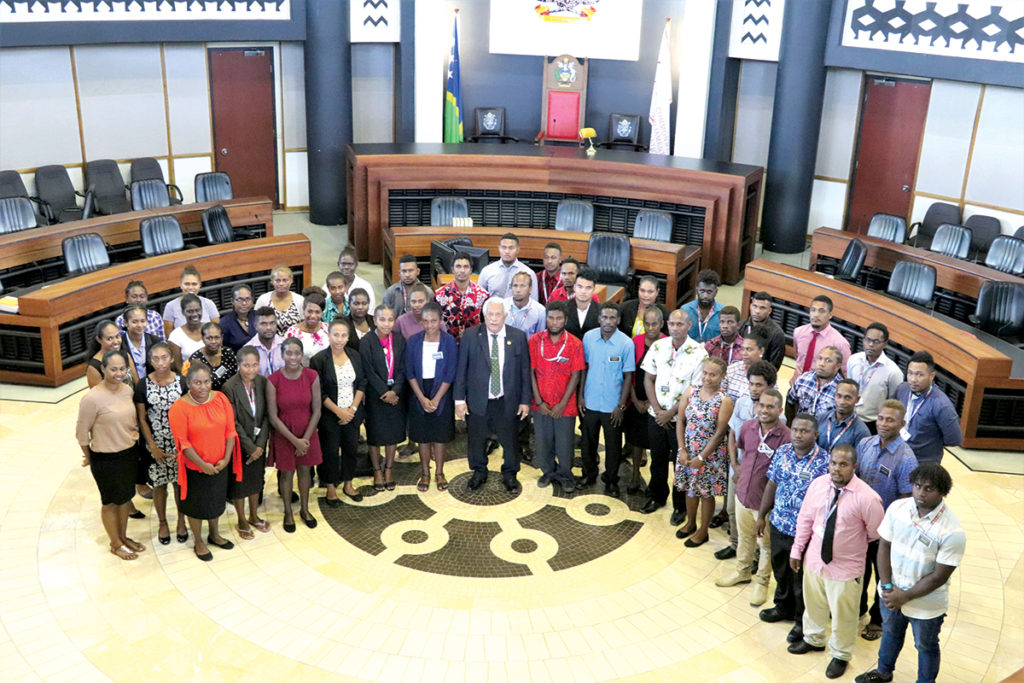
National Youth Parliament participants and speaker of the National Parliament of Solomon Islands Ajilon Jasper Nasiu in the Parliament Chamber on October 15, 2018. Photo by Merinda Valley/UNDP.

AS part of efforts to engage youth in national politics, 50 young women and men are currently gathered in Honiara for the 4th National Youth Parliament.

More than 50 percent of the global population are young people under 30, but according to the Inter-Parliamentary Union, they make up less than two percent of the world’s members of Parliament.

Since its inception in 2009, the National Youth Parliament has involved youth from across the country biennially to learn about the three arms of the state and parliamentary democracy procedures.

Of 130 applicants, 25 women and 25 men were selected to participate in this year’s four-day programme. The youth participants represent all nine provinces of Solomon Islands in terms of places of origin.

In opening the National Youth Parliament today, the Speaker of the National Parliament of Solomon Islands, Ajilon Jasper Nasiu, said the National Parliament embraces youth participation through its education programme.

“By providing a forum in which youths can express their ideas, concerns and expectations, it develops confidence, encourages teamwork and promotes a broader awareness among young people of community issues and processes of government through which those issues can be addressed,” Mr Nasiu said of the National Youth Parliament.

“For some of you, this will define your future and develop your interest to take part in political leadership.”

Nasiu added, “I take this occasion to acknowledge the United Nations Development Programme (UNDP) through the UN Peacebuilding Fund (UNPBF) project with UN Women. The support demonstrates commitment towards youth inclusiveness in the region and Solomon Islands.”

National Youth Parliament participants and speaker of the National Parliament of Solomon Islands Ajilon Jasper Nasiu in the Parliament Chamber on October 15, 2018. Photo by Merinda Valley/UNDP.

In her remarks at the opening, UNDP Solomon Islands Country Manager Azusa Kubota emphasised the importance of youth involvement in the nation’s politics and development.

“Please do not be spectators of what is happening around you in communities and in the world. Get involved. Take it personal. It is your future, so do what you can as a young leader and be the advocate in your community to make a positive change towards the Sustainable Development Goals,” Ms Kubota said.

“With youth making up about 70 percent of the country’s population, collectively, that is a big voice, and it must be heard.”

During the programme, sessions on the separation of powers and parliamentary democracy in the country will prepare participants for a debate in the Parliament Chamber on Thursday.

The 4th National Youth Parliament is facilitated by the National Parliament of Solomon Islands in collaboration with the Ministry of Women, Youth, Children and Family Affairs and made possible with support from the Australian High Commission, the Queen’s Young Leaders Programme through Oxfam and the UNPBF project.

–UNDP, UN WOMEN PRESS

Young Parliamentarians learn about three arms of the state

0

By Gary Hatigeva

THE 50 selected youth participants for this year’s 4th National Youth Parliament (NYP) session were given the opportunity to learn firsthand the existence and importance of the three arms of the state.

The 4th NYP started three days ahead of the debate proper to give time for participants to cover key components of parliament and its function, while at the same time understand the roles of parliamentarians.

Yesterday’s session comes as part of these ongoing trainings and preparations for the major debate session due to take place in the chamber of Parliament this Thursday.

Youths were told that the three arms operate as one or are interconnected but are three separate arms known as the separation of powers, and that these are the pillars that the country is operating under.

They are the Legislature, which represents the members of Parliament, the Executive representing the Government, and the Judiciary, which represents the Courts system of the country.

Participants also learnt that one arm cannot interfere with the function of another in their respective roles and responsibilities but can do check and balances on each other.

As Youth Parliamentarians or representative in Parliament, participants get to understand the roles they are taking on as one arm of the system, which is being a legislature.

They were also given the history of the establishment of the National Parliament of Solomon Islands, with insights to how the term parliament came into existence and used by countries that have parliaments, which was derived from a French term of a place where people get together to debate or discuss issues.

Youth participants also get to further understand the insights of a parliament, its structure and how meetings are coordinated for both parliament debates and committee proceedings, where the Speaker is the head of parliament, gets to preside over meetings of the house.

It was also highlighted during these presentations that MPs are not there to supply copper and materials but to represent the voice of his or her electorates to legislate issues affecting the people and the country.

In the presentation, it is revealed that parliamentarians are to represent all Solomon Islanders through their elected MPs and voice of the people

Youths were also informed that only parliament can make, enact, amend and repeal laws governing the country.

Youths were also told of the three groups that make up parliament, and they include the independent, opposition and the government benches.

They have also learnt that within the government bench has two groups of MPs, which consists of government ministers or ministers of the crown, and government back benchers.

Participants were also informed of the importance of making numbers to rule or form government in parliament, a process they will cover in the final day of this program, before the debate session.

Youths get to understand the roles and responsibility of the opposition group, who according to parliament facilitators, does a check and balance on government’s legislations and give alternative views on laws and issues brought for parliament’s deliberations.

Participants also covered ‘The Experiences and Application of Parliamentary Democracy in the Solomon Islands’ during yesterday’s session and the two major topics according to these youths, have really given better insights to what makes the country a nation under a democratic governance system.

Participants and other youth Organisation reps asked questions and other matters of related to parliament and the independence of the three arms.

The session according to organisers, was very encouraging as most the participants were eager to understand parliament and have more formal understanding of governance, which they (organisers) are anticipate a very good debate session comes Thursday.

The NYP is expected to debate a number of topics during this week’s sessions, but are mainly prepared or geared to dig deep into debating the topic, which looks at ‘Introducing Compulsory Voting in Solomon Islands for the sake of peace-building and social inclusion’.

As for today’s session, youth parliamentarians continue with their preparations, and are expected to cover Parliamentary Committees by get the feel of being part of this procedure.

They will also be covering the electoral process, a sample of how motions are brought before parliament for deliberations, and discuss matters surrounding Youth Affairs, both locally and internationally.

Speaker commends gov’t support to youths

0

By Gary Hatigeva

SPEAKER of the National Parliament of Solomon Islands, Ajilon Jasper Nasiu has given huge commendation to the Solomon Islands Democratic Coalition for Change Government (SIDCCG) in its support towards youths of the country.

The speaker highlighted this when delivering the key speech to mark the official opening of the 4th Youth Parliament yesterday, which currently underway at the National Parliament.

He told a packed gathering of mostly youth participants and guests that the current government is a strong supporter of youth participation in decision making, and it is also reflected in its recently launched National Youth Policy.

“So, with the recent launching national youth policy, I would like to commend the government through the Ministry of Women, Youth, Children and Family Affairs for ensuring that our youths have a place in your policy agenda,” Mr Nasiu stressed.

In acknowledging the Ministry’s representatives present at the official opening, the Speaker pointed out that the group’s attendance gives a clear picture of the government’s high recognition for the youths of this country.

“Your attendance further cements the commitment of the current government, in ensuring that both parliament and other oversight institutions recognise the importance of youth engagements in all sectors of the country.”

On the same note, the Speaker extended his commendation to the United Nations Development Programme (UNDP) through its Peace Building Programme and the UN Women.

“Your support is another fine example of the ongoing commitment towards youth inclusiveness in the region and more specifically, in Solomon Islands,” he added.

Nasiu also acknowledged both the Oxfam and the Australian High Commission office for their support, which he thought will go a long way in shaping the participating youths, whom he is certain, some will become future leaders and better citizens of the country.

“I have no doubt that your support will not go empty handed as the knowledge and skills the participants will learn on parliament and leadership, shall go a long way in preparing them for the future,” the Speaker said.

Before declaring the official opening of the event, the Speaker took time to wish all youth participants the best of luck as they will deliberate and discuss in the remaining days of the programme.

Census office setup soon

0

A separate bureau to coordinate the 2019 National Population and Housing Census operations will be soon be established.

The office will be located within the current National Statistics Office (NSO).

Government Statistician, Douglas Kimi said establishing of the office will happen by next month, November.

He said once the office is establish, there will be a lot of administrative activities, secondment and appointment of staff to be done not only from the NSO but other departments within government to supervise the Census office positions.

Meanwhile, Mr Kimi said since this is a biggest nationwide census survey envisioned to take in records of every citizens no matter what age category and cultural background, it is important that everyone must support and collaborate with the NSO and field officers who will be out in the field for data collection.

He said this is a crucial undertaking to ensure the country have an updated population counts thus collaborative effort and support is indeed appreciative in this regard to guarantee a successful census.

Kimi said unlike other big events in the country like the Election registration which targets only specific age group with other surveys/events, Census is different and the biggest ever occasion as it take record of every individual citizen of a country. The date for the 2019 national census count is yet to be set.

The NSO is also calling on development partners and donors to support the coming 2019 Census in terms of funding and technical assistance.

Also as part of the 2019 census planning and preparatory work, the NSO is currently undertake the Village Resource Survey 2017-2018 and the Household listing exercise.

The VRS has a long history in the NSO.

Initiated in the 1980s, it was then con¬ducted in 1995-1996, then in 2007- 2008 but due to resource constraints the results were only used internally in preparation of the past censuses; the present VRS 2017- 2018 is the fourth one in the series.

The VRS and household listing col¬lects information on services to the village including mapping and also collect information on the location of households by GPS and the number of people per household by gender.

This is the basis for Census enumera¬tion areas (EA) demarcation in 2019.

The survey will play the role of assist¬ing the Solomon Islands Government (SIG) in providing quality data at the village level, which is essential, to see the impact of development, and guide its development efforts and pol¬icy – makers in the future, to improve the livelihood and standard of living for all Solomon Islanders.

The survey now in its final phase and nears completion.

The Solomon Islands Government (SIG) through the Ministry of Finance & Treasury (MoFT) is funding the VRS 2017/18 project.

–SINSO PRESS

Katoro community lauds Ghiro’s leadership

0
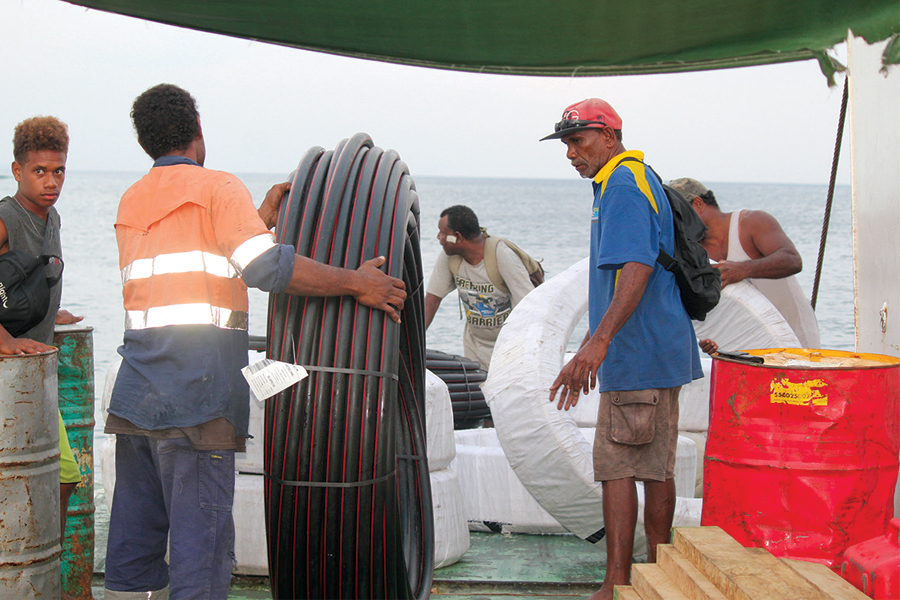
Unloading of rolls of polythane pipes for East Makira Constituency water supply projects.

A new water supply from their constituency office ends Katoro village’s four decades of collecting water from nearby streams and dirty water during rainy seasons.

Since the resettlement of Katoro village on Wainoni in 1978 this community had bathed and collected water for drinking and cooking from a nearby stream that borders their village and the renowned Wainoni Roman Catholic Mission Station.

And the frequent long rainy periods that runs almost all year round on Makira each year meant that most of the communities that are dependent on streams and rivers for their basic water needs would always endure thick muddy water conditions and Katoro village is no exception.

Speaking to the Government Communications Unit officer during the handing over of their new water supply, funded and built by the East Makira Constituency, Chief Pastor Philip Marupa explained that he had almost given up hope of ever finding any assistance to build a water supply system for his people.

“I am a very determined person so I have approached every possible organisations and government authorities in KiraKira and Honiara but on each occasion my hopes kept diminishing,” Marupa explained.

He claimed that for those few bodies who did respond positively to his request about five groups came to his village and inspected their water source, however, these groups’ foreign engineers flatly failed the water source as being technically inadequate to provide a viable and sustainable water supply system.

“I am someone who does not take no for an answer and so I kept on fighting to find any other good Samaritan out there who would help my community overcome its water predicament,” Marupa added.

Thus, it was in one of his visits to a government department in Honiara that Marupa was told to approach his Member of Parliament on his community’s quest for a water supply.

“It was on this occasion that I approached Hon. Alfred Ghiro my Member of Parliament for East Makira Constituency and amazingly as if my meeting was a preordained divine intervention, Ghiro assured me of his assistance straight away because he had already in place plans to focus more on water supply throughout the constituency,” Marupa claimed.

The turn of events was a sigh of great relief for Katoro community because a couple of months after Marupa voiced his people’s dilemma, tonnes of materials funded by the Constituency for the water supply arrived and the East Makira Constituency’s (EMC) RWASH team were promptly on the ground as well to build a water dam and construct the whole water supply system which took only two weeks to complete in June.

Marupa could not hide his profound satisfaction and accomplishment of his efforts which were wholly accommodated by Hon Alfred Ghiro and the EMC RWASH team.

He however lamented that many of the old people who started resettlement of Katoro village and had longed for a proper water supply system have passed on over the years but it was a fortunate moment for one old woman, the only remaining person of the first re-settlers in 1978, who had lived to see the water supply system build from start to finish and has briefly used it before she passed away just two days before the official handing over ceremony on August 29, 2018.

Meanwhile as a result of Ghiro’s deep concern for his people’s plight, seldom does one receive all the praises, compliments and assurances of strong unwavering support from entire communities at one particular occasion, however distant that may be, it actually was an exceptional phenomena for the Member of Parliament for East Makira Constituency, Alfred Ghiro who has deservedly earned all the plaudits from his people of Katoro and the communities of Ward 12 on Wainoni.

As explicitly expressed by chiefs of Taretarena, Aparoro, Naripo (NATS Communities) and Katoro community respectively they have all the confidence, trust and believe in their current leader Ghiro that he is astutely capable of looking after them and he has already led by example many times over with the water supply, solar lighting of their villages, church buildings, literacy centre and many other assistances that have brought meaningful changes to their lives.

George Mackenzie Siapu

GCU

Youths called to be part of the 17 SDGs

0

BY LYNTON AARON FILIA

MINISTRY of Women, Youth, Children and Family Affairs (MWYCFA) is calling for young people’s engagement in the Sustainable Development Goals.

MWYCFA’s Permanent Secretary Dr Cedric Alipendava voiced this during the opening ceremony of the opening of the 4th National Youth Parliament yesterday.

He said Solomon Islands have been embarking on new sets of SDGs officially known as Transforming Our World: the 2030 agenda for sustainable development and 2016—2035 National Development Strategy.

Alipendava said young people also play a significant role in the process of implementing the SDGs and NDS because they are the ones who will benefit.

“It is important to recognise the role of young people as key stakeholders in achieving these development goals—SDGs and NDS.

“Today’s generation of young Solomon Islanders will inherit and must drive the future development.

“They have a vested interest in creating a future Solomon Islands that is to be prosperous and peaceful,” Alipendava said.

UNDP Solomon Islands Country Manager Ms Azusa Kobata said creation of the National Youth Strategy aligns with the National Development Strategy and also resonates well with the SDGs which young people are a part of.

She said with the 17 SDGs, about 193 countries including Solomon Islands have signed up for these goals.

“It shows we all want to address challenges of today’s world in respective where you are and who you are.

“We want to tackle poverty, inequality, climate change, and we all want to have a world that is defined by prosperity, peace and justice,” Kubota said.

Kubota said UNDP is working very closely with the government of Solomon Islands and other partners in the country to make concrete progress of the SDGs.

HCC launches International Rural Women’s Day

0

BY LORETTA BRIGIDIA MANELE

TODAY is a great day for all women in this city. You are an important part of all our lives. You are our mothers, wives, daughters, sisters and friends.

Honiara City Council’s (HCC) Deputy City Mayor, Eddie Ngava said these words before launching “International Rural Women’s Day” three-day programme at the national museum’s auditorium yesterday.

Speaking on the day’s theme “Transforming rural and urban women’s life for better future”, he said women are central to the development of rural areas and national economies.

Ngava said women make up a significant proportion of labour in agriculture, play a key role in food production, especially in subsistence farming and perform most of the unpaid care work in rural areas.

He also stressed on the challenges women and girls in rural areas face.

Ngava said that they often face restricted access to productive resources such as land, agriculture inputs, finance and credit, extension services and technology.

He added that traditional and cultural norms have also made it more challenging for women and girls in rural areas to gain access to public services, markets and institutions, social protection and decent employment opportunities.

However, Ngava encouraged women to unite and work together to help overcome this challenge.

“I encourage you all to participate, celebrate, share, bond, network and strengthen in unity as we all work together, both parents and government to listen to our women’s cry. This is our challenge. Let us unify and overcome this challenge,” he said.

In further remarks, the Deputy City Mayor acknowledged the Ministry of Women, Youth, Children and Family Affairs, (MWYCFA) Honiara City Council and DFAT for funding the project.

He also thanked other supporters, representatives of the Honiara Women’s Network and all Women Service providers for supporting the project.

Ngava noted that he is pleased to see partnership unfold and looks forward to producing more projects with them in the future.

Gender inequality, the root cause of violence against women

0

BY LORETTA BRIGIDIA MANELE

GENDER inequality is the root cause of violence against women.

This statement was made by the Coordinator of Vanuatu’s Women’s Centre (VWC), Merilyn Tahi whose three member team travelled to Solomon Islands to conduct a two-week training session on eliminating violence against women with Family Support Centre (FSC) that ended last week.

She said the second training, “Male Advocacy Training” a first of its kind to take place in the country involved finding out what participants thought about men and women, stressing that this is the root cause of gender inequality.

Tahi added that after gender inequality there is discriminatory attitude and behaviour in men because they have been taught and provided the thinking that they are supreme beings over women.

She said wherever you go in the Pacific you will hear that the main area governments are working on to end violence against women is gender inequality.

Henceforth, Tahi emphasised that gender inequality must be addressed and be ridden of in order to end violence against women and children.

She referred to the participants as male advocates who will be advocating for women’s human rights, ending violence against women and promoting gender equality.

Tahi was accompanied by fellow VWC colleagues, Lyn Rose Tule who is the Centre’s Counselor/Supervisor and Kristine Keasi, the Centre’s Mobile Counselor.

She was speaking at a function on Oct 12 attended by participants from the two trainings, FSC, SAFE NET and the Ministry of Women, Youth, Children and Family Affairs (MWYCFA) representatives.

In her closing remarks, Tahi thanked the Family Support Centre’s (FSC) Manager, Lynffer Wini Maltungtung for having them come over to do the trainings and the Solomon Islands government for funding the training.