Home Blog Page 1152

Government plans to ban rice import

0

DEAR EDITOR, I refer to the above said subject matter at page 2 of your paper issue No 3036 dated Wed 17 Oct 2018.

It says that the Government plans to ban imported rice because “…the government believes eating rice contributes to the spread of infections from Non Communicable disease (NCD).” Para 5 page 2.

Further, it says the plan is to impose higher taxes to ” … discourage families to pay rice.”

Enough of such contradictions.

The plan is to ban, then, came the plan to impose higher taxes.

Who would believe such.

If it intends to ban, just do it.

If it is impossible because every Solomon islanders love that rice and that you don’t want to lose Sol Rais Company (believed to be locally owned or locally registered) and few Wakus who imported rice, don’t proclaim such.

Everybody heard it from doctors that rice is one of the main cause of diabetics and we would welcome the banning of rice.

We don’t believe it is going to be possible. It’s easy to say than do do.

Sincerely yours


Aaron Mane

Honiara


Adaption to climate change dependent on rate environmental changes occur

0

DEAR EDITOR, according to a recent article published in the Island Sun newspaper and from which I quote.

“The Office of the Auditor-General has conducted a Performance Audit on Climate Change Adaptation and Disaster Risk Reduction Strategies. This was in recognition of the impact that Climate Change has and will have on islands in the Solomon Islands.”

Arising from that report the article went on to say –

“The National Climate Change Policy needs to be updated. There needs to be a Food Security Policy developed. There needs to be sufficient budget provision from Parliament to ensure effective policies exist and to ensure that ministries have sufficient resources to implement them effectively and in full. “Solomon Islands cannot stop the rise in sea level but it can become one of the best prepared countries in the world to deal with its consequences and ensure that its people can not only survive but prosper in the post-climate change world.”

When it comes to adaption it should be understood that only when there is likely to be a slow-onset in prolonged environmental changes that communities will have time to react and possibly adapt, but should climate change bring about rapid environmental events, such as frequent cyclones, increased sea levels and inland flooding, people will rarely have any other option but to move to higher ground, if possible, or to migrate.

Already in Kiribati increasingly frequent king tides and storm surges, floods and longer droughts are new, unwelcome additions to the islander’s way of life

Sea level rise has turned freshwater resources salty, rendering the land unable to grow staple crops such as coconut and taro, and eating away the shoreline.

Islanders are being told that they may have to abandon their islands, the places where their ancestors have been buried, where their children have a home and an identity.

Small Pacific nations are increasingly under threat from climate change not of their own making and it is time that those nations, corporations and leaders accept the science and lower carbon emissions, as outlined and agreed upon at the Paris Climate Conference.

If they value the continuing betterment of all nations and an interconnected world, they must take the action that is necessary to preserve the way of life for future generations to enjoy.

Yours Sincerely

Frank Short

Movements can be positive if well planned: Dr Tammy  

0
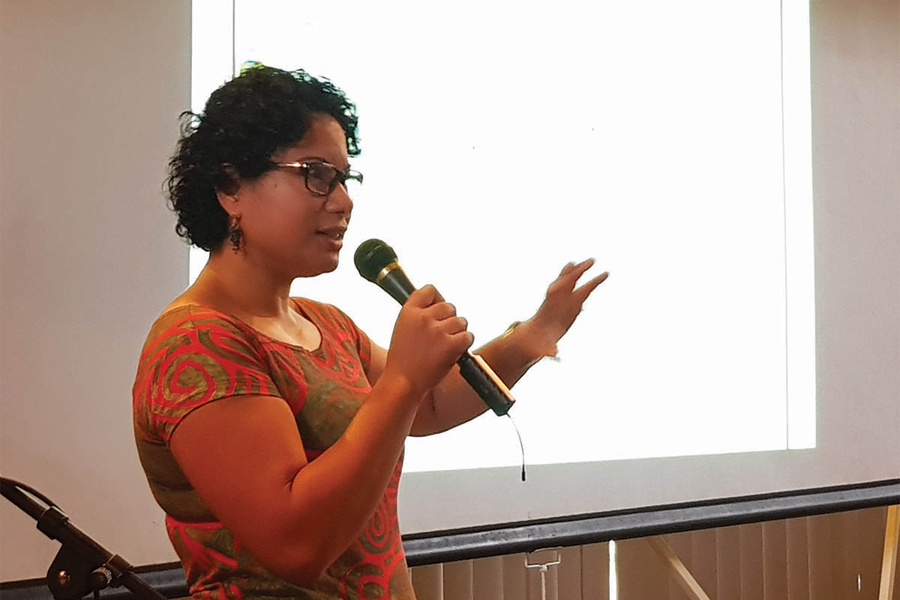
Dr Tammy Tabe doing a presentation for a Solomon Islands resettlement policy.

BY GEORGINA KEKEA

Dr Tammy Tabe doing a presentation for a Solomon Islands resettlement policy.

CLIMATE change will likely increase the rate of migration in the coming decades.

Speaking in the workshop on a proposed draft resettlement policy, Dr Tammy Tabe of the University of the South Pacific (USP) said such movements can be positive if it is well planned and documented.

Ms Tabe says such movement do not always have negative outcomes for those moving and those who are receiving.

She said if well planned and coordinated, migration will increase the capacity of people and communities to adapt to climate change.

“Movements should be voluntary. Involuntary migration or forced relocation should be the last resort,” she said in her presentation.

She said over the years, Solomon Islanders have encountered movement of some sort.

This includes movement because of natural disasters such as earthquake, floods, tsunami and landslide. Man-made relocation includes the ethnic tension.

Tabe said without proper planning and preparation, migration can displace people and communities.

“It can lead to conflict and instability within clans, between communities and within the country,” Tabe said.

She said from experience, government should have a ‘resettlement policy’ to safeguard future citizens of the country.

Working on plans for destruction of cocaine underway

0

BY JENNIFER KUSAPA

POLICE Commissioner Matthew Varley says that working on plans for the forfeiture of the boat and destruction of the Cocaine is currently underway.

He said they are working along with the Director of the Public Prosecution on the forfeiture of the boat and after all issues sorted out destruction will be going ahead.

In regards to the cocaine they are working on it as well and especially on technical issues in relation to the burning site of the cocaine and as soon they can get those sorted police have to do that pretty soon.

This is in relation to the bulk of kilos of cocaine found in a yacht last moth month.

It was a joint investigation involved the RSIPF, the Australian Federal Police (AFP), Australian Criminal Intelligence Commission (ACIC), NSW Police Force (NSWPF) and Australian Border Force (ABF).

The yacht was a double-masted yacht and from intelligence reports a joint operation and investigation was conducted and police found the cocaine concealed in a cavity behind a false wall panel in the interior of the yacht.

It was alleged that the cocaine was loaded onto the yacht in South America and sailed to Honiara.

The alleged organisers in Australia were making arrangements to bring the yacht to Australia just before it was searched by the RSIPF.

SI women join Bougainville women’s forum  

0
May Palataru

BY MAVIS NISIHIMURA PODOKOLO

In Bougainville    

May Palataru

SOLOMON Islands young women together with other Pacific nation women are part of a weeklong Bougainville Women’s Federation Young Women’s Leadership forum.

The forum is hosted purposely to develop young women’s confidence and leadership skills, and provides the opportunity for young women leaders to take on leadership roles in their communities, initiate business and livelihoods projects.

Also a platform where their (young women) voices, needs and concerns can be heard directly by decision-makers in communities and in all levels of government in Bougainville and across the participating Pacific nations.

It’s an opportunity for them (young women) to as well share how they have incorporated the leadership training in economic empowerment, human rights, sexual and reproductive health and financial inclusion in their lives and in their communities.

May Palatatru on behalf of the Solomon Islands delegations said having this wonderful opportunity to be part of the forum has been a milestone for young women leaders in Solomon Islands.

Palataru said it’s a space in which Solomon Islands young women leaders will share experiences with Bougainville and other Pacific nation young women leaders.

She uttered beside it’s a gathering in which Solomon Islands will learn from the participated countries as well.

“Hence I am very proud to represent Solomon Islands Young women leaders in this forum, what my team will get out from this forum will be taken home to share with other young women leaders in Solomon Islands,” said Palataru.

Moreover, Solomon Islands young women leaders have been part of this event through the Women’s Right Action Movement (WRAM) under the Women’s Action for Voice and Empowerment (WAVE) programme.

The forum starts yesterday and has brought together up to 200 young women leaders from Bougainville and across, Papua New Guinea, Solomon Islands, Fiji and Timo Lester.

The theme of the Forum is “Break The Silence, Hear Our Voice”.

It’s a weeklong Forum which was held in Arawa at Marimari House, Central Bougainville and was hosted by the Bougainville Women’s Federation’s Young Women’s Leadership Project.

And is supported by the Australian Government in partnership with the Government of Papua New Guinea as part of the Pacific Women Shaping Pacific Development program, and supported by the International Women’s Development Agency.

Discussions on resettlement commences to help in draft policy

0
Dr Jack Maebuta presenting implications for resettlement policy and practices.

BY LYNTON AARON FILIA

Dr Jack Maebuta presenting implications for resettlement policy and practices.

A GROUP of academics in Solomon Islands have presented case studies that might assist the government to establish a National Resettlement Policy for the country.

Organised by the Ministry of Lands, Housing and Survey, the two-day session convened diverse groups of more than 20 participants that include stakeholders that represent national government, local government, NGOs, and faith-based organisations.

During the discussion, climate change was the most talked about subject with natural disaster identified as the main driver of relocation and land as the main obstacle to facilitate such resettlement.

Dr Jack Maebuta from the Solomon Islands National University (SINU) in his presentation highlighted implication for resettlement policy and practice that are important to consider when looking at formatting the National Resettlement policy.

He said from their research implication for resettlement policy should consider building infrastructures as area to reduce poverty associated with resettlement as well as economic bases and livelihood of the population.

He suggested if the RCDF can be used as starter to finance resettlement since money is the government’s main challenge—from the RCDF it can support for purchasing land or meet other demand needed.

With that he adds education is one important tool as well which the intended policy should look at by building more schools or upgrade schools across the province to avoid migration of people to urban centres.

Moreover, he suggested in any development or relocation plans churches can be regarded as key partners when considering resettlement initiatives.

Besides, the workshop last week gave opportunity for all presenters to shared one thing in common highlighting that it is important to formulate resettlement policy with holistic approaches.

It should look at facilitating the sustainable livelihoods of people, ownership and equal opportunities, they said.

Permanent Secretary for Ministry of Lands, Housing and Survey Mr Stanley Waleanisia said resettlement and relocation is faced by small islands nation which includes Solomon Islands.

He said Solomon Islands are vulnerable to natural hazards including extreme weather events as floods, droughts and tropical cyclones.

It also includes seismic activity such as earthquakes and tsunamis which pose risks to internal displacement of vulnerable communities, Waleanisia said.

He said presentation of the findings by presenters is important for them to understand resettlement and transformation of the rural communities in the country and how the policy will be implicated.

Other presenters include Dr Tammy Tabe, a lecturer from USP, Fiji who did a presentation on case study climate change migration and displacement: learning from the past relocation in the pacific.

Country’s PhD Michael Ha’apio from USP, Pacific Centre for Environment and Sustainable Development (PACE-SD) did his presentation on a case study carried out in Western province

He also did a presentation on a Case study, the Transformation of rural communities: lessons from a local self-initiative for building resilience in the Solomon Islands.

Furthermore, other presenters presenting case studies on Minevi resettlement in Temotu, Auki and western province about the Tsunami victims in Gizo.

Woman likely to enter plea

0

BY JENNIFER KUSAPA

THE woman allegedly involved in a tragic traffic accident which resulted in the death of a 15-year-old girl in Honiara last month will likely enter her plea today at the Honiara Magistrates Court.

This is the case against 26-year-old Veslyn Ririana.

Ms Ririana is facing three charges in relation to traffic offences.

The allegation said Ririana on the night of September 15 was driving a motor vehicle along the Mendana Avenue in a westerly direction when the collision occurred.

Police said the motor vehicle was allegedly approaching the HCC roundabout at high speed when the vehicle went off the road and allegedly collided with the deceased who was walking in an easterly direction on the road near the Solomon Water office.

Police attended to the fatal accident and assisted the victim to the National Referral Hospital. She was later pronounced dead by medical authorities.

The suspect was transported to the Central Police Station and formally arrested for causing death by reckless and dangerous driving under the Traffic Act.

Ms Ririana also was given a Random Breath Test (RBT) and shows that her alcohol blood reading was 0.184 percent well above the legal rate of 0.050 percent.

The accused was also arrested for driving an unlicensed motor vehicle which expired on June 30, 2018 and driving without a driver’s license.

Atoifi Adventist hospital receives urgently needed drugs  

0
Lester Asugeni of PAU receives a carton of drugs for Atoifi hospital from the Commercial Manager of SIPA Glyn Joshua.

By Alfred Sasako

Lester Asugeni of PAU receives a carton of drugs for Atoifi hospital from the Commercial Manager of SIPA Glyn Joshua.

IT is not always the case that hospitals turn to semi commercial organisations for help. But today times are hard – harder for some than others – including government institutions.

And while some remain quiet, others have reached out and are heard. One such institution is Atoifi Adventist Hospital in East Kwaio on Malaita.

This week the Solomon Islands Ports Authority (SIPA) came its aid, providing $26,860 worth of urgently-needed drugs for the hospital.

The first batch of largely tablets, weighing 13.45kg left Honiara on a Solomon Airlines midday flight yesterday freight free. The second batch of injectable is on order from overseas and is expected to arrive in Honiara next weekend.

SIPA’s Chief Executive Officer, Eranda Kotelawala, who approved the support to the Hospital, was unable to handover the donation yesterday. Mr Kotelawala was engaged with a visiting Asian Development Bank (ADB) team.

His Commercial Manager, Glyn Joshua, stepped in to present the carton of drugs to Mr Lester Asugeni, who received it on behalf of Atoifi Adventist Hospital. Mr Asugeni is in charge of the Pacific Adventist University (PAU) which has now set up a base at the Hospital.

Mr Joshua’s father had a long association with the Hospital and the people of East Kwaio. He said SIPA is always willing to assist causes such as the shortage of drugs which Atoifi Adventist faced in recent months.

“It is my hope this support from SIPA will go a long way in saving lives, not only of the people of East Kwaio but also those who come to seek medical help from the hospital.

“We are happy to assist. This is a worthy cause and SIPA is more than pleased to be associated with it,” he said.

Mr Asugeni who once worked at the Atoifi Adventist Hospital before he joined PAU in Papua New Guinea where he graduated with a Master’s degree said SIPA’s assistance is deeply appreciated.

Tourism Ministry starts rolling out new programme

0
Permanent Secretary for Ministry of Culture and Tourism Andrew Nihopara

By Gary Hatigeva

THE Ministry of Culture and Tourism (MCT) has started rolling out its newly introduced Minimum Standards and Classification for Tourism Accommodation programme, which was adopted in the middle of this year.

This was confirmed to Island Sun by Ministry’s Permanent Secretary, Andrew Nihopara in an earlier interview this week.

Last week, Ministry officials were out in four provinces, including parts of Honiara, holding awareness activities on the programme with tourism operators particularly, the accommodation service providers.

Nihopara explained that the awareness comes as part of the first phase of the roll out for the programme, which is done in three rounds of visits.

He said operators will be given insights to the programme, which is pretty much getting people to understand its application and how it will be helpful and beneficial for both the ministry, and particularly the operators.

Meanwhile, the Ministry’s Director of its Tourism Division, Bunyan Sivoro in an interview yesterday confirmed and further explained that the rounds will also include assessment activities.

Sivoro said in the assessment aspect, officials will look to determine whether existing operators fulfil the categories of classifications, and then to be followed by reports that are expected to help operators understand their status or upgrade if need be, to meet the minimum standards.

The Minimum Standards are a set of measurable criteria that outline items and services that must be in place for a tourism accommodation to operate, according to internationally recognised standards.

There are eight categories under the minimum standards and classification programme, and according to the Director, it is from this programme, accommodation providers will then be classified into one of eight categories, which include ‘Hotels, Resorts, Lodges, Backpackers, and four others.

The Tourism Director said currently, some operators are wrongly naming the status of their accommodation services and the programme will ensure that tourists are not misguided by these statuses, with anticipation to have at least the percentage that is actively using these programs, are properly classified.

He added that there are were worries expressed by some operators on the issue of development capacity to meet the standards, fearing they might lose out on business if they are to upgrade or be part of the programme.

But the Director is encouraging all operators to try as it (programme) will come back to benefit their operations with proper ratings or categories, which will also help guide the ministry and responsible authorities in their programmes as far as marketing the right standards are concerned.

“To be known properly in terms of status and be involved in a competitive market, it is important that operators get involved so to know exactly their status, and based on reports, if they wish to upgrade to another category, they can do so, and this will also give them the confidence to be part of whatever potential markets out there.

“Operators’ participation in this programme is also important because, often at times, tourists are have been mislead on the advertised status of accommodation services, who in most cases, only come to realise that operations are actually lower, and with this, businesses can lose reputations,” Mr Sivoro explained.

When questioned, the Tourism Director revealed that so far, based on the first round of visits, three operators have been identified to have undervalued or used lower standards but are qualified to be upgraded straight away.

All in all, the MCT Director of Tourism explained that while people will feel uncomfortable about this programme, the main benefactors would eventually be the tourism operators themselves.

“The tourism department is very excited about this new chapter in the development of our tourisms sector, and note that it is our wish to see it grow to the country’s advantage,” he said.

This programme has also got Tourism Solomons Chief Executive Officer (CEO) Josefa ‘Jo’ Tuamoto excited, describing the move as a major step in the right direction for the country’s tourism industry.

CEO Tuamoto in an earlier statement, said the introduction of the programme was timely in view of the efforts Solomon Islands has gone to in recent times to increase its profile on the international tourism stage.

“This long-awaited but carefully laid out program will act as a catalyst for the local tourism accommodation sector to take a holistic approach to service excellence,” he said.

Officially launched by the Minister for Culture & Tourism, Bartholomew Parapolo at Honiara’s Heritage Park Hotel, the main thrust behind the programme is to implement what is seen as an essential improvement of standards in the tourism accommodation sector.

Currently there are 160 accommodation providers operating in Solomon Islands but only less than a quarter of these can be sold by international wholesalers offering Solomon Islands travel packages.

Despite only agreeing to three rounds of visits, the Tourism Director has assured that because not all may have been covered by then, and the ministry will continue with a few more visits after, which he suggested that by then, many would be ready to take part in what has been described as, a very important programme, as far as taking the tourism sector in the right direction, is concerned.

Gilbertese re-settlement an example why policy is eminent for re-settlers

0
Dr Tammy Tabe who is the third generation of Gilbertese living in Wagina

BY GEORGINA KEKEA

Dr Tammy Tabe who is the third generation of Gilbertese living in Wagina

A resettlement policy is the way to go when dealing with relocation of people. This sentiment was shared by Dr Tammy Tabe, a third generation of the Gilbertese people in Wagina, Choiseul province.

During the recent draft resettlement policy workshop held by Ministry of Lands, Housing and Survey, Ms Tabe was one of the speakers and academics that contributed to the development of a national policy.

Tabe says as a descendant of migrants, she knows and understands the challenges her people are faced with. She said this national policy will safeguard the future generation.

In her presentation, Tabe says resettlement issues are both man made and of natural causes.

She made reference to the people of Gilbert Islands as a case study for the resettlement policy. She said migration can also happen domestically and government need to prepare itself.

She said growing up she had heard stories from her grandparents about their migration and what it meant to them.

She said imagine leaving the place you know all your life to go to somewhere unknown and unheard of. That’s what her family went through when they came to the Solomon Islands.

‘Some went to Gizo and our family came to Wagina,” she said.

She said, based on the experiences her people had gone through, a national policy for resettlement is a must.

Solomon Islanders living in low lying atolls are at risk of sea level rise and losing their home because of climate change, thus a national policy must safeguard them if/when they have to leave their home island to relocate elsewhere.

“Land is always an issue here in Solomon Islands and this National Policy must consider the ownership of land and how government can go about acquiring land for relocation purposes,” Tabe said.

The Gilbertese re-settlement scheme was undertaken by the British Government in the 1950s.

This was made possible, because at that time, the British Solomon Islands Protectorate and the Gilbert islands were administered by Britain’s Western Pacific High Commission.

Due to poor soils and low rainfall that had caused famines, the British Government through the Western Pacific High Commission decided to relocate the people of Gilbert Islands to the Solomon Islands.

“The only problem for us then was we didn’t think much about the ownership of the place in which we were relocated to.

“We heard that our grandparents were shown the place which we now call home as ours and were led to believe that we own the land.

“However, the ownership of the land is in question and we are in doubt of the land ownership because there was nothing in the records to show that we own the land,” Tabe said.

She said Solomon Islands must learn from the Gilbert Islands case and come up with a proper resettlement policy.

Tabe is a Lecturer at the University of the South Pacific (USP), Laucala Campus.

Previously while studying at the USP she had decided to explore the relocation history of her people where she provided a comprehensive account and analysis of this forced relocation.

She had hoped her research will contribute significantly towards policy-making and governing for Pacific Island states that are being affected by climate change and whose people may become subject to future relocation.