Home Blog Page 1095

RSIPF takes significant steps to improve respond to gender based violence incidents

0

THE Royal Solomon Islands Police Force (RSIPF) has made many significant steps to improve the way it responds and manages gender based violence incidents in Solomon Islands.

“Although there is much work to do since the passage of the Family Protection Act in 2014, the RSIPF has made many significant steps to improve the way the Force responds and manages gender based violence incidents during the past 12 months,” says RSIPF Commissioner Matthew Varley.

Commissioner Varley explains: “RSIPF has strengthened its partnerships with key stakeholders through the signing of a Memorandum of Understanding with members of SAFENet in July 2018 and opened a new Family Violence (FV) office at the Central Police Station in Honiara.”

“There has also been an increase in the number of FV reports completed and an increase in the number of Police Safety Notices (PSNs) being completed correctly, served on the respondent and filed in Court. This follows the completion of a two-week FV Coordinators’ Workshop in September this year,” says Commissioner Varley.

He adds: “As a result of increased training for frontline officers by FV Coordinators there have been 168 Police Safety Notices served and filed in Court as from the end of October this year. In addition there has been 87 Protection Orders served and filed in Court.”

“But to be honest, police work is not the answer to the problem of violence against women and girls. It is very important that we must work together to fight and end violence against women and girls and taking a multi-sectoral approach rather than each one working in silos,” says Commissioner Varley.

“I acknowledge the support of other stakeholders including the churches and others for their support in providing humanitarian assistance to the victims of gender based violence.”

–RSIPF MEDIA

RSIPF Commissioner calls on all men to join campaign to end violence against women and girls

0
Commissioner Varley joins campaigners against violences against women and girls.

COMMISSIONER of the Royal Solomon Islands Police Force (RSIPF) Matthew Varley calls on all men in Solomon Islands to join the campaign to end violence against women and girls and make a commitment not to tolerate it in our communities.

Speaking at the end of the float parade to mark the beginning of activities in the 16 Days of campaign against violence against women and girls held from Henderson Police Station in East Honiara to the White River Police Station in West Honiara today, Commissioner Varley says, “The issue of violence against women and girls is an issue that we cannot be silent about. It is happening every day in our communities.

“As you look around in our communities today, domestic violence at homes, offices, streets and elsewhere is a big concern for the police. Based on police daily reports of crime, sometimes up to 90 percent is related to domestic violence matters. This is an alarming rate,” says Commissioner Varley.

He adds: “In the four months up to end of October this year, 12 alleged rape incidents were reported to the Police. Last week in three separate incidents, the RSIPF arrested and charged five more males in relation to rape allegations. The victims of these offences were young women and girls.”

“In the recent past police arrested even family members of young girls all allegations of rape. The lives of our young girls are being destroyed inside their own homes – a place that should be the safest haven for them has become a crime scene. We cannot allow this to continue,” says Commissioner Varley.

He asks: “What is going wrong in our communities?”

“To men in our communities, these women and girls who face sexual abuse are members of your own families or a relative. They look to you for protection and security. Please protect them,” says Commissioner Varley.

He continues: “I want to encourage all good and honourable men across Solomon Islands to come out in great numbers and condemn this violence. Stand up and be counted. Use your leadership and your strong voices to say ‘enough is enough’ and educate your people and followers on the respect and good values of this community.”

Commissioner Varley concludes: “Men must make a positive difference in the lives of women and girls in this country.”

–RSIPF MEDIA

Violence and Corruption

0

DEAR EDITOR, please allow me to put forward my views on this Violence issue and Corruption.

In my view Violence is affecting all mankind.

Man, woman, children and the handicapped/disabled people. Therefore our talk is focusing mainly violence against women and girls only.

But please can we stress clearly that violence is also affecting our men and boys.

If you can see most People, in the Government, in the private sector and everywhere are abusing their office status to degrade other people’s right to justice and even fairness in dealing with life.

This is part of violence and caused by office status abuse. Some people even wanted something in return for the job that is required from them which they are paid to do the job.

I THINK ALL PEOPLE WHO ARE CAUGHT TO GUILTY OF OFFICE STATUS ABUSE SHOULD JAILED AND AND SHOULD NOT BE ALLOWED IN OUR SOCIETIES.

Secondly.

We are talking about corruption. Why is it that the public servants have been crying and suffering in their struggles for their living yet been awarded with or non-benefits improvement.

Our Parliamentarians {Government}, approved their salaries and increased them overnight only. Even their spouses get their benefits. Yet Basic service failed to be improved, Government ministries budget cut out of expectation to fulfil obligation.

Recently shortages of medicines most health clinic closed, and many other essential service affected due to no finance.

I think since this Corruption Bill is now out there, we should reconsider our country’s motto, TO LEAD IS SERVE. NOT to lead to self-service.

Thank you

Jobbie T Ofisiaki

Noro

Western Province.

Health advice for Solomon Islanders: Relief from gout symptoms helped by taking a simple remedy.

0

DEAR EDITOR, a very painful medical condition suffered by many people in the Solomon Islands and the wider Pacific region is known to be caused by having too much uric acid in the blood and is known as gout.

Quoting a recent news bulletin on the subject from Radio New Zealand this is what was said:

“Pacific people who suffer from gout need to see their doctor for a simple remedy, a New Zealand academic says.

“Fourteen percent of Pacific adults in New Zealand have gout compared with eight percent of Maori and four percent of Europeans.

“Only a third of Pacific sufferers are on a managed gout-arthritis programme.

“Otago University professor Tim Merriman said Pacific people had high uric acid counts in their blood which was a genetic advantage in fighting diseases like malaria.

“However, the acid could turn into painful crystals in joints through reaction with certain foods, Dr Merriman said.

“Anti-inflammatory painkillers used for gout can harm kidney function, he said, but another medicine is available.

“Really the way to treat gout is to get on the Allopurinol which slows down the production of uric acid in the blood, gets it down to the level of 0.36 and at that level the crystals won’t form in your blood.”

Copyright © 2018, Radio New Zealand

Reducing the amount of alcohol consumed can also help to reduce the risk of getting gout.

Yours sincerely

Frank Short

Exclusion through Inclusion

0

The Paradox of Fiji’s Race Politics


FIJI’s contemporary politics has always been laced with racial overtones, even in the midst of the current Fiji First Party-led government’s attempts to erase race from Fijians’ political consciousness.

The country’s two dominant racial groups, the iTaukei and Indo-Fijians have been central to political discussions in this country since independence.

This, along with other issues, has contributed to the four coups of 1987, 2000 and 2006.

The racialization of Fiji’s politics has its roots in the British colonial administration’s recruitment of Indian labors in the mid-1800s and early 1900s, its policies that created two racial groups that lived parallel with each other but hardly intersecting, and post-independence government policies and institutions that perpetuated racial divisions.

Since his ascend to power, following the 2006 coup, Fiji’s current prime minister, Voreqe Bainimarama, took upon himself to erase race from the country’s political landscape.

In 2009, Bainimara told The Australian that his, “vision for Fiji is one that’s free of racism. That’s the biggest problem we’ve had in the last 20 years and it needs to be taken out.”

He went on to blame indigenous Fijian chiefs and politicians for the racism: “It’s the lies that are being fed to indigenous Fijians that are causing this, especially from our chiefs who are the dominating factor in our lives. And the politicians take advantage of that. We need to change direction in a dramatic way.”

Bainimarama’s idea was to build an inclusive Fijian society – one that includes, values and provides security for all its people: iTaukei, Indo-Fijians, kailoma, Rotumans, kaivalagi, etc.

This seems like a noble ideal and attracted the support of many Fijians who were tired of coups, racialized politics, and the overburdening power of Ratus.

So, when Bainimarama was elected as prime minister, following the 2014 election, he and his trusted political engineer, Aiyaz Sayed-Khaiyum, set out to institutionalize the eraser of race from Fiji’s politics.

This includes the creation of an electoral system that abolishes racial distinctions in parliamentary seats and creates a nation-wide constituency where voters vote for candidates because of their affiliation to political parties.

In an interview with Dateline in September 2014, Sayed-Khaiyum states that, “If you’re going to have political parties that are going to contest elections based on religion, ethnicity denomination, how will they be as a government?”

Furthermore, in its attempt to remove race-based politics, Bainimarama and Sayed-Khaiyum insist that all Fiji citizens be called Fijians. Consequently, the 2013 constitution legalized the common Fijian name.

In an electoral campaign debate on November 5, 2018, Bainimara says that, “a common name will unite all races in Fiji.”

The FijiFirst Party Government has also abolished racial categories in population census and other official data collection. The Fiji Bureau of Statistics no longer gathers and publishes racially-based data.

The move to erase race-based politics became more pronounced in the lead up to the 2018 election.

In August 2018 during an election campaign speech in Dreketi, Macuata Province, Sayed-Khaiyum said that, “people who campaign using race and religion have nothing to offer to people” He went on to say that, “the obsession with ethnicity will kill our country.”

The irony is that the outcome of the mid-November 2018 Fiji elections may have revealed an exacerbation of racial division, rather than its eraser.

Bainimarama’s FijiFirst Party won the election and retains its hold on government, but the margin with the Social Democratic Liberal Party (SODELPA) is much slimmer than it was in 2014.

FijiFirst Party won 50.02% of the votes cast and 27 seats in the 51-seat parliament. The runner up, SODELPA scooped 39.85% of the votes, the National Federation Party (NFP) with 7.38%, with the rest of the political parties dragging behind.

What is interesting is that in the push for racial inclusion, the FijiFirst Party may have actually marginalized iTaukei from government and hence, political power.

It is revealing that of the 27 members in the ruling FijiFirst Party, only 9 (33%) of the ruling seats, including Bainimarama, are iTaukei.

This is despite the fact that indigenous Fijians (iTaukei) make up for 62% of the entire parliament.

This means that a majority of iTaukei parliamentarians are in the Opposition and therefore marginalized from government decision-makings.

But, why does it matter whether those in Government are iTaukei or not?

In the new Fiji as constructed by the FijiFirst Party, race doesn’t matter. Indeed, the marginalization argument holds only if the FijiFirst Party candidates were elected based on race.

Perhaps the FijiFirst Party would argue that that wasn’t the case. They were elected as Fijians representing all races in Fiji.

That is a valid argument. But it will not alleviate perceptions that iTaukei have become marginal to parliamentary power and government decision-makings.

Such perception could have dire consequences. It was such perceptions of iTaukei disempowerment or marginalization that contributed to the 1987 and 2000 coups.

It could be argued that in its attempt to be racially inclusive, the FijiFirst Party has inadvertently excluded iTaukei from the locus of power.

Another dimension to this discussion is the creation of a single national identity – every Fiji citizen is a Fijian.

While the emphasis is on a legal, rather than cultural identity, the creation of a single identity could also be a process of erasing other identities.

By invoking a single Fijian identity, the FijiFirst Party could overtime erase iTaukei, Indian, kailoma, kaivalagi, and all other identities – the multiple identities that make Fiji such a rich multi-cultural country.

However, it should also be noted that the creation of a single national identity often overwrites, rather than erase cultural identities. These multiple identities often emerge, rapturing the state-making agenda.

It is also worth noting that national identity construction could also be about identity appropriation.

So, because all Fiji citizens are Fijians, it is therefore possible to claim that all Fiji citizens are therefore iTaukei and have entitlements in the same way as other iTaukei.

On April 17, 2018, during a parliamentary debate on the petition by landowners from Nawailevu in Bua, the member of parliament and Minister for Employment, Productivity and Industrial Relations, Jone Usumate, states that, “this Government is focused on the needs of everyone in this country. The rights and the land of the indigenous iTaukei is something that we regard as very precious to all of us. We are all iTaukei here, a lot of us are iTaukei on this side and we regard that as precious.”

His invocation that “we are all iTaukei here” could be interpreted as an acceptance of the appropriation of the iTaukei identity – because we are all iTaukei, nobody is vulagi.

As the FijiFirst Party assumes its second term as government, hopefully that its push for racial inclusiveness does not end up excluding some groups from the governance of this beautiful country.

Such is the paradox of Fiji’s race politics.


Dr. Tarcisius Kabutaulaka*

Honolulu, Hawai’i

Ruling on no case to answer submission pending

0

BY JENNIFER KUSAPA

THE ruling on the no case to answer submission against the former Constituency Development Officer for Gao-Bugotu Constituency and his co-accused is still pending.

Yesterday both accused and lawyers were waiting for the presiding Magistrate to deliver the ruling but the presiding Magistrate never turn up in court.

The accused and lawyers were waited in confusion and then left the court without any instruction as to when the next date of ruling will be made.

However the accused were only advised to check the court registry of any date the court will set for the ruling.

This is the case that has gone through a trial in which the prosecution called their witnesses and gave evidence in court after prosecution closed their case the defence submitted a no case to answer.

The two accused on this case were charged in relation to the allegation that prosecution alleged them for stealing sheet of roofing iron from the Gao-Bugotu Constituency.

Jimmy Dikamana and Lonsdale Tana were charged in relation to incidents that occurred in 2015.

Prosecution alleged that the two stole roofing iron from the constituency and to sell to other people.

The Office of the Director Public Prosecution appears for the crown.

Labour ward lacks bed for women to give birth

0
Lack of beds at NRH’s labour ward.

BY LORETTA BRIGIDIA MANELE

Lack of beds at NRH’s labour ward.

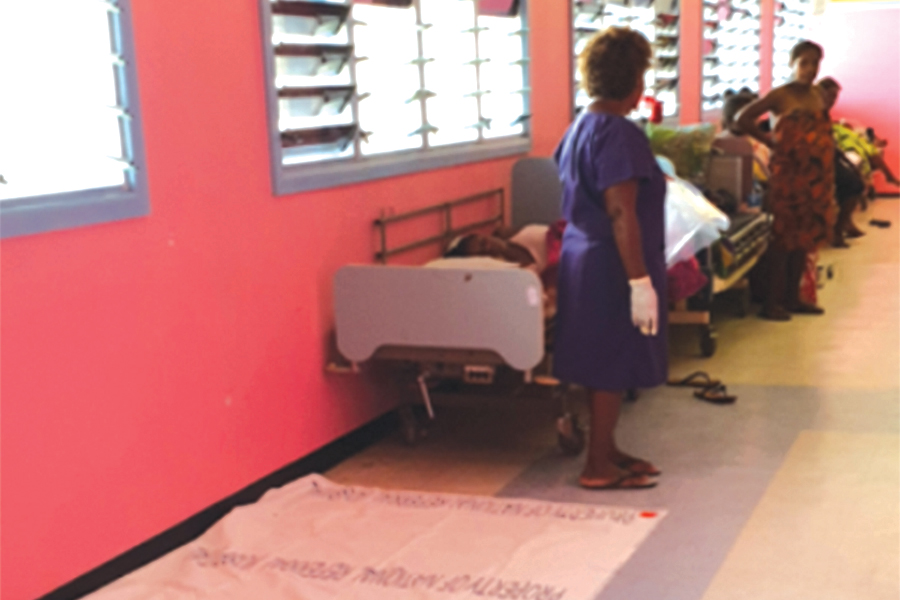
INADEQUATE beds for pregnant women at National Referral Hospital’s (NRH) labour ward is a current medical situation the Obstetrics and Gynecology (O&G) department is facing.

This was expressed by Dr Loo Zixi, an obstetrics and gynecology doctor, specializing in urogynecology and high Intensity Focus ultrasound of uterine fibroid ablation (HIFU) from the department of obstetrics and gynecology at Kaohsiung Medical University Hospital, (KMUH) in Taiwan.

During the month of November she served NRH’s O&G department, held trainings and assisted in gynecology surgery.

Zixi emphasized that one of the difficulties pregnant women experience in the department was not having enough beds.

She said on a daily basis they often have 12 to 17 deliveries, however with only 10 beds available.

Zixi added that at times two women would have to share one bed while some of them had to sleep on the floor.

She went on to say other challenges experienced in the O&G department are; inadequate medical facilities in the labour ward, exhausted antiseptic solution and improper sterile facilities that might increase puerperium and surgical site infection rates.

Zixi hopes that there will be some changes in the future to improve the status of the department.

A number of recommendations made by Dr Loo Zixi to help bring the department to a level to better serve women include; raising awareness on the importance of regular prenatal care, reducing syphilis infection in pregnant women, creating a “Mother classroom” for the pregnant mother for prenatal health education and breastfeeding, health education about the importance of perineal irrigation and care to reduce puerperium infection, annual pelvic ultrasound and pap smear to screen out gynecology malignancy and medical skill sharing with gynecologic cancer surgery and vaginal mesh surgery demonstration for pelvic organ prolapse and urine incontinence.

Malaita supports West in reserve seats for women

Premier Peter Ramohia addresses participants at the Malaita Land Summit in Auki on 13 November 2018. Photo by Tomoko Kashiwazaki/UNDP

BY SAMIE WAIKORI

AUKI

MALAITA provincial government will draw its conclusion on reserve seats for women soon.

Premier of Malaita province, Hon Peter Channel Ramohia said the Executive meeting currently underway, is discussing the reserve seat for women.

Ramohia said Malaita province is in support of what Western Province Government is pursuing as part of their review of the Provincial Government Act.

He said the WPG has made a submission to the national government to consider temporary seats for women in their provincial government.

Adding that in their submission, they were also looking at including the initiative in the current review of the Provincial Government Act.

Ramohia said WPG is seeking support from other provincial governments on the matter and Malaita province is supporting Western Province in this initiative.

The Premier said the notion was purposely to include women in top provincial political decision making body.

Clarifying the initiative, Ramohia said though it is temporary measure, women have to contest the election if they want to go there, but there will be special consideration for women under the initiative.

He assured that more on this issue will be forth coming as discussions are still ongoing.

Premier Ramohia said from the provincial government’s perspective, they are committed to support gender issues in the province.

Ramohia made the statement during the official celebration of the 16 days activism of ending violence against women and girls in Auki.

Court to hear updated status of Bellona murder incident

0

BY JENNIFER KUSAPA

THE case against Kravis Tamaika who was alleged to injure four other victims and alleged to have killed a child on August 17 this year will appear again today at the Honiara Magistrate Court.

The case has been adjourned on the last occasion to allow counsels, update the court on the status of the case.

Tamaika is currently remanded in custody as he is facing a very serious charge of murder.

This is the case where in August this year, a male person, suspected to be mentally ill was reported to attack a young girl at Nukumanu village in West Bellona.

Three other male persons and a female have been allegedly attacked by the same person and reported to be in serious condition.

The suspect has since been arrested and brought over to Honiara. He was charged with murder and other offences.

DBSI Bill gets Parliament’s approval

0

By Gary Hatigeva

DESPITE faced with suspensions and an adjournment over its deliberation and proceedings, the Development Bank of Solomon Islands Bill (Act) 2018 has finally received Parliament’s approval for its enactment.

The Bill (Act) when first introduced, received strong support from members of both the government and the opposition including the independent benches, but getting it through was delayed after being covered up to half of its content, due to a special adjournment of parliament.

Yesterday, following its resumption, Parliament set priority for the completion of its proceedings in the Committee of the Whole House where it was thoroughly scrutinised and passed after it was put up for its third reading.

Many, including Members of Parliament and local establishments in the private sector, particularly those in the rural settings, have since its introduction, anticipated its passage, with great hopes for it to help them access the much needed finances to bolster their opportunities to contribute directly to the national economic development of the country.

These hopes came as no surprise to the government and the Ministry responsible for the DBSI Act, who continuously advocated and promoted the Bank’s intentions and purpose of establishment.

The Development Bank through its Act, according to officials, is highly referenced as people oriented and a solution to the growing need of those in the informal sector, so as the Small and Medium Enterprises who are also finding themselves stuck outside the commercial banking circle.

With its re-establishment, the DBSI is expected to facilitate the economic and social development of Solomon Islands within the overall development plans and strategies of the government, with emphasis on the participation of Solomon Islanders in economic and rural developments.

This according to the Minister responsible, when presenting it after its second reading, stressed that the Development Bank is also expected to facilitate any other form of establishments that also intend to contribute to the development sector of this country, which includes those involved in the forestry sector.

The Solomon Islands Democratic Coalition for Change Government (SIDCCG) was highly praised for ensuring that the bill saw the light of parliament, and for maintaining its strive to bring back a once popular institute, that was seen to have served its purpose, only that it was mismanaged and vulnerable.

It is also the current government’s intention, as evident in the bill, which is to revitalise the institute to serve the people of this country especially, those in the rural settings, and so as those who intend to become direct contributors to the fading economy of Solomon Islands.

After its passing yesterday, the DBSI Bill (Act) 2018 now repealed the existing Development Bank of Solomon Islands Act (Cap. 50), while also amending certain sections within the Financial Institution Act 1998.

The Act was passed with seven (7) amendments in its proceedings within the Committee of the Whole House, which were moved by the Minister of Finance, six of them were amendments on notice, while one without notice.