ONE of the primary responsibilities of a police officer is to do formal investigations into criminal and civil cases and write formal statements or reports.
This responsibility, of course, requires a good knowledge and understanding of the English Language.
These are the sentiments expressed by Inspector Clive Talo, the officer in charge of Recruit, Training and Probationary Constable Programme at the Royal Solomon Islands Police Force (RSIPF).
“As the officer in charge of the recruit and training programme, I noticed that most of the new recruits did well in other training programmes except the English language, especially essay writing and dictation.
“This prompted me to consult my Advisor for approval to include English Grammar Course into the Police Academy training,” Inspector Talo said.
“When my superiors asked me to recommend an institution, I recommended Islands Bible Ministries (IBM) English Grammar Courses without any hesitation because I was a graduate at IBM and have seen the high level of grammar training offered there,” Talo added.
According to Dr Alpheaus Zobule, Director of Islands Bible Ministries, the request from Inspector Talo and RSIPF to engage IBM to teach English Grammar at the RSIPF Police Academy was gracefully considered.
“One of our core visions is to teach professional Solomon Islanders proper English Grammar,” said Dr. Zobule.
“To teach the newly recruited Police Officers is truly an honour,” he affirmed. There are seventy students and the students have been divided into two classes. The classes are organized on Tuesdays and Thursdays from 3pm to 5pm.
According to Miriam Zeke, another IBM teaching staff, the students have successfully completed their first course and are now doing their second course.
Dr. Zobule stated that he was really impressed with the officers’ eagerness and commitment to learn English Grammar.
He added that the students worked so hard to ensure that they attend classes, actively participate in class discussions and complete their given assignments.
“I can confidently say that these police officers are well trained, well organized and well-disciplined in their training,” Dr Zobule said.
According to Francis Wickham, a male student officer, the English Grammar Course is very helpful. “This Grammar Course has helped us to understand English well. More so, it helps to prepare us for our police duties especially in writing reports, statements and other official work documents,” said Officer Wickham.
“Furthermore, I noticed that most of my colleagues have started speaking English at the barracks, something that you would hardly hear from typical Solomon Islanders,” added Wickham. “This is obviously the impact of this English Grammar Course,” he concluded.
For Albrina Suala Manier, a female student, this training is an eye opener. “This training helps me to improve my English Grammar and writing skills. Although some of the concepts are challenging, I see the benefits for my career as a police officer and keep striving to learn them,” said officer Manier. Both Wickham and Manier expressed joy in learning English Grammar and they credit their lecturers Dr. Alpheaus G. Zobule, Mrs Miriam Zeke and Mr Solomon Wara for the professional work in transferring the knowledge to all the newly recruited police officers.
Prime Minister Manasseh Sogavare in his nation-wide address this week said the country maintained its ‘COVID-free status’.
“Since my last update, there are no additional cases detected. Our official figure remains at 20 cases,” he said.
Prime Minister Sogavare said the 20th COVID-19 case has now returned two consecutive negative tests and had been transferred to a step-down facility pending his next test.
The Prime Minister said if he returns a third negative test next week, a decision will then be made on his release from quarantine.
“Our 19th COVID-19 case had been released from quarantine last week following the 3-consecutive negative tests,” he said.
However, the Prime Minister said the 19th case will be followed up by the health team over the next 90 days.
“Our protocol requires us to follow-up all former positive cases in the 90-day period following their release from quarantine,” he said.
The Prime Minister also thanked both the 19th and 20th case for their cooperation and patience.
CSSI Commissioner Gabriel Manelusi (CSSI) and IBM Executive Director Dr Alpheaus G. Zobule showing the signed MOU
CORRECTIONAL Service of Solomon Islands and Islands Bible Ministries have signed a Memorandum of Understanding (MOU).
The milestone event occurred a week ago at the CSSI Conference Room at Rove when CSSI Commissioner Gabriel Manelusi (CSSI) and IBM Executive Director Dr Alpheaus G. Zobule put ink to paper.
The two-year partnership will see officers of the Correctional Service of Solomon Islands (CSSI) undergo training in English Grammar.
Islands Bible Ministries (IBM), through its training arm Islands Christian College, will deliver the programme to the officers of the Correctional Service.
The first class of 30 officers will begin their training on May 3rd, and other classes may be organized during the period of the partnership.
Commissioner Manelusi highlighted his organization policy to continue to upskill Service officers so that they could perform at a higher level of professionalism.
He expressed much appreciation for the opportunity that his officers have to improve their English communication skills.
In response, the Executive Director Dr Alpheaus G. Zobule acknowledged the great importance of the work of CSSI in the country and considered it a great honor to be in partnership with CSSI in building a better Solomon Islands.
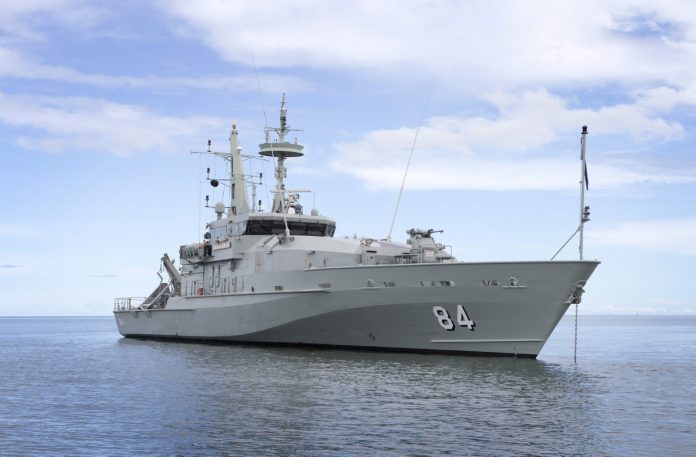
HMAS Larrakia anchored in Leyte Gulf, Philippines.
ROYAL Australian Navy vessel HMAS Larrakia will arrive in Solomon Islands this week to support the Royal Solomon Islands Police Force’s (RSIPF) COVID-19 response.
Larrakia will conduct maritime surveillance activities in the western border region at the request of the Solomon Islands Government.
Commanding Officer of HMAS Larrakia, Lieutenant Commander Dan Lindquist, said the deployment is another example of Australia and Solomon Islands’ strong and enduring security partnership.
“This deployment follows HMAS Maitland’s visit in March which focussed on maritime security in the western provinces,” Lindquist said.
“This includes working to detect, deter and report potential illegal fishing activity with regional partners,” he added.
“HMAS Larrakia will continue the efforts to strengthen our relationship with the Solomon Island Government by providing surveillance support to ensure stability and prosperity in the region.”
The visit will be contactless to ensure the health and safety of the Solomon Islands’ community.
No Australian Defence Force personnel will disembark.
Australian High Commissioner, Dr Lachlan Strahan, said Defence has worked closely with Solomon Islands throughout the pandemic to boost the RSIPF’s COVID-19 response and preparedness at the western border.
“In February, Australia delivered two new special purpose aluminium fast boats, providing a more flexible maritime response capability in remote areas,” Dr Strahan said.
“We are pleased to continue supporting the efforts of the Solomon Islands Government to keep the community safe and free from COVID-19.”
Larrakia’s visit comes as Solomon Islands receives its second Guardian-class Patrol Boat, RSIPV Taro, at a handover ceremony in Australia yesterday.
RSIPV Taro will offer greater range, speed, crew size and operational capability than its Pacific Patrol Boat predecessor, RSIPV Auki.
Through the Pacific Maritime Security Program, Australia is delivering 21 Guardian-class Patrol Boats to 12 Pacific Island nations and Timor-Leste to support regional security and maintain a secure, free and open Pacific.
POLICE have arrested a man in his 20s for alleged assault causing grievous harm to his uncle at Vavanga village, Kolombangara Island in the Western Province on Monday.
It was alleged that the nephew seriously wounded his uncle with a pocketknife, where he stabbed the victim once at his backside and pulled out the knife and stabbed the victim again on his right hand while the victim was busy cutting his wooden canoe at a coconut plantation in their home village.
Provincial Police Commander (PPC) Western Province Chief Superintendent Mathias Lenialu said the suspect was formally arrested by officers at Gizo Police Station and placed in police custody after the matter was reported to police.
“The suspect has been charged with one count of Act of Intend to cause grievous harm contrary to section 224 (1) (a) of the Penal Code and is currently on remand at the Gizo Correctional Centre to appear in the Gizo Magistrates’ Court on a late date,” PPC Lenialu said
“I appeal to members of the communities in and around Vavanga village who may have any information about the incident to come forward and assist the police investigators,” Chief Superintendent Lenialu added.
He stressed that the RSIPF condemns the alleged incident in the strongest term and appeal to members of communities in Western Province to cooperate and work together with the police and report such incidents in a timely manner as the law will not tolerate such inhumane treatment of our old people.
Participants and Facilitators group picture taken at Panarui, Choiseul Province. Picture taken by Ravin Dhari, CEPF Coordinator
MORE than 80 men and women of the Southern Mount Maetabe catchment area (Babatana rainforest catchment area) in Choiseul Province have successfully attended the Protected Areas management and enforcement training last week.
The participants involved included members of the Protected Areas (PA) Management Committees, Rangers and nominated Inspectors of the Sirebe Forest Conservation Area, Siporae Tribal Forest Conservation Area, Padezaka Tribe, Vuri Clan Forest Conservation Area and Garasa Tribal Conservation Area.
Both Sirebe and Siporae Tribal Forest Conservation Areas are legally declared protected areas under the Protected Areas Act 2010 (since 2019), protecting a total of 1400 hectares of their forest.
The other three tribes are still working towards declaring portions of their forested land under the PA Law.
The two days training was held at the Malangono Station Conference hall on Tuesday 27th and 28th April 2021.
The training was organized by the Natural Resources Development Foundation (NRDF) and the Integrated Forest Management Project (IFMP) as part of the ongoing Protected Areas establishment efforts in the southern Mt Maetabe catchment area (Babatana rainforest conservation catchment area).
The main objectives of the training workshop were to support the participants to understand the enforcement laws and regulations under the PA Act including other related environmental laws, roles/responsibilities outlined in their Management Plans; ensure participants be equipped with skills and knowledge to monitor, report and enforce protected areas breaches or offences to enforcement authorities.
Lastly participants should be provided a learning platform for exchange of ideas, views and lessons on managing protected areas, an opportunity to get feedback on rangers and Management Committees for these protected areas on challenges and successes of these sites.
The facilitators at the workshop were staff from the Environment and Conservation Division (ECD), Office of Director of the Public Prosecution (ODPP), Solomon Islands Environmental law Association (SIELA), Solomon Islands Rangers Association (SIRA) and Choiseul Provincial representatives (Forestry and Police).
Other important stakeholders who also attended were representative from the Choiseul Provincial Government (CPG), Critical Ecosystem Partnership Fund (CEPF), Live and Learn (L&L) and Ecological Solutions Foundation (ESF).
Speaking at the closure of the training, the participants were enthusiastic about the training since it is the first of its kind ever organised for them.
They looking forward for more similar trainings ahead.
The Organisers wish to convey their sincere gratitude to the Aid Donors (Critical Ecosystem Partnership Fund, Bread for the World and Food and Agriculture Organisation) partners, stakeholders for assistance and lastly the resource owners for recognising the importance of forest conservation.
The Integrated Land Management (ILM) committee members during their inaugural meeting on 29th April. Other member reps were not able to make it to the first meeting due to other official commitment.
THE Ministry of Agriculture and Livestock through the Integrated Forest Management Project (IFMP) of which the Food and Agriculture Organisation (FAO) of the United Nations is the implementing agency has successfully established its Integrated Land Management Committee (ILMC).
The committee’s core responsibility is to provide general oversight of project execution related to sustainable land management and improved decision making in production landscapes.
The project goal is to strengthen and complement ongoing efforts by the Government of the Solomon Islands and its partners in order to promote new approaches to sustainable forest management that is socially viable, economically feasible, and environmentally sound.
Technical Advisor, FAO Raushan Kumar said the project has the aim of implementing integrated management of protected and productive forest landscapes for sustainable community development and multiple environmental benefits.
“One of the objectives of this project is mainly concerned with Integrated Land Management, and thus the committee was established as part of fulfilment of this objective and where the role would be to provide support as well as carry out monitoring of activities within this focal area,” Mr. Raushan said.
The committee held its inaugural meeting on 29th April at the SIBC conference room in Honiara and was chaired by MAL Permanent Secretary Supervising, Michael Ho’ota, Technical Advisor, FAO Raushan Kumar, and Assistant FAO Country Representative Jimi Saelea, who spoke about the projects and programmes implemented by FAO of the United Nations.
Douglas Yee, National Programme Coordinator of the IFMP facilitated the meeting. The meeting was attended by wide range of stakeholders involved in sustainable land use and its management.
Assistant FAO country representative, Jimi Saelea said Integrated Land Management is the second component of the Integrated Forest Management Project currently implemented in Solomon Islands and is funded by Global Environment Facility (GEF) and implemented by FAO under the country’s program framework (CPF-2018-2022).
“This component practically deals with agriculture and forestry. The establishment of this committee is a requirement under the IFM project. The committee will eventually function within the Ministry of Agriculture and Livestock (MAL) as a technical working group under the Agriculture Oversight Committee of the Agriculture Sector Growth and Investment Plan (ASGIP) 2021-2030 which I understand will be launched later this year,” Mr Saelea explained.
He added that unsustainable use of land for agriculture and to some extent forestry has been blamed for land degradation and soil infertility and he said these are issues that needs serious attention now to avoid future disasters.
“To address these issues both government and non-government actors must collaborate.”
While acknowledging MAL Permanent Secretary, Ethel Frances and Permanent Secretary Supervising/Deputy Secretary Technical (DST) Michael Ho’ota for the formation of the committee (ILMC) Mr Saelea said the establishment of the committee is critical to ensure stakeholders are kept informed and the projects implementation are guided and kept on track.
Meanwhile, Permanent Secretary Supervising of MAL, Michael Ho’ota said Agriculture is an important sector for the Solomon Islands’ national economy as it sustains 85 per cent of the rural population with food crops, cash crops, and livestock for their daily livelihoods, food, and social security.
“Agriculture holdings account for 40 per cent of the landmass of the country. About 35 per cent of GDP is generated by subsistence agriculture, and nationwide, 92 percent of the population is engaged in agriculture in some way.
“We are currently experiencing regularly occurring variabilities in climate change impacts and effects such as heavy rainfalls, hot and dry spells, extremely high and low temperatures, coastal sea level rise, coastal salinity and infiltration, these effects threaten food security and agriculture, infrastructure, and other resources that provide for the wellbeing of men, women, and children of Solomon Islands.
“The manner in which we use Land must now be seriously addressed in light of the increasing environment and land resources exploitation.
“The fast increasing population demands more food and incomes that in turn put more pressure on the land and other resources.
“In the rush to satisfy these needs most people are unaware that they are contributing to negative results like soil degradation, low soil fertility, low crops productivity, and the current increasing health issues such as malnutrition and lack of economic wellbeing resulting in poverty,” Mr. Ho’ota emphasized.
He further stressed that these activities result in more problems like uncontrolled subsistence practices, water catchment deforestation and reduction, nutrients leaching and depletion, use of agro-chemicals detrimental to the environment, clear felling of forest lands, open mining activities, just to mention some of the leading adverse activities that come about with no consideration to proper land use planning.
“With all the issues said and the demand from both the national government and our rural populace I am pleased to note that under the Component 2: Integrated Land Management: reviews and revision of outdated and ineffective policy, regulatory and legal frameworks governing land use in the country will be done.
“Further more thorough assessment of impacts of current land-use practices on biodiversity, land degradation and ecosystem services will also be conducted and this will feed into the review and revision; providing the policy makers with reliable information to base their policies and strategies on and most importantly the establishment of a multi-sectoral coordination mechanism to ensure the sectoral frameworks are streamlined and complementary rather than contradictory,” Mr. Ho’ota highlighted.
He thanked the newly appointed committee (ILMC) members for accepting their appointments and he reiterated that the Integrated Land Management Committee (ILMC) will be the main advisory body for the implementation of integrated land management component 2 of the IFM Project.
ILMC members are representations of the Ministry of Agriculture and Livestock, Ministry of Forestry and Research, Ministry of Environment, Climate Change, Disaster Management and Meteorological Services, Ministry of Lands, Housing and Survey and the Solomon Islands National University (SINU) through the Faculty of Agriculture, Forestry and Fisheries, Kastom Garden Association (KGA) and Live & Learn agency.
HONIARA City Council Youth Worker Mary Tuhaika has been championing the Honiara urban youths on a mission to empower young people on active participation, leadership, and empowerment programs.
Working in the youth space for 15 years, Mary has been instrumental to many young people’s lives within Honiara city.
She led young people to engage in positive activities such as the Youth Volunteer Scheme, Duke of Edinburgh Awards, Youth Events, Youth Group Grants, Specific Youth Projects, and general engagement in Programs implemented by the Honiara City Council.
At the same time, the establishment of the Social, Emotional, and Wellbeing Project “TOK SPOT” launched recently, is described as a milestone achievement that will impact young people now and in the future.
The TOK SPOT initiative is funded by the New Zealand Government and implemented by Honiara City Council in partnership with ChilFund New Zealand, it will be accommodating the youth populace within Honiara City. It is a first-ever youth counselling space and programs specifically for young people.
“I am thrilled such initiative was launched. It will revolutionize young people within Honiara City particularly to tackle youth issues related to their social relations, managing emotions and feelings and their general wellbeing,” MrsTuhaika said.
The project looks to achieve an estimate of 17,000 youth living in Honiara to access the social and emotional services to build better, safer futures and action positive change to young people.
An additional 1500 children and youth will also indirectly benefit from improved knowledge and skills of frontline workers in the acute and complex area of child protection services.
Preparing and upskilling young people towards this youth counselling space, 16 young people graduated with Certificate IV in Youth Work with the Australia Pacific Training Coalition last year, 3 graduated with Diploma in Counselling from the University of the South Pacific, and 1 graduated with a Level 4 NZ Certificate in Health and Wellbeing (mental health & addiction) in Ara Institute of Canterbury, New Zealand.
Mary confirmed these professional youth workers and counsellors are fully equipped with knowledge and skills in their respective fields. She believes they are perfectly ready to deliver to young people who will be accessing the services.
In the Solomon Islands, young people make up 70 percent of the population. Many young people left school at the secondary level, end up engaging in anti – social issues.
With this gap, it inspires Mary to work with this population to engage as much young people in youth empowerment activities.
Growing up as a youth, Mary said she always wants to work with young people, listen to their stories, and be part of their growth journey.
“I grew up to learn that youth’s voices are always not heard, their contributions are not seen and limited services to deal with their social issues. Observing these gaps it has always inspired me to connect and work with young people,” Mary said.
In 2018, the TOK SPOT concept was born after a wider consultation conducted by ChildFund NZ and Honiara City Council’s Youth, Sports, and Women’s Division. A research carried out by other NGOs, identified that adolescent mental health is one area unrecognized and underfunded.
With the gaps, Mary said HCC and ChildFund NZ agreed to form a partnership to support and develop opportunities for youth to promote and address social and emotional wellbeing issues.
Through discussions and consultations with more Honiara Youth Groups, HCC and ChildFund NZ received many feedbacks that young people wanted the project to develop a counselling service specifically for the young.
Today, Mary is proud the youth counselling space has finally been launched. It is a result of hard work, passion, and commitment to work with young people in Honiara.
Mary’s biggest future goal is giving back to her own family.
She said, “On a personal level, years I spent working with young people in Honiara, I saw their personal growth and proud of their professional achievements.
It is time I give back to my children, groom them into knowing their potentials and be good citizens of Honiara.”
“My dream for young people in Honiara now, is having HCC take a direction to establish satellite youth hubs for every ward within Honiara City, so to have HCC provide youth services ward by ward.
We are grateful that, one of HCC’s long-term goal has now been fulfilled by New Zealand Government’s support to construct a ‘Youth Space’ for the youth population in the city, even more grateful for their support through ChildFund NZ will continue for 4 more years.
“My ask to partners and donors wishing to work with young people in Honiara, the only option more sustainable is through working with Honiara City Council and its existing youth networks.
“HCC will always be here, when the next Government and administation comes, the mandate will still remain, only people will change over time, but the system, process, and approaches will be there.
“They will make changes and amendments to what is fitting to the present generation’s context,” she said.
ANOTHER group of Solomon Islanders left yesterday to work in Australia.
They are the latest to travel under the Australian Seasonal Worker Programme (SWP).
Again, public reaction to this latest travel was mixed.
While the majority are happy to see friends ands loved ones go, a few expressed scepticism and negativity.
They described the SWP as another “blackbirding”.
They felt instead of sending our people to go and work overseas, the Government should create more jobs at home to keep our people here.
Others assert our people should be creative and engage in other economic activities than seeking work overseas.
These critics may have a point.
But here’s the thing.
No matter how hard the Government tries to create more jobs at this time, not everyone will get a job.
It is just not possible at this time.
This is why we must not turn away possible job opportunities that are offered on our plates.
Working on a farm in Australia at this time is better than roaming the street of Honiara daily doing nothing.
One gets to earn an income and support his or her family back home.
The fact is the current SWP scheme has filled up an urgent void in our local labour market.
Those involved are earning an income that they would not have earned had it not been for such a scheme.
Besides experiencing a new way of life, they are also learning valuable skills and new attitude to work in a developed country like Australia.
Those who have previously participated in the scheme have a lot to say about it in terms of the lessons learned and the experiences gained.
Of course our participation in the scheme does not take away the Government’s obligation to facilitate and or create new job opportunities for our people.
The role will remain as long as we have a government and an economy.
This however, should not stop our people from participating in the work schemes Australia or New Zealand.
Those who say we shouldn’t be taking part in the work program need to think again!
IN support of my previous article on the question whether SIPA is monopoly I would like to draw reader’s attentions to the long drawn trail of errors and, lack of due diligence perpetrated since the time of Colin Yaw as CEO.
Without experience in International Port Management, Colin Yaw was selected for other reasons and was placed as the administration head of SIPA.
I took time to revisit the Commission of Inquiry (COI) report into SIPA’s Reform Program chaired by Anthony Hughes in 2017.
This is what the COI report says; I quote, “TOR 2(c): The appointment of Colin Yow as Chief Executive Officer, including the manner in which he was engaged and whether sufficient due diligence was undertaken before the appointment was made.
“Following the termination of William Barile as CEO in 2013, the SIPA Board advertised the position on 19 March 2014.
“Eight applications were received, but the Board decided the position should be re-advertised as most of the candidates shortlisted were not suitable.
“The re-advertisement stated that candidates must have experience in port operations and management. Four candidates including Colin Yow were shortlisted for interviews.
“Subsequently Colin Yow was interviewed in Singapore on 3 October 2014 by the Chairman Nollen Leni, Vice Chairman Moses Virivolomo and Directors Pascal Ohoau and Ken Grossmith.
“The assessment sheets used for the interviews scored Colin Yow as the preferred candidate. His CV states that he was a Trainee Manager with Singapore Ports Authority from 1972 to 1974, and subsequently had considerable experience in advising financially troubled businesses.
“There is no record of any reference or history checks or other ‘due diligence’ inquiries being carried out, and his appointment appears to have been made on the basis of the interview in Singapore including the CV provided and on his financial strength.
“Nor does there appear to be any record of the proposed terms and conditions to be offered to a successful candidate, and the terms of the contract appear to have been decided by Colin Yow himself.
“The financial aspects of the contract appear not to have been discussed formally or informally by the SIPA Board, and amount to a remuneration package considerably in excess of those applying to comparable positions in Solomon Islands and the region.”,…. end of quote.
From the outset CEO Colin Yaw set about enacting Port Reforms, albeit without appropriate sanction from the Board which was supposed have been a mandatory requirement.
To his good credit he collected long standing business debts from creditors; an achievement which I and my predecessors failed to address during our time.
But unlike what the COI made it out to be when they claimed SIPA was operating under the radar during our time, we had indeed been plagued with political interference.
CEO Colin Yaw moved on to review the Port Tariffs. Here is what the COI Report says; I quote, “TOR 2(g): The rationale and process by which SIPA has set fees, and whether fees must be set by way of a regulated consultative process under the Ports Act [Cap 161].
The Ports Act [Cap 161] gives SIPA the power to levy dues and rates; Section 72 of the Act gives SIPA the power to make rules for levy of dues and rates. Section 73 states such rules shall not have effect until approved by the Minister of Finance.
In 2014 SIPA changed its method of calculating revenue related to size of vessels, to be in line with the method adopted by other ports in the Pacific Region, from reference to Length Overall, to reference to Gross Registered Tonnage; this change was not implemented until 2015. Other tariffs were reviewed and increased in June 2015 and again in September 2015. The reason given for the increase in September 2015 was to bring them in line with ports within the Pacific Region, but a comparison of these charges with other Ports by ADB in June 2016 indicates the increased tariffs are now the highest in the region. Compared to the June 2015 tariff, SI port charges have increased between 55% and 540% per item.
Although SIPA is not presently required by law to consult with port users when carrying out a review of tariffs the ADB report recommends port users and interested parties be consulted. This clearly makes sense, and we also recommend it in the conclusions to this COI report”…. end of quote.
While the COI did its assessment and calculations on the items that are subject to tariff charges, at about the same time I did a comparative exercise with other regional ports in response to CEO Colin Yaw’s claim to have taken comparison with other Pacific Ports and found that SI tariffs were the lowest. I carried out the comparative exercise through networking with counterparts from Fiji, PNG, Australia and New Zealand.
I released the following article in March of 2016. Facts revealed in the figures therein had been verified with local Shipping Agents and Bulk Fuel Importers.
SIPA’s Heightened Tariff is an Act of Terror against Solomon Islands compiled by William Barile, former CEO of SIPA:
This may sound overly dramatized but it is far better to risk being proven wrong; than to be silent and watch the country plunge itself into self-destruction.
Consciousness must be raised to alert the nation to the possible dark side of SIPA’s heightened tariffs.
At least by highlighting the likely other side of SIPA’s reforms and be offered truthful, rational and factual information, scepticism will be put to rest.
The analysis of the recent increased tariff figures is meeting with apprehensions, even fear. They fall horrendously far beyond the limit of elasticity of the economy of this country.
In the article headed ‘the Downside of SIPA’s Reforms’ (published in the Sol Star edition No. 6080 Monday 18th January 2016), I referred to the difficulty consumers of imported goods will be facing with the newly introduced SIPA’s Tariffs.
I also stated that the prices of our exports will be more expensive and may lose their markets overseas.
In SIPA’s web site, the CEO claims that he had made comparisons with other pacific ports and found that SI is the lowest tariff base.
Yes this may indeed be so but this is relative to the in country economic environment, a mere sub set of the larger Australasia wide business environment.
The good man made the grand entry his time last year hitting the ground running.
He may have neglected as trivia the necessity to be grounded thoroughly on the trends, the status quo, and the programmed policy for future advancement that are in place for the country as laid down by her leaders.
He came, he saw and he intends to conquer. In his haste he would not careless to follow the laws of the land and he has gotten away with a lot that others would have been penalised for.
He had raised the tariffs in the short twelve months; on the 30th March 2015, on the 20th July 2015 and again on the 1st October 2015. Goodness knows when the next one will be. This is nothing less than atrocious.
It is an act of terror against the economy of Solomon Islands.
All this, he is doing with an equally outrageously high salary package (higher than the salary Australians pay their Prime Minister).
Along with this he enjoys tax free salary, he lives in a serviced apartment at Heritage Park Hotel, he moves around with Security Guards in tow, he has a chauffeur driven vehicle; he takes overseas trips almost on a monthly bases, etc.
It will not be too far off to assume that a major chunk of the takings of one month’s revenue of SIPA are burnt up paying for these employment entitlements.
It would appear that by approving these new tariffs after the CEO’s urging, cabinet had legally ushered this country out of economic viability; deceived and innocently ignorant of the implications.
I questioned the competence of the proposers of these increases and the advice. Were the ripple effects properly analysed for affordability of businesses and the masses given serious consideration?
There are questions, questions and more questions. The simple truth could be that Solomon Islands is definitely headed for economic turmoil.
A comparative table of Solomon Islands Tariff with Fiji, Melbourne, Auckland and PNG appears below.
In the table FIJI is Fiji, MEL is Melbourne in Australia, AKL Auckland in New Zealand and PNG is Papua New Guinea with her 22 International ports.
Information in the table is but a partial representation of the proportion of the costs.
A detailed collection of all the other associated costs will place the figures some magnitude higher.
Rates in SBD for unloading and loading FEU (Forty Foot Equivalent Unit)
IMPORT
SIPA
FIJI
MEL
AKL
PNG
Discharge
3588
1053
1193
1482
3221
Wharfage
960
39
1147
Total
4548
1092
2340
1482
3221
Compare, OTHER:SI (%)
unit
24%
52%
32%
71%
Compare, SI:OTHER (%)
Unit
SI is 416% more than FIJI
SI is 194% more than MEL
SI is 307% more than AKL
SI is 141% more than PNG
EXPORT
SIPA
FIJI
MEL
AKL
PNG
Load
702
1193
1061
1992
Wharfage
1529
117
569
Total
3323
819
1762
1061
1992
Compare, SI:OTHER (%)
unit
25%
53%
32%
60%
Compare, OTHER:SI (%)
Unit
SI is 400% more than FIJI
SI is 188% more than MEL
SI is 313% more than AKL
SI is 167% more than PNG
These countries of comparisons have, by far, greater and broader-based economic environment. Solomon Islands is small, weak and fragile.
Citizens of Solomon Islands must not be fooled. There are no secret formulas to explain these madness.
The new tariffs are simply outrageous. All that these tariffs will do is to polarise earnings to a monopoly SOE called SIPA, which in reality will lead to self-destruction and make come true the ‘law of diminishing return’.
Our country must urgently move to rectify the nonsense. Our export commodities are already suffering decline.
Copra and cocoa have dwindled their export tonnages in recent years. Palm Oil had suffered expensive demurrages of up to a quarter million dollars recently.
This gnawed at their turn over and will potentially frustrate augmentative development prospects.
Bulk fuel had already suffered 25% loss of the price advantage Oil Companies enjoyed in the brief period of eighteen months previously.
It was the cumulative effects of these that had manifested themselves in the construction boom we have been enjoying in recent times.
Fuel was the raw material energising these endeavours.
We have been taken down the path of uncertainty but also possible doom. This is not the proverbial ‘darkest before the dawn’. It is simply all murky and grey.
THE END.
Note that in this foregoing compilation I had warned about the high costs of our commodities export due to the heightened tariff will kill them. Today copra and cocoa exports have dwindled to insignificance.
To cap these concerns about tariff charges and their collection thereof, I would like to present to readers another analogy well worth taking note off. The competence of the incumbent CEO of SIPA is in doubt.
The current outbursts are results of obvious misjudgements he is continuing to make. He figure points Leroy Wharf Port for being allowed to land cargo.
He does not concede that appropriate authorities have sanctioned and given consent to its operations.
Then there is the case of serious breach of ISPS code, an unforgiveable violation of IMO security safeguard for international ports.
In my next media release I will reveal another unforgiveable mistake the CEO has committed.
Whistle blowers have blown their whistles and I have a grave duty of care to echo their concerns. It is a matter of serious national security but the Board of SIPA is not taking steps to address it.
But for now I would like to present the analogy referred to above. It pertains to the recruitment of Mr Colin Yaw. I strongly feel the same mistake has been repeated.
I present here another finding of the COI on Port Reforms of 2017, chaired by Anthony Hughes.
I quote; “TOR 2(l): The amount paid by SIPA for overseas travel for Colin Yow during his tenure as Chief Executive Officer and whether such travel was approved by the SIPA Board.
We were unable to locate supporting documents or evidence as to the purpose of Colin Yow’s overseas travel. Under the terms of his contract he was entitled to four business class tickets per year. However it appears from record that he travelled more frequently overseas (refer to appendices x).
We have reviewed the report by KPMG Fiji dated 18 August 2016 which indicates total cost of overseas travel on behalf of SIPA for the period of his employment of $3,858,557 of which $3,177,427 is not adequately supported by documentation. We have not found any evidence of Board approval for this travel or expenditures.”…. end of quote.
Information coming from current and former workers of SIPA unanimously claim that the current CEO has done a lot more overseas travel than the sacked Colin Yaw.
I therefore harbor the opinion that the prevailing situation of SIPA under this CEO is an exact mirror image of that during the reign of Colin Yaw.
Would this then, warrant another Commission of Inquiry?
I wish to close by reiteration two lines from the previous article on the subject of high tariffs.
“The two alternative balancing act in this scenario are to rationalise and right-size the tariff or introduce competition.
“The latter has happened and will continue to happen. SIPA’s Point Cruz Port is bottlenecked and choked by Honiara city growth.”