Home Blog Page 706

CBSI: November riots push back economic growth

0
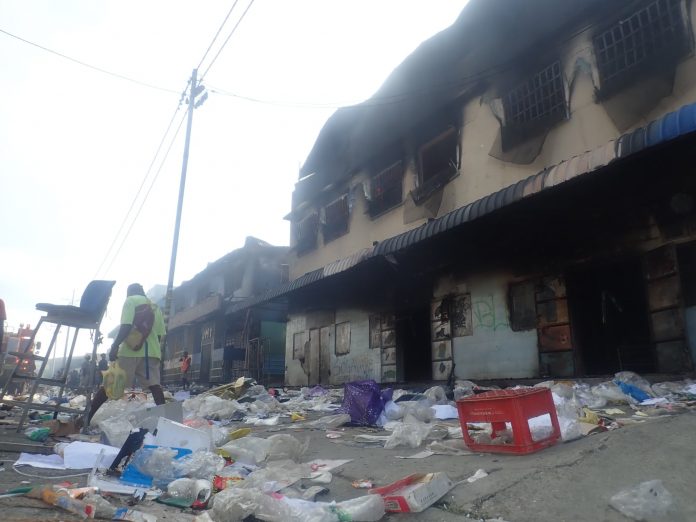
Part of the burnt-out China town from the recent riots. Photo supplied.

By EDDIE OSIFELO

THE November riots in 2021 has pushed the economy into recession with a negative 0.6% growth at the end of 2021.

This after the economy was on its way for recovery in 2021, although at a slower pace, following the depressed condition in 2020.

Central Bank of Solomon Islands (CBSI) Governor, Dr Luke Forau stated this when presented the 2021 Annual Report of the Central Bank of Solomon Islands in this medium last week.

The theme for my statement is “Navigating the way to recovery and strengthening resilience to mitigate future shocks”.

Dr Luke said the decline stemmed from declines across all sectors of the economy, with the exception of fish and copra.

He said the current account position worsened further, driven by the increase in imports relative to the slowdown in exports.

“The fall in primary income surplus during the year also contributed,” he said.

However, Dr Luke said despite the worsening external position, gross foreign reserves for the country grew, reaching 14.2 months of import cover.

He said this is well above the minimum target of six months.

“The increase in foreign reserves came mainly from donor funds and SIG revenue from fishing license,” he added.

Furthermore, in terms of government operations, Dr Luke said the fiscal deficit position stood at 5% of GDP in 2021, owing to the adverse impacts of the COVID-19 pandemic and the November riot.

He said the government debt stock increased to 15% of GDP by the end of the year, owing to COVID related borrowings.

Further to that, he said labour market conditions remained subdued in 2021 in line with sluggish activities.

Furthermore, Dr Luke said partial employment indicators from Solomon Islands National Provident Fund’s (SINPF) showed a decline by 3% to 55,573 contributors in 2021 from 57,028 contributors in 2020.

He said public service positions declined by 38% both for filled and unfilled positions due to the on-going freeze in recruitment.

Moreover, the consumer prices rallied to positive trajectory in 2021, following muted prices in 2020.

Headline inflation reached 2.5% in December due to the surge in food and fuel prices in the second half of last year.

Core inflation increased to 1.2% from -1.5% in 2020.

Dr Luke said the the pick-up in core inflation indicated broad increases in the prices of broad items in the Consumer Price Index (CPI) basket during the year.

He said recent headline inflation for April 2022 eased to minus 0.8% from minus 0.6% in March.

“Falling consumer prices in the domestic component of inflation contributed to this deflation.

“Domestic inflation fell to minus 4.2% from minus 3.2%, owing to price falls in betel-nut and tobacco,” he said.

Further to that, Dr Luke said imported inflation, however, rose to 8% from 6% in March attributable to high global fuel price as a result of the Russian-Ukraine war and its passthrough effects on transport, food and non-alcoholic beverages, housing, water and utilities categories.

“Core inflation increased to 3.3% from 2.8% reflecting broad price increases in April 2022,” he said.

CBSI boss offers way forward

CBSI Governor, Dr Luke Forau.

By EDDIE OSIFELO

CENTRAL Bank of Solomon Islands has offered three actions to start the economy recovery of the country.

This is after the Solomon Islands open economy faced risks of further macroeconomic slowdowns, coming from both the external and domestic fronts.

From external, the Russian-Ukraine war brings a new setback, on top of the pandemic, adding further threats to inflation and recovery for the country.

Domestically, the COVID-19 new variant, declining fiscal space amid elevated debt levels, and spill over effects from the war among other things are adding to headwinds for the economy’s recovery.

CBSI Governor, Dr Luke Forau when presenting the 2021 Annual Report of CBSI for this medium last week, said nonetheless, these challenges bring opportunities for a relook at our macroeconomic policies, objectives, choices, technology and doing things differently.

“We need to get the economic fundamentals right, with the right policy mix to move this country forward and improve our living standard.

“I would like to emphasize that these emerging challenges and opportunities will be the new normal that we will live with,” he said.

Therefore, Dr Luke said strengthening our capacities to navigate these uncertainties will be an important determinant for a resilient recovery from the pandemic.

The three key actions we can prioritize now to start economic recovery include:

  1. Expedite and maintain support for the affected businesses till the recovery takes hold. The return to economic activity and growth hinges on their ability to weather the pandemic and return to work safely and revive from the aftermath of the riot. Business activities have been severely disrupted since the pandemic started, with added challenges now on the horizon, in particular, war outside and the second wave, the future is more uncertain now than ever. It is encouraging to note that businesses and employees remained resilient last year despite these challenges and have successfully adapted to the new normal and returning to work quicker during the year. This brings me to my second point;
  2. In the short to medium term, strengthening resilience and capacity across all sectors of the economy, to sustain the country’s ability to absorb future shocks. Implement strategies that enhance revenue mobilization that will broaden the revenue base, build capital and macroeconomic buffers and expand and promote export diversification to foster a resilient economy. As an example, improving tax administrators’ capacity, reducing tax evasion, improve tax compliance and increase efficient tax administration is a crucial objective to prioritize and execute.
  3. Finally, as I had highlighted in my recent statement during my appearance before the Public Accounts Committee in March this year, we should start working on a growth policy that will drive growth in the country. Prioritizing key commodities with export opportunities in non-logging sectors or new diversification opportunities for instance, can facilitate growth transformations for a resilient recovery.

2050 Strategy will be a beacon of hope for pacific

0
Secretary General of Pacific Islands Forum Secretariat Henry Puna delivers his remark in front of journalists in Suva

BY BEN BILUA
Suva, Fiji

THE Secretary General of Pacific Islands Forum Secretariat says the 2050 Strategy will be a beacon of hope for Pacific Island Countries.

Speaking to Journalists yesterday (Sunday) Henry Puna says the Pacific Islands 2050 Strategy has been tailored towards addressing challenges and opportunities for Pacific Islands States in the next 50 years.

He says Pacific leaders who are currently in Suva Fiji for the Pacific Islands Forum Leaders meeting will be discussing the Strategy and put the strategy forward for adoption at the end of the meeting.

“If there is one thing we Pacific leaders are good at, it is talanoa – the ability to talk, to share great ideas and passion, visions and dreams are often born from the time we spend in the art of talanoa.

“But without a purpose, a plan and a strategy to test and carry ideas forward we would be wasting the same gifts which brought our seafaring ancestors to this sea of islands.

“Just as the stars have mapped the journeys that brought first canoes to our Blue Continent, the 2050 Strategy would be our North Star, guiding our journey to 2050 and beyond.

“Whether we speak of voices, of people, challenges and opportunities you should know that every story you are working on up to this point and onwards will resonate with this document,” Puna says.

Chinese Police train local mining employees on martial arts

China Police Liaison Team instructor, Yin Wei demonstrate a Gong Fu technique with a Win Win employee yesterday.

EMPLOYEES of Winwin Mining Investment Ltd and Solomon Islands Resources Company Limited (SIRCL) have learnt their martial art for self-defence at work places.

China Police Liaison Team instructors Yin Wei and Chen Cheng have trained the employees at their camp at Alligator Creek, East Honiara yesterday.

The purpose of the training:

  1. leads to the building of good health as well as the consciousness and the strength of self defense for existence; and
  2. it helps to improve the way of looking at the world and behaving in a more restrained, tolerant and forgiving attitude.

Overall, the activity broadens their view for international culture exchanges and helps them understand that the real power lies in the strength built up by themselves on a regular accumulated effort.

Win Win and Solomon Islands Resources Company Limited employees doing their drill with the stick.

The same is true with the economic development for a business company and a country.

They were shocked by the strength and deep-rooted culture of how to behave in their human society demonstrated by the Chinese martial art (Chinese Gong Fu) after watching the China Police Liaison Team project put into action smoothly.

As such they invited the Chinese Police Liaison team to train their workers in body and nurture their mind through the martial art in relation to how to behave in the society.

China Police Liaison Team instructor, Chen Cheng demonstrate a combata technique with Win Win employee.

So, a few weeks ago, they formally invited the China Police, Chinese Embassy, Solomon Islands Chinese Association and Solomon Islands Chinese Business Council to pay a visit to the working sites and camps of some Chinese companies in Solomon Islands.

“Our idea for the above-mentioned training activity was greeted by the police team’s great effort in the coaching activity.

“The interactive activities have been strongly supported by China Embassy, Solomon Islands Chinese Association (SICA) and Solomon Islands Chinese Business Council (SICBC),” they said.

Win Win and SIRCL acknowledged China Embassy, SICA and SICBC and Chinese Police Liaison team who has also trained some of local boys of Solomon Islands with Chinese Gong Fu.

“All this, for sure, sets up a good example and plays an important part in developing and strengthening the relationship between the Chinese people and the Solomon Islands people.

“They are worthy of our respect,” they said.

Logging poses danger to common needs of people

0
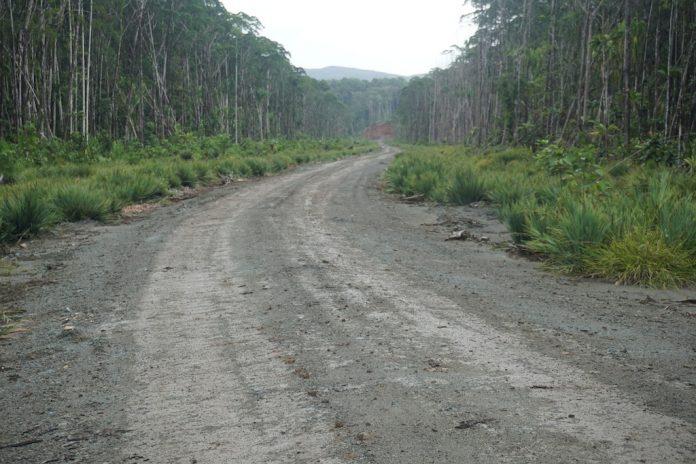
The-logging-road-that-runs-through-the-island-of-San-Jorge.

BY MAVIS N PODOKOLO

THE logging development in Solomon Islands is real and poses danger to the common needs of community people, according to Hilary Wemani.

Mr Wemani is Japan’s International Corporation Agency (JICA) Sustainable Forest Resources Management (SFRM) promoter in Honiara.

He echoed this during a visit to the SFRM pilot site in Komuniboli, Guadalcanal.

“The threat to Forest Environment by logging development in Solomon Islands is real and poses danger to the common needs of community people throughout this nation as forest environment is where we get our basic need from like clean water, food, timber for shelter,” he said.

Wemani said from 2006 to 2011 the average annual log report volume was about 1.45millon m3 ,and this is estimated to be 20 percent of revenue from exported products to the country’s economy.

“Even this is so, the sustainability is being threatened by the decrease in natural forest resources and damage to forest environment creating more challenges to community members in the rural area,” he said.

He said through bilateral collaboration and discussions, the Solomon Islands government requested assistance from the Japanese government to formulate a model for SFRM an alternative forest development approach. And so the agreement was signed between the two parties JICA and Ministry of Forestry and Research in 2017.

“By displaying the reality in the field on the map, the pilot site community could conveniently identify current situation on the current land use map and create their future dreams on future land use map.

“This community could now share the idea of alternative ways to forest development than logging development,”Wemani said.

Dr Nishikawa Tatsuji, Chief Advisor., JICA SFRM in Solomon Islands said the forest provides innumerous ecosystem services, such as timber and no-timber forest products, cultural services and water regulations to local communities.

“Again, profits from forests have not been limited to those from timber, but there is also economical income from non-timber forest products and emissions trading and forest ecosystems would be also derived many profits.

Moreover, the country currently relies on the forest sector as the key contributor to government receipts, export and growth actually. And, this economic aspect has significant impact on sustainable forest resources management in Solomon Islands,” Tatsuji said.

Fiji and Solomon Islands to sign maritime boundary agreement today

0
PM and Madam Sogavare arriving at Nausori airport.

BY BEN BILUA
Suva, Fiji

LEADERS from Solomon Islands and Fiji will sign the maritime boundary agreement later today.

Prime Minister Manasseh Sogavare’ team which includes the Special Secretary to the Prime Minister, Attorney General and other officials are currently in Suva for the Pacific Islands Forum Leaders Meeting.

According to reports, the Agreement will address Maritime Boundary issues between Solomon Islands and Fiji.

The Agreement contains provisions for the resolution of the overlap of EEZ with the EEZ of Solomon Islands in the north-west of the Fiji basin.

The overlapping EEZ boundary between Fiji and Solomon Islands will be settled through the equidistance principle (equal distance from both countries EEZ) through a median line which is calculated from the base points of the respective countries.

Fiji and Solomon Islands will be seen as a parties to the agreement set out in the preamble recognising where maritime boundaries of the two countries compromised.

The good news is, there is no dispute concerning this demarcation.

According to UNCLOS, all coastal states are entitled to a 12 nautical mile territorial sea (Article 3 of UNCLOS), 24 nautical mile contiguous zone (Article 33 of UNCLOS), and a 200 nautical mile EEZ (Article 57 of UNCLOS) including the extended continental shelf claims not exceeding 350 nautical miles (Article 76 of UNCLOS) from the baseline from which the territorial sea is measured.

As a party to UNCLOS, Fiji has an obligation to define its maritime boundaries, most especially its EEZ which, while it is measured to 200 nautical miles, often overlaps with the EEZ boundaries of other coastal neighbouring States which surround Fiji.

In accordance with Article 74 of UNCLOS, if there is an overlap of the EEZ boundaries between coastal neighbouring States, these States need to negotiate and finalise an agreement for the delimitation of those EEZ boundaries.

Fiji shares its EEZ boundaries with the following neighbouring countries – Vanuatu, Tonga, Tuvalu, Solomon Islands, Wallis and Futuna and New Caledonia.

Mayor: Covid-19, Riots worst challenges in the last year

By EDDIE OSIFELO

HONIARA City Council has experienced many challenges including Covid-19 and the November riots last year.

As a result of Covid-19, some families have lost loved ones and business people lost their properties and victims of looting.

However, City Mayor, Eddie Siapu said the Council has overcome these challenges and continue to move forward with their goals.

Speaking at the Mayor Independence Dinner at National Auditorium last Friday, Mayor Siapu said this would not have been possible without the genuine and honest support from the National Government, our external partners and friends.

“Iam proud to say we are moving forward and making progress in developing our City Honiara,” he said.

Mayor Siapu said Honiara has developed and grown substantially over the years.

“We are forced to tackle the problems of a rapidly increasing population, urbanisation, unemployment and increasing demand for council services.

“With the rapid changes, Honiara City Council over the years has been proactive in working towards resolving issues and improving services,” he added.

Furthermore, Mayor Siapu made special mention to the Guadalcanal farmers that supply food to Central market and other small markets in the outskirts of the city every day.

In the meantime, Mayor Siapu acknowledged the development partners that support HCC.

They are:

  1. New Zealand Government for funding the upgrade of the Multipurpose Hall facility and Youth Hub;
  2. Japanese Government for donation of 2 waste management tipper trucks to be officially handed over on 27th July 2022; and
  3. Peoples Republic of China for donation of 2 rubbish compactors.

He also thanked his Councillors and hardworking staff of HCC for their dedication and backbone of ensuring services within the city is maintained and carried us in a timely and orderly manner.

Maelanga urges Solomon Islanders to embrace unity

Deputy Prime Minister, Manasseh Maelanga.

By EDDIE OSIFELO

DEPUTY Prime Minister, Manasseh Maelanga urges Solomon Islanders to embrace unity rather than division.

Maelanga stressed this during the Mayor Independence Dinner at the National Auditorium last Friday.

The dinner was organised by Honiara City Council to celebrate the country’s 44th Independence Day after the country gained her independence in 7th July 1978.

This year’s theme is “Iumi Tugeda for a Stronger and Peaceful Solomon Islands”.

The theme calls for all Solomon Islands citizens to unite as fellow country men and women of the “happy Isles” to build the country into a stronger and peaceful place for everyone.

However, Honiara was the centre of the November riots last year and the outbreak of the Covid 19 that affected some families.

Maelanga said he liked the message preached by Reverend Edward Kolohai during the Thanksgiving service on the need to grow peace and unity by following the teaching of Jesus to love and forgive and not take revenge if someone wrongs you.

“We all come together with different backgrounds, diversity and cultures but we have to have one common understanding that is unity.

“We are one Solomon Islanders. We need to have this in our heart,” he said.

“When I was the Minister of Homes Affairs, I always travelled with national team to Mini Games, Pacific Games and Olympic Games.

“Sometimes when the national anthem cries, I am in tears because I think we are one,” he said.

However, Maelanga said some educated leaders don’t understand this and brain washed our people.

“Sometimes we know these things are right, but we them turn into wrongs,” he added.

Logging industry provides 10,000 jobs

Logging in Solomon Islands. Photo supplied

BY MAVIS N PODOKOLO

THE Solomon Islands logging industry provides around 10,000 jobs.

 This is according to Dr Nishikawa Tatsuji, Chief Advisor of JICA’s Sustainable Forest Resources Management SFRM project in Solomon Islands.

“The logging industry provides around 10,000 jobs, which represent 20 percent of total employment,” Tatsuji says.

He said the population growth facing Solomon Islands has resulted in a large surplus workforce but which as 10 thousand jobs has not been able to fully participate in the logging industry.

“The current status of the demographics and workforce of communities in Solomon Islands communities is that births are increasing in all communities and the proportion of youth and infant in the communities is also increasing.

“It is a challenge in all community for adolescents to get jobs and cash income within the communities. On the other hand, if communities sell their tree to logging company, the following negative effects may occur; the forest resources, which is the main property of the community will be lost at once, the forest will be recovered to take more than 20 years, the youth will have no hope of living in the community and when natural disasters occur, the damage will be enormous,” Tatsuji said.

He echoed the above statement during the event of the second Press tour for local Journalists in the country.

Regional journalists undergo Media master class ahead of the 51st PIFLM

0
Journalists pose for a group photo with PIFS Secretary General Henry Puna and Australian High Commission to Fiji H.E John Feakes

BY BEN BILUA
Suva, Fiji

REGIONAL journalists have undergone an intense training yesterday ahead of the 51st Pacific Island Leaders Forum Meeting that will kick off in Suva, Fiji today.

The training was held at Holiday Inn, Suva and it was blessed with the presence of Secretary General of Pacific Islands Forum Secretariat Henry Puna and Australian High Commissioner to Fiji, His Excellency John Feakes who welcomed the participants and also opened the Master Class training.

Speaking to the journalists, Puna says the need for people to have access to information that is factual and fair will always be the cornerstone of the partnership between the media and regional institutions in the pacific.

“Your work is ensuring communities and people that our leaders serve are informed and engaged on the policies strengthening our common regional future. Collaboration and cooperation are as critical to resourcing the work that we do for the Pacific as it surely is for resourcing the work you do on reporting on regionalism.

“Master Class Training introduced journalists to 2050 Strategy, Trade to 2050 Agreement (Samoa), Pacific to COP27 and Ocean-Climate, Gender to 2050 – the Pacific SDGs postcard, Pacific Islands Forum history, presentation from Civil Society Organisations (PRINGO Alliance and PIANGO), technical session to cover the forum leaders meeting and briefing by Pacific Islands Forum Secretariat Communication and Public Affairs Department,” he says.

Puna says the conversations on development priorities for the Pacific and what the aspirations mean to people in the pacific must always be informed by the voices of the people.

He says the professional ethics and standards of pacific media industry must be shaped and performed according to media ethics advocating positive changes.

Puna acknowledges the Australian government for supporting the Master Class Training.