Home Blog Page 1631

Beche-de-mer exporters, buyers to be issued with price guide

0
The Director of the Ministry of Fisheries and Marine Resources Mr Edward Honiwala

BY JARED KOLI

A set of price guide will be issued to buyers and exporters of the lucrative beche-de-mer product when the Ministry of Fisheries and Marine Resources (MFMR) concluded screening of applicants in the coming days.

This is according to MFMR Permanent Secretary Dr Christian Ramofafia during an interview this week.

“We will provide the price range to buyers and exporters, because the complexity of the trade, many of the buyers didn’t link with exporters

“When we issue export permit we will also be giving exporters a price guide as condition for their license. The licence will be issued with conditions, and one of the conditions is not to buy undersized beche-de-mer,” Dr Christian said.

Dr Christian said the ministry will put in place a strong guide to support villagers in terms of pricing because the lifting is aimed at supporting them.

Meanwhile, Dr Christian said MFMR has established four criterias to establish the truth from the people.

The reason of the criteria is establish truth that these people have been involved on the development of the country in the fisheries sector.

An assessment committee consisting of different heads of divisions in the MFMR are still on the process to select the four successful exporters for this period.

The outcome is hopefully be kbown in the coming days and week.

Meanwhile, Director of Fisheries Mr Edward Honiwala said companies or individuals not meeting the requirement will not be considered.

“Others will argue to grant export licence to locals but many locals are backed by Foreigners. From our experience, licence fee is high and even locals do not afford, and we have seen that many locals are backed by outside people.

The PS and his Director said the ministry will treat all the application same, everyone have to go to the same criteria whether local or foreign

There are many applications but unfortunately only four will be selected on the condition of the criteria set by MFMR.

If there are many applicants meet the criteria set, we have to look at them carefully, but according to cabinet we will have only four.

“I think we will look at commitment with the ministry and support on the development of the country, in terms of employment because all these things is about development of fisheries.

“But if you apply just for the sake of a chance to draw money, then your application will be turned down. Director Honiwala revealed that more than half applicants are fall in this category.

“We know a lot of them will not meet the criteria.

Pacific women most affected on climate change

0

BY MAVIS NISHIMURA PODOKOLO

WOMEN in the Pacific Island Countries are most victimised and vulnerable on climate change impact.

This was revealed by Honourable Member from Fiji, Salote Radrodro yesterday at the Pacific Women Parliamentary Partnership Forum held at Heritage Park Hotel, in Honiara.

Speaking at the PWPP Forum yesterday, Hon Salote Radrodro says disasters, rising sea level, agriculture and aquaculture are the three critical areas women have negative impacts on climate change.

“Research has proven and as we know ourselves that women and children are much more vulnerable in times of disasters.

“Loss of lives, loss of livelihoods leads women and girls in experience more tangible losses,” said Hon Radrodro.

She added rising sea levels, erosion and Stalinization are direct attributed to climate change, which will likely lead to less land for living and less arable land for growing food as well as less fresh water.

“As we only know too well that we (women) are responsible for water collection.

“In regards to this (climate change) issue there will be a decrease in the availability of fresh water will also lead women and girls in spending more time collecting water for their families,” she said.

She furthers that women are also responsible for caring for those who fall sick with water borne diseases.

“This increase in work load means that women and girls have less time to spend on earning an income education and contributing to community level decision making process, including climate and disaster risk reduction,” said Hon Radrodro.

Moreover changing rainfall patterns and salinity intrusion (salt water) are likely to be having significant impact on Agriculture.

“Women and girls are affected the most when traditional crops fail, this is because they have particular skills and knowledge when it comes to growing certain crops and foods preservation , which can help address reduced crop yields,” she said.

She added Pacific Island countries rely heavily on aquaculture for nutrition and income.

“However, ocean warming as a result of climate change affects healthy coral growth and along with coral bleaching reduces fish stock.

“Women are key stakeholders in fishery management yet our contributions are often unrecognised, as these are done for home consumption rather than economic gain.”

Attending the PWPP Forum are Hon minsters, senators, members of Parliament, opposition leaders, country representatives and participants from Australia, Papua New Guinea, Fiji, Vanuatu, Cook Islands, Marshall Islands, Nauru, Niue, Bougainville, Kiribati, Palau, Solomon Islands, Federated States of Micronesia, New Zealand and Tonga.

Climate change’s impact on women in the Pacific

0

BY LORETTA BRIGIDIA MANELE

The adverse effects of climate change on the land and sea will hinder women’s opportunities to sustain their livelihoods.

This is according to Cook Islands Member of Parliament, Hon Nikki Rattle who was speaking at the Pacific Women’s Parliamentary Partnership Workshop at the Heritage Park Hotel yesterday.

She emphasised that because of climate change, women in Cook Islands will not be able to rely on their islands resources as how much they used to.

Hon Rattle explained that women depend very much on the natural resources to support their families whether it is crafting an island necklace from little shells that hover beneath rocks that rest in the shallow waters to sell in the main island to looking for wild leaves that rest in the deep forests turned into garlands for student graduations in Hawaii, women rely heavily on what their islands naturally provide.

In this regard, she stressed that due to climate change and it’s adverse effects they are looking at ways of reviving their resources and one example is the idea of using nurseries to cater for their soil grown resources.

The workshop not only paved way for the Pacific region’s female leaders to enlighten others of their island struggles as it also created a path for them to come together as women, mothers and leaders of their country to work together towards discovering the alternatives and strategies on how they can vigorously address the climate change issue in the present day and in the days to come.

A political issue that requires political will

0

BY LORETTA BRIGIDIA MANELE

THE Pacific Women’s Parliamentary Partnership Forum which kicked off on September 25 2017 continued yesterday with discussions focusing on climate change.

Among key speakers who spoke at the workshop was Fiji’s Opposition Member of Parliament, Hon Salote Radrodro.

In initial remarks, she stated that climate change is a global issue affecting humanity in many different ways.

Moreover, Hon Radrodro highlighted that climate change is a political issue because it requires political will to sign and ratify international agreements, the Paris Agreement for example.

She added that this will subsequently mandate and require each country to enforce and comply with the associated articles for the effective implementation of the climate change agenda.

In relation, Hon Radrodro stated that the United States withdrawal from the Paris Agreement will strongly impact and influence climate change goals under the scope of Sustainable Development Goals (SDGs) on a national, regional and international level.

She mentioned that climate change and gender equality on national and international levels also affect the achievements of SDGs and future development goals.

However, according to Hon Radrodro gradual steps have been taken in effort to address the harsh realities of climate change.

“Regional bodies like PIF, SPC have programmes in Agriculture, Fisheries, Health, Development and Empowerment of Women and other areas that link up to the achievement of SDGs in regards to climate change mitigation and adaptation efforts.

“Kiribatis bought land in Savusavu, Fiji and I am given to understand that the plan is to relocate her people if and when the need arises.”

Taiwan rolls out the red carpet for PM Sogavare

0
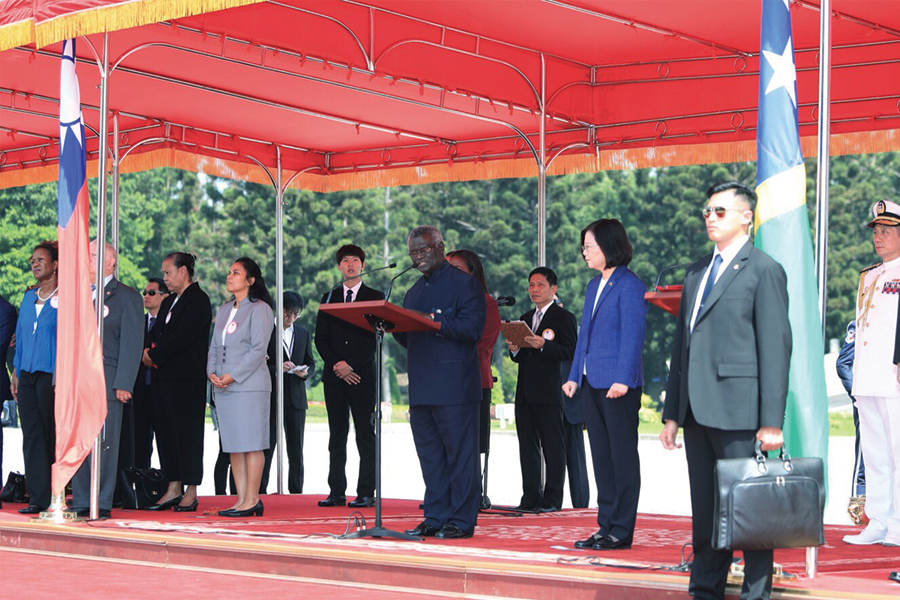
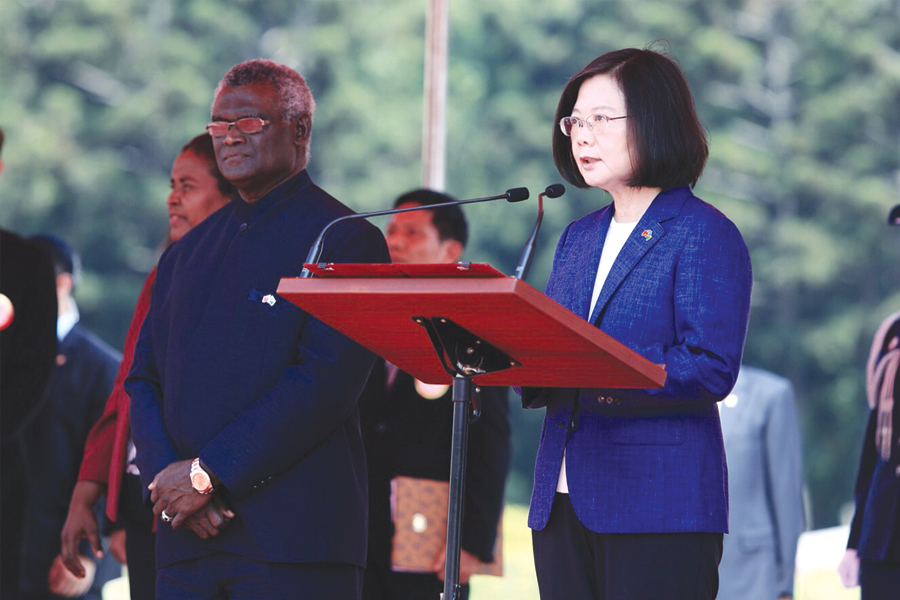
PM Sogavare addressing Taiwan government and people

PRIME Minister Manasseh Sogavare was received with a Red Carpet Welcome Salute Parade by the ROC Taiwan Military in Taipei on Tuesday morning, September 26.

ROC President Dr Tsai Ing-wen and the Government and People of ROC Taiwan accorded PM Sogavare this highest welcome ceremony on his official visit to Taiwan this week.

President Tsai Ing-wen praised Solomon Islands for its ongoing support towards Taiwan’ s desire for membership at the UN and its desire for Self-determination.

At the UN General Assembly in New York last week, PM Sogavare urged world leaders to do more to recognise the desire of other people for freedom from colonialism.

The two leaders also held talks that reinforced each other’s commitment towards enhancing the bilateral ties and existing development cooperation between the two countries.

Prime Minister Sogavare commended ROC Taiwan for its ongoing support to Solomon Islands and other countries to reduce poverty and for meeting its international obligations.

Taiwan is one of Solomon Islands’ traditional bilateral partners, which has contributed largely to the development of Solomon Islands in areas of education, health, rural development, energy, agriculture and cultural cooperation.

PM Sogavare and his delegation will leave Taiwan on Friday.

GRACING THE RED CARPET: PM Sogavare being led by President Tsai Ing-Wen through the Red Carpet welcome
President Tsai Ing-Wen officially welcomes PM Sogavare to Taiwan.
Inspecting the ROC Military Guard of Honour.


–GOVERNMENT COMMUNICATION UNIT

Gender inequality main cause of violence against women and family: Tuki

0
Hon Freda Tuki

BY MAVIS NISHIMURA PODOKOLO

GENDER inequality has been identified as the underlying reason for violence against women and family violence, says Minister for Women, Youth, Children and Family Affairs, Freda Tuki Soriacomua.

She revealed this in her remarks at the Pacific Women Parliamentary Partnership Forum on Tuesday at Heritage Park Hotel in Honiara.

Speaking on the topic family violence she said unequal power relations between women and men can lead to violence and abuse in relationships and marriage where women lack the power to make decisions for the benefit of wellbeing and happy family life.

She said inequalities exist with regards to employment as well as property and heritage rights that render women economically dependent.

“Women’s access to employment and economic empowerment remains a key factor to ensure that women live productive lives.

“Closely related to this is the need to provide women with better education, adequate information on reproductive and sexual health and also the infrastructures to help women and men to balance their work and private life,” said Hon Tuki.

She furthers that strengthening women’s leadership and their participation in decision making processes is vital.

She then posed a challenge on what each of us can do in our position to ease the burdens of women suffering from violence and raising our voices in parliament to bring to the forefront matters and the plight to make the violence stop.

“We love our husbands and want the violence to stop. Violence against women does not happen only to rural illiterate women but also happens to all women with high education qualification, business women, and women in senior management level, a nurse, a teacher and even a gender advocate.

“So as Minister responsible for women, my responsibility is simple. I sit in cabinet with other 23 cabinet Ministers, and I befriended them so I know them well and build the trust among us,” said Hon Tuki.

She added the strategy is not overriding egos, but to maintain a good relationship to press her agenda for addressing women’s issue.

“Hence, the Solomon Islands Government response is targeted, calling on holistic stronger coordinated approach to address gender inequality and eliminating violence against women and family violence

“So far we have been commended for strong coordination on the drafting of the Family Protection Act 2014 between government ministries, development partners and Civil Society Organisations including Faith Based Organisations.”

Moreover, supporting good practice regarding referral and multi-sectoral coordination with SAFNET and developing new national health strategy that mainstream Eliminating Violence against Women and Girls (EVAWG) into the health sector has also been commended for them to undertake.

“Also our work with Non Governmental Organisations (NGOs) in raising awareness on EVAWG, the partnership with donors for increasing investment in EVAWG and new community policing and conflict resolution programmes focused at the community level.

“The government Gender Equality and Women Development policy and the Eliminating Violence against Women and Girls policy are testament to the urgency of government response and action. Understanding and acknowledging fundamental human rights that women and girls are entitled to zero tolerance of violence.”

Fear for marine life if blue boat sinks

0

BY BARNABAS MANEBONA

THE Agriculture Division at Tulaghi has assured that the Vietnamese blue fishing boat currently anchoring in Mboli Passage at Ngella poses no minimal threat of foreign species.

However, they said if the boat sinks then this will be a huge threat to marine life.

“Apart from rats, there is no threat from foreign species of whatsoever on the blue fishing boat,” said the Agriculture Division.

Three Asian blue fishing boats were captured by Maritime Police in the country’s Exclusive Economic Zone (EEZ) early this year.

There were 40 crew members on board the three blue fishing boats but were deported to their home country except for three captains who are serving four years in Rove prison.

A deal to destroy the boats was made according to the High Court decision because they failed to meet the seaworthiness standard as reported by Solomon Islands Maritime Safety Administration (SIMSA).

One of the three blue boats said to be taken to Langalanga Lagoon last month by the selected initial bidder from the Ministry of Fisheries and Marine Resources (MFMR) for $400,000.00 dollars is currently only anchored in Ngella with engine problem as the reason made known.

Since it’s anchoring outside of Hakama Agriculture Station in Mboli Passage, concern was raised by the province that it might only end up sinking there.

Taiwan’s President is due to visit its Pacific allies next month

0

By Alfred Sasako


AS President Tsai Ing-wen prepares to visit Pacific allies next month, China has again warned that there’s only one future for Taiwan – reunification.

The warning was issued in a briefing provided by the Director General of Taiwan Affairs Office of the State Council (of China), Du Shixin, who met a visiting delegation from seven Pacific Island countries in Beijing yesterday.

“There is only one future for Taiwan – that to return to China,” Mr Du said.

He urged Pacific Island Countries that have diplomatic relations with Taiwan to consider their future carefully, saying “there is no political future for Taiwan.”

“Once Taiwan disappears as a sovereign nation, any diplomatic relations it has with any country, also disappears. Those Pacific island countries will be sorry. They will miss out on the benefits from China’s Belt and Road initiative, which has the potential for economic development for the Pacific region,” Mr Du said.

Solomon Islands is one of six Pacific Islands nations that has diplomatic relations with Taipei.

“What people need to understand is that diplomatic relations with Taiwan will disappear sooner or later. There is no way the Chinese government will allow one of its local governments enjoy diplomatic relations with outside countries. There is only one sovereign nation and China is that nation,” Mr Du said.

“Four things people ought to understand about China. First, it is a member of the United Nations Security Council. Secondly, it is the second largest economy in the world. Thirdly, it is largest developing country and fourthly China is the driving engine of the global economy.

“Come with us and enjoy all the benefits our world status offers or starve yourself of the necessary help for economic growth,” Mr Du said.

“Reuniting China and Taiwan will be the irreversible trend,” he said, warning China would not abandon the use of force should it become necessary.”

Mr Du said while Beijing was still pursuing peaceful reunification, it “must also take into account the feelings and wishes of its 1.38 billion people who want to see Taiwan reunited with China.”

He also provided a brief history on Taiwan and its relations with China.

Mr Du said Taiwan was initially ceded to Japan but it was returned to China in November 1945 after 50 years of Japanese occupation. In 1971, sovereignty was granted to Mainland China by the United Nations.

“Since then, Taiwan also known as the Republic of China and its citizens have been barred from the United Nations and its many UN agencies around the world. So the claim by Taiwan as a legitimate sovereign state has neither historical nor legal basis. Taiwan is an integral part of China,” Mr Du said.

He also told the delegations that Taiwanese President Tsai Ing-wen is due to visit its six Pacific allies next month. No other details were available.

Beijing dangles the carrot over the Taiwan issue

0

By Alfred Sasako


IF you think China would let go of Taiwan that easily, if at all, think again. That message was made clear repeatedly to a visiting Pacific Islands delegation, which spent the last 10 days traveling the richer provinces on the east coast of China.

The 15-member delegation consisting of Members of Parliament, senior officials and others, wound up their familiarisation visit of China yesterday (Wednesday 27th Sept). They are heading home today (Friday 28) after the visit which took in Guangdong Province, Zhujiajian Province, Hangzhou Province and the capital Beijing, China’s government seat of power.

Although Honiara does not have diplomatic relations with Beijing, Solomon Islands participated in the visit. The President of the Democratic Alliance Party (DAP), John Teddie Usuramo and his Vice President, Oscar Vahimana represented Solomon Islands.

“This visit was an eye-opener for most of us who are here for the first time,” delegation leader and first time Opposition MP, Robert Naguri of Papua New Guinea told our host.

In any and all of the briefings on economic and social development of China, the issue of Taiwan was never missed.

“Taiwan is an integral part of China. Anyone including countries in the Pacific Islands that have so-called diplomatic relations with Taiwan is a breach of our One-China Policy,” Vice Minister of the International Department of the Communist Party of China (IDCPC), Guo Yezhou told us in pre-dinner briefing on Tuesday in Beijing.

“For us, it is the question of sovereignty – our sovereignty,” Mr Guo said.

Then as in previous occasions came the punch line.

“China will continue to cooperate with Pacific Island countries that have diplomatic relations with us. They will be assisted economically as well as in other areas of need,” he said.

In more ways than one, it is a line choreographed to deliver maximum effect. And it does, particularly in the ears of delegates whose island countries have stitched up diplomatic relations with Beijing.

Mr Du Qiwen, China’s Ministry of Foreign Affairs’ Special Envoy to the Pacific Islands Forum, echoed similar sentiments, adding China “advocates cooperation instead of confrontation” in a briefing earlier that Tuesday afternoon.

“We feel we need to work together,” Mr Du told delegates

“Solomon Islands should seriously consider joining us in establishing diplomatic relations with China. Our countries are getting ahead in development because of Chinese funding,” some delegates would say to us.

Papua New Guinea, Samoa, Tonga and Vanuatu are beneficiaries of China’s economic support over the years.

And it is not the China of 1983 as we knew it then that we are dealing with today.

In 1983, then Prime Minister Solomon Mamaloni dispatched a delegation to Beijing to negotiate diplomatic relations with China. What delegation members, including the late Bartholomew Ulufa’alu, did not know was that the witty Mamaloni also sent another delegation to Taiwan on the same mission.

All China could offer at the time was USD20, 000 in annual budgetary grants. It so happened that while the negotiations in Beijing were still going on that the announcement of Solomon Islands tying the knot with Taiwan was made.

Formal dealings with Beijing ended there and then.

China, on the other hand continued to work behind the scene, addressing its own economic and social agenda, putting in place the necessary framework from which it would launch its bid to be a super power player that it is today.

In the space of just 34 short years since our diplomatic attempt failed, China has become the number two economic super power, taking over from Japan, which held that position for many, many years.

At the same time, China has established the Asia Infrastructure Investment Bank (AIIB) with a USD50 billion to get it off the ground. Initial resistance by the World Bank and some Western governments including the United States of America has died away. They have now taken up membership of this global lending institution designed to address infrastructure development in the Asia-Pacific region.

Using its phenomenal economic growth as a springboard for bigger and better things, China is today looking further afield.

Beijing for example, is eyeing the number one global spot as a military and economic super power. The direction to achieve its global ambition is expected to be consummated by the 19th National Congress of the 80 million-member strong Communist Party when it convenes in Beijing on October 18.

And by all counts, China may not be too far away from achieving that objective.

To show off its economic prowess, China has lengthened the strand from which it dangles the carrot to woo all Pacific Island nations.

In 2013 for example when Chinese President Xi Jinping visited Fiji for a meeting with its diplomatic allies in the Pacific, he announced a USD2 billion funding facility for Pacific Island countries.

The funds are from China Development Bank and the Exim Bank of China. They come in both commercial and concessional loans – commercial interest rates for countries outside the Pacific-China diplomatic fold and concessional rates for diplomatic allies in the Pacific.

That facility remains open today even to countries like Solomon Islands, which continues its recognition of Taiwan.

Skeptics might be wondering why all of a sudden China is doing all this today. A brief look behind the scene might give us an idea whether China’s influence is sustainable and why.

At the end of last year, official record shows China’s population had reached 1.38 billion people. In the same year, its GDP stood at around USD11.2 trillion. Its total value of imports and exports stood at USD3.7 trillion, according to official figures.

Beijing has spread its wings far and wide, poaching for instance, countries that once enjoyed diplomatic relations with Taiwan.

Panama in South America was the latest casualty, switching relations to Beijing in favour of the former’s preference for development rather than free money with little or no accountability.

And that is the difference. While Taiwan provided hard cash to its allies to spend as they wished, China prefers delivering tangible development on the ground to its island allies.

China’s approach unfortunately is the bitter medicine for pro-Taiwan politicians to swallow easily.

Trial on Katalake’s case continues

0

BY JENNIFER KUSAPA

TRIAL into the case against Malia Katalake and two others continues at the Honiara Magistrate Court today.

Peter Rockson and Junior Moris Bolas are co-accused with Malia Katalake.

This is the matter against Malia Katalake who is currently facing counts in relation to fraudulent falsification, false pretences and embezzlement.

Ms Katalake is a former employee of the Solomon Tropical Product, and was working as a plant manager when the alleged incident occurred.

She is charged with two other co-accused her husband Peter Rockson, 30, of Lord Howe, Malaita Outer Island and 29-year-old Junior Morris Bolas from Choiseul.

Rockson faces four counts of receiving and soliciting while Bolas faces seven counts of receiving.

Ms Katalake was responsible for receiving copra from local farmers, scaling and writing on receivable company document (copra inspections and payment forms) for farmers who came from the province.

The allegation said that between January 1, 2008 and June 21, 2008 Malia and Bolas made up false copra payments sheet under the ghost name Sisi David and fraudulently withdrawn a total of $152,570.80 from the company.

Police alleged Malia was the mastermind of the company scandal and she at her own discretion before submitting to the office receptionist to have them calculate and raise the payment according to what names appear on the copra sheet.

Most payments were alleged to have been done on cheques at the National Bank of Solomon Islands now the Bank of South Pacific and Malia and Bolas were the ones who collected and cashed the cheques at the Bank.

The matter was reported to police by the complainant John Vollrat who is the general manager of the Solomon Tropical Products, a company that deals with local farms by purchasing, processing and exporting of copra.

Office of the Director Public Prosecution appears for the state.