Home Blog Page 1605

Chinese nationals trading beche-de-mer without permits

0

BY SAMIE WAIKORI

A good number of Chinese nationals are currently engaged in illegal Beche-de-mer trading in the country.

A source tells Island Sun that around 20 are in the Lord Howe islands, trading beche-de-mer without work permits.

90 percent of foreigners, according to the source, who are buying and harvesting the lucrative resource are without work permits.

“If the Immigration and Police would have the opportunity to check Lord Howe islands now, they will be able to locate more than 20 Chinese foreigners most of whom do not have work permits but engaged in illegal trading of Beche-de-mer on the Island.

“It is utterly important that steps are taken to ensure illegal activities is stopped and that everyone follows the laws of Solomon Islands,” the source said.

When contacted, the Director of Immigration yesterday he said his office was not aware of any foreign national dealing with beche-de-mer without a work permit.

Mr Henry Fugui exclaims that it is news to him and his office, assuring the paper that they will investigate the matter.

Codes of conduct and practice for the police service in the Solomon Islands

0

Dear Editor,

THE online webpage of the Solomon Star newspaper continues to feature an editorial piece, first published on 16 November 2017, relating to an allegation of unlawful detention and assault by the RSIPF reported by two youths.

Without going into the specifics of the allegations made the story raises in my mind whether or not it is time to introduce legislation in the Solomon Islands that governs the major part of police powers over and above the statutory provisions relating to police contained in the existing Police Act and Regulations.

The reputation and standing of the re-built RSIPF cannot be allowed to be sullied by allegations of misconduct but, equally, misconduct that is proven cannot be allowed to go unpunished.

In 1997 I issued this order to the then members of the police service to try to ensure proper conduct, both on and off duty.

“It is the duty of every member of the Force to cultivate good relations with all sections of the public, and always to bear in mind that, where such relations do not exist, police officers work under a severe handicap and cannot therefore. be fully efficient,

“In their daily dealings with the public, police officers are often required to exercise firmness, and sometimes obliged to resort to force in the exercise of their duty. Firmness, however, must be tempered by tact, patience and good humour, and any force used must be the minimum necessary to secure compliance with the law.

“Members of the Force have special powers not possessed by the ordinary citizen, and it is of the utmost importance that these powers should be used with discretion and forbearance.  Harsh or oppressive conduct, incivility, and the use of unnecessary violence can in no circumstances be justified or tolerated, and are punishable offences against discipline.

“Members of the Force must avoid altercations of any nature.  If an officer is wantonly assaulted he has the legal power to arrest his assailant.

“Arguments with members of the public on matters of duty must be carefully avoided; it rarely convinces anyone and naturally irritates persons smarting under some real or imaginary grievance.

“All ranks must, moreover, constantly remember that one offender in this respect may give a bad name to the police generally, and that a display of surliness or ill-humour, or the harsh or oppressive use of authority, by one police officer may have the adverse effects of a far-reaching nature on the Force as a whole.”

In 1984, in the UK, the government introduced The Police and Criminal Evidence Act 1984

This Act is commonly referred to as PACE and it governs the police powers of investigation, including arrests, detention, interrogation, entry and search of premises and the taking of samples.

Quoting from In Brief.co uk, a leading legal website, the legislation contains PACE Codes of Practice, which police officers should consider and refer to when carrying out various procedures associated with their work

The Act attempts to strike a fair balance between the exercise of power by those in authority and the rights of members of the public.

There are 8 Codes of Practice laid down in the Act.

“Failure by a police officer to adhere to the Codes of Practice does not render them liable to criminal or civil proceedings. However, their failure to adhere to what the Codes state can be introduced as evidence in civil and criminal proceedings (PACE, s 67). Additionally, any evidence obtained by the police in relation to the investigation of any criminal offence where they have failed to adhere to PACE, can be deemed inadmissible in court thus harming the case against the defendant.”

Yours sincerely

Frank Short

Where there is a will there is a way

0

Dear Editor

MY recent letter to the media mentioning that the Indian Prime Minister had promised in 2015, to provide several of the smaller islands states in the Pacific region, including the Solomon Islands, lighting for 200 homes in each of 14 island states with electricity generated by renewable energy sources, brought immediate comment from three doctors in service at the NRH.

The sum of the comments put forward was as the Solomon Islands is already an independent nation why can’t the country produce enough electricity to light the homes? “
it was quoted by all three that “Where there is a will there is a way.”

The old English proverb asserts itself with complete assurance: “Where there’s a will, there’s a way.” Like many time-worn sayings, this claim that mind always rules over matter rings true only some of the time. Sometimes we don’t have the will; sometimes we lose our way.

Have I witnessed a new spirit emerging,however,from this trio of doctor and a spirit that will continue to emerge amongst Solomon Islanders till eventually the country’s over-dependency on foreign aid will be radically diminished?

One must hope so, but perhaps not in my lifetime.

In support of the refreshing and enterprising commentary by the doctors, it might be worth recording that total dependence on foreign aid means that it becomes the opiate of the Third World.

In a similar way to how the development of the welfare state in some developed countries has helped undermine society by removing the need for communities to develop themselves through cooperation and exchange but by instead supporting and facilitating anti-social and irresponsible behaviour, foreign aid has largely encouraged Third World governments and their populations to rely on hand-outs instead of on themselves for development.

Yours sincerely

Frank Short

Win-win deal

Office of the Prime Minister

PM defuses internal row over chief of staff appointment – Djokovic or Usuramo, new post created

By Alfred Sasako

PRIME Minister Ricky Hou has used his management skills in defusing an internal row which has the potential to tear his new government apart, sources close to the government have revealed.

The row is over who to fill the position of Chief of Staff (COS), occupied by Robson Djokovich during Hon Manasseh Sogavare’s three-year tenure as prime minister. Mr Djokovich is Mr Sogavare’s nephew.

Sources told Island Sun yesterday on one hand, diehard DCC members are pushing for Djokovich to remain in the post. On the other, Prime Minister Hou has put forward the name of the President of DAP, John Teddie Usuramo, to fill the position.

“It’s a rather explosive situation which has the potential to tear the new government apart,” one source said.

“Fortunately, Prime Minister Hou has used his management skills in defusing the situation by suggesting a new position be created. The position will carry the title of Coordinator, Policy Implementation, Monitoring and Evaluation Unit (PIMEU) in the Prime Minister’s Office. This Unit drives the implementation of the government’s policy and priorities,” the source said.

“The Chief of Staff position will remain but will be relegated to the Prime Minister’s Private Political Office. The Coordinator will be required to report to the Prime Minister through the Office of the Chief of Staff.”

The proposed change is still subject to formal approval, which could be given as early as later this week.

An announcement of the new appointees to fill the two positions is due to be made following endorsement by Caucus.

It is unclear whether Djokovic would be offered the job of Coordinator.

Meanwhile the new government is set to start shedding Political Appointee (PAs) positions soon as a cost-cutting and clean-up measure.

Many in the government are convinced the PAs should go, given that the national general election is just around the corner.

Up to 45 PAs could lose their jobs in the shake-up being foreshadowed.

It is understood the next level for the axe to fall on would be Permanent Secretary positions.

“The priority focus for the Prime Minister is to clean up the mess and to weed out non-performing individuals in the public sector, starting with the Office of the Prime Minister,” one source told Island Sun yesterday.

It is not clear how soon these measures would be undertaken, with observers warning time is against the Prime Minister’s programme of action.

“What I want Prime Minister Hou to put at the back of his mind is that he has no time to do what he’s announced he would do,” businessman and West Are’are community chief, Charles Karaori, told Island Sun yesterday.

“My message to the Prime Minister is that some of the people around him are not there to help him. These people are there to frustrate the process so that nothing moves forward,” Mr Karaori said.

“Prime Minister Hou must be aware of this and the people I am talking about. If it means removing these people, the Prime Minister must do so, before he is overtaken by events,” he said.

We need answers

0

Parents’ last hopes rest on MEHRD as uncertainty over children’s future troubles them

BY BARNABAS MANEBONA

PARENTS of students who sat this year’s examination are still uncertain and are worrying over their children’s future.

Speaking with Island Sun, a parent who last week had brought the issue to the newspaper with her story of proactively going against the network responsible for leaking the exam papers, says that the education ministry’s media assurance in Solomon Star newspaper yesterday only reveals that the ministry and police are investigating the matter.

However, Ms Elizabeth Dima says parents across the country need to be comforted with assurance from the Ministry of education (MEHRD) that their children who have studied and prepared earnestly for the exams will not be bottle-necked by students who had cheated.

“It’s good to see MEHRD engaging police in investigating the matter, but that is only one side of the issue. We parents need to hear from the ministry that our children who have genuinely sat the exams won’t be pushed out by cheaters who have scored higher marks.

“Does the ministry have any mechanisms in place to filter out students who have cheated from those who have sincerely prepared and sat for the exams?

“Can MEHRD reassure us parents that this will not happen again next year and the following years? This needs to stop.”

It is understood that there are only limited spaces in forms four, six and seven, and the exam leakage may mean that students who accessed leaked copies of exams may score higher marks hence push out students who had sat the papers in earnest.

Island Sun had been trying to contact responsible officers in the MEHRD since last week. Attempts to get in touch with Director of National Education Assessment Division (NEAD) Mr John Liliu was futile as the ministry switchboard kept saying “he is in a meeting”.

It was also odd to note that last week’s follow up calls were met with an electronic voice notification that the MEHRD switchboard line was out of service. Yesterday, however, the line was working again when Island Sun called. Surprisingly, it was engaged when the paper made follow-up calls after.

This silence from the ministry is disturbing, which implies that it might be hiding something or is not ready to face the hard questions of the media regarding this serious issue.

Meanwhile, Dima had alerted Island Sun last week that she had led police to the arrest of two men on November 8, who were selling copies of leaked exam papers.

According to her private investigation, students of KGVI, Tuvaruhu, St John, Naha, Mbokona and White River secondary schools had copies of leaked exam papers well before their exam dates.

During her search, she obtained a mobile number belonging to a person selling copies of form six exam papers; she managed to book an appointment with the person and took the police with her, leading to the arrest of two men who were in possession of exam papers.

Of the six schools alleged by Dima, only KGVI responded, denying any incidence relating to students being caught with copies of leaked exam papers.

School Tutor Mr Viva admits that they have heard rumours that some of their students had copies of leaked exam papers, however confirms that upon inspection of their students’ examination forms, found that none of their students had used leaked exam papers.

“I have heard that KGVI is also accused for its students cheating but after going through inspection, we deny accusations.

“It might be other schools outside but not KGVI.”

The other schools mentioned above are without phone contacts or have had their lines cut due to unpaid bills.

The alarming incidence of diabetes in the Solomon Islands and the need for proper dietary control measures

0
THE Solomon Islands Broadcasting Corporation (SIBC) carried an alarming story this week on the occasion of World Diabetes Day.

This is what the SIBC reported.

“Diabetes cases at the National Referral Hospital (NRH) Diabetes Clinic are increasing every day, local health experts say.

“NRH medical consultant Dr Jones Ghabu revealed the alarming trend during World Diabetes day.

“ Ghabu said diabetes cases reported at the NRH were becoming more common, everyday.

“Most people come to the hospital with heart problems, kidney problems, high blood pressure and even infections,” he said.

“Currently we are normally receiving one case of heart attack and stroke a day.”

“The most common type of diabetes seen at the hospital was leg infection and there had been an increase in leg amputations at the hospital.

“Today, surgeons at the national referral hospital perform two to three amputations in a week,” he said.

“This means that is increasing and we don’t know whose legs they are going to amputatetomorrow, it might be one of us or one of our family members, and that is why we need to take serious actions against diabetes.”

Much of the blame for this increase in diabetes can be attributed to replacing traditional foods with imported, processed food which has contributed to the high prevalence of obesity and related health problems in the Pacific islands, according to a WHO report.

The report, from which I quote, says –

“Scattered across the Pacific Ocean are thousands of islands which make up three regions known as Melanesia, Micronesia and Polynesia. Beyond the image of white sandy beaches and carefree lifestyles, the Pacific islands are facing serious health problems, the prime culprit being imported foods.

“In at least 10 Pacific island countries, more than 50% (and in some, up to 90%) of the population is overweight according to World Health Organization (WHO) surveys.

“WHO defines overweight as having a body mass index (BMI) equal to or more than 25, and obesity as a BMI equal to or more than 30. Diabetes prevalence among adults in the Pacific region is among the highest in the world.

“About 40% of the Pacific island region’s population of 9.7 million has been diagnosed with a non communicable disease, notably cardiovascular disease, diabetes and hypertension. These diseases account for three quarters of all deaths across the Pacific archipelago and 40–60% of total health-care expenditure, according to a meeting on obesity prevention and control strategies in the Pacific held in Samoa.

“Dr Temo K Waqanivalu, technical officer for nutrition and physical activity at the Office of the WHO representative for the South Pacific in Suva, Fiji, partly blames poor diet for the region’s health problems. “Promotion of traditional foods has fallen by the wayside. They are unable to compete with the glamour and flashiness of imported foods,” he says.

“People in the Pacific islands may know what constitutes healthy eating but, as in many parts of the world, governments struggle to change people’s behaviour. In eight countries, less than 20% of people surveyed reported eating the recommended five or more portions of fruit and vegetables a day. The often calorie-rich and nutrient-poor imported foods have a stronger appeal.

“A major challenge for Pacific island countries is to reinforce nutrition education in schools by promoting healthy eating practices. “Even as kids we know what we are supposed to eat and not eat; there is a very good level of nutrition education in Fiji,” says Ateca Kama, senior nutritionist at Fiji’s National Food and Nutrition Centre. “The challenge is for us to translate knowledge into behaviour. For example, schools teach good nutrition as part of the curriculum, and then they sell junk food in the school canteen because they need to make a profit.”

“Historically, food was imported from Australia and New Zealand, but now it comes from much further afield: China, Malaysia and the Philippines. Nutrition labels are not only inconsistent but often not in English, the common language spoken in most Pacific island countries. Mandating clear, consistent labelling is crucial. The simpler, the better. Simple nutrition signposts can be useful and should be encouraged, and ingredient labels are really important for monitoring food safety and quality.

“Increasing the proportion of locally grown, nutritious and less energy-dense traditional foods in the diets of Pacific islanders is also essential, says Waqanivalu.”

Turning to the Journal of Education and Health Promotion for general dietary guidelines for the people in the Solomon Islands in order to help reduce the incidence of diabetes I came across this information which I would earnestly request be followed

“Modern dietary management of diabetes essentially involves modifications of the quality and quantity of food to be taken by the diabetic patient. The following guidelines are applicable to diabetes irrespective of type, weight status, age, gender, or occupation. Most of the carbohydrate consumed should be in the form of starch (polysaccharides) such as maize, rice, beans, bread, potatoes etc.

“All refined sugars such as glucose, sucrose, and their products (soft drinks, sweets, toffees, etc.) and honey should be avoided, except during severe illness or episodes of hypoglycemia. These foods contain simple sugar, which is easily absorbed causing rapid rise in blood sugar.

“Non-nutritive sweeteners, e.g., Canderel, saccharine, NutraSweet, aspartame are suitable sugar substitutes for diabetic subjects.

“Animal fat such as butter, lard, egg yolk, and other foods high in saturated fatty acids and cholesterol should be reduced to a minimum and be replaced with vegetable oils, particularly polyunsaturated fats.

“Salt should be reduced whether hypertensive or not.

“Protein (fish, meat, beans, crab, crayfish, soyabean, chicken, etc.) and salt are restricted for those with diabetic nephropathy.

Cigarette smoking should be avoided by diabetic patients. Alcohol should be taken only in moderation.

“The items allowed for free consumption include: Water, green leafy vegetables, tomatoes, onions, cucumber, aubergine, peppers, and vegetable salad without cream. Any brand of tea, coffee, or drinks that contain very low or no calories.

“For patients too ill to eat solid food, a fluid or semi-solid diet should be substituted (papaya, soya bean, custard, etc.).

Patients treated with insulin or certain oral hypoglycemic agents, e.g., sulfonylureas must be advised to eat regularly and often to prevent hypoglycemia- 3 meals a day plus suitable snacks in between, e.g., fresh fruits.

“Small meals spaced over the day, rather than 1 or 2 big meals, are helpful in avoiding post-pyramidal peaks in blood sugar.

“Food can be powerful in preventing and reversing diabetes. However, dietary approaches have changed as we have learned more about the disease. The traditional approach to diabetes focuses on limiting refined sugars and foods that release sugars during digestion-starches, breads, fruits, etc. With carbohydrates reduced, the diet may contain an unhealthful amount of fat and protein. Therefore, diabetes experts have taken care to limit fats- especially saturated fats that can raise cholesterol levels, and to limit protein for people with impaired kidney function. The new approach focuses more attention on fat. Fat is a problem for people with diabetes. The more fat there is in the diet, the harder time insulin has in getting glucose into the cells

“EFFECTS OF THE FRUIT AND VEGETABLES ON THE HUMAN HEALTH

“Fruits constitute a commercially important and nutritionally indispensable food commodity. Being a part of a balanced diet, fruits play a vital role in human nutrition by supplying the necessary growth regulating factors essential for maintaining normal health.”

Yours sincerely

Frank Short

A promise by the Indian Prime Minister to light 200 homes in the Solomon Islands

0

SOLOMON Islands new Prime Minister has said his government will not forget its traditional development partners and seek to work ever closely with them in seeing to the needs of the nation.

 The Solomon Islands must improve its renewable energy sources and I would request the Prime Minister to be mindful that over a weekend in 2015, 14 Pacific nations met in the northern Indian state of Rajasthan for a summit on the subject of renewable energy.

 At that summit, the Indian Prime Minister, Narendra Modi, pledged to give its island neighbours enough solar power to light up thousands of homes.

 Mr. Modi, said on that occasion, “We now commit to provide solar electrification to 2,800 homes – 200 in each Pacific Island country. This will save kerosene worth abbot $1 million.”

 Outlying his ideas the Indian Prime Minister explained his plan was to help the smaller nations deal with the effects of climate change in the coming decades.

 Mr. Modi also mentioned that India would also work with researchers in the Pacific nations to provide better human resources and technologies to deal with natural disaster management with early warning and response systems.

 India has had diplomatic relations with the Solomon Islands since May 1987 and relations are friendly with political interaction between the two nations very comprehensive.

 In the most recent past India has offered some 15 scholarships to the Solomon Island under Technical Cooperation Programs and also offered grants for a range of social programs as well as giving some US$50,000 during the deadly floods that raged through Honiara in 2014.

 As the relations with India are on a sound footing and the new government in the Solomon Islands is keen to maintain its ties with its traditional donor partners, I would urge the PM to seek assurances from the Indian Government when the 200 homes in the Solomon Islands will be provided with lighting as promised by Prime Minister Modi.

 Yours sincerely

 Frank Short

Great expectations

0

THE Solomon Islands has a new Prime Minister and a newly constituted body of Ministers to govern the nation until the next general election in 2018.

Much is expected of the government given the relative poor state of the economy, the high rate of unemployment, perceptions over corruption, deficiencies in the education and health sectors, almost stagnant infrastructure development, gender inequality climate change and environmental issues affecting livelihoods and food security in the rural parts of the country, to name put a few of the challenges the new administration must tackle.

I wish the government well and hope to see change, soon, in fiscal control and particularly in rapid aid to the health sector and in the provision of basic health services.

Prior to the election of the Prime Minister last Wednesday, the SIBC issued rather a stern warning which read, in part,  “Now or never: this has to be the theme for the election of the new Prime Minister.”

“If our MPs do not get it right this time; if they don’t exercise good judgment to correct all their previous errors; if they don’t put the interests of their people and country first – then they and their successors will never be able to look after this country.”

When I read the SIBC’s statement, I was reminded of one of the themes in Charles Dickens’s book ‘Great Expectations’ which referred to moral regeneration when one of the book’s characters started climbing the social ladder, gained wealth and  followed this by a degradation of his integrity

With all the talk of corruption in the Solomon Islands it is imperative that the country’s new leaders render significant services to the people in the areas of education, anti-corruption, health, ethics, judicial responsibility, rule of law, democracy and good governance.

In this age of increasing globalization, I believe the government must reflect on the nation’s journey so far, so the country can do better in the future and leave a better legacy for posterity.

This brings me to the topic of nation building and the new government must give added consideration to nation building which is always a work-in-progress needing nurturing and re-invention.  Nation building is about building a common sense of purpose and strengthening those institutions which symbolize the political entity and having a common sense of purpose, having a sense of a shared destiny and a collective imagination of belonging.

The political game play of the last few weeks underscores my points and adds weight to the view that a viable nation must be synonymous with achieving modernity and have institutions and values which sustain the collective community in these modern times.

I have no right or authority to express what Solomon Islanders expect of their leaders but having been a very close observers of events and happenings in the Solomon Islands for the past 20 years,  I have a fair estimation of what the expectations might be and here are a few thoughts.

Leaders must be committed to the rule of law and have a demonstrated sense of fairplay, vision, ability, integrity and can see beyond the ostentatious pomp of office.

Leaders are not wanted who have no sense of tomorrow, other than that of their bank accounts.

Leaders who lead by deeds and not by words, achievers, not deceivers.

Leaders that will leave their foot prints on the sands of time and leaders who will live forever in the hearts of Solomon Islanders.

Yours sincerely

Frank Short

Hou faces test

MP for Small Malaita Hon. Rick Hou is being nominated to run for PM onbehalf of the DCC Group

PM’S LEADERSHIP STANCE ON WEST PAPUA, CHINA TO BE PUT UNDER THE TEST

By Alfred Sasako

PRIME Minister Ricky Hou’s leadership ability will be put to the test when Caucus and Cabinet meet to look at policy priority issues the new Government will pursue over the next 10 months or so.

A special taskforce is finalising the document, which is said to contain policy on West Papua as well as the One-China Policy.

The taskforce was set up before the vote ousting Manasseh Sogavare was taken on Monday 6th November 2017. It is due to present Mr Hou the policy dossier next Friday. Prime Minister Hou is expected to take the document to Caucus and Cabinet for their formal blessings.

Observers say they expect Mr Hou to tow the line even on both West Papua and the One China Policy even if he is the Prime Minister, because the result of the no confidence vote has made his predecessor, Mr Sogavare the most powerful politician in the new government.

Mr Sogavare opposes both the One China policy as well as Indonesian rule on West Papua.

“Given that Mr Sogavare holds the purse strings, there is little chance in terms of changes on both issues. As such it will definitely be the acid test for Prime Minister Hou’s ability to demonstrate decisive leadership on issues of national interest,” observers said.

They also raised questions about the protocol in the appointment of Mr Sogavare as Deputy Prime Minister as well as the Minister of Finance and Treasury.

“There are four senior portfolios that make up the inner circle of Cabinet. They are the Prime Minister, the Deputy Prime Minister, the Minister of Foreign Affairs and the Minister of Finance and Treasury.

“Protocols dictate that no individuals are to combine holding any of the two portfolios, which is what Mr Sogavare is doing right now. No one, except Prime Minister Hou can explain this,” observers said.

“In allowing Mr Sogavare to occupy two positions, Prime Minister Hou has handed his deputy the most powerful position in the new government.”

14 Ministers sworn in

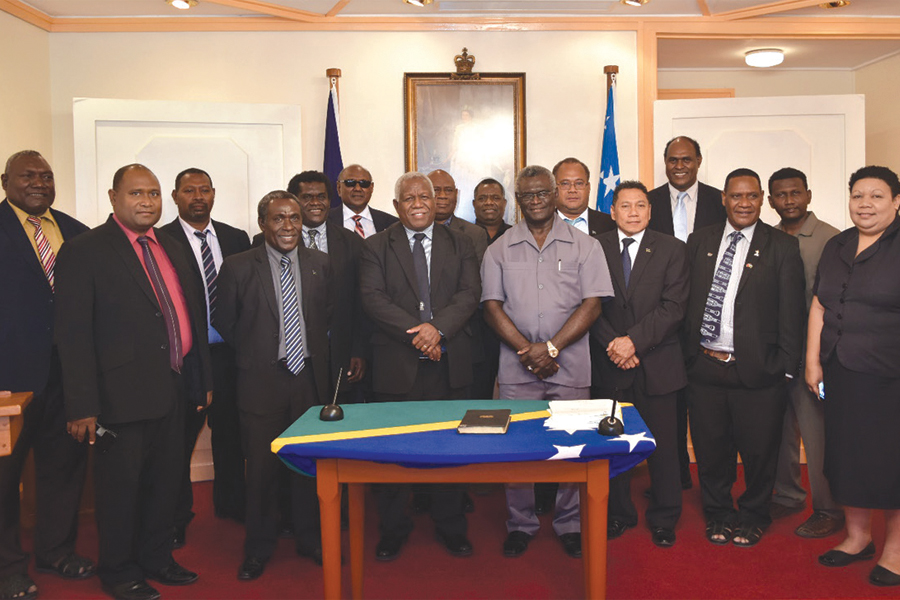
Prime Minister Hon Rick Hou in a group photo with the 14 new ministers after the swearing in ceremony at the Government House. Photo from PMO Press Secretariat

FOURTEEN ministers took their Oath of Allegiance and Oath of Office yesterday at the Government House.

They are:

  1. Manasseh Sogavare MP as the Deputy Prime Minister and Minister of Finance and Treasury;
  2. John Maneniaru MP as the Minister of Fisheries & Marine Resources;
  3. Peter Shanel Agovaka MP as the Minister of Communications and Aviation;
  4. John Dean Kuku MP as the Minister of Education and Human Resources Development;
  5. Jimson Fiau Tanagada MP as the Minister of Home Affairs;
  6. Bradley Tovosia MP as the Minister of Mines and Energy;
  7. Freda Tuki MP as the Minister of Women, Youth & Children Affairs;
  8. Moses Garu MP as the Minister of Police & National Security;
  9. Andrew Manepora MP as the Minister of Lands and Housing;
  10. Bartholomew Parapolo MP as the Minister of Culture & Tourism;
  11. Samuel Manetoali MP as the Minister of Forestry and Research;
  12. Nestor Ghiro MP as the Minister of Provincial Government and Institutional Strengthening;
  13. Dr Culwick Togamana MP as the Minister of Environment & Conservation;
  14. Connelly Sandakabatu MP as the Minister of Public Service.

The ceremony was witnessed by the Prime Minister Rick Hou and other senior Government officials.

The remaining ministers will take the oath of office and oath of allegiance by today.

–OPMC PRESS