Home Blog Page 1533

Watch out today

Office of the Prime Minister

SIDCCG tight-lipped over sackings of ministers and political appointees


BY ALFRED SASAKO

TODAY could be D-Day for up to five senior ministers and at least two senior political appointees.

But the Government remained tight-lipped last night over the sacking of those within government who Prime Minister Ricky Houenipwela has blamed for instigating instability in his three-month-old Government.

Calls and text message inquiries to government officers last night went unanswered.

But others knowledgeable about the political situation told Island Sun last night that up to five Ministers could be removed by today (Monday) along with two senior political appointees.

The unnamed ministers and the political appointees are said to be part of a network of a faction within the three-month-old SIDCCG allegedly responsible for instigating moves to “dethrone” Prime Minister Hou.

Insiders later accused the Opposition of being directly-linked to the plot, infuriating the Prime Minister and prompting him to act.

The planned dismissals of about five Ministers and at least two political appointees were to have taken place last Friday morning to coincide with the formal launch of the SIDCCG’s Policy and Translation documents.

The on-off, on-off ceremony was however moved to 4.30pm that day. But nothing happened last Friday afternoon.

The explanation from Government House was that it had not received the relevant instruments for the sackings and swearing in of new Ministers from the Office of the Prime Minister and Cabinet.

The absence of the Attorney General from Honiara was also blamed for the hiccup.

Island Sun was informed last week that the firing of Ministers and subsequent swearing-in of newer ones has been moved to today (Monday).

Opposition Leader Manasseh Maelanga continues to deny any involvement by his Members, who met last Tuesday and were due to meet again last Thursday.

Last Tuesday’s meeting was reportedly attended by at least one MP from the Independent Group in Parliament.

Maladministrative conduct and penalties

0

By Mike Puia

THE Ombudsman office has announced the commencement of the new Ombudsman Act 2017 on January 31, 2018 after parliament passage in July 2017.

Announcing the new Act commencement at a press conference yesterday, the Ombudsman, Mr Fred Fakari’i said members of the public can now raise complaints of maladministrative conducts by any government agency, ministry or department or contractor to his office for investigation.

Offense Penalty
Failure to provide specified information in writing before a specified time $50,000 or 5 years imprisonment, or both
Failure to produce specified document or thing before a specified time $50,000 or 5 years imprisonment, or both
Failure to attend an oral examination on a specified date $50,000 or 5 years imprisonment, or both
Knowingly gives information that is misleading in a material particular $50,000 or 5 years imprisonment, or both
Knowingly gives a document that is misleading in a material particular $50,000 or 5 years imprisonment, or both
Impersonation $20,000 or 2 years imprisonment, or both
Obstructing $50,000 or 5 years imprisonment, or both
Threatening $50,000 or 5 years imprisonment, or both
Influencing $50,000 or 5 years imprisonment, or both


Fakari’i said he believes the new Act will help curb corruption in general.

No assessment on logging operation in the Malaita

0

BY SAMIE WAIKORI

Auki

The Environment Division and its sub provincial office in Auki have been criticised for failure to carry out environment assessment on logging operations in Malaita province.

A Mr Aloysio Arukeni said people suffer environmentally as the result of operations in the province.

“Pollution to rivers, streams, damage of fertile lands and vegetations and the list goes.

“People suffer, and with that they have right to claim the environmental damage that affects them and their environment.

“Along that line if people pursuing the damage, they need proper assessment from environment division so it can produce them report.

“And the report must not made upon assumption as what usually experience, report must made upon assessment on the ground.”

Arukeni said this is what should happen, so that the status of the damage can be known and plan can design to deal with it.

He said what currently experience was even no assessment on the ground, the assessment report can be made.

“I wonder what the report would like, but that clearly shows the report was just made upon assumption of the officers.

“When reports are conducted that way, the interest of people suffered from the damage is less accounted whilst only saves the ones will be affected by the report.

“This is what happens and it needs changes both for producing assumption reports and luck of ground assessment,” he said.

Arukeni reiterated his appeal that the Environment Division and its sub provincial office in Auki must stride with their work in the province.

Chewing and selling betel in public places illegal

0

BY TANNY.E.VAHI.

“Unlike those that are employed, we street venders too are struggling to meet the needs and demands of our families and for our daily survival.” This was the sentiment raised by a betel vendor in the Central Business District (CBD) of Honiara.

Almost every day Honiara city law enforcement officers will do their rounds to check for those selling betel nut illegally in the CBD of Honiara and most times, the venders will escape from the clutches of the law enforcement officers.

This has now become a common occurrence in the main CBD of Honiara.

However speaking to Island Sun, a betel nut vendor said he totally disagrees with the banning of the sale of betel nut and that there should be leniency on the restriction on the selling of betel nuts along the streets, provided there are proper bins in place.

He said unlike those that are employed, street venders too are struggling to meet the needs and demands of their families and daily survival.

“Not every parent is employed. It is hard for one person or a nuclear family or even two or three families to marshal the money, labour, or land for business on any but a very small scale.

“Like any other businesses, selling of betel nut along the street is one way of fast income generating product for us.’’ he said.

He further stressed that, they (betel nut venders) though do the activity, understand and are aware of the Litter Ordinance that outlines the duty of each business houses or individuals, who are must provide litter receptacles (rubbish bins) for the properties for the waste collection.

“It is not us; it is the behaviour of the consumers that cause lots of glitches to our environment. There are receptacles, to throw or spit our wastes, however public tend to ignore them and as what, we are the ones to be blamed and whilst, it is such behaviours that should be looked and strict with,” he said.

In the meantime, according to the Market Ordinance under Honiara city council Act, no person or individual is allowed to run a private market unless he/she has prior written permission from Council.

The councils also wish to further prompt the general public that chewing and selling of betel nuts in public places such as bus stops, public transport systems, government offices, schools, medical centres and other places that involve public gathering with the city is prohibited.

No person or individual is allowed to run a private market unless he/she has prior written permission from the Council.

Women’s increased income cause men to contribute less

0

BY LORETTA BRIGIDIA MANELE

A research study carried out in Solomon Islands has found out that women’s greater financial resources often enable men to lessen their own contributions to the household with some making no contributions at all.

This was expressed by Professor Richard Eves, of Australian National University’s Department of Pacific Affairs who was speaking at the Heritage Park Hotel under the Do No Harm Research Launch yesterday.

Whilst presenting key findings from the research study which took place in 2014 in Makira and Malaita provinces and Honiara involving 174 participants, he shed light on women’s experiences of having greater financial resources and how it affects the household.

Mr Eves explained that any connection between a woman’s economic empowerment and domestic violence is not always straightforward.

In this regard, he stressed that men and women interviewed pointed out a number of causes of martial conflict and violence, of which the most common one was linked to men’s consumption of alcohol.

Henceforth, Eves said that the research indicates that when women are more involved in greater financial activities, this often leads men to contribute less to their households where some tend to make no form of contributions at all.

“This allows men to use their money for their own personal consumption, resource depleting behavior that is often central to marital conflict.

“In such circumstances, when men contribute little either financially or by helping in the home, women’s increased income means a large increase in their work burden, now that income earning is added to their other customary duties,” said Eves.

Study differentiates income of women in rural areas and capital

0

BY LORETTA BRIGIDIA MANELE

ACCORDING to “Do No Harm: Understanding the Relationship between Women’s Economic Empowerment and Violence Against Women in Melanesia”, there are considerable differences between women in rural areas and the capital in how they depend on income generating activities.

Yesterday, Associate Professor Richard Eves from the Department of Pacific Affairs, Australian National University presented key findings of the above study.

He explained that the research project which took place in Solomon Islands in 2014 and focused on rural women’s income generating activities and savings groups as well as formally employed women in the capital.

Moreover, Mr Eves said that although there are considerable differences between the two research areas, there are also significant similarities such as the rigid adherence to unequal gender roles and discriminatory social norms.

He stressed that for women who were formally employed, most of them still had to secure ways of other income generating activities to support what they already earn to help sustain living conditions in the capital.

“Life for the women we interviewed in Honiara was perhaps more precarious than for the women in the rural communities,” said Eves.

In addition, he said that since access to gardening land is limited for women in the capital, they are more dependent on cash income than women in the rural areas who have sufficient land to plant crops for subsistence even if earning cash income is difficult.

“Several of the women we interviewed in Honiara who were forced to pursue other income generating activities to supplement their income, remarked how exhausted this made them and the negative impact this had on their family life, especially being unable to spend time with their children,” said Eves.

He furthers that despite the differences both parties have, what is common between them is the difficulties relating to generating income.

Eves noted that women’s lack of access to worthwhile markets and their exclusion from value chains illustrates that their efforts to extend their income generating activities into small businesses is curtailed.

Male participation vital to women’s economic empowerment interventions

0

BY LORETTA BRIGIDIA MANEL

WORKING with men to challenge gender inequitable behaviour and norms is crucial for economic empowerment programming.

Yesterday, under Australian Aid’s “Pacific Women Shaping Pacific Development” programme, a Research Launch took place at the Heritage Park Hotel centered on a research project called “Do No Harm: Understanding the Relationship between Women’s Economic Empowerment and Violence Against Women in Melanesia”.

One of the key speakers, Associate Professor Richard Eves from Australian National University’s department of Pacific Affairs shared key findings of the above study.

He said that the research findings have suggested key lessons which are; that women’s savings groups are a potential pathway for women’s economic empowerment, working with men to challenge gender inequitable behavior and norms is important, there is a need for community based gender transformative programmes and that women’s economic empowerment programming should adopt a “Do No Harm” approach.

Speaking of the second recommendation, he voiced that the Do No Harm research in Solomon Islands finds that is important that men are on the same track with women before economic empowerment interventions are staged.

Prof Eves added that it is vital that men are exposed to gender training at the beginning of any economic empowerment initiatives.

“The gender awareness training done by Live and Learn in Makira in preparation for the establishment of savings clubs was very helpful to men’s acceptance of women-only saving clubs,” he said.

Is environment awareness a matter for rural people in Malaita?

0

BY SAMIE WAIKORI

Auki

A Malaita man has questioned whether the director of environment’s office has been carrying out awareness to rural people on logging operations in the provinces.

Mr Aloysio Arukeni from Sihu village in East Are Are raised the concern saying that people need to be aware of the importance of their environment.

He said logging poses a major environment problem everywhere in the country, and environmental awareness in rural communities is lacking.

“To that extent, people continue to suffer with environmental impacts since they don’t know how to live-up when comes to those situations.

“Rivers, streams or the entire surrounding in which people live are polluted by logging operations.

“Because it’s quite difficult for everyone to stop logging, except only government can do.

“And logging is a form of development as government advocates and the biggest revenue the country collect comes from logging industry.

“That clearly shows logging will continue and it will also continue to cause environmental impacts to the lives of people.”

He said on that line Environment Division if responsible for that matter they must step-up and do their work as well.

Mr Arukeni demanded that whenever logging is proposed for any area, Environment Office must conduct awareness to tell people the likely environmental impacts they will encounter.

Saying this is so that people can make choices for their good and the good of their environment.

He said this is a serious concern and the office of the Director of Environment Division must do sometime about it.

Private sector, tuna and tourism key focus for IFC

0
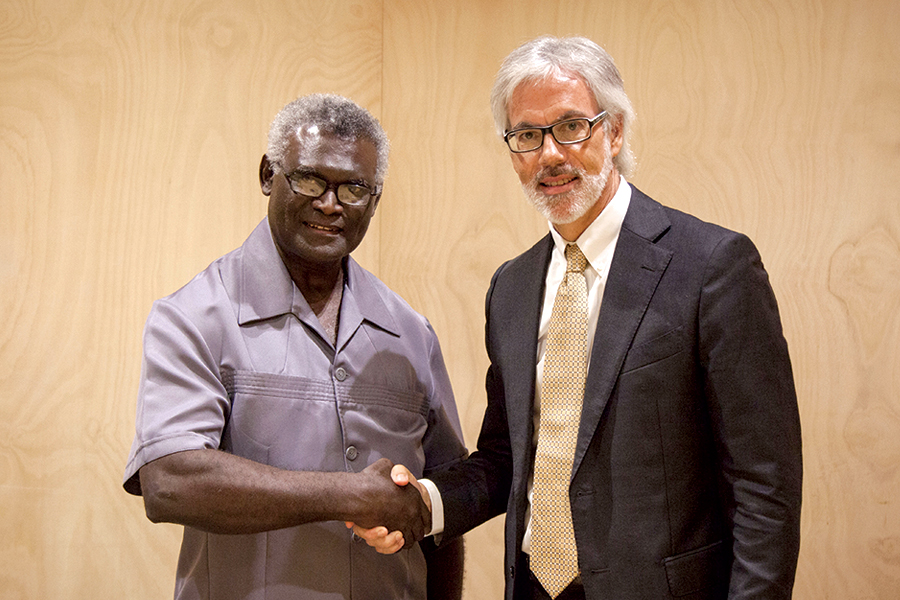
Deputy Prime MInister, Manasseh Sogavare, shakes hands with IFC's Pacific head, Thomas Jacobs, during a meeting in Honiara

BY GEORGINA KEKEA

IFC’s Pacific head, Thomas Jacobs yesterday met with Deputy Prime Minister, Manasseh Sogavare.

IFC the International Finance Corporation, a sister organisation of the World Bank and member of the World Bank Group – is the largest global development institution focused on the private sector in emerging markets.

The government’s meeting yesterday with IFC is focused on the private sector as well as IFC’s support for the tuna industry and efforts to boost tourism.

Last year in November 2017, IFC has signed a Memorandum of Understanding (MoU) with the Ministry of Culture and Tourism that aims to for a broader tourism programme in the country to boost tourist arrivals, generate tourism-related revenue, draw investments and create jobs.

Also in the tuna industry, in August 2017 IFC lends $10 million to National Fisheries Development (NFD) Limited to support sustainable tuna production and employment in the Solomon Islands.

The loan to NFD is IFC’s second investment support to the tuna industry in the country. The first being a $9 million loan provided to Soltuna Limited, NFD’s sister company.

This past week, the IFC’s Pacific head had been spent his visit on meetings with the government, business, and women.

His key focus is on IFC’s support for women in business, moves to boost the tuna industry and moves to spur tourism in the Western Province.

IFC’s work in the Pacific is guided by the Pacific Partnership. Australia, New Zealand and IFC are working together through the Pacific Partnership to stimulate private sector investment and reduce poverty in the Pacific.

Japanese friends experience Solomon Islands culture

0
Two visitors check out local materials display at the International wharf on Thursday

BY LYNTON AARON FILIA

HONIARA city was flocked yesterday with friends from Japan on board the Ocean Dream who were here on a mission to learn of the people and culture of Solomon Islands.

They learnt a lot about Solomon Islands’ culture during their visits to the National museum, Art Gallery, National Parliament, WWII site at Bloody Ridge and beaches in west Guadalcanal.

From a random interview with the Japanese tourists, they shared their experiences saying they were excited and enjoyed cruising around and learning new things about Solomon Islands.

Two visitors check out local materials display at the International wharf on Thursday

At the Museum, they were treated to performances from the popular Narasirato panpipe group and a dance group from the Isabel province. Many of the tourists could not resist the urge to dance to the traditional music.

Tour guides from Travel Solomons led them to see our country’s stored cultures, artefacts, histories and display of carvings and other local designs at the National museum and Art Gallery.

Many tourists returned to the boat laden with souvenir bought from the various vendors who sold a variety of cultural and traditional items.

Despite sun’s heat yesterday, friends from Japan still enjoy Honiara.

Travel Solomons engaged 47 local buses yesterday to transport the tourists to the country’s iconic sites while others hired taxis to the beaches for snorkeling.

Travel Solomons confirmed that 1,300 tourists came with the Ocean Dream Cruise ship, and all are Japanese.

MV Ocean Dream’s visit to Honiara is however not all about touring. A main component of their visit is to highlight and promote peace and grassroots interaction between Japan and host countries.

Stalls selling crafts.

They are also committed to campaign for the United Nations Sustainable Development Goals (SDGs).

Since 2016, the Peace Boat’s ship also named as Ocean Dream has sailing with the Global Goals logo on its hull.

Each port visited, Peace Boat also conducts activities with International Campaign to Abolish Nuclear Weapons (ICAN) around the world, and the ICAN logo is also featured on the ship.