Home Blog Page 1527

Auki fish market needs improvement

0

BY GEORGE MANFORD

AUKI

THE Auki fish market facilities are in need of upgrade and improvement.

A regular customer Mr David Hane raises this concern regarding the health and hygiene.

“The Auki fish market should be upgraded to provide clean fresh water and proper marketing areas for the fish market vendors. Most times I have seen the fish market vendors have collected sea water from the sea front area to wash their fish where it was polluted by rubbishes from the betel nut stalls nearby.

“Our fish market should be set up properly and needs clean fresh water every day for the vendors to do washing after marketing each day. I call on the Auki market management to look at improving those small areas which is more important for the good of our people concerning our health.”

Land development in Auki questioned

0

BY SAMIE WAIKORI

Auki

THE Malaita provincial government is being questioned for the non-development of purchased lands within Auki town

A man from Auki said the central business district of Auki contains parcels of land which have been paid for long ago, but today remains undeveloped.

He said according to the provincial land ordinance, land should be developed within 18 months after purchase.

He adds, failure to do this would lead to the province reclaiming back the land.

“But in this case, people purchased many lands within Auki town about 10-15 years ago and still without development until today. So who legally own those lands is our question. Whether the title holders still own the lands or the province already retrieve them?” the man said.

He said this practice of not developing paid lands in Auki contributes to stalling development of the township as a whole.

It blocks investors who want to come into Auki and develop it, and the province.

Ombudsman to increase staff

0
Ombudsman Fred Fakarii.

By Mike Puia


Ombudsman Fred Fakarii.

THE Ombudsman Office is looking to recruit more staff to roll out its new Ombudsman Act 2017.

The Act, which was passed in Parliament in July 2017, has come to effect on January 31 this year.

The Ombudsman, Fred Fakari’i, confirmed his office currently has about 24 staff and this year it looks to recruit about 16 more.

The increase in staffing is necessary as now the Office will also register verbal (in person or through telephone) complaints.

These are complaints from members of the public who think they are being unfairly treated by any government agency, ministry, department or contractor – maladministrative conducts.

Under the old Ombudsman Act, the Ombudsman office only registered written complaints.

Fakarii said the task will be challenging but it accepts the fact that most people in this country are illiterate.

He said opening the office to also receive verbal complaints will help get more people to come forward.

Fakari’i said the new Act requires the Ministry of Public Service to staff his office.

He also revealed his office is looking at the possibility of opening office branches in the provinces.

Fakarii said moving out to the provinces is a plan but it will depend much on the data the office will get about where most complaints come from.

“We will start here (Honiara). We might as well only need to make people in remote communities aware of this Act so they can come to our Honiara office,” the Ombudsman said.

The Ombudsman office, under the Act, now has a separate budget head. Most things required to get the Ombudsman office to do its work properly are required by law.

Kopu praises Taiwan’s clean energy project

0
HE Roger Luo and Minister Duddley Kopu

BY LYNTON AARON FILIA


HE Roger Luo and Minister Duddley Kopu

MINISTRY of Rural Development (MRD) appreciates Taiwan’s Clean Energy Project: One Student One Lamp programme, saying it aligns with national governments’ priority areas.

Minister for MRD, Duddley Kopu said Taiwan’s project of solar lamps for schools and villages in the country’s 50 constituencies is in line with the government’s national development strategy 2016-2035.

He said Taiwan’s programme specifically meets the Solomon Islands government’s aim to improve spiritual, social and economic livelihood of all Solomon Islanders.

“The programme is aligned with the NSD object three and SDG four and 13—Resilient and sustainable environmental climate actions,” Mr Kopu said.

“This Clean Energy Project: One Student One Solar Lamp Project is also clearly in line with various SIDCC Government policy priority programmes.”

Kopu thanks the Republic of China (Taiwan) for recognising the need for assistance in important areas.

Taiwan’s Ambassador to Solomon Islands, His Excellency Roger Luo said Taiwan is proud to assist Solomon Islands meets its priority goal, and reassures they will always stay committed to support.

“We wish 2018 Clean Energy Project: One Student One Solar Lamp Program will not only light up the night in the rural areas of Solomon Islands, but also shed light on a true sustainable future,” Mr Luo said.

Setting the record straight in the context of the reported conclusions of the TRC report

0

LAST week Ms Caroline Laore, one of the former TRC Commissioners, wrote a letter to the SI media urging the Solomon Islands Government to act on the recommendations of the Truth and Reconciliation Commission, saying the TRC report was tabled in parliament in 2012 but had never been acted upon.

Ms Laore also voiced her concerns about the TRC report when speaking with a reporter of Radio New Zealand International when she was quoted as saying, “People all round the country contributed to the report hoping their stories would help create a better Solomon Islands.”

She then said (relating to the final TRC report). “The conclusion was that government had a responsibility to protect its citizens but it failed because we all know the police force was divided so the citizens were left on their own.”

I fully understand Ms Laore’s call on the government to act on the recommendations of the TRC but I take issue over her statement to RNZI, “The conclusion was that government had a responsibility to protect its citizens but it failed because we all know the police force was divided so the citizens were left on their own.”

If indeed that is an accurate record of the conclusion of the TRC report, which I would need to see verified, then there are several matters that need to be clarified in order to set the record straight.

I have personal knowledge of the painful and tragic events that occurred from late 1998 (not 1997 as Ms Laore said in one of her statements to the media) when the so-called “ethnic tension” first became evident (and a situation that was continuing when I left the Solomon Islands in mid-July 1999).

In my book ‘Policing a Clash of Cultures’ (most chapters of the book, with the exception of three which the Editor of Solomon Times removed), are available to see and to read on the online publication ‘Solomon Times’ and my book is available on Amazon Kindle’s book shelf), I fully and truthfully recorded all the happenings and events from the time of assuming my appointment as the Commissioner of Police and until my departure at the end of my two year contract.

I have also covered the period between 1997 and mid-1999 in my autobiography ‘Cometh the Hour’ which is also available on Amazon Kindle’s book shelf.

When Ms Laore referred to the government, “but it failed, ”she was referring, I presume, to the Solomon Islands Alliance for Change Government (SIAC) which assumed office in August 1997 under the leadership of Prime Minister Bartholomew Ulufa’ala, but if one reads by book‘Policing a Clash of Cultures’ then one will get a better understanding and a clearer picture of the dire financial situation the country was in when Ulufa’ala took over, but also gain valuable insights into the terrible state I found the RSIP in when I took command.

One will also read of the Strategic Review of the Solomon Islands security situation conducted by Australia at the request of the SIAC government in the early months of my appointment, and at my instigating, but a review that failed to identify the internal security threats then facing the country in 1998/99.

The Review did lay out a 5 year plan for changes to the police service and operational improvements but, crucially, no financial help or logistical support was mentioned and Prime Minister Ulufa’alu labelled it a whitewash.

Readers will also be able to learn of the accurate intelligence reports that I presented to the SIAC government as early as November 1998 warning of the then serious threat posed by the militant activities of the GRA and of subsequent accurate intelligence reports I gave to Australia, New Zealand and other regional governments before leaving office and afterward in Australia.

None of those reports were acted upon, including the final one I gave to Australia’s Defence Intelligence Organization in July 1999 – yes 1999.

It was I that recommended the SIAC government seek help from the Commonwealth to try and broker a peaceful outcome to the internal civil conflict but even that intervention did not end the bloodshed.

During my tenure in office two foreign journalists in particular manipulated their stories of events occurring in the Solomon Islands as a means of promoting specific agendas and created events that did not happen and omitted positive happenings altogether.

Those journalists laid the foundation for a denial of the truth with defamatory reports and slanted racial slurs and it was my fear that the knowledge of the truth will die with those who lived and witnessed the real events, hence the reason for my books, and because the alternative version will be universally accepted as the true facts unless one reads today of what really occurred.

It would necessitate writing a very lengthy précis of my book ‘Policing a Clash of Cultures’ and the simple answer is for your readers to see for themselves what can be found by turning to the “Opinions Column” of the Solomon Times if one wishes to get a better understanding of why I contest Ms Laore’s allegations of a government that failed and a divided police force.

Yes, there were indeed some divisions that surfaced in the police service when forced evictions of Malaitan plantation workers on Guadalcanal occurred, and after many of the workers and their families had been attacked and injured during the early months of 1999, but the divisions were not so serious to have been contained if only Australia had acceded to my request for help, given the RSIP was greatly handicapped by its lack of manpower, equipment and logistics, especially transport and communications.

One will read in my book of the assurances given to me by the police of their loyalty during the troubled times and despite the fact that police patrols had often come under fire and their lives at risk.

My book also tells how Keke and Sangu and other fellow militants were captured by a police party on Bungana Island in early 1999 and taken into police custody awaiting a string of criminal charges for attempted murder, assault and theft of police firearms and ammunition from the Yandina Police Station but only to be released on bail by the then Chief Magistrate in a highly unwarranted decision which allowed the pair to escape to the Weathercoast and to continue their armed militancy until 2003

The RSIP in 1997-1999 was short of the most basic equipment, logistics and manpower after years of neglect by successive governments. It was not possible to have taken on the militants who were capable of faceless hit and run tactics in guerrilla style raids supported by many sympathisers on the ground with the available transport poor communications and a shortage of manpower well below the authorised establishment.

(Here readers might want to pause and reflect on what I wrote last week when commenting on the report by the incumbent RSIPF police commissioner of a shortage of police vehicles, maintenance problems and the need for replacement vehicles to remain operational).

Because there are three chapters omitted from those listed in the Solomon Times publication, readers will need to see those chapters in my autobiography.

It is too simplistic and not a fair or accurate judgment for Ms Laore to have said, (and assuming the TRC report did find), “The conclusion was that government had a responsibility to protect its citizens but it failed because we all know the police force was divided so the citizens were left on their own.”

The Solomon Islands was left on its own until the regional governments decided to become involved in 2003 after the Prime Minister was ousted at gun point in a coup. Prior to that Australia had rejected two pleas for help by Prime Minister Ulufa’alu and one by myself.

“Policing a Clash of Cultures’ sets out the background to Australia’s decision not to have helped its troubled neighbour and why, in 2003, following the two Bali bombings. and a strategic shift in Australia’s security policy, RAMSI was born and a huge transfer of military and civil assets diverted to Honiara quickly ending the civil unrest, the capture of militant foot soldiers and the surrender of weapons.

An intervention by Australia in 1999 with a contingent of ‘tough’ Aussie soldiers and some police, with a transfer of military assets and under the cover of enabling legislation similar to what was cobbled together in Canberra and Wellington for Operation ‘Helpen Fren’ could have routed the militants there and then, kept the SIAC government in power to pursue the reform programmes it had earlier initiated and given the police service the support that was needed to bring criminals to justice for the heinous crimes and atrocious acts they had committed.

In 2018 the “Big Fish” responsible for the ethnic uprising and the economic and social downfall of the Solomon Islands go unpunished while the victims of those terrible years of internal conflict are having to still appeal for justice to heal wounds and bring closure to their lives.

Note: In 1997 to 1999 during my time in office the police service was known as the RSIP.

Yours sincerely


FRANK SHORT

 

Loggers caught smuggling gemstones in West Fataleka

0
Picture of gem stones found in Solomon Islands

BY LYNTON AARON FILIA


Picture of gem stones found in Solomon Islands

MORE than 70 bags of gemstones have been confiscated from a container belonging to a logging company operating in West Fataleka, Malaita province.

Landowners recently found a logging company collecting gem stones in secret under the ostensible covering of logging.

A concerned Malaitan, Mr Francis Baeburi explained landowners caught the logger after investigating a ‘secret business’ which the loggers were involved in aside from their logging operation.

They then found the bags of gemstones hidden in the barricade of a container.

“The landowner at once demanded the loggers to remove the bags, as it is only appropriate under the agreement that log are the only resource to be harvested,” Baeburi said.

Baeburi cautions landowners across the country to be wary of loggers operating in their lands, saying they might be victims to these extra ‘secret businesses’.

Administrator of popular Facebook Yumi Toktok Forum, Mr Benjamin Afuga said their shared views debated are the beginning of any change to any legislation.

“We just cannot sit back, relax and expect things to happen, look at what is happening to our resources like gem stone, the so-called loggers are smuggling bags without any slightest benefit for LOs and province,” Afuga said.

He urges community leaders to work hard to lobby for legislation changes.

He said Malaita province has 14 members of Parliament which is a huge number to support for any push for changes in legislation.

Why we intercepted the Bougainvilleans: RSIPF

0
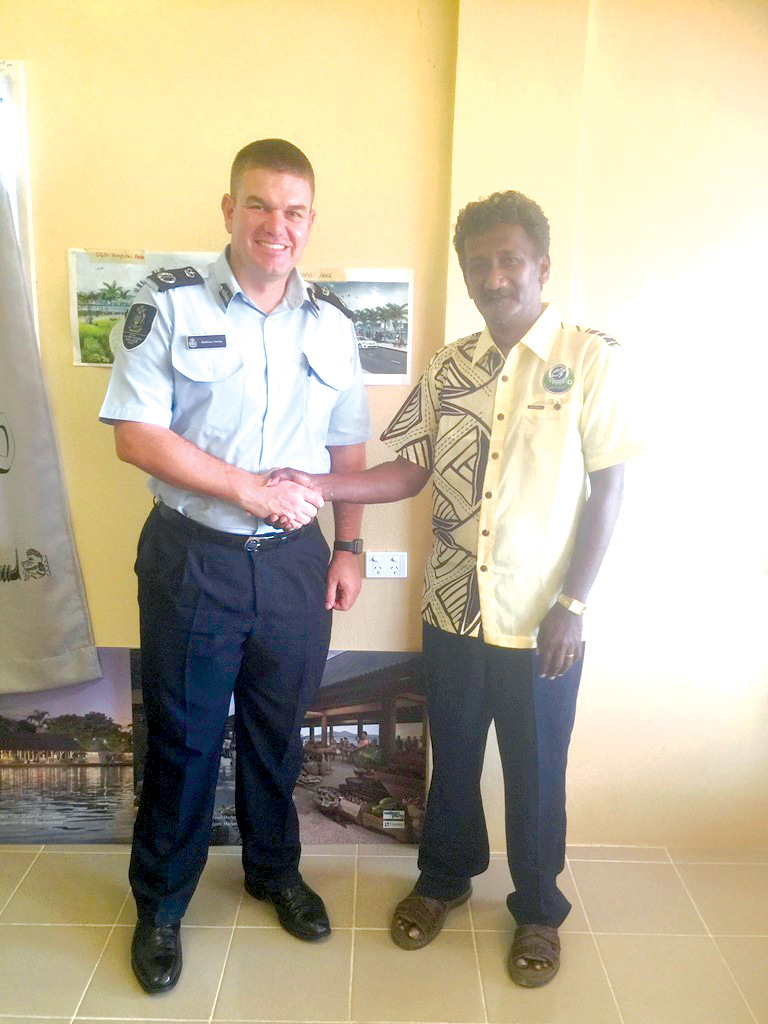
RSIPF Commissioner Varley meets with Western Provincial Premier, Wayne Maepioh during a meeting in Gizo.

THE Royal Solomon Islands Police Force (RSIPF) explains that it had to intercept 29 Bougainvilleans travelling in three boats at sea near Vella la Vella Island in the Western Province on Tuesday (February 20) last week because it had information that the group might pose a security risk to local communities.

Police intelligence indicated that the men were allegedly travelling to Gizo and Noro to demand compensation following the death of a relative in Noro town in early February.

There were concerns that if demands for compensation were not met, then community safety could be at risk. There was also intelligence that the men could be armed, which presented a high risk, requiring the involvement of the Police Response Team and Maritime Officers to intercept the boats at sea.

The men were detained at the Gizo Police Station on Tuesday night (February 20) while police and immigration officers made checks on their immigration status. Early the next day the men escaped from custody at Gizo Police Station.

Following negotiations between the Police, the Western provincial government and a chief representing the men, nine of the Bougainvilleans have since surrendered themselves.

The nine men have been interviewed and processed by police and immigration officers and assisted back to their side of the common Solomon Islands-Papua New Guinea border.

“The RSIPF intercepted the 29 Bougainvilleans for good reasons. We had reason to believe that if we did not intercept them before they reached Gizo, there was a possibility that they could have posed a threat to our people. The police did not want that to happen so we intercepted them and took them to the Gizo Police Station,” says Police Commissioner, Matthew Varley.

“Our actions might seem to some people that police do not respect the family ties that exist between the people of Bougainville and the Shortland Islands. Far from it. We respect the traditional ties but at the same time public must understand police has the task to prevent crime before it happens in our communities.

“The special customary travel zone between Bougainville and Western Province only applies to the area of Shortland Islands. There is no automatic immigration approval for foreign citizens to travel beyond the Shortland Islands. The RSIPF is duty-bound to protect the laws of this country.

“During the whole operation, RSIPF has been in daily contact with our counterparts of the Royal Papua New Guinea Constabulary in Buin on Bougainville updating them on our actions and getting assistance from the officers there.”

As to the question of the possibility that citizens of Solomon Islands residing in various locations on Bougainville might be affected following the incident of the 29 Bougainvilleans, Varley says, “We ask all peoples of both countries to respect each other’s laws. The RSIPF respects the strong traditional ties between the people of Western Province and Bougainville, but our communities must also observe the laws on both sides.

“We however believe that the community leaders of the Shortland Islands and Bougainville will not want any fallout from the events of the past week to affect their people and will work out in their own way how to stop anything happening.”

The RSIPF will continue to maintain a high visibility presence in Gizo and surrounding islands over the coming days.

Police will also continue to investigate the lapse in security which led to the escape of the men from Gizo Police Station in the morning of February 21. Furthermore police are investigating if any persons harboured and assisted the remainder of the escaped men to get back to Bougainville. It is unlawful to harbour and assist anyone who has escaped from the legal custody of police.

–POLICE MEDIA

9 Bougainvilleans surrender to police in Gizo

0

POLICE are in custody of nine of the 29 Bougainvillean men who had escaped detention last week in Gizo.

Five men surrendered to RSIPF officers in Gizo on Saturday (Feb 24), adding to the initial four men who had turned themselves in on Friday night last week.

The men are now at Gizo Police Station in immigration custody. They will soon be interviewed and processed by police and immigration officers.

The men are supposed to have been returned to Bougainville yesterday after immigration checks have been completed.

Plans are being developed to return the men to Bougainville under police escort tom.

The four men who were detained on Friday night have already been removed from Gizo on Saturday morning by RSIPF officers, after immigration processing was completed.

–POLICE MEDIA

New machines for Lau/Mbaelelea highway

0
New machineries ready for constructing Lau/Mbaelelea constituency propose highway- Photo courtesy on Facebook

BY LYNTON AARON FILIA

LAU/Mbaelelea constituency in north Malaita province has new machines to build its new roads and fix old ones.

A ground breaking ceremony and launching of the new machines to kick-start road construction in the constituency took place last week.

The ceremony was officiated by Member of Parliament for Lau/Mbaelelea constituency and Minister for Agriculture and Livestock, Mr Augustine Auga and his team.

The new machines come under the National Transport Fund, and Auga has utilised the fund as part of a rehabilitation project to construct a proposed highway road to the mountainous regions of his constituency and to upgrade existing roads.

The new machines include a bulldozer, excavator, digger, loader, roller, dump trucks and 500 drums of fuel.

According to the Lau/Mbaelelea Office, the road construction will start after launching because the machines and the fuel drums are already on site.

It said the proposed highway will start from the eastern side through the highlands and connected to the western part of Mbaelelea.

“This milestone project if completed will not only benefitting people of Lau/Mbaelelea constituency but Baegu and Fataleka constituency as well, and it will be less than four hours of traveling to and from Auki,” it said.

The people of Lau/Mbaelelea constituency thank Minister Auga for utilising the National Transport Fund for the most needed service.

They said for years people are have suffered from road accessibility to services such as health, education and marketing of garden products to Auki and Honiara.

The launching event last week was attended and witnessed by hundreds, and has been described as the first of its kind in the constituency since the country’s independence.

Mother of five ‘shortlisted’ for police training

0

By Alfred Sasako

A NORTH-WEST Choiseul housewife may have cracked the recruitment code in getting into the Royal Solomon Islands Police Force (RSIPF) allegedly without the prerequisite requirements.

The mother of five has reportedly been “shortlisted” to undertake a series of tests which would determine whether she is qualified to be in uniform.

Her inclusion on the shortlist has prompted questions about her qualifications as well as the potential to undermine maintaining the minimum entry level into the RSIPF.

“As far as we know, she only completed Grade Six. We also know that whoever put her on the shortlist had bypassed the prerequisites requirements for everyone who wants to join the RSIPF.

“These include fitness test, which requires potential candidates to run an X-number of kilometres within a set time,” one Choiseul man from the woman’s village told Island Sun last night.

“We don’t believe she has completed the fitness test and other prerequisite requirements before being shortlisted,” the individual said.

He said the woman’s name is now on the shortlist of more than 1, 000 candidates being posted at Kukum Police Station, Central Police Station and Police Headquarters, Rove among others.

“Her selection has raised a lot of questions about the due process. It has also raised questions about maintaining the minimum entry requirement into the RSIPF.

“We believe the minimum education entry level in RSIPF is Form 5 and 6,” one informant told Island Sun.

“Her entry on the shortlist is a clear case of corruption in the RSIPF. We demand that this matter be investigated,” they said.

Island Sun was unable to get a comment from the Royal Solomon Islands Police Force media.