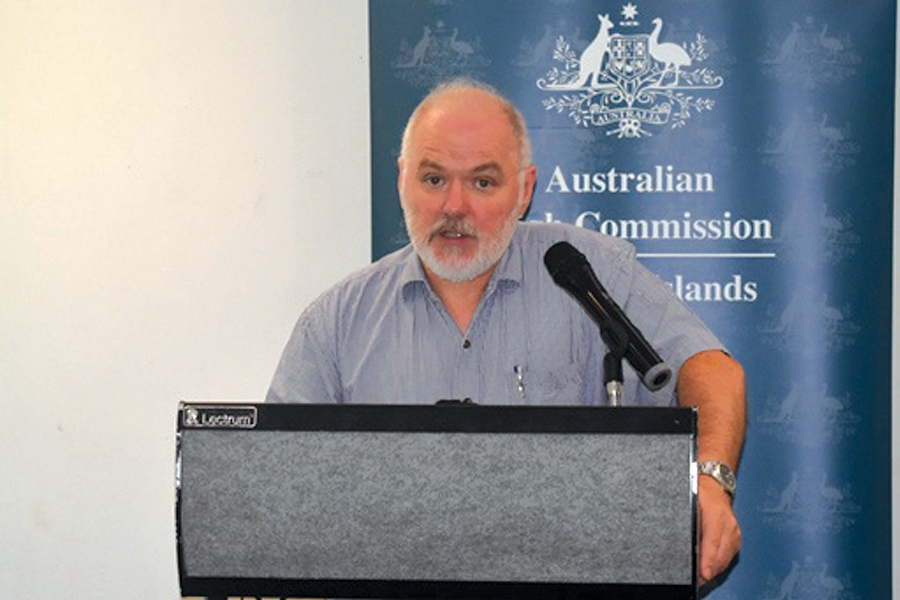
Professor Eves speaking at the Research Launch last week.
BY LORETTA BRIGIDIA MANELE
Professor Eves speaking at the Research Launch last week.
ACCORDING to Pacific Financial Inclusion Programme (PFIP) 2016 report of Solomon Islands financial services demand side surveys, the ratio of women to men with bank accounts is 20.1 percent to 31.8.
Associate Professor Richard Eves from Australian National University’s department of Pacific Affairs expressed this during last week’s Research Launch at the Heritage Park Hotel.
In 2014, he carried out a case study in Makira and Malaita provinces and worked with women’s savings groups to understand whether economic advancement in Solomon Islands had positive or negative outcomes.
Moreover, speaking of financial inclusion Mr Eves said that while the 2016 PFIP report indicates a lower percentage of women with bank accounts compared to men, informal financial services said otherwise.
“Despite this, 85 percent of women reported saving, with a high proportion saying this was done at home or in informal financial services, such as savings clubs,” he said.
Eves furthers that savings groups are one modality for delivering women’s economic empowerment interventions.
“In Solomon Islands, savings groups have been extremely popular and durable, emerging as a low-cost vehicle for providing much needed financial services, as well as keeping capital within in the local community,” he said.
A lot of people don’t have pensions and assisting to develop micro-pensions, even in small fractions will take pressure off the government, maybe in the long run.
These words were echoed by Mr Martin Hine, President of Global Partnerships, Bibimoney who along with Solomon Islands Postal Corporation (SIPC) called in the Prime Minister’s Office last week to brief Prime Minister Rick Houenipwela about their Ezi Pei system.
He stressed that besides providing services like allowing customers to withdraw cash from agents, buy goods, top up their airtime, transfer money across the country, put money back into their savings and make micro loan payments, they are also working on pension payments.
Hine pointed out that a good number of people do not have pensions hence mentioned that by providing this service, even if it is in small payments will somehow relieve the government.
He added that this service will also give people a sense financial control.
“It also gives people a sense of power, financial power and ability to control their own destiny,” said Hine.
MINISTRY of Police, National Security and Correctional Service (MPNS&CS) with its two agencies strives to establish a workforce that reflects gender equality and ethnic diversity.
MPNS&CS Permanent Secretary Ms Karen Qalokale, during the recent graduation ceremony of 40 new CSSI officers, said the ministry continues to uphold the comprehensive long term objective of successive governments to improve gender equality.
“But while we strive to meet this objective, we also consider that these selected few should be the best people for this important national duty in the Correctional Services. Also all must fit for the job and must be of fair representation of the 9 provinces of this country.”
WEST Kwara’ae voters are calling on their member of parliament to publish the constituency’s financial report for the last 11 years.
The voters say since 2006, their MP has not made public any report regarding the constituency’s RCDF.
“We want to know how the public money belongs to West Kwara’ae constituency was spent on constituency development projects or individual projects within the constituency.
“We call on the West Kwara’ae MP to clarify and provide the financial reports from 2016 to 2018. As a good leader for West Kwara’ae constituency we need transparency and quality leadership to be seen in our beloved constituency.
“We acknowledge our MP for his great effort for the past 11 years of leadership for your fine support towards West Kwara’ae constituency regarding your development plans for the people of the constituency.”
SOLOMON Islands Women in Business Association (SIWIBA) recently launched its strategic plan (2018 -2020) as well as a revolving fund for members who cannot access financial institutions for support.
Speaking during the official ceremony of its programme, SIWIBA CEO (Ag) Jennifer Pascal says the event is a milestone achievement for SIWIBA.
Echoing this sentiment, SIWIBA President Mrs Pamela Zoleveke says this is another boost for the women who continue to support their family through whatever means they can.
She says over the years, SIWIBA has continued to empower women in both formal and informal sectors. She says at first she was skeptical about women getting support from their menfolk but overtime it was proven that the men had continued to support their women in SIWIBA despite what other reports and survey might have said about men being less supportive of their women in economic activities.
Because of this, Zoleveke says she is also thankful to the men for the support they provide for their spouses. She says both women and men need to work together and this sort of partnership should be encouraged.
Also speaking during the launch was the Permanent Secretary of the Ministry of Women Youth Children and Family Affairs (MWYCFA), Dr Cedric Alependava who was impressed with the revolving fund.
“I came in last year to the Ministry and I was not able to support SIWIBA’s mini trade fair which some of the monies from the revolving fund came from. But I was able to support SIWIBA in the awards night held in early December 2017,” Mr Alependava says.
“For that the MWYCFA is proud to be a partner in SIWIBA’s endeavors to provide a revolving fund for its members, especially women in the informal sector.”
The awards night event is an ongoing support from the Solomon Islands government, which has a naming-rights partnership with SIWIBA.
Speaking on behalf of the women, Mrs Gale Au Ramosaea says the banks don’t recognise them.
“SIWIBA recognizes us to which we are forever grateful. The banks don’t recognize us only SIWIBA,” she says.
Speaking to Island Sun, Ramosaea says already she has secured four loans from SIWIBA for her shell money making business.
“I am so happy and proud that the revolving fund will be able to help women like me in the informal sector to get money to assist us in our business,” she said.
The revolving fund comes from monies from the women’s trade fair activities as well as monies from the SIWIBA awards night.
$100,000 is being used as the starting base for the revolving fund.
Present during the launch of SIWIBA’s activities were representatives and staff from the Australian High Commission Office in Honiara as well as the Permanent Secretary of Home Affairs, George Palua including the CEO of Solomon Islands Chamber of Commerce and Industry (SICCI) Dennis Meone.
Presented to the members and those present during the event was also a report on the awards night held last year. The report was compiled by Nina Tuhaika and endorsed by Mrs Julie Haro, Chairlady of 2017 SIWIBA Awards committee.
MP for Small Malaita Hon. Rick Hou is being nominated to run for PM onbehalf of the
DCC Group
By Gary Hatigeva
PRIME Minister, Rick Hounipwela revealed that his government has established a new management and oversight framework that will ensure there is effective coordination and implementation into key priority areas within the SIDCCG policy statement, which was launched on Friday last week.
According to the Prime Minister, the framework involves the creation of a “Core Ministerial Coordinating Committee (CMCC), based in the Office of the Prime Minister and Cabinet (OPMC)”.
The Committee comprises of selected Ministers who will provide the needed political leadership in the implementation of the government development programme.
Prime Minister Hou in an official statement explained that this strategic approach will ensure the political government as it should, “taking the whelm and the needed commanding role in making sure its priority policies are implemented appropriately and timely”.
He added that all these will be done through government agencies and their quasi agencies that have been designated for the tasks.
This Committee will also play a supporting role to the Policy, Implementation, Monitoring and Evaluation Unit (PIMEU) also based in the Prime Minister’s office.
The PIMEU will provide the secretariat support to the Cluster Groups to ensure there is comprehensive, cohesive and coordination of sectoral and cross sectoral programme and objective activities.
The Prime Minister said his government together with the support of the coalition parties within the SIDCCG, is confident that under his leadership, the government will deliver against its policy objectives however, calls for the participation of stakeholders in the implementation process.
He said his government continues to value the involvement of its stakeholders in the translation of its statement of policy into policy translation strategy.
“Together as a team, we can bring change in the lives of all persons in the country,” the Prime Minister said.
The Policy Translation Strategy provides the detail activities that will be undertaken in the expected outcomes that would be achieved from the government’s policy statement.
HAVING conversations about emotions is not one thing Solomon Islanders, particularly males talk about on a daily basis.
“I bet they’ve never sat down and have a conversation about their emotions”. This sentiment is shared by a trainer on behavioural skills, Mr Chris Elphick.
Mr Elphick from Breadfruit Consulting is based in Port Villa, Vanuatu and he and his partner, Hazel Kirkham look after the business focusing mainly on Melanesia. What they do is to support the development of businesses and organisations in Melanesia and other parts of the Pacific through training, coaching and mentoring in businesses.
Breadfruit Consulting apart from other topics also does what they call ‘soft skills’ training which focusses on human behaviour and attitude in the workplace.
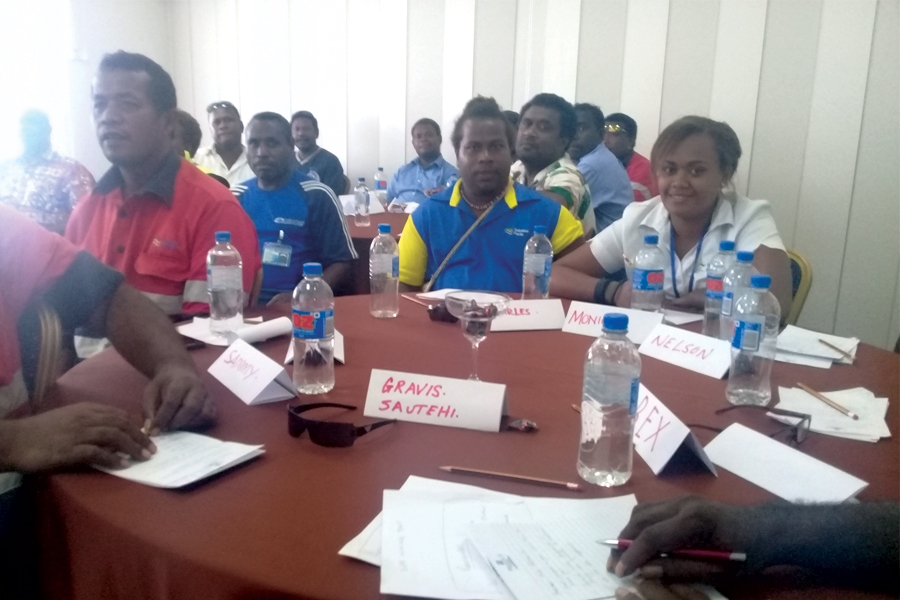
When Island Sun last caught up with Elphick, he was in Honiara to carry out a weeklong workshop for senior staff and team leaders of the Solomon Islands Ports Authority (SIPA) at the Heritage Park Hotel (HPH).
“As you can see for yourself, the room is full of men and yesterday we spent a lot of time focusing on our emotions. We started the day before and yesterday, two of the men came up to me and said, you know, last night I had a conversation with my wife, telling her about what I was learning. I had never done that before.”
Men in Solomon Islands tend to be quiet whilst women on the other hand will generally talk about anything even to a person they don’t know. In the workplace women often are the ones to raise issues, whilst men on the other hand will tend to be quiet and continue to do the task at hand with less protest. However, being quiet does also have its downside. Like a sleeping volcano.
SIPA staff during training
For leaders in the organisation, from strategy to hiring, no matter what they set out to do, their success depends on how they do it. When they thrive on positive emotions, they create a sparkling atmosphere and ensure success in staff’s performances. When they drive negative emotions, they also drive the organisation down and undermine group collaboration.
Dealing with change has always been difficult for any organisation. Some people feel okay and don’t believe any change is necessary whilst some are aware that a change is imminent but reject the change and its consequences whilst some might feel overwhelmed and confused because of the scope and pace of change. Then we have those people that embraced change and began working wholeheartedly in the changed environment.
In the country, Government state owned enterprises (SOEs) have been undergoing reforms to identify and address core issues within the SOE sectors.
Solomon Islands Ports Authority (SIPA) is an SOE established under the Ports Act 1956 (amended in 1996) to operate the ports of Noro and Honiara.
With strong support from the Board and Chief Executive Officer (CEO) they had engaged Breadfruit Consulting to carry out training for its staff with the aim to unify the whole Ports organisation as ‘one team’.
“With its troubled history, what staff must realise is that despite working in different departments, they are all one and they represent the one organisation. We see staff from different departments within the organisation working distinctly from each other. This has to be changed if we want our organisation to move forward together.
“The world is changing. We need to do something and we need the team to move forward together if we want to see a difference in how we do things.”
At the same time, SIPA Training Manager, James Gerea said the training which they had undergone had definitely changed the participants’ mindset.
“It is more self-analysis of ourselves, our values and how we can manage our emotions. This training is the way forward and a direction which SIPA has to take with strong support from our CEO. If people remain the same, culture not changed, SIPA will remain the same. Let us not think that we will remain as it is, as we need to change too because we are no longer a monopoly,” Gerea says.
Behaviour change doesn’t come overnight but it is important for an organisation to have employees who deliver high-quality goods and services, Elphick says.
“A robust human resource with emotional intelligence will be able to boost the company in the right direction once they understand the different roles each one has to play in order to fulfill the company’s objectives.”
This training is said to make participants more aware of their surroundings, how they interact with their fellow colleagues in the workplace and mostly make them more aware of themselves as a person and how they fit in the company and the society as a whole.
“We need managers who are well equipped to deal with issues in the business. From what I’ve learnt over the years, a lot of managers come into the office and close the door. We must know how to deal with our human resources. We call it unlocking potential in the pacific. I think a lot of our potential is locked up by our behaviours. If you can find a way in expressing yourself, you are going to start unlock something within you,” Elphick says.
The training for SIPA was carried out mainly for team leaders and senior staff with leadership roles who will be able to practise and pass what they have learnt to the junior staff.
Breadfruit Consulting is carrying out ongoing training for SIPA and will be heading down to the west soon to facilitate the same training for its staff in Noro.
An outspoken contractor from Malaita province has raised concern over delay of the National Transport Fund (NTF) under the Ministry of Infrastructure Development.
Mr Philp Iro said authorities need to clarify the delay of the NTF.
“The delay has now taken three to four months and is still yet to be settled, unlike few years ago it took them only one month to settle the payment. This matter has stirred our working recruits to compress us for their payment and also it has halted us to continue our road works in the province for this year.
“Hence we need the responsible authority to seriously consider our call and speed up the process of this delayed payment.”
Iro is one of the road contractor working in Malaita province.
THE Auki fish market facilities are in need of upgrade and improvement.
A regular customer Mr David Hane raises this concern regarding the health and hygiene.
“The Auki fish market should be upgraded to provide clean fresh water and proper marketing areas for the fish market vendors. Most times I have seen the fish market vendors have collected sea water from the sea front area to wash their fish where it was polluted by rubbishes from the betel nut stalls nearby.
“Our fish market should be set up properly and needs clean fresh water every day for the vendors to do washing after marketing each day. I call on the Auki market management to look at improving those small areas which is more important for the good of our people concerning our health.”
THE Malaita provincial government is being questioned for the non-development of purchased lands within Auki town
A man from Auki said the central business district of Auki contains parcels of land which have been paid for long ago, but today remains undeveloped.
He said according to the provincial land ordinance, land should be developed within 18 months after purchase.
He adds, failure to do this would lead to the province reclaiming back the land.
“But in this case, people purchased many lands within Auki town about 10-15 years ago and still without development until today. So who legally own those lands is our question. Whether the title holders still own the lands or the province already retrieve them?” the man said.
He said this practice of not developing paid lands in Auki contributes to stalling development of the township as a whole.
It blocks investors who want to come into Auki and develop it, and the province.