Home Blog Page 1515

Science equipment for GP schools

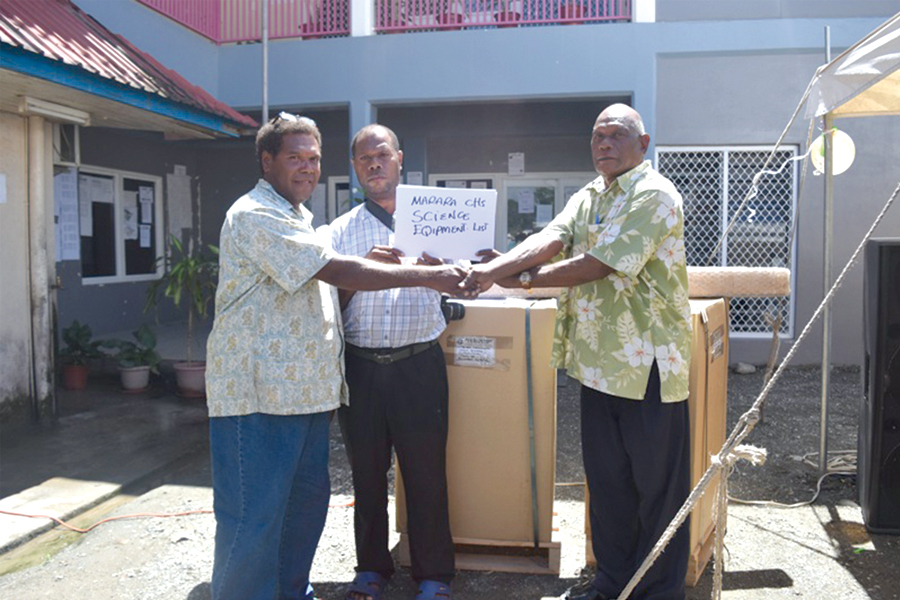
GP Deputy Premier Mr Peter Aoraonisaka handover science equipments to School principal in a ceremony held at the GP Head Quarter on Tuesday

BY LYNTON AARON FILIA

GP Deputy Premier Mr Peter Aoraonisaka handover science equipments to School principal in a ceremony held at the GP Head Quarter on Tuesday

FOUR secondary schools of the Guadalcanal province are owners of science equipment.

They are the first recipients of the PCDF – provincial capacity development fund project.

The equipment were officially handed over yesterday by the Guadalcanal Provincial Deputy Premier Mr Peter Aoraonisaka to the principals of the schools.

Speaking on behalf for the schools, the Principal for Marara Community High School Mr John Botsi said the schools are now well-equipped with science apparatuses.

He said their labs will be conducive to the students’ learning of science, especially regarding experiments.

“It is imperative for schools to have latest and high quality science lab supply these days,” Mr Botsi said.

Mr Aoraonisaka said the province’s government is likewise proud to assist its schools and advance their learning potentials.

Aoraonisaka thanked the Crowntech Scientific and Omega Scientific for delivering the equipment.

Permanent Secretary for Ministry of Provincial Government and Institutional Strengthening, Mr Stanley Pirione said the science equipment is fundamentally crucial for science curricular for children’s learning.

“It may not be enough in terms of overall need from education sector but at least these scientific equipments will surely benefit our children in their studies.”

APTC honoured in colourful graduation

0
Graduants

By Tanny.E.Vahi

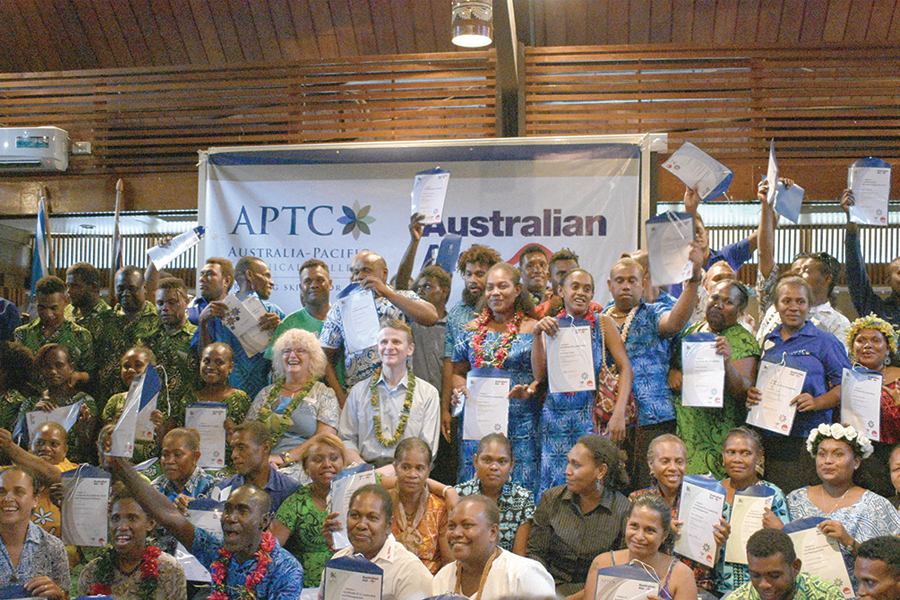
Australian High Commissionert HE Roderick Brazier delivering his speech.

MORE than a hundred students who studied at the APTC (Australia-Pacific Technical College) graduated in style yesterday in the presence of family, friends and peers, marking the successful completion of their programmes.

With the theme, ‘Contributing towards a prosperous Pacific driven by skilled, competitive and productive workforce’, the graduation ceremony started with a colourful parade, followed by singing of both national anthems, Australia and the Solomon Islands, at the Mendana Hotel Avenue.

The Australian High Commissioner to Solomon Islands, HE Roderick Brazier was the keynote speaker of the day.

Mr Brazier congratulated the students and urged them to use the knowledge gained to help in the growth of our economy.

“This day is your day. On behalf of the Australia-Pacific Technical College, it is my great pleasure to offer you our congratulations on this very special graduation day. You have demonstrated courage, hard work and dedication to your learning. As a result you have been awarded an Australian vocational qualification that is recognised nationally and internationally.”

In his accolade he extends his gratitude to the graduates’ employers and families for their efforts and support.

“You have made sacrifices to undertake your studies at the APTC. We know that for many, you needed to leave your place of work, your family and community for a period of time in order to undertake your studies. We thank your employers and families who have supported you through this time.”

Speaking for the students, Ms Betty Ramolelea thanks foremost the staff of APTC.

“It is an honour to represent all the graduate students. Today, we are so thankful and have trusts that we not only acquire skills and knowledge to equip us well for employment but that you have leave the experiences with new professional friendships and also has given us a new chapter I our lives.”

Ms Helen Leeson, APTC Executive Director Training Delivery, wished all the graduates well in their future.

“We appreciate that you came to APTC with a wealth of experience and such we acknowledge that we learn from you. All at APTC thank you for the opportunity to share in your learning. We trust that this is just the beginning and that you continue to strive to be the very best you can be in your preferred work. We wish you well on your graduation and for your future.”

The ceremony was closed by a word of prayer by Catholic Archbishop Christopher Cardone, followed by group photos and refreshments.

Siota PSS holds induction service for 2018

0
Siota PSS teachers during the Induction Service

BY BARNABAS MANEBONA

SIOTA Provincial Secondary School (PSS) held an Induction Service for this year 2018 last Sunday.

The special ceremony that took place was for teachers, school captains and prefect’s commitment to helping with the schools programs said Principal Fr Patterson Tako.

“Theme for 2018 is on “Restrengthening academic excellence” to quality teaching. We will be working closely with the Provincial Authority to academically improve Siota PSS so that it matches up with other Premier Schools of the country,” said Tako.

The induction was attended by the CIP Premier Hon Patrick Vasuni and members of the provincial government, CIP Education Authority, province administrators and inspectors and representatives of communities surrounding the school.

“We thank the provincial government for their attendance and we assure them in our handling with the school budget for this year,” said Tako.

He said the school’s students and teachers were very happy for the induction service to take place in which they ended the ceremony with a feast.

Mr Vasuni when speaking to Island Sun on Sunday said that he was impressed with the improvement in the schools administration and setting so far since experiencing academic downfall during the past year.

Gov’t comes under fire after Minister indicates objections to fragments of Nickel Project

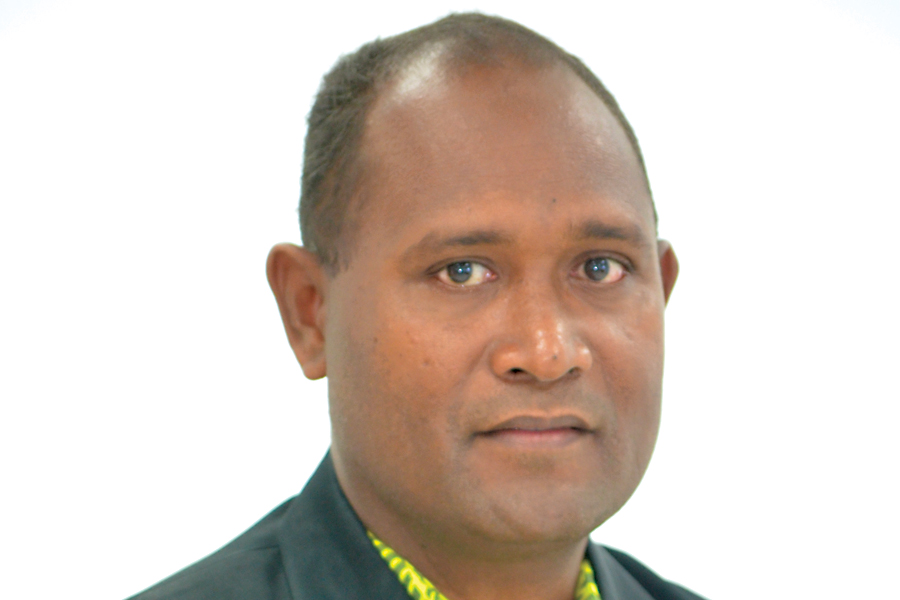
Minister for Health and Medical Services Dr Culwick Togamana

By Gary Hatigeva

THE Solomon Islands Democratic Coalition for Change Government (SIDCCG) yesterday, came under heavy criticism after one of its ministers spoke out in objection to one of the government’s policy initiations on the Nickel Mining Project in Isabel Province

Minister of Environment and Meteorology and Member of Parliament for Maringe/Kokota expressed his disagreements with current drive the government is initiating to have the Nickel Mining Project get underway.

In his contribution to the Nickel Project issue, which was put under question in Parliament by the Member of Parliament for Aoke/Langalanga, Matthew Wale, the Isabel MP suggested for the government to delay its processes on getting the projects started and wait for a better time when prices are stable to get the maximum benefits, but said in strong words his utmost objection to certain aspects of exporting the minerals.

“The likelihood of processing nickel on shore is very slim and so we will be left with one option, and that is to go for direct shipment of ore, certainly, the country will not stand to benefit from that and I as Member of Parliament from Isabel province, do not approve that,” the Environment Minister and Maringe/Kokota MP stressed.

MP Dr Culwick Togamana added that in terms of when the government would want the project to commence, “as we have heard from the Minister, now”.

“But note that the price of Nickel is down at its lowest and the sizes of our ores are very small and nonrenewable

“If we were to maximise the economic returns from those, then we will have to wait until the price of nickel goes up

“As it is now, if we start to do mining now, we are not going to get the most if we were to try to optimize economic returns from mining

However, following the Environment Minister’s statement the Aoke/Langalanga MP made a strong call on the Prime Minister to ensure cabinet thoroughly go through all its businesses before taking them to public.

He said this is to avoid making the scenario look as if the government come in differences and gone to argue over matters in parliament.

“It looks like you have not discuss this matters on the government level and so we see the member and minister of environment, who will issue the development permit seemed to have disagreed with the position taken by the minister for mines who is responsible for the activities and licences and so Prime Minister, I think this is a matter you need to sort out,” Wale pointed out.

Wale strongly reminded the PM and his ministers that the country needs the mines up and running and running in the best possible sustainable exploitation in the resources with a good distribution framework for all landowners to benefit from and not to repeat what continues to be experienced in the logging industry.

Gov’t close to getting Nickel mining projects running: Tovosia

0

By Gary Hatigeva

MINISTER of Mines, Energy and Rural Electrification, Bradley Tovosia says the government is confident with the progress in which things are handled regarding the Nickel Mining Projects in Isabel province.

The Minister made this statement when responding to questions raised in Parliament yesterday where he was asked to update Parliament on the status of the projects and enlightened the house on the government’s policy on the projects.

Mr Tovosia said with the current position of the consultation and meeting stages, the government is close to getting the projects started and are hoping that identified companies finalise necessary requirements.

It is understood that the government has been holding thorough talks with landowners and also met with companies the resource owners have earmarked to operate in their tenements.

In his response, Tovosia confirmed that the government has had successful meetings and consultations with landowners where joint conclusions were extracted.

He also confirmed that his ministry has met with the investors whom he said are genuine mining operators and not middle agents and two of them have shown keenness to start off with the projects.

The operators include two companies from the Asian region and one from Australia.

He said it is also the government’s wish to see that this project eventuates as soon as possible but will have to ensure that all procedures and processes are followed and completed before operations can actually start.

Following much confusions and uncertainty in the Industry over the past decades, the government has chosen to set high focus on getting things right and that came with the projection of reviewing mineral exploration and mining in the country, which according to the minister, is now taking shape.

Under its policy statement and priority guide and following years of uncertainty in the industry, the government is looking to see the advancement of Nickel mining in Isabel and Choiseul provinces.

Talking security again 20 years after a strategic security review

0

DEAR EDITOR, it was reported in the Island Sun newspaper last week that Prime Minister Hou met in Honiara with the visiting Head of Australia’s Intelligence Organization, ASIS, Mr. Paul Symon, when the PM was briefed on the proposed South Pacific Intelligence Dialogue (SPID) to be held in June this year.

The planned SPID meeting will follow a previous one held in Fiji last year.

During the course of his meeting with Mr. Symon, Prime Minister Hou was reported as having informed the ASIS head of the challenges faced with national security in the country, mentioning the Solomon Islands border with Papua New Guinea, confidentiality of information, cyber security and financial intelligence.

Rather surprisingly the PM was quoted in the paper as having said to Mr. Symon, “I believe we do have a national intelligence committee in the country but it has been operating on an ad hoc basis. Therefore, there is a need to establish a proper institution to address these issues.”

Taking the meaning of ad hoc for “a special or an immediate purpose without previous planning”, it was perhaps not untimely for the PM to add there was the need for a proper institution to address these (security) issues.

Twenty years ago there was a body in the Solomon Islands known as the National Security Council but that too seemed to have functioned on an ad hoc basis.

Just as PM Hou said the incumbent police commissioner briefed him and his Cabinet on the most recent incident regarding the much reported apprehension in February of 29 Boungainvilleans for allegedly entering the country’s border illegally, I too, as a former Commissioner of Police, reported security matters weekly to the Prime Minister and his Cabinet during the Solomon Alliance for Change (SIAC) administration.

My weekly reports were presented on information that had been provided to me by the RSIP Special Branch which was a valuable and much needed security intelligence branch that had been instituted during the Colonial era and its most senior personnel, including the Director of Special Branch and his Deputy, trained in security intelligence matters in the United Kingdom.

The Special Branch’s function and mandate was to identify any threat or potential threat to the security of the Solomon Islands and to develop intelligence of a political or sensitive nature and conduct investigations to protect the country from perceived threats of subversion, terrorism and other extremist political activity.

The Special Branch reports provided me with the means of giving the SIAC government the very early warnings of the serious threat posed by the activities of the GRA in November 1998 and subsequent reports provided by the Special Branch, aided by a British intelligence specialist I recruited to the Special Branch, provided the accurate ongoing security assessments which were disregarded by SIAC and by regional governments during my time in office from 1997 to mid 1999.

When the Regional Assistance Mission (RAMSI) arrived in the country the RSIP Special Branch was disbanded.

A Strategic Review of the Solomon Islands Security was conducted in 1998 by Australia at the request of the Solomon Islands (SIAC) Government and at my urging.

The concluding report of the Strategic Review which was handed to Prime Minister Bartholomew Ulufa’ala in April 1999 set out some specific recommendations on barrier control measures needed and I will quote some of the measures that were publically released at the time.

It has to be said that the Strategic Review did not spell out any financial support for any of the recommendations and in 1999 the SIAC government was faced with a dire financial crisis (a staggering USD 200 million debt) and soon became overwhelmed by the onset of militant activities (although predicted by the regular Special Branch reports). As a consequence none of the recommendations made in the Strategic Review were implemented. As I left in July 1999, I cannot say what happened to implementing anything in my absence from the Solomon Islands.

Quoting from the Strategic Review on Barrier Control and generally here is a précis.

“The key to effective barrier control operations lies in the implementation of a comprehensive surveillance regime to provide early and a reliably high probability of detection together with the effective coordination of response operations among relevant control agencies.”

“The situation will be significantly improved with the introduction of a new layered strategy. The first layer will be the information provided by regional intelligence sharing.” (Then there was little or none taking place but occasional drop-in visits from liaison officials from security agencies in Australia and New Zealand).

“Cooperation with neighbours in this regard is not well developed at present and it will be the task of the National Security Operations Centre (through the Intelligence and Communications Cell) to promote such exchanges.”

“The maintenance of a comprehensive national picture of sightings and movements is essential to developing this cooperation.”

“Some wide area surveillance will also be provided by patrols of the two Pacific Patrol Boats and aerial surveillance reports from flights by cooperating security partners.” (In 1997-1999 I received no such aerial surveillance reports).

“All government agencies must work together to manage current problems and to tackle the underlying causes of any future instability.” ( A remarkable sentence given that when the Strategic Review was given to Prime Minister Ulufa’ala in April 1999, GRA militancy was then intense and thousands of Malaitan plantation workers and their families coming under attack and being forced out of Guadalcanal)

It went on – “The contribution of areas such as education, youth affairs, and national development plans play a valuable part in avoiding tensions and dislocation within society and promoting realistic expectations and support networks, especially for the nation’s youth. Similarly, the effective administration of justice is essential to giving credibility to enforcement operations.”

“The National Security Council is being revived as a focus for this new approach.”

I do not believe the National Security Council got off the ground.

There was much more in the Strategic Review, including the suggested composition and make-up of the National Security Operations Centre, but hardly worth going into more details since the many recommendations were all ‘pie in the sky’ given what I have already had to say about the SIAC government’s finances, no support for the implementation phases of the Review from Australia and the onset of armed militancy.

In conclusion, I would like to endorse the words of Prime Minister Hou in saying that the Solomon Islands does, indeed, need to have a proper functioning institution to address the nation’s security situation if all that exists is a ad hoc Committee in 2018.

Yours sincerely

FRANK SHORT

Service to others and accountability of leaders

0

DEAR EDITOR, an article in the Island Sun newspaper on Tuesday this week cited a claim that voters in a certain Ward in Malaita province had questioned their MPA about the ward grant the MPA had allegedly received over a period of eight years and how he had spent that money, allegedly about $1.6 million over that time.

Without going into specifics, the voters of the ward in question raised concerns because they claimed they had not received any assistance from the particular MPA.

In keeping with previous comments I have often made in writing to the local media, MPs, whether those sitting in the National Parliament or MPAs in provincial assemblies are first and foremost servants of the people they are elected to represent and are duty bound to serve the interest of the voters.

If allegations of corrupt practices in the administration of the country are to be resolved then those who represent the people must be held to account and in the case of the distribution of ward grants or the disbursement of CDF funds subject to close supervision and auditing of all monies they receive on behalf of their constituents.

It is all too common to read of allegations of corruption involving leaders and perhaps unjustified in some cases, but to counter such allegations it would be in the best interest of all to be open and accountable for all dealings.

Yours sincerely

FRANK SHORT

Regulate area council acts – Chiefs responsibility

0

DEAR EDITOR, I would like to speak for the chiefs who are implementing an important role within our country that also liaise with the government’s plan of action but they were ignored for their time, sweat and thoughts.

It is understood for the establishment of chiefs acts, the Late Mr Solomon Mamaloni who initiated the local government and called it Area Council and amend its Acts for the chiefs in the rural communities to implement the Acts that the chiefs may as well achieve at the end of the day.

Engaging and trusting the chiefs to carry out major issues in the rural communities for example, land settlement and problem solving without recognition from the central government to me is seen as an illegal while the government considers others for permanent employment.

The government of Solomon Islands while engaging and trusting the chiefs for implementing their roles in the communities should set up a structure for the chiefs according to this:

1)              House of Chief- Chiefs sat at the panel for hearing of land settlements should be paid an allowance from the government budget and not for the parties who brought forth the land dispute for settlement.

2)              Local Court Judge- Those appointed to be members of the local court if the Solomon Islands government may consider their payment to a level in the Ministry of Justice and Legal Affairs as level 4/5 with a sitting and travelling allowance.

3)              Customary Land Appeal Court Judge – The members of this legal body should be considered employment to a level, as level 6/7 also with sitting allowance, travelling and dangerous allowance.

The Solomon Islands Government since the country has grown up and mature in its 40 years, need to change and improve some of the Acts.

Read Psalm 92:6, it reads, Senseless man never know, stand, fools will never understand.

Jessie Bobby,

Baelelea, Malaita

Saying sorry is a position of strength, not weakness

0

DEPUTY Prime Minister Manasseh Sogavare had a go at his boss on the floor of Parliament two days ago, accusing him of ignoring his brief for the recent Melanesian Spearhead Group (MSG) in Port Moresby, Papua New Guinea

That brief, according to Mr Sogavare, was essentially to hand over the MSG baton to the next chairman, PNG’s Prime Minister Peter O’Neil, and not to apologise. It’s quite a departure from the protocols of Parliament.

You are allowed to make such comments in Caucus and Cabinet, but not outside those two foras, which is open to the whole nation, given that proceedings of Parliament are transmitted on air.

But like it or not, the Deputy Prime Minister’s position is one many of our MPs support.

They believe it is wrong to apologise.

They also believe that by apologising as Prime Minister Ricky Houenipwela has done, we have weakened our position as a sovereign nation.

“We should have maintained our position on the West Papua issue, not apologising which made us a laughing stock before Fiji and Papua New Guinea,” they said.

That may be so.

But in a world where ego controls some, it is a breather to see someone has the guts to take the lead in showing servant leadership. Servant leadership, not macho leadership, is needed today more than anything else.

Macho leadership achieves practically nothing – we have seen that in the last three years. $4.2 billion in budget were used and there was little to show for such a phenomenal amount of money.

Servant leadership exudes greatness and strength. Apologising is therefore an outward demonstration of what is within and that we are prepared to forgive and forget.

Apologising is a position of strength, not weakness. It raises an individual who hitherto has been somewhat an unknown to the height of greatness. If follows then that if we want our nation to be great and recognised there is only one way to achieve that.

We must not only demonstrate our willingness to say sorry, but must be seen to be doing so. For the only way up is the way down – on our knees.

I firmly believe that Prime Minister Houenipwela did the right thing by us in apologising. We should never poke our nose into an issue which is already on the UN agenda.

Apologising does not mean we are precluding ourselves from making contributions to international debates on the matter. Far from it.

Apologising means we support all UN efforts being pursued to ensure the plight of the West Papua people remain on the UN radar at all times. By taking the position we did under the most recent administration implied that we are more powerful than the UN, which has already taken the matter on board.

Furthermore, Papua New Guinea the country that shares the common land border with Indonesia has taken a position that should be exemplary. Solomon Islands would do well to take a common stand with Port Moresby on the issue, instead of pushing it. There could be repercussions.

And so the position taken by Prime Minister Houenipwela is probably the best for us and the region, now and in the future. It is a position of strength, a position of peace, not of fear. It is a position that many world leaders lack at the present time.

And for us, it is a position that tells the world that it works for us. They should also try it.

By Alfred Sasako

Women press for progress, so do men

0

INTERNATIONAL Women’s Day (IWD) is fast approaching and once again achievements of women past and present will be celebrated with the theme “Press for Progress”.

Solomon Islands women have come a long way in a short time frame.

‘Breaking through the glass ceiling’ is the term which WDD Director Pauline Soaki used to describe women who are now occupying positions usually occupied by men.

Needless to say, some people might be skeptical of IWD and some might even say ‘olowe nomoa?’

Often we hear that ‘this women rights thing is getting to our women’s head that they don’t listen to their husbands anymore and that it is a waste of time’.

Humans as we are, these are the very challenges faced by women thus the theme ‘Press for progress’ is very appropriate.

Women’s struggles are real and only empathetic people will understand where women are coming from.

Despite the challenges, our men should also be commended for trying their best to support our women.

The road hasn’t been easy for everyone.

As we strive for equality, let us be professionals and act like professionals in our areas of work as well as in our homes.

Let us not fight against each other but support each other. Women don’t gossip nor back bite but empower one another.

As we commemorate IWD, women let us also take the time to salute our men and ourselves. Together we work hand in hand for the development of our country.

On this note, Island Sun newspaper will be featuring an exclusive centerpiece spread of some women who had ‘broke through the glass ceiling’ in tomorrow’s paper, thank you to Ministry of Women Youth Children and Family Affairs and UN Women.

Happy celebrations olketa mere. #PressForProgress