Home Blog Page 1376

Police arrest 2 females for brewing kwaso

0
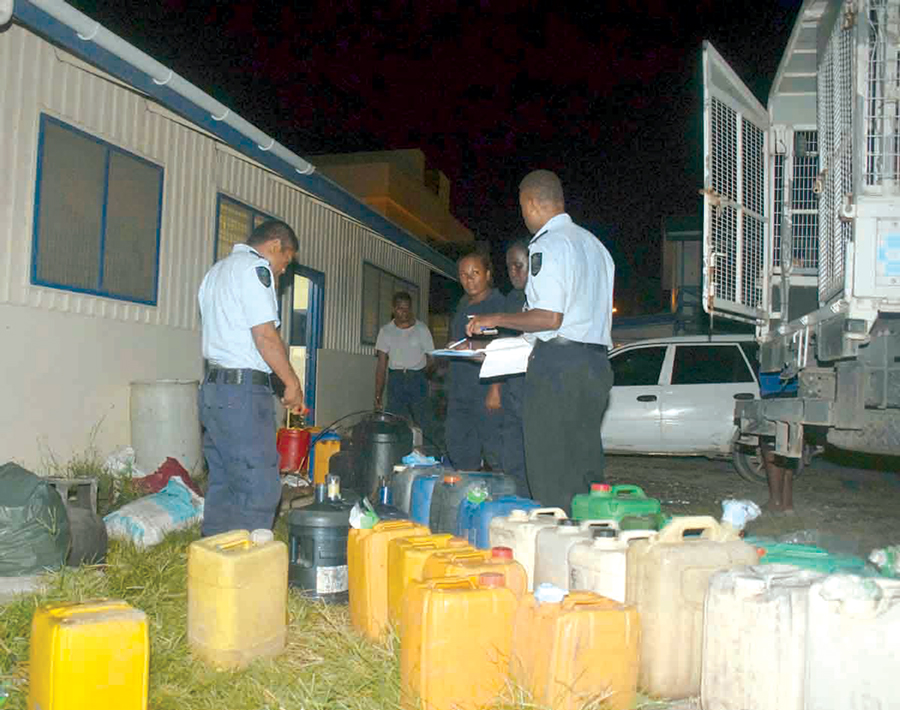
Honiara city police officers checking all containers of kwaso after the raid. Photo from Police Media

OFFICERS of the Royal Solomon Island Police Force have arrested two female suspects for illegal brewing of kwaso at the Crusher are in White River, West Honiara on Wednesday this week (May 9).

A 35-year-old and a 28-year-old female were arrested after police conducted a ground search warrant at the Crusher opposite the Karaina Settlement area.

The alleged suspects were apprehend at the Honiara Central Police station for further dealings and investigation.

Provincial Police Commander (PPC), Chief Superintendent Alfred Uiga says, “On May 8, 2018, my officers from the Liquor Squad received information from the community around White River that brewing and distilling of kwaso was being done at the Crusher opposite the Karaina Settlement.

“Based on the information we applied for a search warrant which gave effect to the raid in the afternoon of Wednesday, May 9. Officers involved included the Central Police Response team, Central Police Criminal Investigation Department, Police Response Team, Honiara City front line police and White River front line police.

“All the equipment for brewing of kwaso were confiscated and under police custody as police exhibits. The total value of kwaso confiscated is about $50,000.

“I would like to thank those communities who assisted police especially in the White River area and the Karaina settlement for their continous support to fight against this type of illegal activities in our communities.

“I would like to take this opportunity to commend my officers for their tireless efforts to conduct this raid and arrested the suspects.”

–POLICE MEDIA

Students question SINU’s action

SINU student on strike on April 4 at the Panatina campus

BY LYNTON AARON FILIA

MORE than 2,000 student members of the dissolved Solomon Islands National University Students Association (SINUSA) are questioning the University’s integrity over the termination of eight students in response to last month’s strike.

They are questioning if the termination of the eight students hold any element of justice, truth and fairness.

Late last month, the Solomon Islands national university terminated eight students who the institution claims were actively involved in the 14-day strike carried out early in April.

The students association (SINUSA) had led the student boycott of classes over several issues it said needed addressing by the institution, after giving SINU a strike notice earlier.

The concerned students counter that SINU should have sought the truth from students and open their eyes to the issues underlying the strike instead of opting to merely removing students.

They say SINUSA had resorted to the strike decision since all the formal avenues available to resolve the outstanding issues had been futile, adding that the students were only acting within their rights to ‘things’ which they perceive as ‘not right’ in the institution.

The students summarise the action taken by SINU to terminate the eight students as a ‘suppression of the students’ rights’.

In response to Island Sun queries, SINU Acting Pro Vice Chancellor Prof Basil Marasinghe said the eight students were terminated because of their direct involvement in the student strike.

He explained this was a result of the Students Disciplinary Committee’s investigation and deliberations into their behaviour which included issuance of press releases, organising protests and call for boycott of classes.

He said such behaviours are in breach of section 1.9 of Students Code of Conduct, which warrants termination with immediate effect.

“That is the truth behind their termination, and the university has nothing to hide by terminating these students,” Marasinghe said.

Marasinghe said only the eight students submitted a signed petition calling for strike and boycott classes and not one of the 2,000 students involved to have signed support for the boycott call.

Meanwhile, Marasinghe assures that there will be a by-election for the SINUSA executive soon.

KGVI students cry once more

0

BY LORETTA BRIGIDIA MANELE

STUDENTS of national secondary school, King George Sixth have expressed dismay over their administration’s leadership.

According to a report received by the paper, teachers are alleged of turning up to classes drunk, mistreating students, lying to students and being absent from class.

To add on, students are questioning why these school leaders are indulged in such actions if it has to do with taking their leadership roles as means to benefit themselves or others.

The acting principal was also referred to as “unqualified” and “unsuitable” to lead an institution like King George VI, for the reason that some of the programmes students enjoyed last year are now forbidden to take course this year.

Further expressed is that the students are humbly calling on the national ministry of education to visit the school and see for themselves the kind of discipline the school is under.

Mr Augustine Omearo, the acting deputy principal, was contacted for comments on the matter but he declined to make any.

Dwindling external funding support hits social services

By Alfred Sasako

THE impact of dwindling external financial support is beginning to show as donors, suffering funding fatigue, wind back their generosity.

With 52 percent cut in external funding this year, service delivery in the social services sector, is being hard hit. Long queues are expected in hospitals throughout the country as the impact of cuts in donor funding sinks in.

Former police commissioner, Frank Short, told this newspaper in a letter that the national life-saving programme run by the Solomon Islands Red Cross (SIRC) Voluntary Non-Renumerated Blood Donation Programme is now set to be the first casualty of cuts in donor funding by the end of June this year.

The program is being conducted in partnership with the SI Ministry of Health and Medical Services.

“Under the 2017-2020 strategy, the goal is to provide safe and adequate blood supplies in Honiara, Auki and Gizo with the objective of reaching eighty per cent (80%) blood donations voluntarily all unremunerated,” Mr Short said.

Funding for the programme has, in recent years, come from the (Australian) Department of Foreign Affairs and Trade through the Australian Red Cross (ARC). However, this support will now cease as from June 30, the end of Australia’s 2017-2018 financial year.

Mr Short said the local Red Cross Society would be placed in a very difficult position to support its national life-saving programme from then on.

“The SIRC has seen the importance of their national program over many years but to have their program cease will mean risking the lives of mothers and children and all who are in critical need of blood.

“Given the financial situation of the National Society, the SIRC will not be able to afford to take on the responsibility for its hitherto national life-saving programme and, as a consequence, the Blood Bank at the National Referral Hospital will be in a very difficult and critical position over blood supplies given that the Solomon Islands Red Cross Society might have to close down this national life-saving programme due to funding difficulties.

“For the past decades, SIRCS staff and volunteers contributed enormously in pursuit of blood collections and donations.

“Today, the society has reached a milestone in the success of the programme with 100 per cent voluntary donation and unremunerated.

“It matters most to the SRCS to save lives. The service the society has done until now is living testimonies for many people in the Solomon Islands,” Short said.

“Because of the importance of the SIRC programme and the critical service it provides nationwide, the ultimate goal is to ensure it remains operational. Simply, however, the SIRC needs to cover the costs of its operation.”

He appealed for support in order to help save lives.

“Please will you consider donating to the SIRC to keep the programme alive and save lives?” Short said.

No plans yet to re-arm ‘other’ units

0
PC Mathew Varley

BY JENNIFER KUSAPA

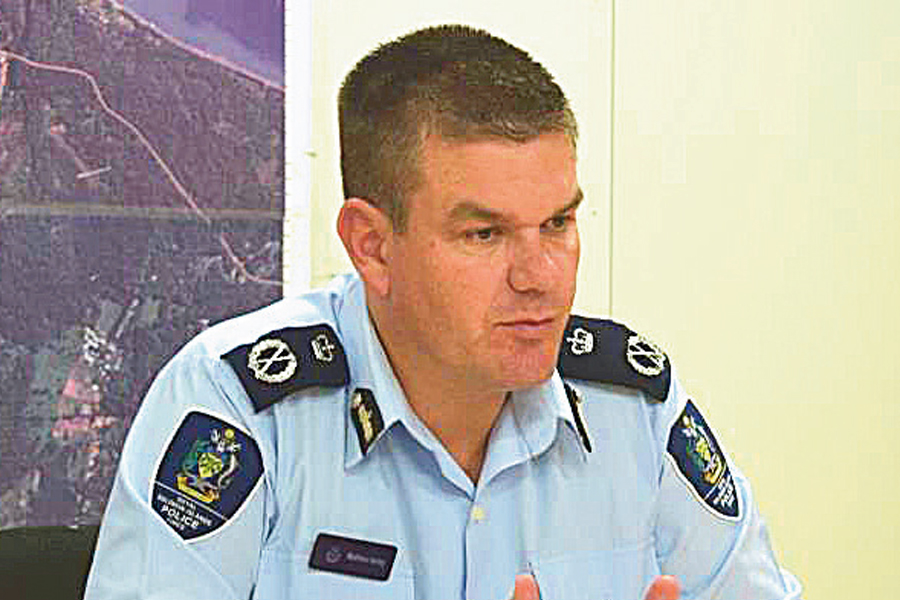
POLICE Commissioner Mathew Varley says there are no plans as yet to rearm other police units.

He said this in response to questions on whether officers in provincial stations which have the PRT stationed in are legible to be re-armed.

During the press conference yesterday, Varley downplayed rumours that the Auki police station has been rearmed.

He clarifies that the police response team were merely training the officers in Auki on less lethal weapons such as pepper sprays, baton usage and tear gas.

He stresses that there is a world of difference between non-lethal equipment and fire arms.

“We have what we call a response unit which the first line of public orders and these officers are well trained in capability such as riot control and public order incident and they use equipment such as shields, baton and helmets to be able to deal with first line of incident of riots and the PRT is the top level response behind them.”

No PPC at Tigoa police station

0

BY BARNABAS MANEBONA

LOCALS in Rennell and Bellona capital Tigoa are raising concerns that there is no PPC looking after the police station there.

Speaking to Island Sun in anonymity, three prominent figures in Tigoa community say Renbel’s provincial police commander Inspector Aloysio Manegaua had left Tigoa early April and has not been seen since.

They add that there has not been a replacement for Manegaua since, and the station is being manned by constables.

The Tigoa community leaders say there is an observed increase in anti-social behaviour, especially related to drunk and disorderly and public rows, which they say police do not act upon.

They are calling on the RSIPF HQ in Honiara to seriously consider Tigoa police station because Rennell island needs a working, visible and active police presence since it is a hub for extractive operations.

Island Sun had been following up the matter with the police media for clarification this week, but have not received any response.

Court dismisses Muaki’s review claim against LCC

0

BY BARNABAS MANEBONA

THE High Court has dismissed the Judicial Review of the Leadership Code Commission’s (LCC) determination process sought by former Special Secretary to the Prime Minister (SSPM), Andrew Muaki.

The former SSPM was found guilty of misconduct by the Leadership Code Commission in 2016 and penalised with a fine of $10,000.

According to report, the misconduct was said to have taken place within the Prime Minister’s Office during Muaki’s tenure as SSPM to then prime minister Manasseh Sogavare.

“High Court has dismissed his JR Claim on the ground because he did not satisfy the Court that there is no other available remedy that resolves that matter fully and directly,” said LCC in their press statement.

“In other words, Mr Muaki should have appealed the determination against him instead. This means that the LCC’s determination against Mr Muaki still stands.”

“However since the Court’s decision on 19 March 2018 to date, Mr Muaki had not paid his fine.”

Sick cows risk

MAL orders cattle from farm with TB-outbreak history

BY BARNABAS MANEBONA

A cattle farm in Fiji the Ministry of Agriculture and Livestock (MAL) orders cattle from has a history of cattle tuberculosis (TB) outbreaks, it is reported.

Interestingly, MAL’s Livestock Division prefers to be tight-lipped over this allegation when approached by Island Sun for clarifications.

This was brought to attention by concerned farmers who learnt that the Yangara farm, in Tavua, Fiji, has reportedly experienced few outbreaks of TB in recent years.

This concern has been raised on social media’s ‘Solomon Farmers Corner’ and have sparked quite a debate.

It is currently questioned if anyone knows of any information regarding a current proposed shipment of cattle from Fiji to Solomon Islands.

“The cattle (250 heads) are from the Yangara Farm in Tavua, Fiji, and this shipment is proposed for a breeding farm in Western province,” explained a post on social media.

According to the local poster from Makira province, who is also part of a family farming cattle themselves, he recently spoke to senior veterinary officers in Fiji and they raised two concerns.

First is why the Agriculture Livestock Division in Solomon Islands would want to buy and import animals from a farm experiencing regular outbreaks of cattle TB when they (veterinary officers) know the lack of capacities with big animal vet services in Solomon Islands.

“They had mentioned that the DFAT funded Vet in the Livestock office in Solomon Islands had already been advised of the situation by them but preferred to listen to the Yangara Farm personnel’s that the animals destined for Solomon Islands have been quarantined and are disease free,” said the poster.

“This is where the second concern is as to why would one believe the seller and not independent professional advice?

“Yangara Farm has many issues with damaged fences and animals mixing even going as far-a-stray as Ba, so how would infected animals not come into contact?

“Whilst I am a strong supporter of reviving the cattle industry and the need for import of live animals, I think importing animals from Fiji are not our best option. Even the Fiji Government has had to put strong control measures against use of its own dairy produced products within Fiji.

“This is by subsidising farmers to kill off animals in infected farms and even do stronger checks and balances on slaughtered animals being allowed for consumption.

“Vanuatu’s Government stands ready to assist us, however we have not been able to produce a report on the first and second batch of breeding cattle imported to Guadalcanal and Malaita respectively.

“I think the Vanuatu Government deserves that much of a jester and respect, considering they had to amend laws around export of breeding animals in the goodwill of helping a fellow Melanesian country only to have the herds killed at will without any real monitoring and support by our Livestock department.”

With the lack of check and balance in the Solomon Islands Livestock sector, according to the local, speaking in his capacity as a cattle farmer, without any Government or donor assistance the repercussions of one infected animal anywhere in Solomon Islands will affect the current disease-free status enjoyed.

“Why would we a free from any serious cattle diseases country would want to risk any future development of the cattle industry? Kill it even before it starts I suppose?” posted the local.

Island Sun has followed up on this issue for more than two months, and it is loud and clear that no one in positions of responsibility is willing to talk. From Solomon Islands ministry of agriculture to Fiji’s veterinary and livestock officers, there is screaming silence.

The MAL Director of Livestock Barnabas Keqa said that he will not comment or respond to the issue raised on social media.

“I have already been directed by the MAL Permanent Secretary (PS) to not make any response to this issue,” Mr Keqa said.

Attempts to get response and information from authorities and the cattle farm in Fiji that MAL is said to be buying and importing cattle herd from has not been possible within the weeks.

Pacific journalist launch environment network

0
PINA President Moses Stevens, left, EJN's Imelda Abano and PEJN Interim President Iliesa Tora cut the cake to mark the official launch of PEJN in Tonga, on Monday night.

BY ELLISON.T.VAHI

THE Pacific Environment Journalist Network officially launched a network that will act as a platform for the exchange of stories and news content on environment issues in the Pacific.

During the launching of the Network, Pacific Islands News Association (PINA) President Moses Steven said it is good that the Pacific tells its own stories instead of overseas media coming to report on issues of the Pacific.

“It is time Pacific islanders tell the world their own stories and this is a part of it. I would like to congratulate everyone behind it.”

He said PEJN should work with national media organisations to develop and grow reporting on environment issues ‘because we have to take ownership of our stories’.

PINA President Moses Stevens, left, EJN’s Imelda Abano and PEJN Interim President Iliesa Tora cut the cake to mark the official launch of PEJN in Tonga, on Monday night.

Earth Journalism Network’s Imelda Abano said it is important to have such networks to strengthen and improve the quality and quantity of environment reporting in the Pacific.

PEJN is registered in Tonga and will have its Secretariat in Tonga as well.

The Pacific Environment Journalist Network (PEJN) is made up of 10 Pacific journalists who had won awards to attend and report on the 23rd Conference of the Parties (COP23) in Bonn, Germany, in November last year.

Membership will be open to journalists from across the region.

Backed by a wide range of positive announcements from governments, cities, states, regions, companies and civil society, delegates from over 190 countries agreed to a 12-month engagement focusing on ‘Where are we, where do we want to go and how do we get there?’

The ‘Talanoa Dialogue’, inspired by the Pacific concept of constructive discussion, debate and story-telling, will set the stage in Poland in 2018 for the revising upwards of national climate action plans needed to put the world on track to meet pre-2020 ambition and the long-term goals of the two-year old Paris Agreement.

The Paris Agreement’s central goal is keep the global average temperature rise below 2 Celsius and as close as possible to 1.5. The lower limit is deemed crucial for survival by many small islands and vulnerable countries.

Over one degree of this rise has already occurred since pre-industrial times. The current set of national climate action plans, known as NDCs, are still heading for a path towards 3 Celsius, possibly more.

Frank Bainimarama, President of the conference also known as ‘COP23’ and Prime Minister of Fiji, said: “I’m very pleased that COP23 has been such a success, especially given the challenge to the multilateral consensus for decisive climate action. We have done the job we were given to do, which is to advance the implementation guidelines of the Paris Agreement and prepare for more ambitious action in the Talanoa Dialogue of 2018.”

“There has been positive momentum all around us. And Fiji is especially gratified how the global community has embraced our concept of a Grand Coalition for greater ambition linking national governments with states and cities, civil society, the private sector and ordinary men and women around the world,” he said.

“We leave Bonn having irregular up some notable achievements, including our Ocean Pathway, the historic agreement on agriculture and others on a Gender Action Plan and Indigenous People’s Platform.

“We have also secured more funding for climate adaptation and launched a global partnership to provide millions of climate-vulnerable people the world over with affordable access to insurance.

“I want to warmly thank our hosts, the German Government and the UNFCCC, as well as the residents of Bonn. We brought our Fijian Bula Spirit to COP and it’s been wonderful how people responded. Vinaka vakalevu. Let’s all leave rededicating ourselves to more ambitious action on climate change by moving Further, Faster, and Together in the year ahead.”

Positive impacts from SI cocoa entering world market

0
Australian High Commissioner to Solomon Islands Rodrick Brazier standing alongside the winner of the recent cocoa competition during the SolChoc festival 2018.

BY MAVIS NISHIMURA PODOKOLO

Australian High Commissioner to Solomon Islands Rodrick Brazier standing alongside the winner of the recent cocoa competition during the SolChoc festival 2018.

PRESENCE of Solomon Islands cocoa in the world market is positively impacting the country’s capacity and economy.

The success of the country’s cocoa industry means increasing income for cocoa producing communities, more employment created and wellbeing of individuals involved in the trade are improved.

This was revealed by the Australian High Commissioner to Solomon Islands Rodrick Brazier during the recent Solomon Islands Cocoa and Chocolate festival held in Honiara.

He applauds the country’s cocoa stakeholders especially the farmers for producing such fine quality cocoa.

“Production of quality dried cocoa beans for the international market has the capacity to increase incomes, create employment and improve the wellbeing of cocoa producing communities,” said Brazier.

Chief Executive Officer (CEO) of Strongim Bisnis Mandy Whyte said the growth of Solomon Islands cocoa industry is something everyone can benefit from.

“With this in particular I would like to acknowledge the Solomon Islands Government and the contribution of the Australian Government and the spirit and labour of cocoa farming families and producers of Solomon Islands and the buyers who can connect them to this increased prosperity.

“It’s been a great way for cocoa farmers to connect with cocoa buyers and learn about innovations in cocoa farming and production,” she said.