Home Blog Page 1296

Kilufi’I hospital in the clear with medicines

0

BY GEORGE MANFORD

AUKI

KILUUFI hospital yesterday confirmed that medicine and drug storages in the Pharmacy department is enough until the next supply is due.

Dr. Henry Kako director of Kiluufi hospital confirmed this during an interview.

Dr. Kako said, their supply is enough to cater for the hospital until they receive their next supply in the coming months.

“It seems that our supply here at Kiluufi will sustain our admitted sick patients and the public especially at the outpatient department (OPD) where it will be enough for a month or two if our supply delays”.

He said, that they are not experiencing shortages at the moment and all their departments in the hospital are still in good form in providing health services to the sick patients and those in the OPD department.

“Maybe such shortages will be experienced in the future but at the moment we are still operating without any shortages of medicine here at Kiluufi hospital”.

Island Sun Auki understands National Referral Hospital is currently facing drugs shortages.

Dermatologist reaches out to Auki for clinical skincare visit

0
The Australian dermatologist specialist, associate professor Dr Anthony Hall during his visit to Kilu’ufi Hospital in Auki

BY SAMIE WAIKORI

AUKI

The Australian dermatologist specialist, associate professor Dr Anthony Hall during his visit to Kilu’ufi Hospital in Auki

AN Australian dermatologist specialist has concluded a three days clinical skin disease visit to Kilu’ufi hospital on Wednesday.

During his short visit, Associate Professor Dr Anthony Hall attended to lot of patients with skin diseases at the hospital.

In an interview he said he was invited by the Solomon Islands Government as part of an aid programme from Australia.

He said it was a pacific island programme funded by the Australian government as part of the consequence of the tension where Australia provided assistance to Solomon Islands through RAMSI.

Hall said under the programme Australia will continue to provide assistance and a component of that assistance was to send a medical specialist team to help doctors in the country

He said he was the only dermatologist invited by the medical superintendent at NRH who saw the need for skin a dermatologist.

Hall said during his visit to hospitals in the country he helped doctors run clinical service on skin diseases.

He thanked the Australian government through the Solomon Island government for allowing him to come Solomon Islands under the programme.

Auki Women Care Centre eyes bigger development plans

0
Malaita Provincial Council of Women care centre in Auki.

BY SAMIE WAIKORI

AUKI

Malaita Provincial Council of Women care centre in Auki.

THE Malaita Provincial Council of Women has set in place its plans to develop the Women Care Centre in Auki.

In an interview with the President of the organization, Martha Rurai on Wednesday, she said that there are a lot of things she is putting in place for the development of the organization.

She said one area her office is working on now is the development of the Women Care Centre.

Rurai said refurbishment of the building will soon take place as she is looking at improving the Centre into a modern standard building.

“This is our short plan for the development of the centre that will include adjustment and upgrading of the settings within the building.

“Our long term plan with the centre is we are looking at constructing another building within the area that will cater for conference and hosting other bigger programmes,” she said.

Rurai said there are many programmes under her radar for the development of the Women Council, but focus is firstly on developing it before going to other areas.

She said the Women Centre was the foundation of the organisation and it must happen for the development of the organization.

Island Sun understands that MPCW has been working tirelessly over the past years on women issues in the province.

One major area they continue to provide service on was rehabilitating victims of domestic violence.

Biometric technology still to be used

0
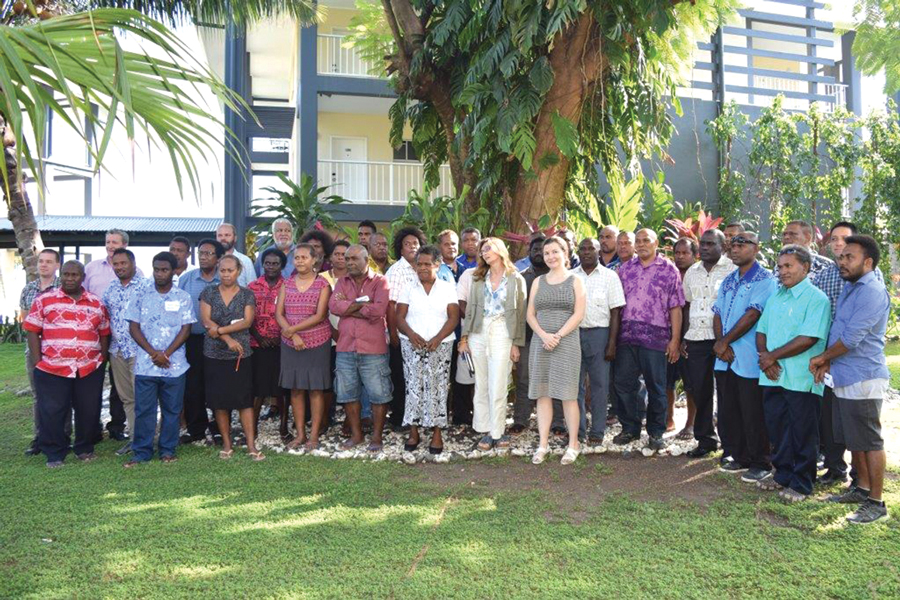
SIEC staff and RM and ROs posed for a group photo on Wednesday

BY MIKE PUIA

SIEC staff and RM and ROs posed for a group photo on Wednesday

SOLOMON Islands will continue to use the BIOMETRIC Technology first used in the 2014 national general elections registration process.

Speaking at the opening of the training, one SIEC’s commissioners, Ms. Taeasi Sanga said the biometric technology will again be used in the voter registration exercise.

Ms. Sanga said the biometric technology will reduce the incidence of multiple registrations that have occurred during previous exercises.

“Using biometric technology, the Commission hopes to produce a more credible register of voters for the 2019 National General elections,” Ms. Sanga said.

She encouraged participants of the training to involve all their community in engaging with them and to provide public awareness about the biometric voter registration program and voter information.

Ms. Sanga said she hopes the training package that is delivered will greatly assist those who are involved in the registration process know and perform their roles at a higher level.

Valapata Primary School in need of urgent repair

0

BY ALFRED PAGEPITU

GIZO

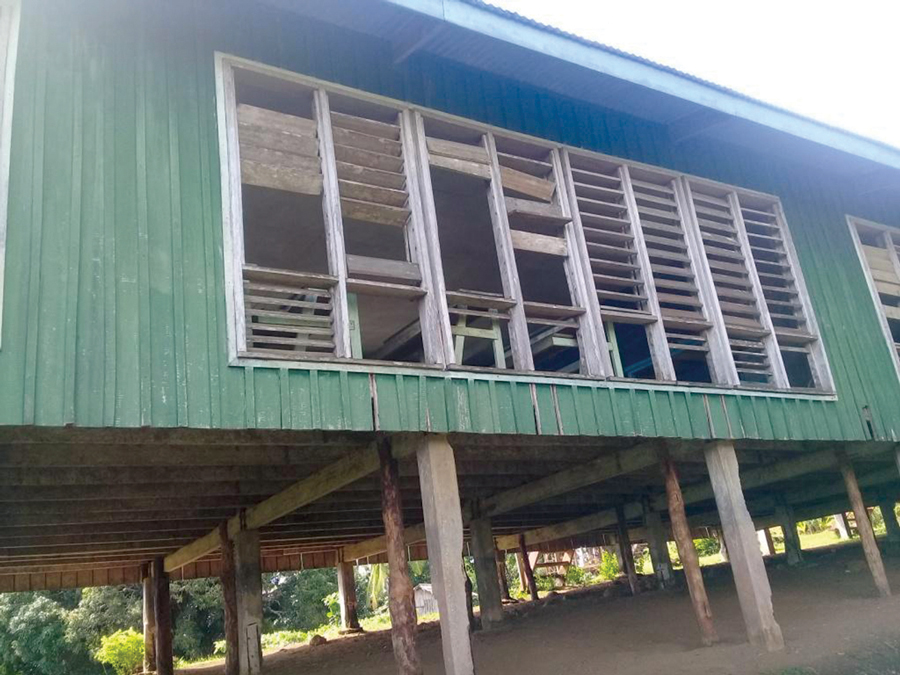
VALAPATA Primary School in South Vella la Vella Island urgently needs repair.

Headmistress Jennifer Kaniki is calling on the National government, Provincial government, Member of Parliament for South East Vella Constituency, Provincial Member for ward eight and Western Province Education Authorities to improve the infrastructure of Valapata Primary in Western Province.

Kaniki told Island Sun Gizo that the school staff houses, classroom and office have not been renovated yet and had not been improved since the School was established in 1989.

She said the School registered more than 140 plus students including 8 teachers with one extension school namely Baresama located within the School compound.

Kaniki said the School has now reach level seven, but the status of the building needs urgent repair and infrastructure development.

“I am concerned for our children and we need responsible members of the Western Province Education Authority and Wesley United Church Authority to quickly visit our school to improve the status of Valapata.”

“We want our government both provincial and National to re-build the school’s infrastructure for our children.”

“Children are the future of this province and nation but it seems our government and provincial members, communities around Valapata are not prioritizing education”, she added.

“This school is funded under Provincial Development Unit through Canadian fund way back in year 1989 until now, nothing have improved so we build one staff house but it was incomplete due to financial crisis,” said Kaniki.

Kaniki said the school is working close with the community to raise funds to slowly improve its status.

“Education is the key to success in everything and we need our children to learn in a good school environment”.

Invasive biotype of CRB damaging for country

0
Director Division Resources Terrestres (SPC) Mr Jan Helsen.

BY ELLISON.T.VAHI

Director Division Resources Terrestres (SPC) Mr Jan Helsen.

PACIFIC livelihoods and economies reliant on coconuts, oil palm and other palm species are under threat of an invasive biotype Coconut Rhinoceros Beetle (CRB).

According to Dr. Jan Helsen, Director of the Pacific Community (SPC) Land Resources Division, the new biotype of Coconut rhinoceros beetle (CRB), Oryctes rhinoceros was first discovered in Guam in 2007.

He said this biotype known as CRB Guam (CRB-G) is highly invasive with the ability to cause significant damage to palm trees. It can also rapidly adapt to its environment. Since its discovery, new invasions have been recorded on the Papua New Guinea (PNG) mainland (2009), Hawaii (2014), Palau (2014) and Solomon Islands (2015).

Helsen said that CRB Guam is resistant to known isolates of the Oryctes nudivirus (Or NV) which had previously proven effective against the CRB-Pacific (CRB-P) biotype.

He said that study of palms in CRB ‘hot spots’ with uncontrolled breeding sites yielded the following comparative results between the CRB-P and CRB-G biotypes, that is, that the CRB has a long life cycle of around 180 days.

“The adult beetles live up to 9 months, causing damage by chewing into the growing shoot of the palms, which results in the V-shape notches on the leaves after they unfurl, this is only noticeable sometime up to 4 months after the damage has been caused.

“Intensive feeding damage can also causes eventual death to the palms” he said.

He adds that the Tree mortality occurs when beetles destroy the growing tips (meristems) of palms in the immature stages and that the grubs feed on compost materials.

He further adds that the spread of CRB between islands, is highly dependent on human mediated activities.

‘’Soil and plant materials can contain the immature life stages of the beetle. The beetles are attracted to light from boats and planes, which can then transport them to new locations. Detection of first incursions usually results from evidence of physical damage symptoms on palm leaves” he said.

In the meantime Dr Jan said that Management initiatives to suppress CRB populations in infested sites may include; crop sanitation, pheromone trapping, biological control agents, cover-cropping, insecticide application and physical killing of beetles.

“The use of pheromone trap technology is common for CRB surveillance and National Biosecurity Authorities are encouraged to use them for early detection and monitoring programmes” he adds.

The Government of New Zealand and the South Pacific Community (SPC) leading the fight against the threat of the Coconut Rhinoceros Beetle

0

DEAR EDITOR, it was in a Post issued by the Solomon Islands Chamber of Commerce and Industry (SICCI) in January 2017 that I first read of the real threat for the coconut and palm tree industry in the Solomon Islands if the spread of the Coconut Rhinoceros Beetle intensified and went untreated as a pest.

I was aware at the time of the damage the pest had already brought to coconut palms in both Samoa and Guam and also in Hawaii and the impact of the pest on some coconut and palm oil trees in Guadalcanal.

SICCI had reached the view that the country could face a national crisis given the severity of the potential damage the Coconut Rhinoceros Beetle could cause but had mentioned that the biggest challenge in combating the envisaged threat was the lack of resources and funding to carry out proper assessments and effective treatments.

Some 18 months after the SICCI warning the full extent of the damage caused by the spread of the beetle was revealed in a recent meeting in Honiara which had brought together Government, private sector and international participants to develop an extensive clean-up plan to tackle the Rhinoceros Beetle threat.

During that meeting, the Acting Permanent Secretary of the Ministry of Agriculture and Livestock (MAL), Oswald Ramo, told the gathering, “Over the last four years, 90% of the palms in Honiara had been severely damaged or dead, such devastation being due to the Coconut Rhinoceros Beetle.”

The New Zealand Ministry of Foreign Affairs and Trade is providing $NZ1 million (approx. SBD5.4m) to support this latest clean-up project and additional help is being given by the Pacific Community (SPC) Land Resources Division, who are providing MAL with administrative and some technical support for the project.

Both the New Zealand Government and the SPC are thanked for the generous help rendered to the Solomon Islands to try and contain the Coconut Rhinoceros Beetle threat and, hopefully, to eventually to be able to eradicate the foreign invading pest completely.

Yours sincerely

Frank Short

Taiwanese help in donating medical supplies to the NRH

0

DEAR EDITOR, I am aware that the Taiwanese government on Tuesday stepped in to donate medical supplies worth SBD$80,000 to the National Referral Hospital (NRH).

I believe this was done in response to the current drug shortage at the NRH and essentially to be used in the hospital’s surgical wards and the operation theatre.

I express my personal thanks to the Taiwanese Government and to the Taiwan Health Centre at the NRH for this timely and very generous donation.

Yours sincerely

Frank Short

Donations to good causes in the Solomon Islands  

0

DEAR EDITOR, last month I wrote in letters to the local media how my partner charity organization in New Zealand, ‘Take My Hands,’ (TMH) had donated and delivered some ninety packets of assorted clothing to the Malaita based Hearts of Hope Charity working to aid over 1300 young children and elderly widows.

 A subsequent article in the media later featured how more than forty tiny babies had been given sets of clothing, including shirts and caps from that initial delivery from TMH.

 The first supply of clothing to HOH was facilitated by the very kind donation of money by the Solomon Forest Association (SFA) which covered the container freight from New Zealand.

 The work of the dedicated team of volunteer workers of HOH, led by Ms. Janet Aihari, continues to reach out to many orphans and elderly people throughout Malaita Province.

 To provide the assistance that is increasingly needed across the province, HOH needs more help by way of clothing and donations to acquire mattresses, blankets, towels, soap, school exercise books, pens, pencils, colouring materials and footwear for women and boys and girls of all ages.

 A Singapore second-hand clothing trader has been in touch with me offering to send HOH all they need by regular supplies of clothing but at “competitive prices” which, of course, is a drawback given HOH is a charity essentially providing help without any funding, other than what is given locally, albeit still insufficient to meet the needs of the poor and needy HOH works to help.

 If anyone is able and willing to donate funds to continue to get more clothing collected and freighted from TMH or to help pay for at least and initial supply of clothing from the Singapore trader, please write to me via the link on my websitewww.solomonislandsinfocus.com.

 In terms of offering donations, let me end by reporting that a private donor from Australia has written to me offering to help the SI MOHMS with ‘dressing materials’ and ‘over the counter first aid supplies.’  This offer has been made known to the Medical Superintendent of the NRH and the assistance is now under consideration by the potential donor.

 Also, finally, I extend my personal thanks to the Taiwanese Government for the medical supplies most recently donated to the NRH as a result of the current shortages.

Yours sincerely

 Frank Short

Wantok System and its historical evolution, Colonialism and the Political Economy in Pre-independence Solomon Islands

0

By Derek Smiles Mane

IN the Pacific region, particularly in the Solomon Islands, the wantok system is seen as an informal social network that households or individuals employ to access much needed resources, government services, favours, or job and educational placements. Although many view or understands it as an important social network or a coping strategy of the poor, it has negative impacts.

In the Solomon Islands, individuals or groups use such wantok network to influence politics (who gets what), resource sharing, and to maintain peace. However, in the process, state rules and laws are often compromised and being abused by the wantok system. Political analysts, scholars, journalists and other commentaries often view the wantok system as the major stumbling block to modernisation in the Solomon Islands.

However, although the wantok system has negative impacts, there are some positive features we need to critically understand. For Solomon Islanders to convert the wantok system into social capital, we need to re-access how the contemporary wantok culture emerged and its historical transition. I felt that by understanding its history, we may be able to re-organise how we can utilise the wantok culture to drive rural development and meet our development aspirations.

The formation of the contemporary wantok system culture is associated with the spread of Christianity, the plantation network, and the birth of Pidgin English as a spoken language. The idea of the wantok system may have started much earlier with the missionaries. Mission schools were indeed a space for interculturalism. Similar cultural orientations can be seen later in the plantations. However, the compositions of labourers in the plantations were more diverse. Being isolated from their village the probability to interact, passing ideas and cultural elements with one another were high. Such space re-enforce ‘brotherhood’, or ‘oneness’ culture. Although their tradition and languages differed, cultural values were similar. The emergence of ‘pidgin’ as a common language eased the transition by disabling language barriers, misunderstanding, suspicious behaviour and improved effective communication to build personal relations. Soon after, such personal bonding evolved to group bonding and spread out of the plantation.

The spread of the wantok idea in the plantations soon travelled through the major shipping routes and ports aided by the pidgin language. Pidgin quickly becomes the language used for trading and selling. Villagers had to embrace and learn pidgin in order to trade. Back in the commercial plantations, the sense of wantokism had transformed into a bargaining tool for workers’ unification, challenging the ill-treatment by white plantation owners and working conditions. For example in Rabual, Papua New Guinea (around the early 1920s) on the German plantations for the first time white owners experienced labour strikes. There is no doubt; such news that transpired in Rabual via plantation shipping routes might have inspired wantok movements in the Solomon Islands.

In the Solomon Islands, the spread of the wantok culture become an avenue to confront imperialism. For example, in Santa Isabel (1920 or there about) the chair and rule movement (vaukola) organised by Father Fallows and his Christian chiefs demanded native voice in the British Advisory Council, the Ma’asina movement (1950) in Malaita (Are Are), the Mathew Belamataga’s freedom movement (1948), and the Moro movement (1950) in Guadalcanal are clear illustrations of such wantok movements.

Although the wantok culture was partly the reason for nationalism movements, what could we learn from it today? However, we also need to understand our colonial economy to plot our development future.

The post second world war government in the Solomon Islands continued as an experiment for modernisation projects. The British in the Solomon Islands established a Western economic system with copra being the largest source of income for its subjects and the government. Yet, production rates were low, with only 6,600 tons of copra in 1917, 21,000 tons in 1939 and 24,000 tons by 1960. This indicated that the economy had not improved since the pre-war era. Nonetheless, the situation gradually changed into the 1950s registering an economic growth of 5 per cent per annum. The growth can be associated with the colonial government’s shift in approach to the economy and the increased British foreign aid which has partly improved local infrastructure and communication. Yet such improvement were designed to attract foreign investment and not for local production.

Although the British colonial government played a minimal role promoting local production, it facilitates some investment in agriculture; particularly the village base agriculture projects. In Fiu village, Malaita, for instance a government demonstration farm was established in the early 1960s. The farm resembles farms in New Zealand, Australia, and other western countries. Although many locals participated in the farm, they were merely labourers. Whilst they mastered the routine farm work, none acquired managerial skills. This partly led to the failure of the farm. In other districts, agriculture diversification of cocoa, rice, chilli, peanut, and livestock, along with small business ventures were introduced. To their disadvantage, almost no incentive was undertaken to stimulate indigenous entrepreneurship training, nor loans (medium and long term) for establishing the local business. Education was solely the missionaries’ job, and even towards the late 1960s, there were no vocational schools, capable of training managers and businessmen and women. Moreover, such initiatives did not lead to significant agrarian technology change. For example, when the protectorate was established, bush knives, hand hoes, and steel axes were promoted as main tools for agriculture and were still the main tools.

So what does history inform us about our development plights today? After almost 80 years of colonial rule and 40 years of political independence what has changed? Today, most entrepreneurial or business activities are still in the hands of foreigners and Solomon Islanders continue to play the servant role. When will we start operating and managing our own investments? On the other hand, the government still continues to prioritise the interest of foreign businesses (mostly logging, mining and fishing) through tax exemptions and allow foreign companies to expatriate money overseas, while government subsidies to encourage local entrepreneurs and investment are limited and not prioritised. In the villages, most Solomon Islanders still view development as a gift foreigners will bring and dish out to them. They continue to rely on projects and funding rather than working for themselves. The Solomon Islands Government instead of eradicating this poor mindset has led a state sponsored dependency syndrome campaign by legitimating the use of government funds (RCDF) to feed this mindset. Farms are still subsistence oriented and technology remains primitive. Solomon Islands complained bitterly claiming that land is the issue to development, yet in rural areas, there are logging camps in every village sea front. So should we blame our culture and traditions for our misfortune?