Home Blog Page 1227

Pupuku Mothers Union set for first mission and 100th anniversary celebration

0
Hon Connelly Sandakabatu with members of Pupuku Mothers Union group and Chief Siro.

BY LORETTA BRIGIDIA MANELE

Hon Connelly Sandakabatu with members of Pupuku Mothers Union group and Chief Siro.

A Mothers Union group from Northwest Choiseul constituency’s only Anglican community, Pupuku community will for the first time travel out of the province to Isabel province and are thankful for their Member of Parliament, Connelly Sandakabatu for his support.

On August 16, the six member group received $5000 from Sandakabatu that will assist them when they travel to Buala to celebrate with other Mothers Union members Isabel Diocese’s Mothers Union’s 100th anniversary.

Whilst addressing the group, Sandakabatu told them that mothers are the center and entity in the family and without them the church will not grow.

“You are the eyes, the ears, the mouth and the nourishment of our children and if I can help you the little I have I think that is the best way to grow the church. The best place to grow the church is through Mothers Union,” he said.

Pupuku Mothers Union group leader, Ms Joanah Kanakolo said they are thankful for his support and would not be where they are without him.

“I want to say thank for the assistance you have given us. Although we are a small community you accepted our request,” she said.

Chief of Pupuku community, Abraham Siro also thanked Sandakabatu and commended him for taking time out of his busy schedule to come and see them.

He mentioned that despite Pupuku being a small Anglican community under the Diocese of Isabel, they have a responsibility for the diocese and for the Anglican Church of Melanesia (ACOM).

Members of the Pupuku Mothers Union group told Island Sun that they are very excited to go to Isabel province and are really looking forward to the trip which they will make later this month.

Three Taiwan specialists share SI experience after 11 month mission

0
(Left to right) Chien-Jang Huang, Shao-Chuan Yu and Chia- Han Hou.

BY LORETTA BRIGIDIA MANELE

(Left to right) Chien-Jang Huang, Shao-Chuan Yu and Chia- Han Hou.

IN Taiwan, young men are required to do military service or provide their services in any of Taiwan’s ally countries.

Shao-Chuan Yu, Chia-Han Hou and Chien-Jang Huang are three young men who decided to leave their country and travel all the way to Solomon Islands to provide their specialised services rather than joining the military service.

They graduated from the best universities, are all masters graduates and came to serve the country through their services at the Taiwan Technical Mission (TTM) farm.

Shao-Chuan Yu, who specialises in nutrition mission in the country focuses on helping to improve the health status of Solomon Islanders through school farms and school nutrition.

Chia-Han Hou work involves helping out to manage the farm as well as in the delivery of fruits and vegetables to schools located near the farm.

Chien-Jang Huang’s mission is to provide qualified piglets and pig farm managing skills to local farmers in order to improve piggery industry in Solomon Islands.

They have served and been in the country for about 11 months and will soon leave for Taiwan sometime this month and next month.

All three have found Solomon Islands interesting with eye opening experiences of how different Solomon Islands is to Taiwan.

For Yu, Solomon Islands is a lovely place where unlike Taiwan, life is more relaxed and the pace of life makes him feel so comfortable despite the difference in weather, culture and people.

He says that the friendliness of people here is what lessens the feeling of being homesick.

During his mission, Yu said he had to interview staff of school kitchens and collect data which was very interesting.

“Things like chopping vegetables, boiling the water and cooking the food in local style is also refreshing. I also got more familiar with Solomon Islands’ food culture and know how people eat and cook. I guess that would be my favorite memory of the days I spent in Solomon Islands,” he said.

Hou said the most unforgettable moment during his time in the country is when he worked with the horticulture staff and got to communicate with them in Pidgin and hear them speak in their own dialects.

He said it is moments like this that makes him feel closer to the real Solomon Islands.

Hou added that Solomon Islands is truly the happy isles it calls itself.

“Solomon Islands call itself the happy isles and it truly is because people are always smiling with smiles bright as the sun here. People are always taking their time, enjoying every day with no worries,” he said.

Meanwhile Huang expressed that everything he has seen in Solomon Islands has impressed him.

He said the country is different from Taiwan not only in climate and environment but also people.

“The people here are very friendly and lovely. In these 10 months, I’ve met many people, and they have helped me a lot. This is a great country,” said Huang.

Huang mentioned that working with his colleagues is unforgettable especially when he uses pidgin to communicate with them.

“It seems I can be one of them, to be an islander. I really enjoy my time with them,” he said.

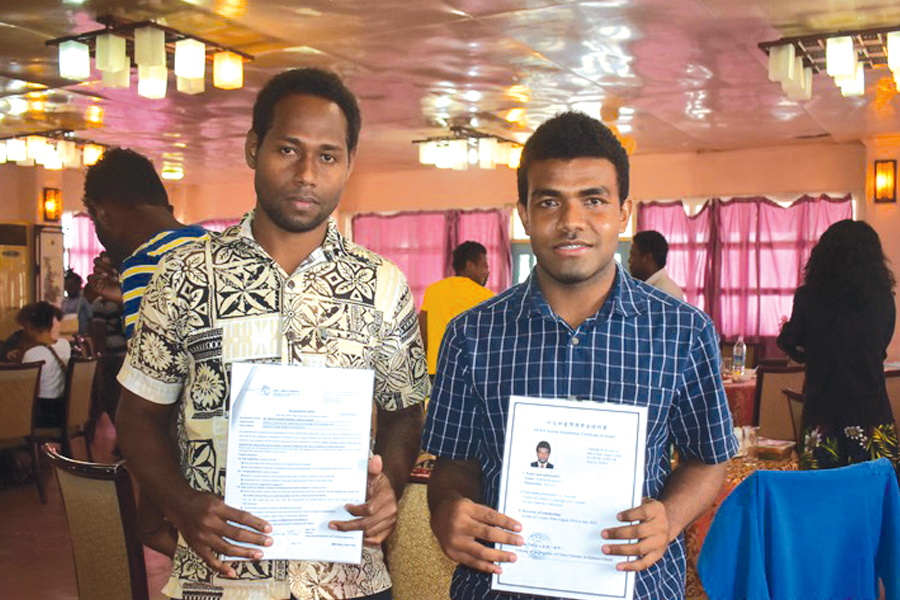
The ultimate focus is to get that qualification, scholarship recipients told

(Left to right) Mr Gerald Ngarasi and Mr Jockim Kwanairara.

BY LORETTA BRIGIDIA MANELE

(Left to right) Mr Gerald Ngarasi and Mr Jockim Kwanairara.

ACTING Vice Chancellor of Solomon Islands National University, (SINU) Dr Prem Rai has told 18 Taiwan MOFA and eight ICDF scholarship recipients that the ultimate focus is to get that qualification.

He voiced this during a farewell function that was held for the recipients at Jina’s Restaurant last week.

Rai said that among 800 plus applicants they were the fortunate ones to be selected thus must not forget that the goal is to return to the country with their qualifications.

He stressed that this is an investment in human resource that Solomon Islands is in dire need of and they are expected to return and contribute to the economic development of the country.

Rai stated that without human resources the country cannot move forward for growth and development.

“We need human resource and capable people in all sectors who can contribute to the growth of this country. That is what is expected of you. So when you complete your education and return, your family will be proud of you, your community will be proud of you and the nation will be proud of you,” he said.

In relation, Rai said that they will also learn a new language, Mandarin, which will soon become the second established and recognized international language.

He said that they are fortunate to learn the language and this will be an important asset for them.

“We wish you well in your education in Taiwan,” he said.

In further remarks, Rai acknowledged the Republic of China (ROC), Taiwan for its relationship with Solomon Islands.

“Taiwan is a country that Solomon Islands has an excellent relationship with. Taiwan is one country that stands shoulder to shoulder with Solomon Islands so we have to acknowledge that, appreciate that and recognise that,” he said.

26 Solo recipients kick-start Taiwan’s promise

Taiwan Ambassador HE Roger Luo.

BY LYNTON AARON FILIA

Taiwan Ambassador HE Roger Luo.

TAIWAN has more than just kept its promise by increasing the number of Taiwan scholarships to 26 for this year.

In November last year, Taiwan’s President Tsai Ing-wen made a commitment that Taiwan will increase its scholarship awards to 18, however this year 26 Solomon Islanders have been awarded.

On Friday last week, Taiwan’s Embassy in Solomon Islands awarded the 26 recipients in a get-together at the Jinas restaurant which convened Education Permanent Secretary Franco Rodie and SINU Acting Vice Chancellor Dr Prem Rai.

Taiwan Ambassador His Exellency Roger Luo said this year the Republic of China (Taiwan) has increased its award to 26 for both Taiwan Scholarship and ICDF— International Cooperation and Development Fund.

“It’s a commitment that President Tsai Ing-wen made during her visit last November.”

He said lots of foreign students like to study in Taiwan because Taiwanese are friendly and moreover, Taiwan has very high quality higher education.

Luo encouraged Solomon Islands’ students to work hard and maintain connection with country’s Embassy in Taiwan and Taiwan Embassy in Honiara.

Luo during the short ceremony strongly encouraged Solomon Islands students to study hard purposely to return with new knowledge and skills to contribute for country’s development.

The scholars will left to Taiwan on August 27 and Deputy Counsellor Oliver Weng will accompanied them which is the first its kind an officer accompanied recipients to Taiwan.

Taiwan Scholarship is 18 and ICDF eight which is total up to 26 scholarship recipients for this round.

How politics keeps Solomon Islands and Papua New Guinea poor and poorly governed

0

THE Western Melanesian countries of Solomon Islands and Papua New Guinea (PNG) are both poor and poorly governed.

Anyone who has spent any time in either country will have seen how governance woes contribute to the countries’ poverty.

Their governments neglect essential infrastructure.

Dysfunctional bureaucracies impede legitimate businesses and let other businesses get away with causing harm.

Health and education systems are poorly run.

This much is obvious. What is less well understood is the way the two countries’ politics contribute to their governance woes.

In my new Asia & the Pacific Policy Studies paper I explain that many of the governance problems in the two countries stem from their clientelist politics.

In elections in clientelist polities voters don’t vote in search of better public policy, or on the basis of how well the country is being governed.

Rather, they vote for candidates they think will help them directly if they win.

This has the effect of selecting and incentivising members of parliament (MPs) to focus on delivering direct benefits to their supporters back in their electorates rather than running the national government well.

The effects of this are obvious. In both countries, funds that MPs can spend at their discretion within their electorates have grown at the same time as government departments have been underfunded.

In both countries, ministers often pay little attention to the government departments they are supposed to be running.

Ministers are rarely punished for poor performance. Bureaucracies are not subject to political pressure to improve; they are neglected and demoralised.

It may sound like I am blaming voters in Solomon Islands and PNG for their countries’ governance woes. I’m not.

I think voters who vote in search of personal or localised benefits in the two countries are voting perfectly reasonably. Voters’ decisions are reasonable because the states they live in are weak, while at the same time voters’ needs are acute.

Voters need something from elections, and when the government can’t deliver it through better policy and better services, all they can hope for is direct assistance from MPs.

You might ask why voters don’t vote for better governance to solve this problem.

It might take longer but it would bring greater benefits in the end.

The problem is that individual voters, or families, or communities, or even electorates, don’t control the quality of national governance.

At best, all they can do is elect one MP out of many (50 in Solomon Islands and 111 in PNG), and one MP can’t change the country on their own.

We’ve resolved this particular problem in countries like Australia through strong national political parties that translate individual preferences into national action.

However, these were formed in a very particular environment associated with the industrial revolution and the rise of national social movements.

In the mostly rural, fragmented countries of Solomon Islands and PNG, nothing equivalent exists.

And so we have the clientelism trap. Because Solomon Islands and PNG are poor, underdeveloped countries, people vote for members of parliament who they think will help them directly.

This, in turn, creates perverse political incentives and contributes to the continuation of poor governance and poverty.

There are exceptions of course: voters who strive to find candidates who will help the country, and members of parliament who focus on national issues despite the incentives.

There are also politicians whose corruption cannot be explained away by political incentives. And there are other problems including mining and logging money.

But the trap I’ve outlined above is a key feature of the political economy of Solomon Islands and Papua New Guinea.

And – because of its self-reinforcing nature – it’s going to be very difficult to shift.

That’s the bad news.

The good news is that there are many people in both countries who want to bring change.

In recent years I’ve had the good fortune of meeting a lot of them.

I don’t know what their pathway to success is, but I think positive change is possible if they can successfully engage in national collective action.

Aid can also play a helping role in both countries.

It won’t change either country’s political economy, but if it’s given intelligently it will help hold key government institutions together, providing space for change to emerge from within.

If given cognisant of the realities of Solomon Islands and PNG’s political economies, aid can also help to provide services and to ameliorate human suffering for the time being.

In the short-term, aid can help if it’s given well. In the long-term, change will come even if the clientelism trap will be hard to escape.

Terence Wood is a Research Fellow at the Development Policy Centre. His research includes work on aid policy, the politics of aid, and governance in developing countries.

By Terence Wood

DEVPOLICY

Vella United Church men’s fellowship ends weekend rally

0

BY ALFRED PAGEPITU

GIZO

THE United Church Men’s Fellowship group from Vonunu and Sambora Community have successfully ended their weekend rally.

The three-day weekend rally started on Friday and ended at Sambora Village, South Vella la Vella Island in the Western province, yesterday.

Theme for this year Men’s Fellowship weekend rally is ‘Arise Men to reorganise in God’s mission’.

Zone-two Vonunu Men’s group and Sambora community combined together and carried out church activities.

A Mr Stanley Basi reported from Sambora Village yesterday the event was very interesting, inspiring and challenging.

“There are Church activities involve short studies in Christian developments, men’s rolls in Christianity and reorganising in the church.

“Our Sunday programme highlights with choir from two congregations who gathering at the weekend rally,” said Basi.

Rev Superintendent Minister Gideon Pina shared a very powerful message with the theme ‘Arise Men to reorganise in God’s mission’.

He said many fathers have expressed their acknowledgement and testimonies for attending such a well organised event by the Wesley United Church in Solomon Islands.

Peace and security gaining momentum

0
Australia High Commissioner HE Roderick Brazier. Photo by Australian Government, DFAT

BY LYNTON AARON FILIA

Australia High Commissioner HE Roderick Brazier. Photo by Australian Government, DFAT

SOLOMON Islands is optimistic about its future with peace and security gaining momentum on a high note and people beginning to build trust in the Royal Solomon Islands Police Force (RSIPF).

The assurance was made by the Australian High Commissioner His Excellency Roderick Brazier during a visit to the Royal Australian naval ships last week.

He said Solomon Islands is doing really well in terms of peace and security.

Mr Brazier adds, the country faces major challenges in terms peace and security only during the ethnic tension which is an effect of the civil war 15 years ago.

“Compared to many countries around the world, that have been through terrible trauma, Solomon Islands is doing really well, your economy is growing and developments are improving.

“Honiara is peaceful, Malaita is peaceful and people are optimistic about the future and certainly don’t want to go back to those awful days.”

Brazier said Solomon Islands is a very young country, and the current generation have no memories of the causes of past terrible days.

Brazier said it is a critical ingredient to ensure the economy remains growing so that people have hope in the future.

He said a strong economy will encourage kids to go to school and encourage friends and families to participate in community activities peacefully.

He adds, people now are expecting five to 10 years from now their lives will be better.

“I think keeping the economy healthy and growing which it is at the moment is really important ingredients to peace and security,” Brazier said.

Brazier pledged that Australian will continue to support the RSIPF purposely to gain trust on police forces.

“We know when we go around the country including places where tension was traumatic such as weather coast, and the trust in police force is high at the moment, but people still remembered the days when trust was low.”

On the other hand, Brazier acknowledged the Solomon Islands Government to continue providing resources to the police force so it can keep the peace and security in Solomon Islands.

Prime Minister Rick Houenipwela said Australia will continue to permanently build peace and security in Solomon Islands.

PM Hou adds that Australia and Solomon Islands have been strong partners into development aspects of the country including other development partners which resulted in country’s peace and security.

Solomon Islands have been working progressively for the SDGs Goal 16.

That is to promote peaceful and inclusive societies for sustainable development, provide access to justice for all and build effective, accountable and inclusive institutions at all levels.


Photo caption—Australia High Commissioner HE Roderick Brazier.

New market for fresh produce

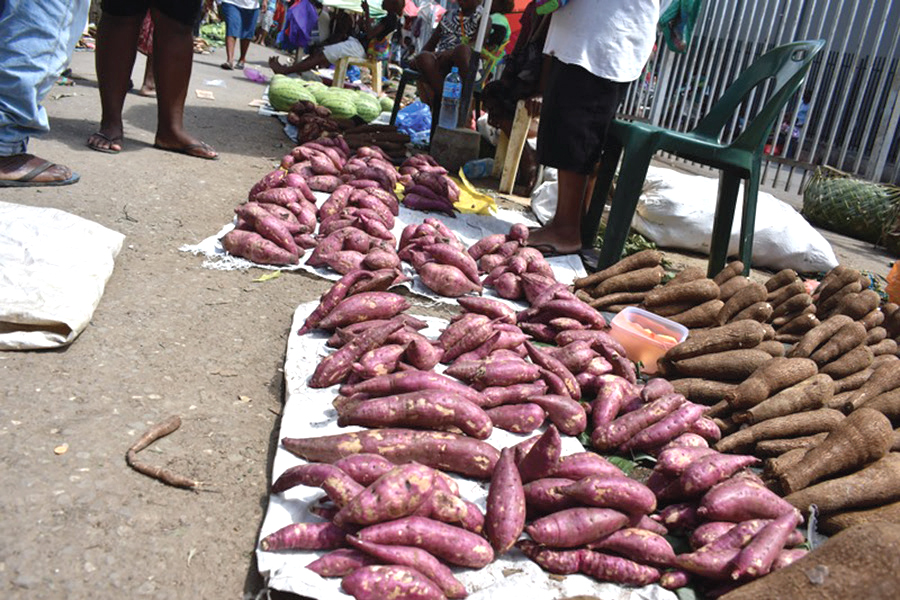
Market venders from the North West Guadalcanal constituency lay their potato on the floor.

BY LYNTON AARON FILIA

Market venders from the North West Guadalcanal constituency lay their potato on the floor.

THE North West Guadalcanal constituency will establish a new market for fresh produce late this year at the Mataniko River Bank.

Market vendors from North west Guadalcanal will no longer have to lay their produce on the floor of the market as they have been doing for many years.

Member of Parliament for North West Guadalcanal Mr Bodo Dettke has stepped in to address the hardship women of his constituency are facing.

Dettke will build a new market particularly for vegetables called the North West Guadalcanal Constituency Rural Farmers Market at the Mataniko River Bank.

North West Guadalcanal Subsistent Farmer Association’s Chairman Mr Francis Orodani welcomes the initiative by Dettke, saying that it will remove one hardship the women of the constituency face every day.

He says it is mentally degrading for women to have to put their fresh produce on the dirty floor of the market, but have been forced to do so in the past years because they did not have any choice.

It also affects the quality of the produce too, he adds.

Orodani said every day about 100 women in the constituency come to Honiara Central Market and spend the whole day in such conditions, wet or hot and dry.

North West Guadalcanal MP, Hon.Bodo Dettke

Thus, MP Dettke decided to offer his block at the Mataniko River Bank to build a market which the new proposed market will contain 40 tables designed to accommodate two vendors each, thus allowing for 80 in total.

“If the pilot the project works perfectly and gain popularity among women then its permanency will be around white River area,” Orodani said.

HCC Market Master Jimmy Hanson Riunga said if HCC’s authority aware about the new market setting, he welcome such initiative as it will address issues central market currently face in terms of spaces.

He explained in legal side, if market setup within town boundary it should be under HCC’s mandatory.

However, Riunga said he support the idea MP Dettke has in place for people of the North West Constituency.

Currently, construction is progressing slowly at the Mataniko River bank.

Each woman will have her own market space, and no one will be allowed to use another’s spot.

Vendors will also be using identification tags.

The market also designed to have a storage container to avoid half price or free supplying of produce goods at the end of the day which commonly practices.

No betel-nut and coconut is allowed (unless it is clean, and this is purposely to avoid littering around the area) —only vegetable and sea foods.

Australia protects South Pacific waters

0

BY MAVIS NISHIMURA PODOKOLO

AUSTRALIAN naval ships have played a critical role in providing assistance to protect the South Pacific marine realm from threats.

During the Royal Australian naval ship’s recent visit to the country the Australian High Commissioner to Solomon Islands HE Roderick Brazier said the assistance they have rendered is to protect the marine domain from threats.

“The assistance we are providing in the South of the Pacific is helping them to protect the marine time domain from transnational treats to your precious national environments,” said Brazier.

He said with this major role, they will soon be providing replacements for the Auki and Lata patrol boats to assist them (Australian naval ships) in protecting the waters.

“This for them (Auki and Lata Police) to help play a critical role in protecting the marine time domain,” said Brazier.

Four people wounded in fatal stabbing incident on Bellona airlifted to Honiara

Australian Defence Force personnel carry one of the victims from the helicopter after landing onboard the HMAS Adelaide.

THE four people wounded during a fatal stabbing incident on Bellona Island in the Rennell and Bellona province Friday last week have been airlifted by Australian Defence Force helicopters on Saturday morning to the National Referral Hospital (NRH) in Honiara.

A young girl died during the incident in West Bellona. The suspect is believed to be a mentally ill man, and is under police custody for further dealings.

Supervising Assistant Commissioner (AC), Provincial, Chief Superintendent Evelyn Thugea says, “The airlift of the seriously wounded four people by helicopters was possible following an urgent request from the RSIPF to the Australian Defence Force to assist get the wounded quickly for medical attention at the NRH.”

The helicopters used in the emergency airlift are from the HMAS Adelaide which is currently visiting Honiara along with HMAS Toowoomba.

AC Thugea says, “The victims were transported by Fire and Rescue Services and NRH ambulances from the Point Cruz main wharf on arrival.

“They are undergoing treatment at the Hospital. The victims include three males and a female. Their conditions have been described as stable.”

“I would like to thank the Australian Defence for quick response to assist Royal Solomon Island Police Force to airlift the wounded victims to Honiara for medical attention.

“I appeal to relatives of the deceased and injured persons not to take the law into their own hands but assist our investigators with information that will help with the investigation.”

A team of police investigators from Honiara are now on Bellona to investigate the fatal incident.

AC Thugea adds; “The suspect in relation to this wounding incident is currently under police custody for further dealings.”

The RSIPF extends its condolences to the family and relatives of the deceased at their great loss.

Australian Defence personnel assist wounded victim.
A RSIPF Fire and Rescue ambulance rushes two of victims to the NRH.
ADF personnel assist one of the victims from the helicopter after landing onboard the HMAS Adelaide.
Australian Defence Force personnel carry one of the victims from the
helicopter after landing onboard the HMAS Adelaide.

–POLICE MEDIA