Home Blog Page 1146

Shortlands constituency

0

DEAR EDITOR, the elections are coming up and as a member of the Shortlands Constituency I wish to raise the following questions to the current Member of Parliament with regard to constituency matters and funds that are channelled through him as our Member of Parliament in the name of Shortlands constituency.

Shipping Grant

I call on the Member of Parliament for Shortlands constituency to explain to the people of   Shortlands constituency the status of the ship for Shortlands constituency.

In 2016, the constituency was given $4,000,000 for the purchase of buying a ship for the constituency. To date, there is no constituency ship serving the people of Shortlands constituency. According to the information people in the constituency have, it is alleged that the Member of Parliament for Shortlands constituency used the $4,000,000.00 to buy an old ship of Hon Steve Abana, the MV Malulata.

I am calling on the MP to please explain to the people of Shortlands the real story about the shipping grant and why buy an old ship and what happened to the $4 million of the taxpayers and when will Shortland have the ship. It is only fair that we do know before the election.

Questionable use of RCDF

I call on the Member of Parliament for Shortlands constituency to explain to the people of the constituency how he used the CDF. There are many outboard engines being delivered but no canoes. The engines are very powerful ones and inconvenient in most cases and require fuel.

We want the MP to explain how he has used the Shortlands constituency’s RCDF.

Constituency Development Officer’s Mansion in Tuvaruhu

I call on the CDO to explain to the people of Shortlands how he is able to build such a big mansion with his salary. We would like to know how he acquired money to build that expensive house, given that his salary would understandably not be able to afford it. Did he loan for the capital.

I call on the police to investigate how and where he got the money from to build the house.

This is the reason why we support the inclusion of unexplained wealth in the Anti-Corruption Act to deal with people who suddenly become wealthy especially when they have access to the CDF as in this case.

Expensive Cars and Expensive Overseas Trips of the MP’s wife

I call on the MP to explain to the people where the money come from to fund the frequent overseas trips that the MP’s wife makes to Australia, Fiji etc and how they own three very expensive vehicles.

The salary of the MP is not enough to pay for these so the MP needs to explain so that we are assured the funds used to purchase these do not come from funds allocated through him for the constituencies. I call on responsible authorities to investigate this because it is not fair on the constituency and the tax payers if this is how CDF has been used by the MP.

I call on the MP to make all his retirement for the 9th and 10th Parliament available to the people of the constituency.

Derick Pako

Honiara

Medicine is sick care, Nutrition is health care

0

DEAR EDITOR, a quote I believe people of all ages in the Solomon Islands should consider while striving to increase their own health and quality of life and that of their loved ones.

We have all been pre-occupied and worried over the recent shortages of medicine at the National Referral Hospital (NRH) and clinics but have we ever paused to think how a lack of proper nutrition is putting a significant burden on the public health system through associated non-communicable diseases and contributing to the use of imported medicines to combat diseases that are often preventable with a proper diet?

Currently, it is understood more than 90% of Solomon Islanders aren’t eating enough fruit and vegetables, substituting instead, imported foods high in fat content and sugar, leading to increasing levels of obesity, diabetes, associated blindness, hypertension (blood pressure), strokes, and high levels of nutritional deficiency.

It is considered by the health authorities that the people should move away from the standard diet of rice, noodles and bread and eat more balanced diets with plenty of local body-building (fish and legumes), as well as eating ‘protective’ foods (fruit and vegetables).

The Solomon Islands Chief Nutrition Officer has been pushing for better nutrition education in schools and staff from the Embassy of the Republic of China (ROC) has also been giving extended nutritional advice to selected community groups.

The relevance of all this is important when one reads that the World Health Organisation (WHO) figures show one third of children in the Solomon Islands are stunted due to chronic malnutrition and almost half of under five year olds are anaemic.

Children need to learn the importance of choosing healthy foods so when they grow up, they can make informed decisions on what to eat and how they can live healthy.

Let me close by saying I perceive with the growing NCD burdens in the Solomon Islands, combined with modest economic growth, it will inevitably further squeeze the Ministry of Health and Medical Services MOHMS) development budgets unless urgent action is taken now to step up the giving of nutritional advice to all communities with a sustained education programme.

Yours sincerely

Frank Short

Cataracts remain leading cause of visual impairment despite progress in surgical techniques

0

DEAR EDITOR, the National Referral Hospital Medical Superintendent Dr John Hue said, recently, the country’s top causes for blindness and visual impairment is cataracts.

He said, “The top causes of blindness and visual impairment in the Solomon Islands in the age group of 40 years and above are cataracts meaning clouding of the natural lens in the eye.

Other leading causes are refractive errors, he added.

According to the World Health Organization (WHO } 81 percent of all people who are blind or have moderate to severe vision impairment are aged 50 years and above. With an increasing population of older people, WHO has stated that more people will be at risk of vision impairment due to chronic eye diseases.

Dr Hue advised people in the Solomon Island, especially those over 40 and those suffering from diabetes, as well as all those having vision difficulties, to have regular eye checks, at least once a year to see if glasses are needed.

Source: Quoting extracts from the Island Sun newspaper.

Solomon Islands is not alone when having to deal with blindness and impaired vision.

In neighbouring Papua New Guinea (PNG) the government there recently signed a new agreement with the Fred Hollows Foundation in New Zealand.

The agreement outlines commitments to ensure all people have access to high quality eye care, provided by a skilled local eye care workforce in a supportive healthcare environment.

The Fred Hollows Foundation has operated in PNG over the last 11 years and helped to train 86 specialist eye care nurses to provide community care and to help PNG address the burden of blindness.

Very sadly, PNG has the highest rate of blindness and vision impairment in the Pacific. “One in eighteen adults over 50-years-old are blind and women are more likely to be blind than men.

Given the latest revelations about the state of blindness and impaired vision in the Solomon Islands and especially as it seems that blindness can be prevented if cataracts are diagnosed and removed earlier enough, I strongly urge the Solomon Islands Ministry of Health and Medical Services (MHMS) to see whether the Fred Hollows Foundation, such a worthy charity, can aid eye care and treatment in the Solomon Islands on a similar basis as is now being done in PNG.

Over the past two years, Lions Clubs in New Zealand has given the National Referral Hospital in Honiara 6000 pairs of spectacles, at my request, and Take My Hands Charity Trust with help from the SFA freighted the several boxes of spectacles to Honiara.

I am especially indebted to Lions Clubs (NZ), to my partner charity Take My Hands and to the Solomons SFA for everything they have done to help those having impaired vision throughout the Solomon Islands.

It is my wish that more will be done by all those committed to relieve and to overcome the burden of blindness which, from what Dr Hue said, could be prevented if cataracts could be removed in the early stages.

Finally, I extend my appreciation of the work being done in eye care and treatment by the Honiara National Referral Hospital.

Yours sincerely

Frank Short

Acknowledgement to gov’t and people of Solomon Islands

0

DEAR EDITOR, as the 2018 academic year has approaching its end, I as the President outgoing of SISA, On Behalf of the Solomon Islands Student Association here in Fiji, wish to convey our sincere gratitude and acknowledgement to the government of the day and especially the Minister of Education, the PS, the hard working staffs of NTU, the Minister of finance, His PS and Staffs for Prioritising the allowance and welfare of our students studying here in the various institutions in Fiji.

This year 2018 has begun with many challenges and especially the financial hardship our country is facing.

The allowance delay of students is an ongoing issue that students faced year in year out.

All we can see in the media when it comes to allowance issue was us complaining.

However, upon commencement of the 2nd semester 2018, there has been a huge twist which despite the unstable financial difficulties our country is facing, the two ministries has opt to prioritised our students in facilitating the allowance on time.

It was indeed a new turn as all allowance has been paid right on the first day of each month.

Which really motivates students to strive more on what we are sent here for.

Therefore, we wish to give all credit to the two Ministries and also the hardworking tax payers of Solomon Islands for your hard earned money which was spent on our cause.

We believe one day we will come back and join you all in serving our country and continue on where all of you have left.

With that said, Thank you Solomon Island Citizen and thank you SIG

Former SISA President

Lawrence Ini Kopuria

No resource to look after wrecks or marine pollution

0
Bikoi 1 wrecking on the reefs near Tulaghi townships undersea water supply pipelines now for months. PHOTO by MANEBONA BARNABAS.

BY BARNABAS MANEBONA

IT has been said that Solomon Islands Maritime Safety Administration (SIMSA) has no resource to look after wrecks or marine pollution in the country.

The explanation was made known for some time as continuous queries over calls for the removal of MV Mbikoi Company’s ship wreckage between Tulaghi Island and big Ngella mainland continues seeing that authorities, the owner and provincial government have now ignored to address this issue for quite a while now.

Locals are concerned over oil leakage and such strongly reminding authorities to not use Central Islands Province (CIP) as a wreckage site.

According to SIMSA during first response over this concern, even though they are mandated through the Shipping Act of 1998 and the Shipping (Marine Pollution) Regulations 2010 to do so, they have been trying since 2014 to establish and recruit Marine Pollution Officers.

“Although the positions were established in 2015, we have not been successful in recruiting officers due to the freeze on recruitment when the DCCG went into power, so we have not been successful.”

It is understood that this is part of the reason why SIMSA is trying to become an authority where all revenue that comes from shipping taxes and levies would be paid to the new authority.

This will enable them to recruit more staff and have the resources to go to wreck sites and develop a marine pollution response capability.

“At present, SIMSA has nothing with which to respond to oil spill incidents, nor the ability to enforce wreck removal.

“There is a draft Wreck Removal Regulation but SIMSA has not had a Legal Officer for more than a year, consequently there is nobody to guide it through drafting and being brought into law.”

Island Sun is still yet to pursue on what has been the latest update of SIMSA for response capability on removals and checking over the countries ship wreckage sites.

New youth bill to update SI legislation

0
Ethel Sigimanu.

BY LYNTON AARON FILIA

Permanent Secretary for Ministry of Justice and Legal Affairs Ms Ethel Sigimanu.

THE Ministry of Justice and Legal Affairs is in the process of finalising the Youth Justice Bill.

The youth justice bill aims to bring Solomon Islands Legislation up to date, and to help it meet its obligations under the UN Convention on the rights of the child.

It will deal with the differences and gaps in the current law which is now outdated, said the Permanent Secretary for Justice and Legal Affairs, Ms Ethel SIgimanu.

Sigimanu said the new legislation would reflect a more enlightened and modern concept for dealing with youths in conflict with the law. This can be done by diverting young people away from crime, she said.

“And also the formal legal system and assist them to rehabilitate and lead productive lives.

“It is my hope that in the future; a set of standard for administration of justice will be developed.

“That is to ensure that we are sensitive to the particular needs of young people undergoing a difficult process in their lives and also to make that we do not undermine the quality of service delivery to our young people,” Sigiamnu said.

This service delivery comes with the refurbishment of the country’s Juvenile Court, an undertaking most welcomed by Sigimanu.

She said, “This is welcomed news to my Ministry since we are now in the process of finalising the Youth Justice Bill which has also been made possible with funding from Australia through Save the Children.”

With that, Sigimanu acknowledged the Australian Government for its commitment through the Solomon Islands Justice programme in supporting the country’s justice sector.

Particularly, the re-development of the Juvenile Court as it will bring Solomon Islands in line with International best practice, she adds.

Australian High Commissioner His Excellency Roderick Brazier said, “With Australia’s support, Save the Children was able to assist the Ministry to engage with young people during the Youth Justice Bill consultations.”

Brazier said Australia’s support for youth justice is part of their larger Solomon Islands Justice Programme, which is committing to $32million over four years.

The refurbishment of the Juvenile Court is a milestone achievement for Solomon Islands’ justice in particular to bring it into line the best of International practice in juvenile court.

Global Witness calls on China to rethink its import of logs from Solomon Islands

0
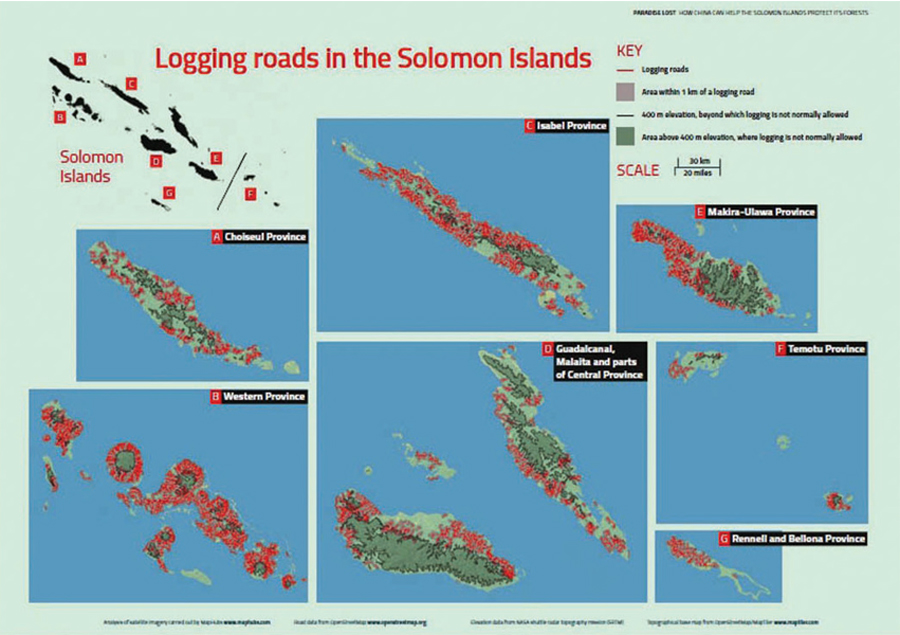
Logging road in Solomon Islands cover a distance twice the length of China’s Yangtze River, despite Solomon Islands being 338 times smaller than China.

BY GEORGINA KEKEA

THE fate of Solomon Islands environment lies in the hands of China. In a report called ‘A paradise lost’ by Global Witness, it was predicted that Solomon Islands natural forests are to be exhausted soon and China is to be blamed.

While China is taking serious steps to address environmental degradation and to reduce pollution and carbon emissions at home, they don’t mind causing environmental degradation in the poor pacific nations of Solomon Islands and Papua New Guinea (PNG), the report said.

Virtually all of Solomon Islands’ timber is exported to mainland China, and Solomon Islands is the second biggest source of tropical logs, after PNG. PNG and Solomon Islands supply half of China’s tropical log imports.

The report said at a national conference on environmental protection in 2018, China’s President Xi Jinping reiterated China’s goal of building an ‘ecological civilisation’, leading in global climate governance and drew links between a healthy environment and improved national security. Also in 2017, China extended a ban on commercial logging in natural forests so that it covered the whole of the country.

Logging road in Solomon Islands cover a distance twice the length of China’s Yangtze River, despite Solomon Islands being 338 times smaller than China.

But the report said that the Chinese government is overlooking an important aspect of its ecological footprint.

“The raw materials that it consumes from overseas.”

China is the destination for about two-thirds of all tropical logs globally. Many are said to come from countries like Solomon Islands that are struggling to address governance and rule of law issues.

This report shows that 50 percent of China’s tropical logs come from countries whose forest sectors are plagued with risks of illegality.

“If China continues to buy its wood with ‘no questions asked’, it risks undermining efforts by its trading partners to improve governance, prevent environmental degradation, and achieve the UN Sustainable Development Goals,” the report said.

The innovative steps that China is taking to reduce its own carbon emissions will be undermined if it continues to buy so much tropical wood from the Solomon Islands.

The NGO Global Witness therefore make a call on China to require its timber importers to carry out checks to ensure that the timber they buy, is at a minimum, legal in its country of origin. Time is running out for China, both to protect the forests of the Solomon Islands it profits from and its position as a leader and pioneer on the global trade and environmental landscape.

“Indeed, 77 percent of the Solomon Islands’ greenhouse gas emissions come from forestry and land-use changes. By not questioning the illegal activity businesses are taking part in, China enormously increases the commercial and reputational risks to its businesses and those they trade with,” Global Witness said.

Global Witness is an international NGO established in 1993 that works to break the links between natural resource exploitation, conflict, poverty, corruption, and human rights abuses worldwide.

International NGO calls on Gov’t to freeze logging operations

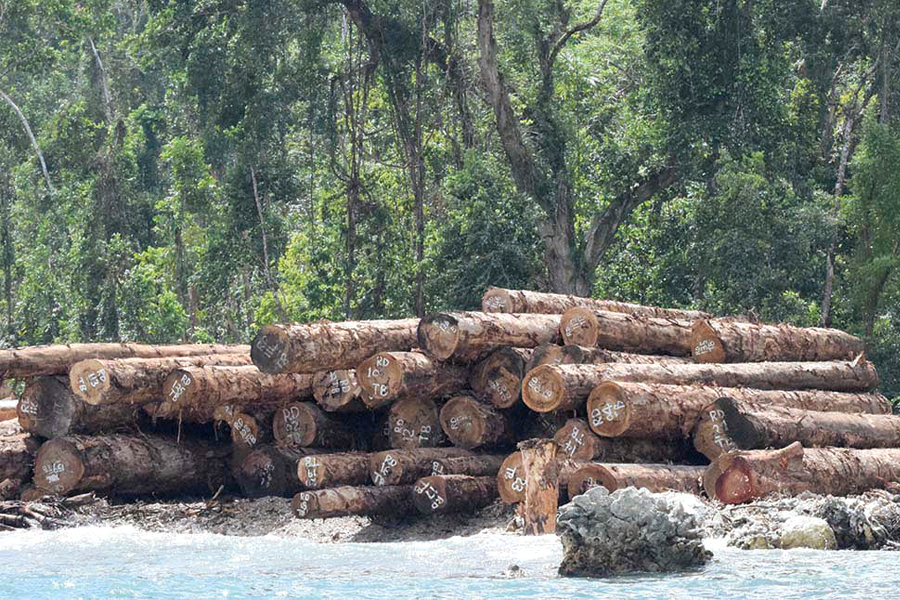
Logging in Solomon Islands. Photo supplied

BY GEORGINA KEKEA

INTERNATIONAL NGO, Global Witness is calling on the Government of Solomon Islands to immediately place a moratorium on all existing logging operations.

This moratorium comes amidst a report that is said to unpack issues that lie at the heart of the Solomon Islands disappearing forests.

“The hugely unsustainable rate of logging, the high risks of illegality around how timber is sourced on the islands, the fact that the industry does little to benefit local people – all of these create a picture of islands far from unspoiled, untouched or unexploited,” Global Witness say.

With that, they recommend that Government of Solomon Islands review the issuance of operator’s permits and the operations themselves for legal violations and permits with those found operating illegally to have their licence removed.

Global Witness say that in order to curtail the issues of illegality and unsustainability, Solomon Islands government must proceed in improving the systems in place so that documents relating to issuance and oversight of logging operations can be publicly accessed via electronic systems.

“This will allow landowners to monitor how their own land is being used and challenge any unauthorised uses, as well as facilitate thorough due diligence by timber buyers.”

The international NGO say Solomon Islands should employ an independent organisation or expert company to verify the volumes, values and species of logs that are exported in order to check that the logging companies are paying the correct amount of taxes.

Meanwhile, an assessment report on Forest resource in Solomon Islands in 2011 says the natural forest logging industry is unlikely to crash in the next few years, despite the acceleration in logging activity since the 2006 Solomon Islands Forest Resource Assessment.

“Re-entry into secondary forests is projected to sustain significant levels of logging activity for at least another decade and, potentially, at lower levels for several more decades.”

However the current report by Global Witness says Solomon Islands do not have much time before the forests are exhausted.

A recent report commissioned by the Ministry of Finance suggested that if logging activities continue at the current pace, in 18 years’ time, natural forests will be exhausted and not in 70 years’ time.

At the same time, Global Witness is calling on the Chinese government to put in place mandatory measures requiring all timber importers to carry out due diligence to ensure they do not import timber produced in violation of source country laws.

“The measures should require importers to go beyond official documents as proof of legality and require importers to investigate and verify the conditions under which the timber was produced. The measures should also require companies to publish their due diligence policy and procedures,” Global Witness say.

If this current trend continues, Global Witness is fearful that this will have a devastating and irreparable impact on the country’s environment.

Gov’t Minister refuses to shake hands with Malaita Premier, public aghast

0
Former Premier of Malaita Province, Hon Peter Channel Ramohia.

BY GEORGE MANFORD & Georgina Kekea

AUKI

A senior minister of the crown has acted unbecomingly towards the Premier of Malaita province during a recent Church programme in Auki.

Leading up to the programme of the consecration of the Catholic’s new Bishop of Malaita, Premier Peter Ramohia got the shock of his life when he was ignored by the said MP when he greeted them upon their arrival in Malaita for the programme.

Witnesses to the incident say they were quite embarrassed and do not know what to think.

“We think they are coming for a church programme and not to show such disrespectful ways and actions like this,” a witness said.

The witnesses say they want the MP who is also a Minister of the Crown to clarify to the public why he acted unbecomingly towards the Premier.

“We are ashamed because our premier welcomes him with a hand shake but he refuses in front of everyone except for the PM where he was greeted first before the disrespectful way happened,” the witnesses say.

They say there were also ashamed of the MP’s behaviour because it goes against their traditional beliefs and custom including values.

The accused Minister was said to be part of the Prime Minister delegation that arrived on the same flight.

The incident was said to take place at the Auki airport when the Premier greeted the officials upon their arrival.

Meanwhile, Premier Peter Ramohia confirmed that this snootiness actually took place and he was quite taken aback when the MP ignored his handshake.

He said had he known he would be snubbed at the airport, he will send someone within his Executive to greet the officials when they arrive or requests that the Minister do not accompany the PM and his delegation.

He said the most likely reason that the MP snubbed him was because he (Premier) intends to contest the seat in which the MP currently holds.

“But the constitution clearly stated that it is everyone’s right to contest the National General Election. As long as you are fit, in a good state of mind and over 18 years of age, there is nothing stopping you to contest,” Ramohia said.

He said the MP also comes from the same village as his and he has heard from their people that the MP doesn’t like it that he (Premier) will be contesting against him and he is quite angry with him (Premier) for that.

“Even in Church, I was sitting right behind him during the Consecration mass and when it comes to the sharing of peace, he just ignored me and continued to take pictures with his camera,” Ramohia said.

With this behaviour displayed by the MP, those witnessing the incident said the MP’s action is contrary to the Christian principles and values which are more to do with love, mercy and forgiveness.

This was disrespectful to the government and people of Malaita province, they say.

“Disrespectful of the Leaders of Catholic church in Solomon Islands and Malaita province. We are demanding an explanation from the Minister,” the people said.

They say if this action was because of politics, then the Minister should know better than to leave politics out of the church activity.

They then requested that Prime Minister Rick Hou, reminds his Minister of good public conduct since he has tarnished the image of the PM’s delegation to Malaita province for an important Church event.

Details of co-funding of the CDF grants revealed

0

By Alfred Sasako

FURTHER details have emerged about annual funding for the Constituency Development Fund (CDF) grant, which is intended to fund micro economic activities in the nation’s 50 constituencies.

A breakdown of figures obtained by Island Sun shows it is not just the CDF grants that is covered in the funding. It also shows Solomon Islands and Taiwanese taxpayers have been sharing the cost of the CDF grant over the years.

The figures show that an average of $6 million is allocated for CDF funding each year. Of this amount, the Government contributes $5.2 million, while Taiwanese taxpayers’ support is $1.4 million.

“This has always been the formula used in the co-funding arrangement of the CDF grant,” officials said.

According to one official some $1.2 million from the Government’s total funding is allocated to Members of Parliament to use at their discretion.

“Its use is the discretion of each Member of Parliament. And this is where the concern is. By allowing MPs to have easy access to such a huge amount of money, the whole thing is open to abuse, which is what members of public suspect,” the official said.

The official said the Taiwanese component is usually paid to MPs’ Constituency Bank Account, which probably explained why very little goes into the Constituency accounts.

The contribution by Government on the other hand goes directly to pay preferred suppliers whose goods and services have been used by politicians.

Meanwhile it has been revealed that MPs who have used up their overdraft facility (OD) with banks have been requesting the Ministry of Rural Development (MRD) to be issued cash cheques instead of direct payment to their Constituency’s bank account.

“What many of them are doing increasingly these days is once they know the CDF grants are ready to be disbursed, they simply pick up the phone and call the Permanent Secretary to ensure their allocations are paid in cash cheques,” the official said.

“They are doing this to avoid the bank deducting their dues from Constituency payments,” the official said.