Home Blog Page 1139

Many support women participation in politics

0

BY LYNTON AARON FILIA

 THERE have been positive attitudes towards women participating in politics in Solomon Islands.

In the lead up to the Solomon Island’s National General Election (NGE) in 2014, the Solomon Island Electoral Commission (SIEC) conducted a range of Voter Awareness Programmes (VAPs).

These were designed to enhance voter engagement with the electoral system and improve voter awareness of key electoral issues.

With that, a survey shows there have high number of people in the country supporting the participation of women into politics.

From the People’s Survey, the report indicates positive attitudes towards women as leaders in the Solomon Islands; however this has not lead to significant representation of women in politics.

For example, the 2013 People’s Survey reported that 91 percent of respondents considered woman would be a good leader, while the results of the 2014 NGE showed only 2.7 percent of the population voted for women candidates.

In return, only one female Member of Parliament in a 50 member chamber, the report said.

In this survey, SIEC further explore such gap through investigating attitudes of respondents in relation to the capability of women to be politicians, as compared to men.

The findings resulted with 81 percent of respondents considered women to be as skilled as men at being politicians.

82 percent women respondents reported a similar response rate, and while this is a high proportion, it is not quite as high as results from the 2013 People’s Survey.

The positive response rate to women’s level of skill as being a politician when compared to men was relatively consistent across all provinces.

In identifying what women candidates needed to win in their constituency, respondents most frequently noted that having a reputation for helping accounts to 34 percent and demonstrating good personal attributes is 34 percent were critical.

Of the respondents who said women were not as skilled at being a politician as men, 40 percent said that it was not a woman’s role to be a politician or a leader (this was less than 8 percent of overall respondents).

This was similar among both women (35 percent) and men (45 percent).

Overall, 19 percent of respondents (14 percent of women respondents) felt women were not as capable at being politicians as men simply because of their gender.

This suggests that there are further gender-based issues, particularly in promoting women’s representation in politics, to be addressed within the Solomon Islands.

SINCW congratulate Tanagada over new appointment

0

BY BARNABAS MANEBONA

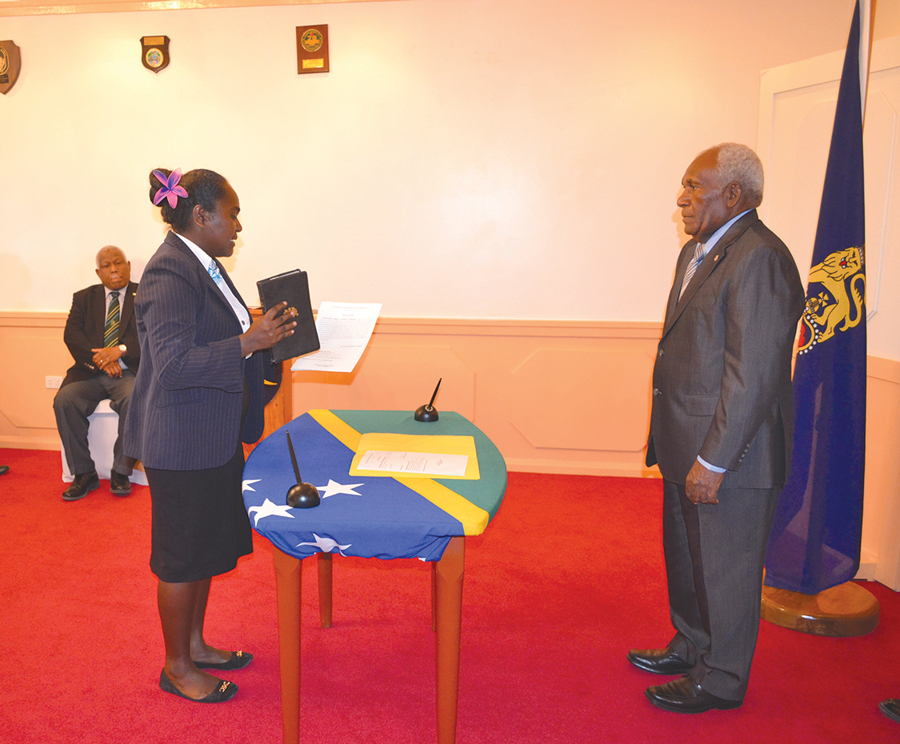
THE Executive and management of the Solomon Islands National Council of Women (SINCW) congratulate Hon Lanelle Tanagada of her appointment as the new Minister for the Ministry of Women, Youth and Children Affairs (MWYCFA).

In a Press Release yesterday, SINCW as the umbrella NGO of women’s organisation mandated to provide the complementary and support role to the MWYCFA in implementing its policies for women look forward to continue and give that support to the Hon. Minister and her team in the MWYCFA.

“We also look forward to working closely with you and your staff to continue as well as further strengthen our special relationship in striving to better the lives of our women, youths and children in Solomon Islands.

“We wish the Hon. Minister all success in her role as the Minister for MWYCFA as we are looking forward for a new and longer political turn around in the 2019 National General Election,” stated SINCW in their Press Release.

Hon Lanelle Tanagada is the Member of Parliament (MP) for Gizo/Kolombangara Constituency in Western Province.

CPG question past Executive on shopping complex project

0

BY BARNABAS MANEBONA

THE current Central Islands Province (CIP) Provincial Government are questioning why the previous Executive of the province had come up with a Shopping Complex project for Tulaghi.

Comparing to the small scale yet in terms of business houses development in Tulaghi, the current Executive see the project as too early to develop such having already spent part of the province past Provincial Capacity Development Fund (PCDF) of around $5 Million.

“We should currently be focusing more on other areas to start off with that are beneficial with the level of scale development that CIP is in at this stage,” said a disappointing Premier for CIP Hon Patrick Vasuni with the understanding that his provincial government is criticized by the people of the province over the incomplete Shopping Complex project.

Nevertheless CIP’s Premier has assured that despite of such, his current provincial Executive will still yet be looking back into this project but will have to wait for the next PCDF funding before they can see how things work out from planning.

CIP this year after being disqualified from the 2015 and 2016 PCDF funding has topped first position in the assessment of PCDFs in the country.

NSO staff honoured with certificates

0

STAFF of the National Statistics Office (NSO) were honoured on Friday last week for their participation during the two weeks of in-depth training on Census Management and CSPro.

Commenced on October 8, the training concluded with certificate presentation on Friday.

“The training is a massive leap for the NSO staff,” Government Statistician, Douglas Kimi said.

It was envisioned to prepare and equip staff with crucial proficiency regarding staff involvement in different levels of census management and operational activities and also impart officers with procedures into editing census data.

Mr Kimi said equipping staff with essential expertise ahead of the 2019 population census is vital.

“Since the census project involves huge operations and the information to be collected will be used and useful in the next ten years, it is important that proper management of census activities, processes together with monitoring/evaluation are being implemented to control and guarantee management of data quality and to complete the Census count,” Kimi emphasised.

Kimi thanked his staff for their patience and cooperation throughout the course of the training and also acknowledged the training facilitator Dr Michael Jonathan Levin for his time and service.

He said the teamwork essence and serenity displayed by participants (staff) has ensued in the training success.

The training was the first of its kind for the NSO and the presentation contents are similar to the recommended UN revised Population handbook together with the approved international standards, classifications and definitions.

Meanwhile, participants thanked the NSO management for making the training accessible and pledged to put into practice what has been learned.

–SINSO MEDIA

Successful public spending to reduce poverty requires targeting benefits to right people

0

BY LORETTA BRIGIDIA MANELE

SUCCESSFUL and financially feasible public spending to reduce poverty requires targeting to prevent the benefits dripping into the hands of the non-poor.

This was expressed in the “Solomon Islands Poverty Maps Based in the 2012/13 Household Income and Expenditure Survey and the 2009 Census of Population” report.

The report emphasized that if poor households can be easily identified, transfer payments and other direct interventions can be made with the approach of giving directly advocated in the form of conditional cash transfers.

However, also stated was that there are concerns regarding the above mechanism’s applicability, particularly because of unknown interplay between new sources of social transfers and existing informal safety net with the inclusion that informational requirements for screening and the financial infrastructure for making direct payments may not be present.

On top of that, the report says distributing benefits to only a number of people in any one village or area requires institutions and personnel that can withstand temptations of corruption and reciprocal obligations that can be present in clan-based societies.

The study mentioned that if there is relatively high number of poor people in certain areas, spatial targeting may be attainable in which extra development projects and public services are provided for everyone in those areas.

Significant pockets of poverty apparent in central SI

0

BY LORETTA BRIGIDIA MANELE

ACCORDING to, “Solomon Islands Poverty Maps Based in the 2012/13 Household Income and Expenditure Survey and the 2009 Census of Population”, report on small-area estimates of poverty, one of three key findings says there are significant pockets of poverty in the Central region of Solomon Islands.

The areas with high concentration of poverty include Honiara City, Guadalcanal, Makira Malaita and Central provinces.

Moreover, in Honiara it is reported that while small-area estimates suggest that most wards in the city have above average rates of poverty, the highest rates are evident in Naha wards.

In relation, the census data also provided favourable indicators of welfare for residents in Honiara City in contrast to residents in nearby Guadalcanal province such as having greater access to wage employment, improved quality housing and higher rates of durable goods ownership.

For Guadalcanal province, the report expressed that there are many wards including the continuous belt along Weather Coast with estimated poverty rates that are very high, above 34 percent.

To add on, the highest rates which surpass 50 percent are noted be evident in wards of Valasi, Avuavu, Talise, Moli and Tetekanji.

As for Eastern Makira, five wards, namely; Wainori East and West, Star Harbour South and North, and Santa Ana have poverty rates above 34 percent and large numbers of poor people.

Meanwhile, as reported poverty rates tend to be lower in wards of Malaita province and consistent with the low incidence of poverty for province as a whole.

However, there are moderately higher rates of poverty and larger numbers of poor people that are still apparent in some of the wards in the northern part of the province.

In Central province, the poverty level in wards was estimated to be relatively low.

The report emphasized that small-area estimated of poverty can inform policy design by means of spatial targeting of poverty interventions and contribute to monitoring efforts such as facilitating analyses of the correlation of poverty with other socio-economic phenomena.

“Ultimately, it is hoped that the information presented in the poverty maps can help policy makers better allocate resources to support faster, more effective poverty reduction,” said the report.

SI’s first small-area estimate poverty report, a statistical milestone: Sogavare

0
Deputy Prime Minister Manasseh Sogavare with his key note address.

BY LORETTA BRIGIDIA MANELE

THIS report further strengthens our partnership and collaboration with our regional and international development partners towards addressing poverty and the sustainable development goals.

The above statement was made by Minister for Finance and Treasury, Manasseh Sogavare in a report titled “Solomon Islands Poverty Maps Based in the 2012/13 Household Income and Expenditure Survey and the 2009 Census of Population” launched last year.

In initial remarks, he referred to the report as a first of its kind and another significant statistical milestone for the nation.

Sogavare expressed that the analysis utilises an internationally recognised method by combing the census data and survey data (2009 Census and 2012/2013 Household Income and Expenditure Survey) to enable the production of poverty and inequality measures at a lower geographical ward level or small area (EAs), something that was previously far-fetched.

He stated that results from this report enables policy makers, planners, students and even the average citizen to easily identify the scale of poverty among households in relatively smaller geographical areas within and across the provinces.

Sogavare mentioned that the report is an extension of the Solomon Islands Poverty Profile Based on the 2012/13 Household and Expenditure Survey report that was published in December 2015.

“It shows that new and value adding research about the dynamics of poverty can be undertaken to inform government policy,” he said.

Sogavare stressed that results and maps generated from the report provide a formidable guide in the fight against poverty across the country and in supporting the government address poverty alleviation through fiscal policy in the allocation of limited resources and in targeting interventions through the National Development Strategy (NDS) and the Medium-Term Development Strategy (MTDS).

OAG sets direction on Corporate Business Plan

0

BY ELLISON VAHI

THE Office of the Auditor General has a structured approach to governance that supports the delivery of the OAG’s purpose and outcomes.

As per part of its corporate governance framework, the OAG has set a clear direction on organisational priorities on Corporate Business and how its progress is monitored.

The framework also provides assurance that management is achieving this direction in an ethical and legal way and that risk and opportunities are recognised and addressed.

According to the OAG Corporate Plan, it serves that, the elements of their corporate governance framework includes; committees, strategic planning framework, risk and fraud management, audit and assurance activities, Auditor-General Instructions, policies and guidelines.

In relation, the OAG is currently using the Corporate Plan 2017 – 2022. However, it has become apparent that this plan is too difficult and not “fit for purpose” as a tool to guide the OAG’s future development.

Accordingly, this year, they have proposed in developing a Corporate Business Plan for the period 2019 – 2023 to address this problem.

The purpose of this Corporate Plan is to provide guidance and a focus for OAG’s work over the next six years 2017 – 2022.

It also, gives broad objectives that they will strive to achieve over the period and sets down the activities and values they have set for the office in meeting those objectives.

In addition, the OAG have also sets out Plans that also maps out how the Office is going to work towards meeting its obligations as a Supreme Audit Institution (SAI) within the international network of SAI’s in meeting international auditing standards and making their contribution towards the international goal of all SAIs of “making a difference to the lives of citizens”.

In developing the Plan in consultation with all their staff at every level, the OAG has kept in mind what their international world expected of them to make a difference to our citizens through; strengthening the accountability, transparency and integrity of government and public sector entities through audit activities, reporting and publication of findings, demonstrating ongoing relevance to citizens, Parliaments and other stakeholders – through being responsive, using effective and proactive communication, and supporting change in government and public entities and being a model organization through leading by example in terms of good governance, transparency and accountability of SAI performance, in following ethical standards, in promoting a culture of quality and continual improvement, and in learning and knowledge sharing.

Whilst, when looking at how they do this within the Solomon Islands, they also take account of the development plans guiding our nation to ensure that their work is relevant and useful in improving the lives of Solomon Islanders through scrutiny of the effectiveness of those plans, at regional, national, provincial and constituency levels.

In the meantime, OAG trust the Corporate Plan 2017 – 2022 will remind and guide them in providing assurance to the Parliament and people of Solomon Islands that public funds are accurately accounted for and making a significant contribution to improvements in public administration.

Capacity of Choiseul police on public disorder control boosted

0
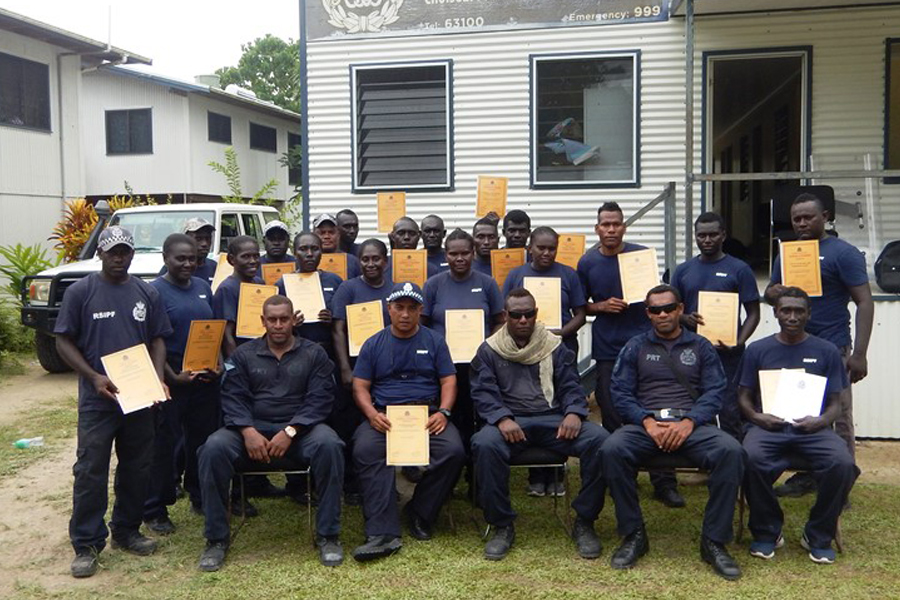
PPC Vincent Eria (sitting 2nd from left), PRT instructors and officers at Taro who attended the POM training

THE capacity of Royal Solomon Islands Police Force (RSIPF) officers serving in Choiseul province to deal with Public Order Management (POM) incidents has been boosted with the completion of an intensive POM training conducted at Taro from October 16-20, 2018.

Provincial Police Commander (PPC) Choiseul Province, Superintendent Vincent Eria says, “The training is to equip my officers in preparation for any public order situation that might arise in the province in the future including during the National General Election (NGE) next year.

“This is the first such training programme conducted here at Taro and the public appreciated it when they were able to watch the demonstrations held at the Station’s Football field by the officers to show their capabilities.

“During the POM capability demonstration some leaders who were present to witness the event commented saying they now have confidence in the Police should any public order incident occur in Choiseul.

“I want to acknowledge the Police Response Team (PRT) instructors from Honiara for their hard work ensuring the training programme was achieved successfully.

“I want to also thank my officers who participated in the programme for their commitment and dedication towards the training.

“I assure the people of Choiseul Province that my Provincial Response Unit is ready should any situation arise that calls into question the safety and security of the communities in this province.

“We will continue to maintain this capability of my officers with future refresher training in POM.”

The officers who attended the POM programme received certificates at the end of the training on October 20, 2018.

–POLICE MEDIA

134 workers under RSE Scheme ready to leave for New Zealand  

0

134 workers bound for New Zealand under the Recognised Seasonal Employer (RSE) scheme are currently undergoing a two-day Pre departure briefing.

The Pre-departure briefing which started yesterday, ending today, is an essential activity that always takes place, prior to a group of Seasonal workers departing for New Zealand or Australia work under the labour schemes.

The briefing is delivered by officials from the Labour Mobility Unit (LMU) at the Department of External Trade of the Ministry of Foreign Affairs and External Trade (MFAET).

The LMU oversees both the New Zealand RSE Scheme and the Australia Seasonal Worker Programme (SWP).

The 134 workers are recruited by five different employers and they will work on various farms around New Zealand.

In her opening remarks the Deputy Director for the Department of External Trade, Ms Jenny Barile, informed the workers that they must ensure that they work hard, to enable high productivity output as this will lead to them earning sufficient income to save and at the same time sustain themselves while working in the orchards in New Zealand.

“You are amongst the fortunate ones who are selected from hundreds of other applicants who have applied to be part of this programme, and as such I ask you to take advantage of this opportunity.

“All of you will be working in New Zealand under our Country’s name and I urge you to be good ambassadors representing our country when in New Zealand.

“Many other workers who have returned from working on other farms under this programme, have greatly benefited from their hard work and tangible results can be seen,” Barile said.

Barile also reminded the workers that they must not lose sight of the purpose of travelling to New Zealand, which is to work hard to earn money to help improve their own livelihoods as well as of their families.

Also delivering remarks at the opening, was the New Zealand Deputy High Commissioner to Solomon Islands Mr Tim Breese who reminded the workers that they must work hard in order to earn good money from the Scheme.

“RSE is a win-win situation for all those involved under the scheme as such I ask you to make use of this opportunity,” the Deputy High Commissioner said.

The briefing covers various relevant topics including, living in New Zealand, the type of work that is expected to be undertaken, going through worker contracts, finance, how to save money and so forth.

RSE season usually starts around October of each year and goes on until around May of the following year.

The first batch of this 134 workers will leave tomorrow and are expected to be in New Zealand for six months.

More workers are expected to leave in the coming months

Solomon Islands usually sends more than 650 workers in one season.

–GOVERNMENT COMMUNICATION UNIT