Home Blog Page 1138

Solomon Islands is the custodian of a battle ground that is deserving of maintenance and preservation in remembrance of the deceased.

0

DEAR EDITOR, WW II sites have been said to be important to destinational marketing in the Solomon Islands.

Quoting from a recent article in the Island Sun newspaper it read:

“Battlefields from World War II form an important part of Solomon Islands history so do the heritage, which forms an important component of the Solomon Islands tourism products.

“WWII heritage though small, standalone as a special interest market, focusing on the relatives of WWII veterans and historians from USA, Australia and Japan, but also appealing to a broader market interested in recent history.

“There are many sites around Honiara and on Guadalcanal including the American War Memorial, Thin Red Line and Bloody Ridge. Iron Bottom Sound, Tulagi and Western Province also contain sign cant sites from WWII.

“Meanwhile, most sites however are poorly presented, poorly maintained and in many instances have limited information and documentation associated with them.

“Unlike PNG (Kokoda Track) or Vanuatu (SS President Coolidge) there has been no combined effort to support the development of an iconic WWII site into a major tourism attraction.”

Source:  Island Sun newspaper.

Apart from the necessity, as I see it, of better maintaining and preserving the historic battle sites, one should remember that those battle sites also contain the last remains of many deceased soldiers.

It is believed that about 300 Americans and a staggering figure of 20,000 Japanese are still listed as missing.

The battle for Guadalcanal during World War II will remain forever as a battle that changed the course of history in the Pacific.

The historical significance of this means that the Solomon Islands must do all it can to ensure that all those who lost their lives and are still unrecovered are given respect by way of maintaining the battle fields befitting how we  should care for the deceased.

I have visited the Kranji War Cemetery in Singapore and also visited the Chungkai War Graves Cemetery in Kanchanaburi in Thailand.

Both those places of final rest are beautifully maintained and living gardens of peace and rest.

Yours sincerely

Frank Short

Scientists are reported to have succeeded in wiping out mosquitoes in new laboratory experiments

0

DEAR EDITOR, quoting from an article written by Kate Kelland and published by Reuters in September this year.

 “ Scientists have succeeded in wiping out a population of caged mosquitoes in laboratory experiments using a type of genetic engineering known as a gene drive, which spread a modification blocking female reproduction.

 “The researchers, whose work was published on Monday in the journal Nature Biotechnology, managed to eliminate the population in less than 11 generations, suggesting the technique could in future be used to control the spread of malaria, a parasitic disease carried by Anopheles gambiae mosquitoes.

“It will still be at least five to 10 years before we consider testing any mosquitoes with gene drive in the wild, but now we have some encouraging proof that we’re on the right path,” said Andrea Crisanti, a professor at Imperial College London who co-led the work.

“The results mark the first time this technology has been able to completely suppress a population. The hope is that in future, mosquitoes carrying a gene drive could be released, spreading female infertility within local malaria-carrying mosquito populations and causing them to collapse.

“Gene drive technologies alter DNA and drive self-sustaining genetic changes through multiple generations by overriding normal biological processes. The technologies can be very powerful, but they are also controversial, since such genetically engineered organisms released into the environment could have an unknown and irreversible impact on the ecosystem.

“The technique used in this study was designed to target the specific mosquito species Anopheles gambiae that is responsible for malaria transmission in sub-Saharan Africa.

“The World Health Organization has warned that global progress against malaria is stalling and could be reversed if momentum in the fight to wipe it out was lost.

“The disease infected around 216 million people worldwide in 2016 and killed 445,000 of them. The vast majority of malaria deaths are in babies and young children in sub-Saharan Africa.

“Crisanti’s team designed their gene drive to selectively alter a region of a so-called “doublesex gene” in the mosquitoes, which is responsible for female development.

“Males who carried this modified gene showed no changes, and neither did females with only one copy of it, he explained in the study. But females with two copies of the modified gene showed both male and female characteristics – they failed to bite and did not lay eggs.

“The experiments found the gene drive transmitted the genetic modification nearly 100 percent of the time, and after 7-11 generations the populations collapsed due to lack of offspring.

“Crisanti said the results showed that gene drive solutions can work, offering “hope in the fight against a disease that has plagued mankind for centuries”.

“He added, however, that “there is still more work to be done, both in terms of testing the technology in larger lab-based studies and working with affected countries to assess the feasibility of such an intervention”.

“But Mariann Bassey, a campaigner with the environmental group Friends of the Earth Africa, said the technique was risky.

“To solve the malaria crisis, we should focus on the least risky and most effective solutions, not experiment with ecosystems with little regard for the potentially new environmental and health consequences,” she said in a statement.”

Copyright @ 2018 Reuters.

In the Solomon Islands malaria remains a health hazard and the cause of much sickness, especially in the rural areas of the country.

Yours sincerely

Frank Short

Maitaki commends young Kurukurus

0

BY ROMULUS HUTA

THE head of the Solomon Islands delegation to the recent Youth Olympic Games held in Argentina this month says he is more convinced that the national under-18 futsal side is one of the world’s best in the sport.

Chef De Mission Morris Maitaki shared his conviction after watching how the boys performed during the games in Buenos Aires taking on the likes of Brazil, Russia and Iran in Pool B of the futsal competition.

Maitaki, who watched all their four pool matches by cheering from the sideline, said the young futsal side was exceptional. “The outstanding performance of our Futsal team was extremely exceptional despite not winning a medal.

“We have proven to the world of futsal that we are among the best teams in the world.

“Attending to all matches of our futsal team at Technolopolise and Cenard arenas it’s the best feeling to witness our boys displaying their skills with an overwhelming support from the crowd of Argentina.

“This has proved to me our common saying that we are a little Brazil or Argentina in the Oceania,” Maitaki stressed.

The Chef De Mission believes that futsal has a very bright future ahead of them in Solomon Islands.

“I strongly believe our futsal can be a real threat in the World of futsal in the next 10 years if given the right home and proper training and adequate preparation.

“We came to the youth Olympic Games to compete knowing very well that we have nothing to compare to other nations with no proper facilities, competitions and adequate preparation unlike other countries who prepare well for this youth Olympic Games.

“However, despite all these difficulties yet our team performance have impressed and surprises many participating teams, officials, spectators and I do believe it has also impacted our young players back at home who also aspire to come this far,” Maitaki expressed.

The young kurukurus and the rest of One Team Solomon members will arrive in Honiara this afternoon.

Futsal challenge looms

0
Marist Futsal Club was crowned the champions of the SIPA Futsal League. The second part of the 2018 futsal season which is the Futsal Challenge will kick off on November 5.

THE Solomon Islands Ports Authority (SIPA) Futsal Challenge 2018 will commence on November 5, Solomon Islands Football federation (SIFF) confirms yesterday.

The challenge is part of the SIPA-sponsored national futsal league which concluded in June and won by Marist.

Clubs entering the challenge are ones who have took part in the national league. They are Marist, Kooline, Mataks, Koloale, Vania, Solympics, Gantimak, Indo-Solo, Real kakamora and Henderson Eels.

The clubs have been drawn into two pools, A and B. Draws are based on team ranking at the completion of the league competition.

Champions Marist leads Pool A and is joined by Kooline, Mataks, Koloale, KOSSA and Vania. Pool B comprises Solympics, Guntimark, G-Camp, Indoor-Solo, Real Kakamora and Henderson Eels.

SIFF Futsal Development Officer Jerry Sam said registration will close on October 31 and forms can be collected at the SIFF Office.

Sam said teams will play according to pools. The top two teams emerging from each group will qualify into the semi-finals. Sam explained that the presentation for both the league proper and the challenge competition will be held after the SIPA Futsal Challenge.

He added that clubs need to get organized to successfully compete in the final competition for this year.

GROUP A: Marist, Kooline, Mataks, Koloale, KOSSA and Vania.

GROUP B: Solympics, Guntimark, G-Camp, Indoor- Solo, Real Kakamora and Henderson Eels

Matangiki triumph

HRUA action is set to kick off with SOLRICE again major sponsors
Hammerheads Chris Saru breaks away from a tackle during the grand final of the HRUA 2018 top 4 play offs on Tuesday.
Matangiki won 16-12. Picture Taromane Martin.

MATANGIKI rugby club is the new champion for the 2018 Honiara Rugby Union Association (HRUA) top four play-off.

This came after defeating league proper winner, Henderson Hammerhead Sharks 16-12 in yesterday’s close-contested grand final showdown at the Town Ground Rugby stadium.

Matangiki led 7-0 after 20 minutes in the first half via a Moana Tepuke converted try but saw the score margin reduced 7-5 ten minutes later, Bobby Sade crossing the line for Sharks’ first try.

It remained 7-5 in favor of Matangiki when second half resumed. Hammerheads were struggling to get out their own half, Matangiki forcing a number of turnovers and mistakes out of the Sharks forwards.

“It’s a big achievement for the club.

Our club once won 10 titles in a row and to win again today is definitely a cause to celebrate,” Matangiki team captain Owen Teika said.

“I really appreciate the support from the fans, our church.

The old players we always try to show good rugby for our young boys.

“On this note I want to thank Hammerheads for a tough but very clean game today (on Tuesday).

“Definitely they have a lot of big forwards. But we know they are tall, bulky and strong so we had to play smart.

“We stuck to our game pattern or 1-3-3-1 and spread their forwards wide so they can run and eventually puff themselves out.

“In the semi final his kicking was spot on so we all decided Simon will continue with the penalty conversion duties.

“I don’t look at who the player is to give the responsibility too but I give it to who will get the win for our team,” Teika said.

Three more Simon Tepuke penalty conversions in the second half were enough to secure Matangiki the win beating HHH 16-12 in the grand final match yesterday.

“Obviously Matangiki was the better team today. We created one or two mistakes which led to the penalties and their first try.

“Playing catch up rugby is a bit tough but then again we only had ourselves to blame for not keeping our discipline and letting that one go,” HHH Head Coach Philip Campbell said.

Prize presentation for the winners will take place on a later date to be confirmed by HRUA executive.

Final HRUA top four play-offs standing:

1st place: Matangiki, 2nd place: HHH Sharks, 3rd place: TIA Warriors, 4th place: Avaiki rugby club.

‘Economic interest puts health at risk’

0
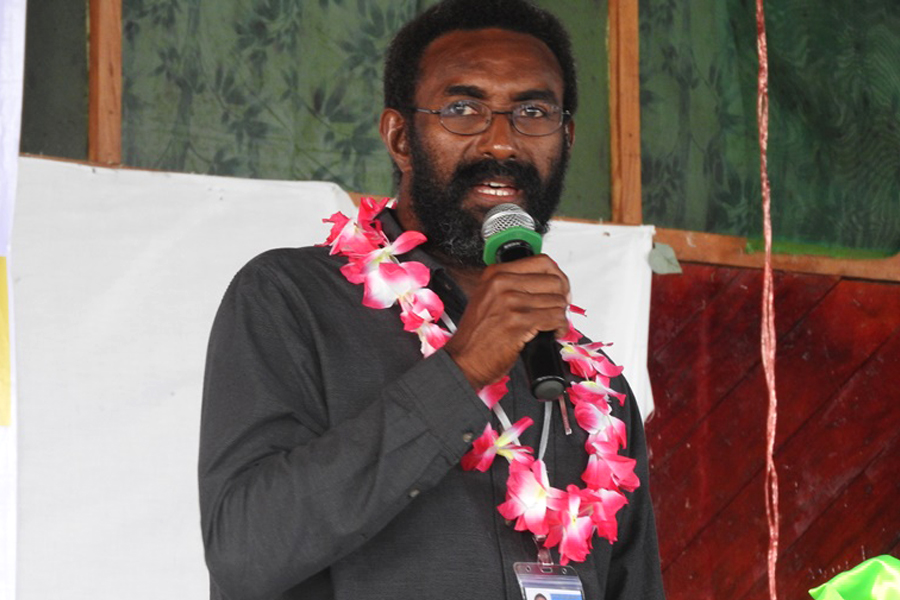
Director of Malaita Health Authority, Dr Henry Kako delivering the keynote address during official opening of the four days National Health Setting Conference which currently in Auki.

BY SAMIE WAIKORI

AUKI

COMMERCIAL and economic interest of a country is a risk to its people and environment.
Director of Malaita Health Authority, Dr Henry Kako raised the alarm in the keynote address during official opening of the National Healthy Setting Conference in Malaita on Monday.

He said while progress has been significant and inspiring, it has not sufficient to cope with the speed of change the region especially Solomon Islands is facing.

Kako said at no point in human existence has there a rate of environmental change that so profoundly threatens the health of people and the planet.

“Destruction of our habitat and destabilization of our climate compromises our access to the most fundamental requisites for human existence, safe water, clean air, food security and shelter,” he said.

Kako said climate change in particular continue to threatens many Pacific island countries and health promotion intervention are relevant to the process of adaptation and mitigation.

He said a distinct feature of life in the 21st century is the speed, power and reach of marketing of commercial products.

“People are tunes in and exposed to information at unprecedented rates.

“This can be empowering as knowledge is readily accessible to the public, but this would also require discernment to filter credible from illegitimate sources.

“At no other point in history has it possible to rapidly alter or create ‘social norms’ and influence behaviour in favour of specific products, especially those that may be harmful to our health,” Kako said.

He said that increasingly, health messages from Ministries of Health were drowned by sectors protects the commercial and economic interests of a country.

He said often times, decisions were made to support or stimulate economic growth with little or no thought on both the immediate and long term health effects of these decisions.

“There is no doubt that commercial and economic determinants create opportunities to improve quality of life.

“At the same time risk to health can no longer be ignored, especially where there is strong evidence of long-term consequences on critical health requisites.

“Increasingly, ministries of health will need to call out situations where commercial and economic decisions may result in short-term gains (e.g. job creation) and long-term adverse impacts (eg forest denudation, flash floods and loss of life and property),” Kako said.

Human behaviours important in healthy setting

0
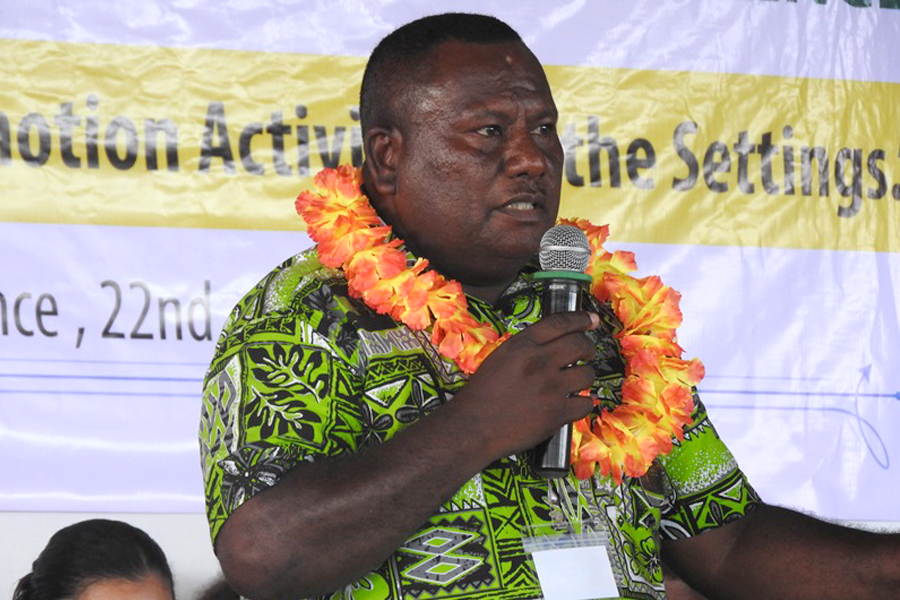
Director of Health Promotion Division of MHMS, Mr Ben Rickie speaking during the official opening of the National Health Setting Conference at Motel Malaita in Auki on Monday..

BY SAMIE WAIKORI

AUKI

Director of Health Promotion Division of MHMS, Mr Ben Rickie speaking during the official opening of the National Health Setting Conference at Motel Malaita in Auki on Monday..

HUMAN behaviour is very important in health setting as it affects health and quality of life.

Director of Health Promotion Division of MHMS, Mr Ben Rickie said yesterday that behaviour is the result of a complex interplay of internal and external drivers.

He said individuals and groups will consider their values beliefs, perceptions and knowledge as they make decision.

Rickie said people’s decisions are also influence by contexts, social norms and group expectations.

“As people interact with their environments where they work, live and play, they decisions and the setting will affect their health outcomes for better or worse.

“Collectively, human behaviours result in human activity that can create or destroy health.

“It is only in the 21st century that the world has reached consensus on the urgent need to address human activity that has plunged the planet into a state of crisis, from relentless use of fossil fuels to destruction of the physical environment,” he said.

Rickie said efforts to mobilise support for sustainable development started in the 1990s with the Unite Nations Conference on Environment and Development or Agenda 21, the Kyoto Protocol, Rio+20, the Sendai declaration and COP21 among others.

He said WHO has long recognised the importance of behaviour and settings in achieving better health and quality of life.

Rickie said health promotion was defined as the process of enabling people to increase control over and to improve their health in 1986 through the Ottawa Charter.

He said health promotion challenged the dominant biomedical approach in public health and pave the way for uptake of a broader socio-ecological model for population health.

Rickie said this would articulate a different role of the health sector include, creating supportive environments, developing personal skills, strengthen community action, building healthy public policy and reorienting health systems.

National Health Setting Conference 2018 in Malaita

0
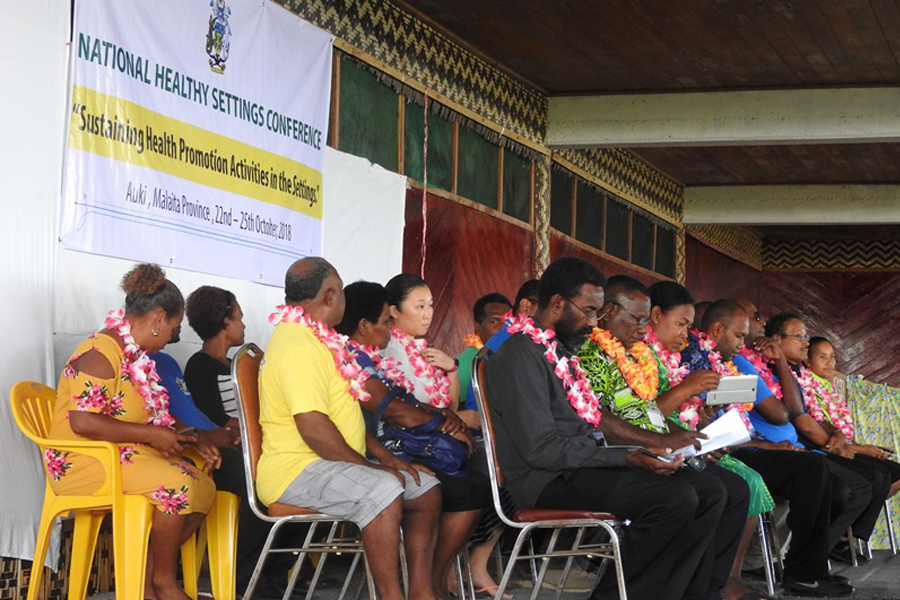
Officialls attending the National Health Settings Conference currently in Auki, Malaita province.

BY SAMIE WAIKORI

AUKI

Officialls attending the National Health Settings Conference currently in Auki, Malaita province.

MALAITA Provincial Health Authority is hosting the first-ever National Health Setting Conference, underway in Auki.

The four-day meeting started on Monday this week with the theme “Sustaining health promotion activities in the setting”.

Speaking during the official opening of the programme yesterday, Director of Health Promotion Division of MHMS, Mr Ben Rickie said since health promotion embarked on healthy setting, they learned a lot from establishing the programme in the country.

“All the health promotion officers may present their experience for the past years.

“We all must acknowledge those pioneering experiences, through them we can have some insights that direct us to a position for future aspiration on all healthy setting,” he said.

Thus, Rickie challenged the participants to move beyond participation and engagement at hand and to interact with people.

Saying, this is by mobilising it to a higher order of inclusion, self-determination – defining the agenda and initiating action.

He said the missing step may be in providing people with sufficient information and capacity to understand discern and decided what is in their best interest.

“Making informed decision is a necessary step that individuals, families, groups, societies and nation must take in order to be active players who are not just engaging or participating in the development process, but are determine their own destiny,” Rickie said.

He said health promotion offers solutions and methods to go beyond the rhetoric of inclusion, participation and engagement to enable people to increase control and improve their health.

Rickie added that health promotion focused on providing supportive environments for people to develop their individual and collective skills in making decisions from the choices present to them.

He said in the western pacific region, health setting is one of the most important mechanisms that organise people’s participation in health matters.

Rickie said this might constitute a rhythm that has the potential to permeate health actions across all SDGs.

“Whether is healthy islands, healthy cities, health-promotion schools, healthy hospitals, healthy communities, or others, these settings are natural sites for integrated action and excellent platforms for local ownership of any combination of the SDGs,” he said.

He emphasised that healthy settings in turn cannot be achieved unless it equips or supports people tom modify their behaviour.

Rickie continued that healthy behaviours are triggered by health literacy, better choices and informed decisions.

“This provides the ‘beat’ – the punctuation of sound through silence of individuals contributing in their own ways at their own pace to collective achievement of health, until each and every one is reaching for better health, and no one left behind,” he said.

The conference gathered health promotional staffs from the nine provinces across the country including HCC.

Youth unemployment associated with exploitation: UNDP report

0

BY LYNTON AARON FILIA 

A United Nation Development Programme (UNDP) report highlighted youth unemployment in Solomon Islands is associated with the risk of exploitation.

UNDP’s Solomon Islands Youth Status Report 2018 said youth unemployment is associated with the risk of exploitation – particularly sexual exploitation of young girls around logging and mining camps and foreign fishing vessels.

The findings were compiled from a research carried out in eight provinces across Solomon Islands.

According to the report, Honiara’s street prostitution often involves young women who have experienced abuse at home, while prostitution at hotels and bars involves both local and Asian migrant women.

In the meantime, the report said it is unclear if these trades also include young boys but investigation and prosecution of the sex trade is rare in the country.

However, first case of human trafficking involving a young girl married to a foreign logger was brought before court in September 2017.

Regarding the issues, Government and group of NGOs in the country has been working on the UN Convention on the Rights of the Child with aim to address the risk of exploitation.

Now, only Save the Children and UNICEF are actively working on prevention through awareness and child protection programme locally, while the ILO builds capacity through its Pacific Sub Regional Child Labor and Trafficking Program

At the government level, the Advisory Committee on Children informs Cabinet and coordinates the implementation of the UN Convention on the Rights of the Child.

The Committee on the Rights of the Child has pointed to several inconsistencies on minimum ages that could be changed to reflect international standards—the minimum age of criminal responsibility is just 8 years old, employment 12 and marriage 15.

Furthermore with the report it stated lack of adequate opportunities for young people to participate in the informal and formal economy makes lasting peace harder to sustain.

This includes young men who lack direction more prone to recruitment by militant or criminal groups – as happened during the tensions, it said.

Besides, the report also highlighted that Solomon Islands Family Health and Safety Study found a correlation between male unemployment and violence against women.

Lack of employment and livelihood opportunities affects many young people’s sense of self-worth and their ability to participate in social, community and political life.

In Honiara, while there are regulations that set aside certain sectors such as transport for indigenous small businesses, the entry of Asian migrants and their subsequent scapegoating for broader governance failures is also creating a potential security risk.

PM congratulates first recipient of Skills Passport Programme

0
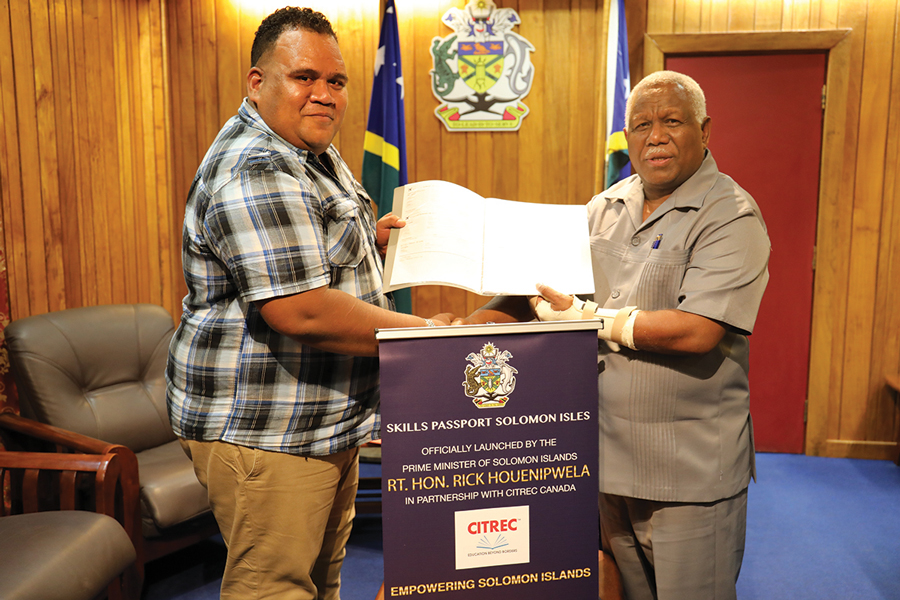
PM Hou handing over the PR and work permits to Mr Leve this afternoon.

PRIME Minister Rick Houenipwela has congratulated the first recipient of the Skills Passport Solomon Isles program in Canada.

Mr Ofati Leve will be the first recipient of the programme following the launching of the new initiative with Canadian International Training & Education Corp of Canada [CITREC] by the Prime Minister at the margins of the UNGA in New York last month.

The Prime Minister encouraged Leve to be a good ambassador for the Solomon Islands whilst in Canada.

“You are the pioneer under this new programme and therefore you have a very important responsibility to give a good impression to your employers and the Government of Canada of the value of Solomon Islanders,” he said.

The Prime Minister said Leve’s success will open more doors and opportunities for more Solomon Islanders.

Leve in response said he is a proud Solomon Islander and he will be flying the flag of his country in Canada.

“I am excited for this new journey to a new country to work. I am so happy to be the first recipient and I thank the Prime Minister for launching the new programme with CITREC which will definitely be opening new opportunities for people like me,” he said.

Under this programme, Leve will be employed as a chef with a permanent full time employee in a Canadian restaurant with permanent residence and work permit.

He will depart to Canada this Saturday.

This new initiative will introduce eligible Solomon Islands nationals to an expedited stream for Canadian Permanent Residency which comes with permanent jobs into Canada’s Hospitality and Tourism Sector.

It will also introduce new efforts in empowering women in Solomon Islands with seven out of 15 Permanent Residency nominations under the pilot project.

This programme will allow Solomon Islands nationals under a special pilot project to apply for Permanent Residence nomination for Canada that will be supported under Canada’s Provincial Nomination programme.
–OPMC PRESS