How copra farmer Adabule was supported to recover from Maila
BY TONY IROGA
The Commodities Export Marketing Authority (CEMA) is proactively supporting farmers, not only during the good times – CEMA is rescuing farmers who have been devastated by cyclone Maila.
The country has rallied to support Maila victims recover. The national government, provincial governments, development partners and private sector are all in.
CEMA is likewise on the ground for the farmers in the affected provinces.
One farmer of the Western province shares his story.
For Keron Adabule, of North Vela la Vella, Western province, cyclone Maila brought him to the point where he was faced with questions of either continue with copra farming or just leave it.
Adabule lost 54 bags of copra to Maila, within a few hours, in just one night.
The sea stopped being water and became something else entirely — something angry, something without mercy, something that did not care what a man had spent years building.
He stood in the dark and watched it happen.
Fifty-four bags of copra. His stock. His income. His next school term and his family’s next meal and every hour of labour that had gone into filling those bags — all of it lifted by the surge and swallowed by the sea between the hours when the world was asleep and the sky had not yet decided to be morning.
Fifty-four bags. Gone.
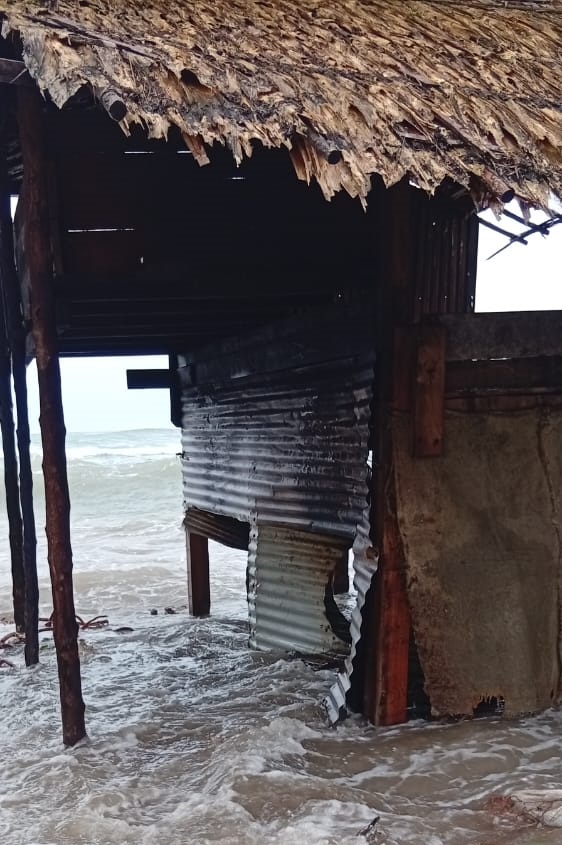
He grabbed what he could. A few essentials. The things you reach for when you realise that the building is lost and all that is left to save is the people inside it. He got his family out. He held them together in the dark while the wind screamed and the water rose and Leona Village shook.
When the light finally came, Keron Adabule stood on what remained of his life and looked at the water.
The copra was not coming back.
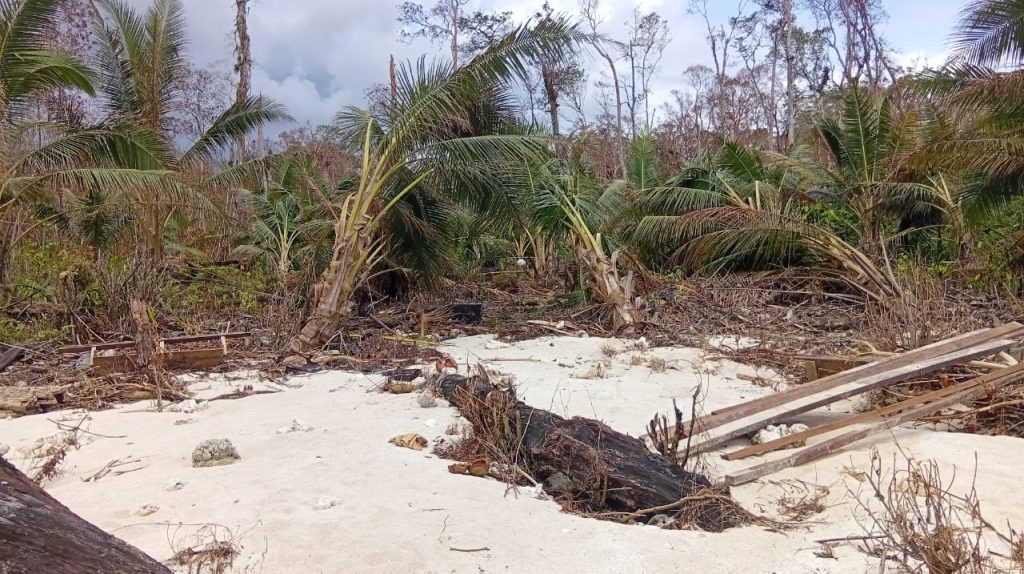
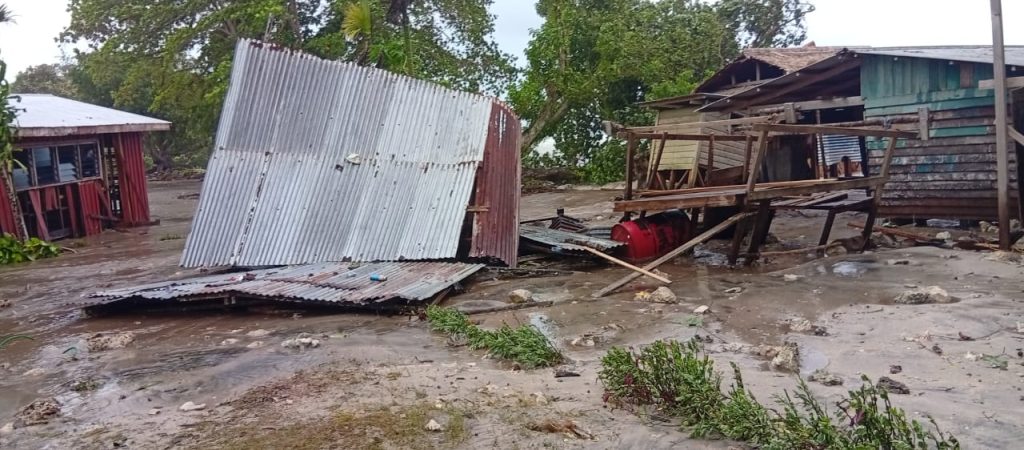
And neither were the driers. Neither was the storage shed. The coconut trees he had planted with his own hands — young trees, trees that had not yet had a season to prove themselves — were snapped and scattered like they had never existed at all.
In a single night, the cyclone had taken not just his present. It had reached into his future and torn that out too.
In the days that followed, the promises came.
A director visited from Malaita. He looked at the damage. He shook his head the way officials do when they want to appear moved. He promised a new storage shed. He promised a kukum drier, to be funded through provincial government procedures.
Keron listened. He nodded. He was grateful.
He waited.
He followed up. He made the calls, sent the messages, asked the questions that a man asks when he is trying to rebuild and needs what he was promised. He was not aggressive about it. He was patient. He believed that when a person in authority gives their word, they mean it.
The shed never came.
The drier never came.
The director never came back.
Keron sat in Leona Village with nothing but the same two hands he had always had, a community that still needed him, and a silence where the support was supposed to be.
This is the part of the story where many men break.
And no one would have blamed him. Not after a cyclone. Not after losing fifty-four bags in a single night, every drier destroyed, every new tree flattened. Not after being promised help by the very institutions that existed to provide it, and then abandoned without explanation or apology.
The easy thing — the understandable thing — would have been to walk away. To stop making calls that went unanswered, to let the bush take back what the sea had already started.
Keron Adabule did not do the easy thing.
He went back to work.
Not because help arrived. Not because anyone made it simple. He had no drier of his own anymore. No shed to store under. But there was a community copra drier in the village — a modest facility, funded by the province — and Keron used it. Humbly, practically, without complaint. He adapted to what existed rather than waiting for what had been promised.
Because the farmers in his community were still showing up. Still carrying their copra. Still looking to him as the man who stood between their harvest and a market that would treat them fairly. And he could not look those farmers in the eye and tell them that a cyclone had broken him when it had not broken them.
So he started again. Slowly. Painfully. Bag by bag.
Here is something else about Keron Adabule that matters.
The land beneath his feet has never been in question.
Through his father’s tribal ownership and his mother’s, Keron holds rights to enough land to do something that many farmers in this country only dream about — to expand. To plant more trees. To grow deliberately and with vision rather than simply maintaining what already exists.
The cyclone damaged his young plantation severely. But it could not take the land itself. And a man who still has his land still has everything he needs to begin again.
That is exactly what Keron intends to do.
When the facilities are rebuilt — and he will rebuild them, because that is the kind of man he is — the land will be ready. The roots of this thing go deeper than any storm can reach.
And then CEMA came.
Not with a director in a clean shirt. Not with a promise wrapped in procedure. CEMA came the way that real rescue comes — not loudly, but reliably. Not with ceremony, but with commitment.
Market access. A fair price. And the simple, revolutionary act of bringing the buyer to the village instead of forcing the farmer to the wharf.
This is what Keron wants people to understand about what CEMA’s presence actually means for a farmer in North Vela Lavella.
Without CEMA, a farmer here faces a brutal choice. Load your copra. Find your own transport. Make the long journey to Honiara wharf and wait — wait at the main port for a buyer to come to you, on their terms, at their price, at their convenience. The transportation costs alone are enough to hollow out a man’s earnings before the negotiation even begins.
With CEMA, the market comes to the village.
Fair price. Local access. No wharf. No waiting. No losing half your income to the cost of simply getting there.
That is what Keron delivers to every farmer who walks through his door. Not charity. Not sympathy. A genuine economic alternative that treats rural people as if their time and their labour and their distance from the capital are not disadvantages to be exploited but realities to be solved.
When the government’s promise evaporated and the silence from Malaita became permanent, CEMA did not evaporate. CEMA did not go silent. It stayed. And in staying, it gave Keron the one thing he needed more than a shed or a drier or a government grant.
It gave him a reason to keep going.
Today, the numbers tell a story that the cyclone did not expect to write.
Seventy-six bags. Each one averaging eighty-five kilograms of copra. Produced from a community drier that is not yet his own, on land that has always been his, by a man who had nothing left to his name in the hours after the storm.
But Keron does not talk much about himself when you ask him how things are going.
He talks about his farmers.
He talks about the satisfaction on their faces when they bring their copra and receive a fair price — not a price squeezed down by someone who knows they have no other option, but a genuine price, offered with respect. He talks about what it means to have the market at your doorstep rather than a day’s travel away in Honiara. He talks about the dignity of honest work that is honestly rewarded.
“They are satisfied,” he says. And the way he says it makes clear that this matters to him more than anything else. A CEMA agent’s measure of success is not what fills his own shed. It is what fills the lives of the people he serves.
There is a particular kind of courage that does not look like courage from the outside.
It gets up before sunrise and opens a buying point. It uses a community drier because its own was destroyed and it refuses to stop producing while it rebuilds. It holds onto land that a cyclone tried to ruin and plants the vision of what that land will one day become. It keeps showing up for farmers who need it, even when the institutions that should have shown up for it did not.
That is Keron Adabule’s courage.
He is grateful to CEMA. He says so plainly, without flourish. But CEMA should be grateful to him too.
Because men like Keron — men who survive a cyclone, survive broken promises, adapt without bitterness, and still stand in their community offering a fair deal to every farmer who walks through the door — these are the people on whom everything else is built.
The land is ready.
The man is ready.
And when those new driers finally rise and the young coconut trees grow tall again on land that has belonged to his family for generations — that will not be a comeback story.
That will be a continuation of something that was never truly stopped.
Because CEMA came to the rescue.
Photos: Supplied
For feedback, contact: [email protected]
Editor: [email protected]