The case against a 37-year-old man, accused of stealing from his employer, has been adjourned for March 29, for trial.
This is the case of Ian Pias Walelabua who faces with one count of Burglary in relation to an incident on August 28, 2020 between 11.30pm and 12.30am when the victim and his wife were out from their residence at Henderson.
Police said the accused and other males entered into the complainant’s house by climbing the walling and removed the security camera.
The allegation said it was when they were inside the house, they removed a cash box that contained the amounst of $300,000 SBD, $20,000 AUD and 5,000 pounds.
It was also alleged that the defendant Walelabua before committing the offence did called another employee, who also works for the complainant to find out the couple’s movement on that night.
The phone conversations were made by the accused was to check on the couple whether they were out of their residence.
Police also said the accused Walelabua worked as an electronic officer for the complainant.
Deputy Chief Magistrate Ricky Iomea presided over the matter yesterday.
Public Solicitor George Gray is representing the accused in court.
The case against a bus driver accused of causing death to a pedestrian has been adjourned for March 30.
This is for the crown and defence lawyers to decide whether the trial will proceed on April 5.
Yesterday a lawyer from the Public Solicitor’s Office who appeared on instructions from Allan Tinoni told the court that the lawyer in carriage have no issues to raise but seek to adjourn the case for the next 14 days.
Deputy Chief Magistrate Ricky Iomea adjourned the case to March 30 for both counsels to appear and confirm whether trial will proceed on the dates previously agreed to; both counsels in carriage of the matter did not appear yesterday to give full instructions to the court regarding the case.
Diau Konge is being alleged in a hit and run incident at the Henderson area.
Prosecution said the deceased with his wife and their teenage boy were onboard a pick-up truck travelling from Honiara main market heading back home. The deceased is believed to have taken some alcohol before he and his family boarded the vehicle. On their way passing the Lungga Bridge East of Honiara, the deceased asked his wife to give him some money. His wife gave him $100.
Police said they stopped at the shops in the Lungga area and the deceased went into one of the shops and bought some goods before they drove out again heading in the easterly direction.
Police also said just opposite the Island Night Club in the Henderson area, the deceased asked the driver of the motor vehicle to stop.
As the driver was ready to stop the deceased suddenly jumped out of the truck, without looking for incoming vehicles from both lanes. It is believed that he ran straight into the main road, after one vehicle passed him from the westerly direction.
Police also said when the deceased crossed the road, a 15-seater mini bus was travelling at a high speed from the easterly direction and unfortunately hit the deceased and it is believed he died instantly.
THE AstraZeneca vaccines are well preserved at the national medical store, ready to be distributed from administration.
This was confirmed by Dr Ibrahim Dadari, programme officer UNICEF, during a covid-19 radio talkback show.
Temperature is a critical factor to storing vaccine. And, AstraZeneca vaccine can be stored in temperatures between eight and two degrees Celsius for about six months.
Dadari assures that the vaccines are stored in recommended temperatures to ensure the vaccine remains safe for human use.
“The vaccines preserved in a special box storage, with ice pack to maintain temperature as per standard UNICEF requirement the vaccines were immediately shipped to the national medical store where we have a big fridge called the working cool room so vaccines were immediately offloaded.
“All the processes on how this vaccine was handled was documented and expected inspections was conducted on site and was communicated to UNICEF. The documentation inspection process was well observed and resulted with everything ticked, so we are fine to go,” said Dadari.
In terms of how vaccines are going to getting out of the medical store to the field, they have standard WHO pre-approved freezers to store vaccines and standby cool boxes and vaccine carriers which are also meant to store vaccines.
He adds that these specialised boxes have temperature monitoring devices installed in each.
“Our health workers are being trained to look at these things so, they will be taking temperatures twice daily morning and evening to make sure that vaccine is maintain at two to eight degree. These is part of the safety measures to maintain what is called vaccine potential.”
He said for vaccine deployment to borders, health authority will use WHO pre-qualified freezers to store vaccines where they will be kept properly at Taro in Choiseul Province, at Nila in Western Province and also in Malaita Outer Islands.
“So, all measures are in place to ensure these vaccines remain potential and safe for all of us. If there is any breach, we will make sure it is addressed immediately,” he said.
COMMUNITY Access and Urban Services Enhancement (CAUSE) Project is on a mission to give Gizo town a facelift in 2021.
Currently six projects are underway which include; Gizo Satellite Market, Construction of bridge next to Gizo wharf, construction of Jacob’s ladder behind Gizo Primary and Secondary School, Improving Drainage system within Gizo Primary and Secondary School, Installation of Electricity to Western Province’s Quarantine Centre and Street Clean-up campaign.
Penny Aloysio Siliake of CAUSE project Gizo explained that specific teams have been identified to implement respective projects.
“So, these projects are implemented simultaneously. Now those responsible for constructing the bridge are on the ground so as the team to improve the drainage system, constructing the Jacob’s ladder, construction of Gizo Satellite Market and Gizo Clean-up campaign.
“In all, 2021 will be a busy year for CAUSE project in Gizo and we are committed to fulfil what is required in the given period of time,” he said.
Siliake adds that there are numbers of projects that have been completed last year in Gizo – two of which are the improvement of Gizo Footpath and improvement of Western Province’s Quarantine Centre.
He said the project is still ongoing but had been slowed down due to covid-19.
“Foot path completed in some parts of Gizo town and now looking at extending the development to other parts of Gizo,” Siliake said.
He said these projects will surely make a huge different on Gizo town as a business hub in the Western Province.
The Champions of tomorrow project of World Vision Solomon Islands and Save the Children that aim at reducing disaster risks in schools has shined in schools in Makira Ulawa Province.
The project that supported by the Australian Government through the Australian Humanitarian Partnership (AHP) Disaster Ready program is being implemented in Makira and Malaita Provinces.
The project has shined through empowering students in four schools in Makira Ulawa Province on disaster and climate change resilience.
The schools are Toroiwango Primary School, Manama Primary School, Etemwarore Primary School and Taripara Community High School.
Last week World Vision and its partners did a cross learning monitoring trip to the schools to see the progress of the project.
Head Techer of Toroiwango Primary School in Arosi 1 Charles Dauasi applauded the project saying, he is confident that through the drills they usually conducted in the school the students understand what to do and where to run to in an event of earth quake and tsunami.
“I thanked World Vision and your partners for choosing Toroiwango Primary school as one of the project sites, indeed this project is important as children are vulnerable to disaster. I am now confident that my students learn a lot through the disaster drills that we usually conduct,” he said.
Nelly Siehu Head Mistress of Etemwarore Primary School said, her school is now conducting drills every month.
“We have different signals for our drills, so when the signal comes on, even when students are busy in their classrooms or anywhere outside they will all walk up to the assemble area. ,”
“We are serious about this and we now see our students know what to do,” she said.
Disaster Risk reduction programs are important to schools as children and women are 14 times more likely to die or injured during disasters.
The team that toured the schools included the representative from the, Ministry of Education and Human Resources (MEHRD), Malaita and Makira Education Authority, Save the Children, People with Disabilities SI (PWDSI), Makira Community Based Rehabilitation (CBR), Provincial Disaster Management Office, Solomon Islands Meteorological Services (SIMS) and World Vision Solomon Islands.
During the tour, students also conducted drills to show the level of their preparedness and understanding on responding to disasters. . – World Vision Press
One of the projects being worked under the CAUSE programme in Gizo
BY BEN BILUA Gizo
CONSTRUCTION of Gizo Satellite Market has reached its final phase and is progressing well.
The development is carried out by Community Access and Urban Services Enhancement (CAUSE) Project, Western Branch with the support of World Bank.
In an interview with this paper, Penny Aloysio Siliake of CAUSE project Gizo said CAUSE Project has engaged three separate groups in the construction of the market.
He explained that the first group completed their task early this year – and that is construction of the market building.
“Currently, there are two groups working on the ground. One is focusing on the drainage system and the other group is constructing the market’s Ablution block,” Siliake said.
He said the project is expected to be completed around May this year before handover to the Western Provincial Government.
Men busy at work yesterday
“Ablution block expected to complete around May and drainage with fence complete end this months,” Siliake said.
He said the Satellite Market known as the Banana Valley Satellite Market in Gizo was one of the projects initiated as part of covid-19 resilience programme.
Siliake told this paper that the satellite market will expand and improve the existing Market facilities in Gizo and at the same time solve the issue of over-crowded at the current market.
“So basically, the idea is to help promote social distancing at the same time provide enough space for vendors to sell their products,” he said.
Siliake said the project is progressing well but depends on the weather to meet the deadline.
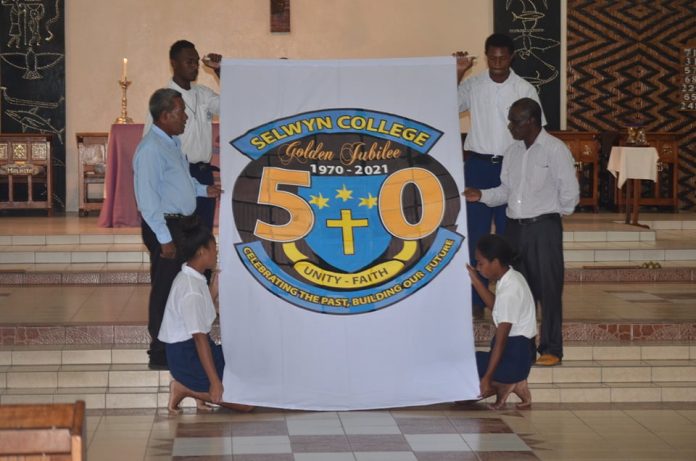
SELWYN College has unveiled its Golden Jubilee celebration with the theme ‘Celebrating the Past, Building our Future’.
Minister of Foreign Affairs and External Trade Hon. Jeremiah Manele launched the celebration during a church service in Honiara on Sunday afternoon.
Hon. Manele, who is a former student of Selwyn College and taught briefly at the school, was happy to be part of the launching ceremony.
He used the occasion to also appeals to all former students to support effort toward the celebration scheduled for late September 2021.
All former students will be conducting fundraising activities in their four divisional groups of Kirio, Masi, Noabu and Tahula culminating in the September Golden Jubilee celebrations.
Masi members preparing refreshments after the launchingGuests cutting the Golden Jubilee cake
Hon. Manele who is a member of MASI division also appeals to all former students to support the Golden Jubilee Committee and the Selwyn College Old Scholars Association (SOSA) in their planning of the jubilee celebrations.
During the launching service, preacher and former Chaplain of Selwyn College, Fr. Philemon Akao said SOSA is not just a group but a ‘way of life’.
He also appeals to all former and current Selwyn College staff, students and supporters to take pride in SOSA and be part of it as a way of life and service to God and Solomon Islands.
Fr. Philemon Akao says SOSA is a way of life
The keynote speaker during the launching service Dr. David Welchman Gegeo said he was elated to be back and reconnect with former classmates and friends.
As a pioneer student of Selwyn College from 1970 to 1972, Dr. David said he owed it the school for what he has achieved in his academic career.
Some former students with a young man after the launching
He recalled how his poetry and writings published in a Selwyn College school magazine that somehow made its way into the University of Massachusetts library, which proved to be his ticket for admission into the Bachelor of Arts programme.
“The university wanted some proof of what I was taught in high school and the highest level of secondary school I had completed in Solomon Islands, so my writings allowed my admission into the university.”
Dr. David had a stint in radio broadcasting with the then Solomon Islands Broadcasting Service (SIBS) after leaving Selwyn College and was sent to study music in USA. It was when he was studying music that he developed an interest to pursue further studies.
He returned and resigned from SIBS before going back to continue his studies in the US where he eventually graduated with a B.A in Cultural and Linguistic Anthropology (University of Massachusetts), an M.S in Mass Communications and Public Relations (Boston University) and a PhD in Political Science and Political Philosophy (University of Hawai’i).
“I’m a living witness to what Selwyn College can offer,” Dr. David told SOSA members and Selwyn College choir who was part of the launching service.
Meanwhile, members of the SOSA executive, Golden Jubilee Committee and divisional heads were commissioned by chief celebrant Fr. Michael Palmer during the launching service. Chairman of the Golden Jubilee Robert Iroga said Selwyn College Golden Jubilee will be celebrated from September 24th to October 3rd, 2021
SOSA leaders and Golden Jubilee committee members in their meeting hosted by Governor General His Excellency Sir David Vunagi and Lady Mary
Eugene Gavibatu (right) and Bryan Wale stands infront the building they help erect for an elderly couple who lost their home to severe TC Yasa early this year. Pictures supplied
Local students assist in disaster voluntary recovery work in Fiji
BY JARED KOLI
“LOVE your neighbour as you love yourself,” said young Eugene Gavibatu, “does not refer to the ones close to your home.”
“It actually refers to being compassionate and help people that are in need and in distress,” the final year Land Management student at the University of the South Pacific (USP) in Fiji, puts it.
Gavibatu of Choiseul Province and Bryan Wale of Malaita early this month assist on disaster recovery voluntary work by erecting a new home for an elderly couple at Yaqaga island, close to Fiji’s second-largest island of Vanua Levu.
This follows the aftermath of category five Tropical Cyclone Yasa which tore through Vanua Levu early this year, destroying more than a thousand homes and claimed four lives.
The elderly couple also lost their home during the severe storm.
Gavibatu and Wale were joined by two other university students from Fiji, accompanied by their supervisor traveled the 173-kilometer journey from Suva to Yaqaga island on March 2, 2021 and commenced work on March 3rd.
They complete the new dwelling ground floor home on the fifth day. Building materials for the construction of the new home and the trip was made possible through support by Nephrologist Dr Amrish Krishnan of the Kidney Hub in Suva.
Bryan at the foreground with Eugene and two other Fiji university students and their supervisor
Inspired by the popular teaching from the parable of the good Samaritan in the Bible, Gavibatu said he felt that to go out and help rebuild the lives of the elderly couple was a special calling.
“When Jesus spoke of this parable, he taught us to help the needy, people who you never met them before and who had been through a lot in life.
“Those that are faced by disaster, living in fear and depression and those that the society had turn their back towards them,” the softly spoken Choiseul lad, said.
Bryan Wale, a final-year student at the Fiji National University (FNU) said the pain of losing a home is what motivates him to go out and volunteer.
“If I put myself in their shoes, it would be surely a bad experience indeed. So since the opportunity was given to volunteer, I decided that I must go and help to rehabilitate the elderly couple.
“It’s beyond one’s imagination to witness someone to have gone through such devastating experience but I felt happy to put a smile on their face again,” said Wale.
The two Solomon Islands students said Fiji has been their home for the past few years and provided for them a lot, and as good citizens and ambassadors of Solomon Islands, it is time to give back to the community.
The complete building the volunteers erect for the elderly couple
Tropical Cyclone Yasa assessment has revealed that 1500 homes were destroyed while 6000 damaged. Four lives were also lost during the cyclone. Radio New Zealand reported it caused around $250 million worth of damage to infrastructure, agriculture and livelihoods.
It was the strongest tropical cyclone in the South Pacific since Winston in 2016, as well as the fourth most intense tropical cyclone on record in the basin.
Dr Amrish Krishnan of the Kidney Hub in Suva who supported the voluntary work with funds is not new to helping people that were in the midst of trouble.
In May 2020 he and his best friend, Dr Ahemd Shakeel of Kidney Hub in Nadi offer free services to those who lost their job as a result of Covid-19.
“Dr Krishnan, had thought that helping people in the midst of his own struggles would help make the world a better place in these trying times,” cited Fiji Sun.
This is also not the first time Solomon Islands students in Fiji assist in disaster voluntary and relief efforts in Fiji. In May 2020 Solomon Islands students studying at Fiji universities donate food, clothing and cash to 18 families who were badly affected by Tropical Cyclone Harold.
In July 2016, a 22-year-old Solomon Islands student Randy Chite walked around the island of Viti Levu, raising more than a thousand dollars for people affected by Cyclone Winston.
THE 24,000 AstraZeneca vaccine received last week is meant to inoculate 24,000 people.
These people will get a second jab around May and June.
AstraZeneca is administered in two doses. Depending on the country, the second jab is taken four to 12 weeks after the first.
In our neighbour Australia, the second dose is administered after 12 weeks. Other WHO-approved vaccines such as the Pfizer-BioNTech and Moderna are also taken twice.
An Australian study published in February this year, involving 17,000 participants, showed that having the second dose after three months increased the efficacy rate of AstraZeneca. Lesser periods lowers the efficacy rate.
Explaining the roll-out plan for the vaccine in Solomon Islands, Dr Yogesh Choudri, technical advisor to the ministry of health, said the first batch received on Friday last week will be administered to 24,000 people.
These vaccinated people will get their second dose when more vaccines are brought in later, he said.
“We are going to use all these doses to 24,000 people and when we receive the second batch of vaccine in May and June, we will call these people again to get their second dose.
“We decide to vaccinate 24,000 people because we are confident that we have more vaccines that will be coming into the country.
“After receiving the first dose the second one would be after between eight to 12 weeks, they should get their second dose,” he said.
Choudhri said out of the 24,000 doses of AstraZeneca received, 7,000 doses will be used in Honiara for the front liners, and the rest will be sent to the western border to protect communities along the western border from the virus.
“The vaccine will be rolled out on Wednesday at the Central Field hospital which was the identified location for roll out of the vaccine in Honiara.
“Currently a total of 24,000 doses of AstraZeneca vaccine arrived in Solomon Islands and they are being kept right now at the National Medical stores in proper storage conditions that the vaccine requires.”
TWENTY thousand Sinopharm covid-19 vaccine is set to arrive in the country early April once approved by World Health Organisation.
This was confirmed by Minister for Health and Medical Services Dr Culwick Togamana.
Mr Togamana said this vaccine will be shipped from the People’s Republic of China.
“We are also anticipating another 20,000 does of Sinopharm covid-19 vaccine early next month from the People’s Republic of China. Once approved by World Health Organisation, we will also roll out the Sinopharm vaccine. So, thank you China,” he said.
Togamana said they are also anticipating a significant amount of financial support from the Australia and New Zealand governments for the procurement of more covid-19 vaccines, with discussions on this underway.
“Thus, I extend sincere thank you to Australia and New Zealand,” he said.
Togamana adds, the Solomon Islands Government is also taking proactive actions in its efforts to secure more vaccines for the population.
“Last week we have also finalised our request to the government of India for 600 thousand more AstraZeneca vaccines for our people.
“This is important to fulfil the government’s desire to get all of its eligible population vaccinated,” he said.
China has two covid-19 vaccines; the Coronavac and Sinopharm. The Coronavac is produced by the Beijing-based Sinovac company. It has an efficacy rate of 60 percent. The second vaccine is called BBIBP-CorV, which was trialled by the state-owned company, Sinopharm. BBIBP-CorV is commonly referred to simply as Sinopharm. The Sinopharm has an efficacy rate of 79 percent.