Home Blog Page 923

Aviation ministry defends PS over social media comments

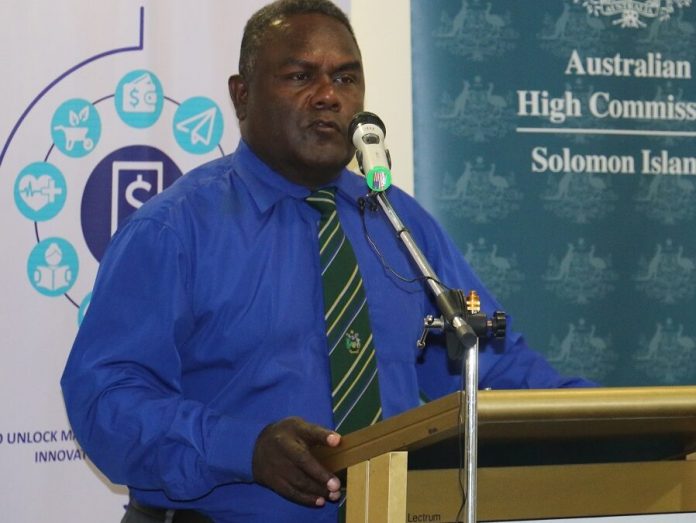
A Facebook commentary criticising the Permanent Secretary of the Ministry of Communication and Aviation, Moses Virivolomo of threatening to pullout the Solomon Islands Roads and Aviation Projects (SIRAP) from Malaita Province last week were “baseless” and “deceiving” to the people of Malaita Province.

Premier Suidani’s Political Appointee, Celsus Talifilu ambiguously claimed Mr Virivolomo threatened the Provincial Executive at a meeting in Auki Tuesday last week that he would cancel all SIRAP activities on Malaita if the Provincial Executive did not accept a Chinese Company earmarked to construct the Fiu Bridge project.

Talifilu further claimed the Solomon Islands Government through its respective ministries have already awarded the contract to build the Fiu Bridge project to Chinese company, China Harbour, a claim that is not true.

In response to these unqualified claims, Virivolomo said the consultation meeting in Auki on Tuesday, May 18, essentially helped the MPG Executive members to fully understand the components of the project, which were executed according to World Bank Procurement Guidelines and not SIG Procurement Guidelines as alleged by the Premier’s private advisor.

“We informed the MPG Executive that the SIRAP National Steering Committee (NSC) has not recommended any company including any Chinese related companies at this stage as alleged by Talifilu who deceptively claimed that we awarded a contract to China Harbour.

“He needs to prove to us any disgrace we have caused regarding the projects,” Virivolomo said in reference to the claim by Talifilu, who was not seen at the Auki meeting.

He added that the World Bank Office in Honiara could not find any irregularities regarding the processes involved in implementing the Fiu Bridge project after Mr Talifilu personally emailed the World Bank directly alleging misprocurement by SIG and demanding a re-tender of the project.

“His unqualified approach to personally email the World Bank regarding this project obviously degrades the authority placed on Premier Suidani and his Executive as intended beneficiaries of the project,” Virivolomo said in a statement over the weekend.

Virivolomo reiterated that the MPG Executive is now aware of the risks of politicizing project implementation that is not in the interest of the NSC, which is mandated to deliver subprojects on Malaita in an open and transparent manner outside ongoing politicking on PRC issues that the Premier and his Executive including his Advisor may have.

Virivolomo said the MPG is an arm of Government and infrastructure development are functions of the National Government and not a devolved function and NSC is only implementing its mandate to deliver transport infrastructure to Malaita.

He further clarified that the allegation of collusion as slandered by Talifilu are baseless and did not have evidence to impress any healthy minded person.

Virivolomo said the claim that SIG has manipulated the tender pricing to suit the China Harbour bid is invalid since the Government is guided by World Bank Procurement guidelines.

Regarding concerns that Suidani’s Executive have on tender and procurement processes, Virivolomo said this assertion is a non-issue at this stage since no award was granted.

Virivolomo is a qualified engineer and Project Coordinator in his career and has provided leadership in delivering infrastructure projects in Malaita when he was Permanent Secretary of the Ministry of Infrastructure Development.

These included the Manawai wharf, the Aluta Bridge, Labour based roads, Small Malaita Roads Rehabilitation-Afio and Afio-Olosu’u road, Marine and Navaids Project at Su’u and all Navigational aids on Malaita, the Auki wharf and Market, Manaoba, Auki and Parasi airports.

–GOVERNMENT COMMUNICATION UNIT

Shipping operators defend safety measures over covid-19 cases

Shipping companies and ports authorities in the Pacific have defended their coronavirus measures after they were criticised for bringing COVID-19 to Solomon Islands and Kiribati.

Solomon Islands Prime Minister Manasseh Sogavare blasted shipping companies after two new COVID-19 cases were detected among the crew of the PNG-registered MV Kopi Chief in Honiara.

Mr Sogavare said it was the third time a shipping company had brought COVID-19 to Solomon Islands.

But David Toua from Steamships Trading, which owns MV Kopi Chief, told the ABC that all COVID-19 safety protocols were followed before the MV Kopi left for Solomon Islands.

“When we get a series of negative tests, we have a confidence that these people are in good health …if someone’s asymptomatic, or pre-symptomatic, that’ll be something that’s impossible for us to detect,” he said.

Mr Toua said the company is reviewing its operations to look at ways of catching COVID-19 infections among crew.

Kiribati recorded its first COVID-19 infection earlier this month, with crew onboard a ship that had sailed from PNG.

Fego Kiniafa, the managing director for PNG Ports said their COVID security bubble has been widened at ports facilities.

“The critical thing for us is if we do not allow cargo to flow then we will have a bigger problem than the COVID. And we do recognise that importance as an island country largely dependent on sea trade,” he said.

MAL looks forward to implement MEAs national activities with FAO

0
Participants of the inception workshop which include representatives from relevant government ministries, FAO, organisations and private sector.

THE Ministry of Agriculture and Livestock (MAL) is looking forward to the implementation of national activities of the Multilateral Environment Agreements (MEAs) in Solomon Islands with the Food and Agriculture Organisation (FAO) of the United Nations.

Deputy Secretary Technical (DST) of MAL, Michael Ho’ota uttered the statement during MEAs two-day inception workshop/meeting held at the Heritage Park Hotel in Honiara from 13-14 May 2021.

Objectives of the meeting is to raise awareness on the programme’s objective and activities; scoping out strategic partnerships with civil society and private sector; refine and validate work plan for year 1 which include validating agro-biodiversity priorities areas, reaffirming preliminary sites/province identified, reaffirming preliminary subsector (commodities such as cocoa, coconut and others) and scope strategic partnerships with civil society and private sector.

“The two days consultation mainly dealt with a component of the programme on the mainstreaming of biodiversity into agriculture and Solomon Islands is the selected focus country for intensified action in the Pacific Region. We (MAL) look forward to the implementation of national activities jointly with FAO,” Ho’ota said.

He said agriculture is an important sector for the Solomon Islands’ national economy as it sustains 85 percent of the rural population with food crops, cash crops, and livestock for their daily livelihoods, food, and social security.

“…it is common knowledge and studies have indicated effects of agriculture on the environment.

“Agriculture is known as one of our greatest triumphs and sources of environmental damage.

“Major environmental problems – Soil erosion – Sediment transport and deposition downstream – On-site pollution from overuse and secondary effects of fertilizers and pesticides – Off-site pollution of other ecosystems, of soil, water and air. It changes the environment major environmental problems such as deforestation, desertification, degradation of aquifers, salinization, accumulation of toxic organic compounds and Loss of biodiversity.

“Therefore, the manner in which we develop agriculture sustainably and environmentally friendly must now be seriously addressed in light of the increasing environment and land resources exploitation,” the Deputy Secretary Technical of MAL,” Ho’ota stressed.

Meanwhile, former Permanent Secretary of MAL and now the Assistant FAO Country Representative Jimi Saelea said FAO has the global mandate to improve levels of nutrition, increase agricultural productivity, and improve lives of rural populations through agriculture development.

He said one of FAO’s strategic global objectives is to focus on “Increase and improve provision of goods and services from agriculture, forestry and fisheries in a sustainable manner”.

Saelea said this is but one of the projects that FAO is implementing and will be implementing in the country.

“The project operates at the global, regional and national levels, thus for Solomon Islands to be selected as the focus country in the Pacific region requires that we commit to make sure we benefit from the programme,” Saelea stressed.

He said the primary focus of the project (MEAs) is to promote mainstreaming biodiversity and sound pesticides management in agriculture.

“This initiative will contribute to achieving the Solomon Islands National Development Strategy, NDS-2016 to 2035 Objectives of which Objective 1: Sustained and inclusive economic growth through Agriculture &livestock. Objective 2: Poverty alleviated across the whole of the Solomon Islands, basic needs addressed and food security improved. Objective 4: Resilient and environmentally sustainable development with effective disaster risk management, response and recovery,” Saelea added.

He said FAO remain committed towards supporting the development of sustainable agriculture, fisheries, forestry and environmental management of pesticides in Solomon Islands to ensure food security, livelihoods and healthy living for the households and people of our country.

Saelea also took the opportunity to acknowledge the role that government through the Ministry of Agriculture and Livestock, and the Ministry of Environment, Climate Change, Disaster Management and Meteorology will play in ensuring this project achieve its objectives.

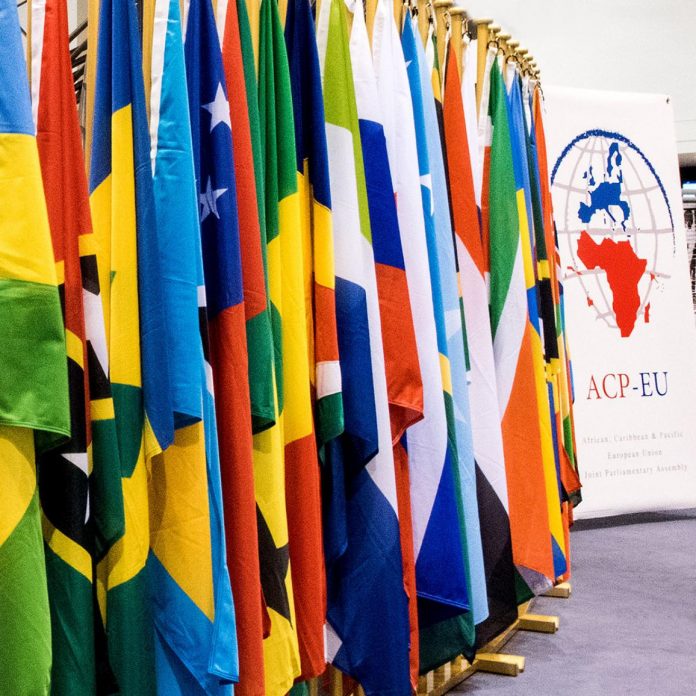
Multilateral Environmental Agreements (MEAs) – phase III Programme is an initiative of the Organization of the African, Caribbean and Pacific Group of States (OACPS) and is funded by the European Union, under the Intra-ACP envelope of the 11th EDF.

The Programme is being implemented jointly by the UN Environment Programme (UNEP) and the UN Food and Agriculture Organization (FAO).

The primary objective of the programme is to promote environmental sustainability in African, Caribbean and Pacific (ACP) countries by strengthening environmental governance and the implementation of Multilateral Environmental Agreements (MEAs).

The target of MEAs are the Convention on Biological Diversity, the Basel, Rotterdam and Stockholm Conventions (BRS) and indirectly the United Nations Convention to Combat Diversification (UNCCD) and the United Nations Framework Convention on Climate Change (UNFCCC).

FAO, in close collaboration with regional partners and national counterparts, implements a component of the programme on the mainstreaming of biodiversity into agriculture.

The programme operates at the global, regional and national levels.

Solomon Islands is the selected focus country for intensified action in the Pacific Region.

The implementation of national activities will be jointly done by the Ministry of Agriculture and Livestock (MAL) and FAO.

Representatives from relevant government ministries, FAO, national research institutes and organizations and private sector attended the inception meeting. – Source: MAL Media

Police review team meet border chiefs

0
Review Team with community in Mono

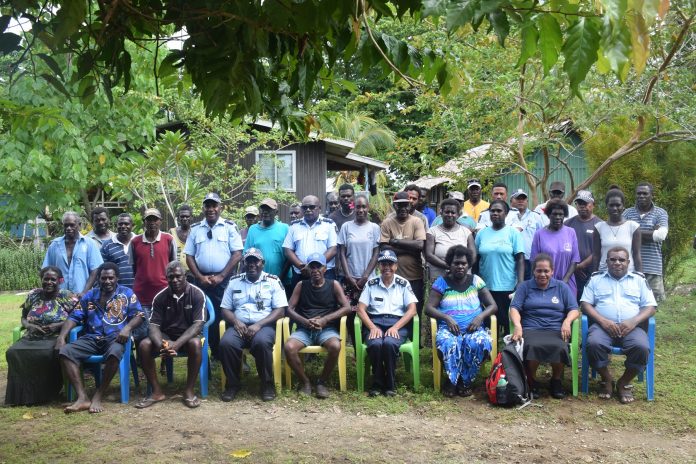
THE Police Review Team on its COVID 19 operation in the Western Border met with the FAMOA Council of Chiefs, Mono chiefs and elders as part of the review of their operation.

A police statement said the meeting with the FAMOA Council of Chiefs was held on 20 May 2012 and team met with Mono Chiefs on 21 May 2021.

Assistant Commissioner (AC) of Police National Capital and Crime Prevention (RSIPF COVID-19 Operation Commander) Simpson Pogeava says during their meetings, many positive issues were raised concerning the Police Operations here at the Western border including representatives from the women and youth groups in both islands.”

AC Pogeava and AC Thugea at the meeting

“Communities are secured with the presence of police, especially the Police Response Team (PRT) at the Western border as they had been assisting in many situation that they have encountered before in terms of reporting criminal cases that cannot be handled by our communities,” Pogeava said.

“The communities also noted that with regards to the COVID-19 pandemic that is now affecting them especially those here in border, they have full confident in our police officers,” he added.

An elder raising concern during the meeting in Mono

“With the increasing number of COVID-19 cases in Papua New Guinea (PNG) policing work is very important to protect communities in the Western border.

“People from our neighbouring island in Bougainville had made attempts to enter in to our waters even through these trying times as we fight against this COVID-19 with declaration of the State of Public Emergency (SoPE) last year 2020.

Tactical Commander Inspector Lionel Kapisa clarify community on some issues raised

“But we have been assured by our police officers on how we observe them carrying out their duties.”

Pogeava said communities in Shortland Islands applaud his officers for the job well done and recommend that the operation continues.

“I want to acknowledge both communities for all the comments and recommendations raised to help support our review team.

“We appreciate you for honouring our request and for taking time out from your busy schedules or commitments within your families and communities.

“We look forward for continues support rendered to our officers to help each other in working together to fight against this COVID-19 pandemic.”

A global turning point

0

JUTTA URPILAINEN
Commissioner for International Partnerships, European Commission

PROFESSOR ROBERT DUSSEY

Minister of Foreign Affairs, African Integration and Togolese Abroad

AFTER two-and-a-half years of intense negotiations, a successor to the Cotonou Agreement is in sight.

On 15 April, we as chief negotiators concluded the negotiations that will lead to the signing of a new Association Agreement between the 79 members of the Organisation of African, Caribbean and Pacific States and the European Union.

We are proud of what we have achieved together.

This Agreement renews, modernises and deepens the special relationship the African, Caribbean and Pacific States and the European Union have built over more than 40 years.

It sets a framework for our cooperation in the next twenty years.

Together, we represent 1.5 billion people on four continents, 106 countries, and more than half of the seats at the United Nations’ General Assembly.

We share common values, but also a common vision: peaceful and prosperous societies that leave no one behind.

In a troubled world, grappling with an unprecedented environmental crisis, a devastating pandemic, and a revival of the unilateralist temptation, the relationship between our two groups of countries represents a pillar of stability and a beacon of hope.

We choose to work together.

The new Agreement takes our partnership to the next level.

It is more ambitious, comprehensive and flexible than its predecessors, be it in terms of jobs, global challenges, rights, multilateralism and differentiation. It really goes beyond the Cotonou Agreement, in various fields. Let us raise just three of these aspects.

From geopolitical perspective, we will together be stronger globally and strive to implement the United Nations 2030 Agenda and the Paris Agreement, the overarching frameworks guiding our partnership.

From partnership point of view, the first time in over forty years of collaboration, strong regional components are included in the text.

This strengthens the EU’s relations with each region through three tailor-made regional Protocols with specific priorities.

In substance, the agreement puts human rights, gender equality, democracy and good governance at the core of our partnership.

We will have special focus on human development, fostering economic opportunities for all, and preserving the environment.

The result of our negotiations is a testimony to the vitality of our relationship.

It is a true turning point, a major political achievement, and a powerful tool to advance the UN’s Sustainable Development Goals.

Our young people demand a fairer, greener and more peaceful world.

The future generation deserves a global rules-based order that regulates power politics, protects the vulnerable and promotes open societies while leaving no one behind.

Our new agreement works towards this.

VIEWPOINT- SIPA CEO is again in the news, but for mere led lights

0

WILLIAM BARILE

Former CEO, SIPA

IN the interest of fair press, I take liberty to update readers to the early history of toils and sweat that preceded the most recent glamour and fanfare of CEO of SIPA in mere switching on of LED Lights at Noro Port. 

His extravagance is digging deep into the pocket of port users and ordinary paying citizen of Solomon Islands.

I would not have bothered, but the good man once went public to discredit former CEOs of SIPA as not having done their job. 

The sweeping statement made Wednesday 18th December 2020 on page 3, Issue 2434 of The Island Sun Newspaper; to the effect that all CEOs before him had not been doing their jobs and that had they done so, SIPA would have been much better off; is the particular case in point.

This is the brunt of his denial of former CEOs.  He must have missed something.  May I recount the past to put matters into perspective.

In 1989, just before Christmas, late Capt. Raymond Maebiru, founding Port Manager/Port Pilot of Noro, together with a workforce of eight men, received their first international cargo vessel at the Noro International Port. 

It was an inaugural act, a culmination of successful completion of a multilateral grant-in-aid project for a ‘Township and International Port Project’.

Within the project scope were fisheries, energy and community service components.  Organisations involved were, MEMRE, SIEA, SIHA (forerunner of Home Finance), CEMA and SIPA.

Having oversight role for the energy component was the Ministry of Energy, Mines and Rural Electrification (MEMRE), of which notably the oversight officer is now a former Prime Minister of Solomon Islands.

He was freshly out of University at the time.  I was the Civil Engineer project managing for and on behalf of SIPA. 

I exercised liaison role with SIEA, CEMA, SIHA and MEMRE.

The international berth and port compound was, at the time, a comprehensive array of facilities and support infrastructure for a functioning international port. 

It was a phase of the overall project funded by European Union and constructed by an offshore Contractor. 

The components to this phase were the international wharf, fuel bunkering manifold, a 40x20m warehouse, five navigation leading lights, and two state-of-art wharf light towers complete with retractable lights suspenders that can be crank-winged to lower or hoist for servicing. 

These lights were ballast equipped with selector and intensity switches. 

They were cutting-edge technology, and were designed for purpose and capacity for the time and period of their installation.

The opening of Noro International Port to receive the first international cargo vessel was just another working day and another port operation activity. 

We did not engage in any pomp or fanfare.

Because I was the Project Manager acting on behalf of Chief Engineer and General Manager SIPA, and responsible to the Delegate of the European Union, the call for use of the new international berth was mine. 

Back in the Honiara office, I received a telephone call from late Capt. Raymond Maebiru one afternoon requesting to use the berth, for it had had final inspections more than two months previous. 

I told him to go ahead and berth the vessel alongside the new wharf.  And that was how it was; no big deal. 

We did not have the resources for grandiosity and pomp, but even if we had we would have considered these to be waste of public funds, for the funds in SIPA’s Bank Account are public funds.

Over time the Port of Noro had grown in trade and requirements for augmentative development. 

As far back in the mid-90s, Noro Port was already identified as the ‘point-dead-centre’ of the shipping lane and trade route from Asia to New Zealand, and that it was ideal spot for a hub-port. 

I still have on data base the write-up I did for that project.  It was to be called the ‘Kula Gulf Port Precinct’, incorporating the slot surrounded by Noro Cove, Tunguivili/Mbaeroko, Kolombangara Is., Gizo and Vona Vona/Kohingo.

An Inception Report had been done but moving forward would require political will and capable professionals.

Incidentally, the former PM alluded to as representative for MEMRE in the international port construction phase above was current in the post when I was putting together these project aspirations. 

He, through a staff member of PMO, was behind the conduct of the Inception Report.

But then again, this may have also been missed by the current CEO of SIPA.

After all, the dream for hub-port for Solomon Islands may be difficult to attain due to extremely high tariff charge by SIPA compared to all the ports in the region. 

We had also been chasing after a ‘Market Position’ called the ‘Favoured Port’ status which entails enticements by ‘market positioning’.

At this point in time this may be farfetched because SIPA’s tariff is turning international shipping away; in effect, it is a dichotomy. 

Acting to worsen the situations for these forlorn dreams, the current CEO’s expenditure on peripherals and neglect of core necessities is conspicuous.

He spends unnecessarily on visibility exercises. 

SIPA is already aptly visible; so much so to the point of being a sore thumb.  He cannot fool all of the people all of the time. 

This extravagance is going to come to an end when enough people realise SIPA’s expenditure binge is unsustainable.

That end time is probably imminent more sooner than later.

SICCI hosts PM’s Breakfast with members

0
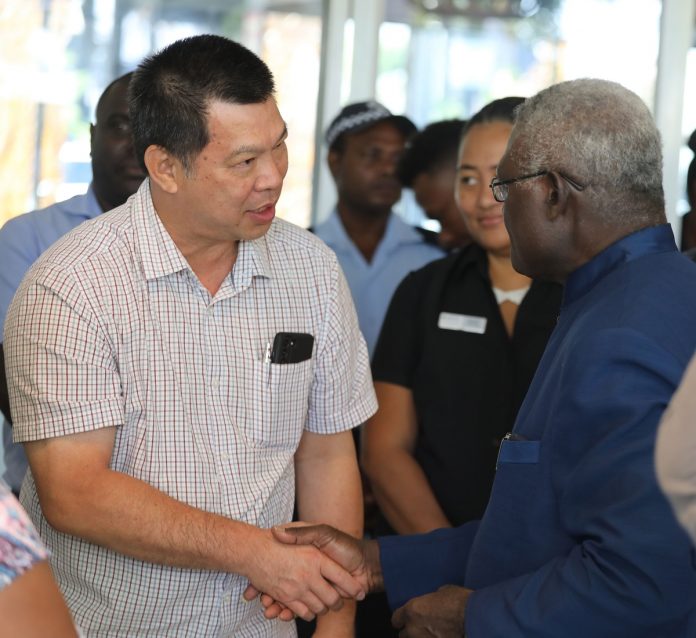
Chairman of Solomon Power David Quan meeting the Prime Minister during the PM’s Breakfast event.

PRIME Minister Manasseh Sogavare had the opportunity to address key members of the business community in Solomon Islands on relevant Policy, enhanced partnership and respond to the Private Sector Pathway to COVID-19 Recovery Strategy submitted to his Government earlier this year.

This was during a Prime Minister’s Business Breakfast on Friday 21st May, 2021 hosted by the Solomon Islands Chamber of Commerce and Industry (SICCI).

The event is an initiative under the MoU between Government and the private sector which presents the opportunity for SICCI members to engage directly with the country’s leadership and also creates a platform for the Prime Minister engage to directly with tax payers.

Delivering his keynote address, Prime Minister Sogavare said such occasion provides a space where we can discuss common but important issues and objectives that is pertinent to business development and overall growth in the country. 


Prime Minister Manasseh Sogavare meeting with representatives of the Private Sector.

“The current global pandemic underscores the important role that this kind of discussion plays in nurturing and strengthening the partnership between the Government and the private sector in mapping out the appropriate policies, strategies and legislations to ensure economic recovery following the adverse effects of COVID-19 in 2020,” he said.

The Democratic Coalition Government for Advancement (DCGA) acknowledges that the private sector is the engine of growth, primarily because real economic growth hinges on the creation of and earnings from goods and/or services.

As the world “motors” out of the pandemic, private sector development will be vital, especially since many sectors will emerge decimated.

“The Government agrees that for sustained economic development, the private sector needs space to unleash its entrepreneurial potential through creativity and flexibility for innovative solutions.


Prime Minister Manasseh Sogavare and members of the SICCI Board and CEO during the PM’s Breakfast event. Photos: SICCI Media.

“In this regard, it is only right that the private sector, Government, and civil society, with crucial assistance from international development partners, proactively participate in accelerating and strengthening the recovery process,” the Prime Minister said.

In response, Board Chairman of SICCI, Ricky Fuo’o highlighted that the relationship between SICCI and Government needs to function beyond political and commercial interests “and underpinned by our commitment to rebuild this great nation, to provide opportunities for our people and to fully realize our growth potential.”

Fuo’o said SICCI’s continuous emphasis on partnership with Government and development partners is crucial for growing business that will impact economic growth.

He assured the Prime Minister that SICCI members have affirmed their willingness to work with Government to support inclusive economic development.

“We all play a major role in supporting Solomon Islands’ aspirations to achieve more inclusive economic development by investing in the productive capacity of the country and creating jobs to benefit Solomon Islanders,” the SICCI Chair said.

Fuo’o said it is clear that development cannot occur without any partnership with the private sector.

“As stated many times before, the private sector is the engine of economic growth.

“The development of the private sector directly links to the decisions and policy of the Government that encourages growth and creating a conducive environment for businesses to thrive, innovate and compete.

“I believe the 2021 Prime Minister’s Business Breakfast is timely and relevant in the context of current events. It is timely as the world continuous to navigate through one of the most devastating global pandemics of our generation,” he said.

Fuo’o also took the opportunity to acknowledge Prime Minister Hon Sogavare for yet again demonstrating the Government’s and his personal support to the Private Sector.  

Meanwhile, the Prime Minister used the occasion to announce that Government will now provide budgetary support to SICCI by including this in each year’s National Budget under the Ministry of Commerce, Industry, Labour and Immigration.

“I reassure you all that the Government values and is committed to this partnership and as a testament to this commitment the Government will now support SICCI as well,” Sogavare told members of the business community during the Breakfast event.

-SICCI Media

Maximise the benefits of infrastructure spending: SICCI

SICCI Chairman, Ricky Fuo’o responding to the Prime Minister’s keynote address during the PM’s Breakfast.

THE Solomon Islands Chamber of Commerce and Industry (SICCI) believes the country can maximise the benefits of infrastructure spending if there are policies and regulations in place to promote local content.

SICCI Board Chairman, Ricky Fuo’o said focusing on maximizing local content ensures that local workers have a job that will lead to skills development and transfer

Not only that but local suppliers will also have an opportunity to grow in the market, and local companies will develop and contribute to revenue that remains in the country and promotes the standards of local private sector, he said.

Fuo’o was speaking the Prime Minister’s Breakfast on Friday 21st May hosted by SICCI for its members to have an opportunity to directly engage with the country’s leadership.


SICCI CEO, Natalina Hong welcoming Prime Minister Manasseh Sogavare upon his arrival for the event along with Vice Chair, Qila Tuhanuku

“It is vital that Government takes an active approach to ensuring the greatest benefits from infrastructure development are retained locally. Procurement processes should prioritize local business and MSMEs.

“Some countries prioritize local business in their tenders under a certain monetary threshold. Likewise local partnering and minimum local employee requirements can be a requirement for contracts given to foreign businesses,” he said.


Prime Minister Manasseh Sogavare finds time to meet members of the business community and employees in private sector.

SICCI believes that creating such regulations and policies to promote local content will maximise local participation, otherwise local businesses will remain spectators in all these infrastructure developments. 

SICCI further acknowledges the actions taken by the Government to stimulate economic activity and improve productivity through infrastructure spending and to development partners who have contributed towards these infrastructure developments.

Some of these multi-billion dollars infrastructure activities have already been committed to and are currently being constructed.

These includes the 2023 South Pacific Games projects, Tina River Hydro Development Project, Upgrade – Munda International Airport Project, Tar Seal of Seghe and Taro domestic airport, Henderson International Airport Upgrade, Fisheries-Henderson road, White River Highway-road and the USP Campus project.


CEO of the National Broadcaster SIBC, Johnson Honimae and General Manager of the Heritage Park Hotel, Sanjay Bhargava

“Infrastructure is often considered to provide a ‘double befit’ to the economy.

“Initially short-term as an economic stimulus and then in the long term, from benefits the new infrastructure provides.

“Social and economical infrastructure is essential to sustainable economic growth and poverty alleviation,” SICCI Chair,” Fuo’o, said.

Meanwhile, SICCI will also continue to advocate for fundamental reforms especially in Transport and Tax which are pivotal to expansion of businesses.

These will require partnership, consistent dialogues and support to ensure there is a fair and level playing field for all.

-SICCI Media

Melanesian brothers receive new vehicle

0
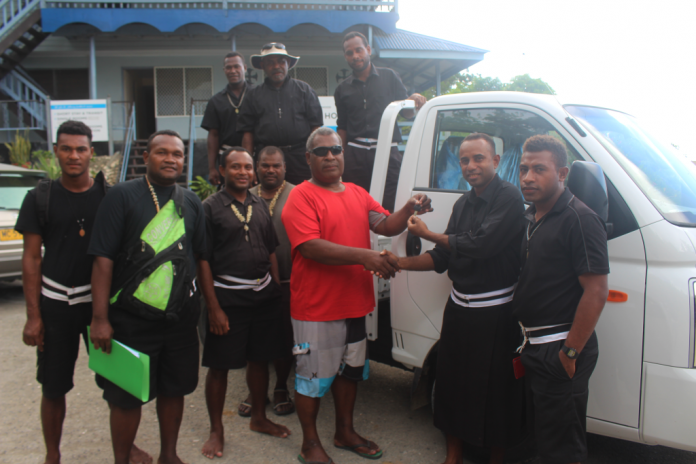
Mr. Tahiri handing over key to Assistant Head Brother while other brothers looking on

MEMBERS of the Melanesian Brotherhood Fox household in Makira have received a brand new one ton-truck from Central Makira Constituency.

Constituency Development Officer (CDO), Gravis Tahiri handed over the key to the vehicle to Assistant Head Brother at the Chester Rest-house, Wednesday.

The vehicle will be shipped to Makira later.

 “This is part of the constituency’s continuous support to the churches in the Constituency of Central Makira,” Tahiri said after the handing over of the vehicle.

“Observing the brothers usually walking long distances to carry out their mission and ministry not only in our constituency but in other areas, had us decide that the vehicle would be one of their urgent needs,” the CDO said.

Rev Erick Tano, tutor at Fox Household in the Diocese of Hanuato’o (DOH), who joined the brothers to receive the vehicle said, “the vehicle is truly one of our needs in Makira”.

“Many thanks to Central Makira Constituency for identifying one of our needs.

“We are so thankful because the vehicle will surely help us to travel around Makira to carry out our Mission and Ministry,” Erick said.

The vehicle will be shipped to Fox Household in the Diocese of Hanuato’o at a later date.

MALA TAKES STAND

Some members of MPG executive after announcing their decision on CHEC’s engagement on construction of Fiu Bridge in the provincial chamber in Auki yesterday.

BY SAMIE WAIKORI

Auki

CHINA Harbor Engineering Company (CHEC) will never be accepted in Malaita.

That’s the decision the provincial executive reached yesterday after CHEC was recently announced as the winning bidder to build Fiu Bridge, near provincial capital Auki.

Permanent Secretary of the Ministry of Aviation and Communication Moses Virivolomo was in Auki last week to inform the provincial government about the winning bidder.

He reportedly told the provincial executive to come up with a decision whether to accept CHEC to build the project.

But Deputy Premier Randol Sifoni told the media yesterday while the province and its people want the Fiu bridge built quickly, it must not be done by any Chinese company.

“We want the national government to re-tender the project,” Sifoni said.

“This is so that other companies can bid,” he added.

“Our decision is CHEC or any other Chinese firms cannot be accepted to do business in Malaita, directly or indirectly.”

Sifoni said the decision was inline with the Auki Communique, and after consulting the people.

The Auki Communique, a set of resolutions produced after the country switched allegiance from Taiwan to China, explicitly stated Malaita will not deal with the Chinese government or any of its associates.

The Fiu Bridge project is a component of the World Bank funded multi-million-dollar Solomon Islands Roads and Aviation Project (SIRAP).