THE Commodities Export Marketing Authority’s Revitalisation and Recapitalisation Strategy 2021-2027 says it wants a piece of land in Kira Kira, the Provincial Capital, to build its Buying Centre.
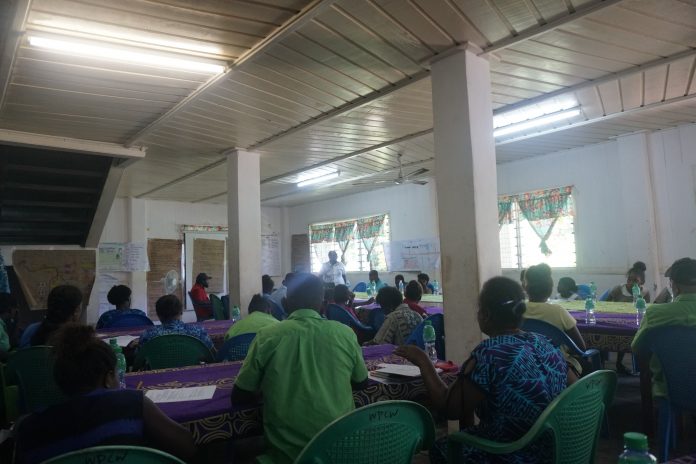
The Director of CEMA Cabinet Sub-Committee of the Office of the Prime Minister and Cabinet, Martin Housanau relayed the request to the Makira Ulawa Premier, Julian Maka’a and his Executive Ministers at a meeting he had with them in Kira Kira June 16, 2021.
He also relayed the same appeal to the Heads of Department of the Makira Ulawa Provincial Government when he met them after meeting with Premier Maka’a and his Executive.
Mr Housanau who led a CEMA Technical Working Team to Kira Kira said CEMA under the Revitalisation and Recapitalisation Strategy Programme, would want to build the Buying Centre in Kira Kira because the landowners of the land it had its old Buying Centre at Kaonasugu in West Bauro of Central Makira, have been disputing over it.
He said CEMA would not build Buying Centres on disputed sites. CEMA built the Kaonasugu Copra Buying Centre in the 80s, but stopped buying copra from producers when the National Parliament amended the CEMA Act to become a regulatory body.
Housanau said the amendment had impacted badly on both rural village and national economies as copra production thus copra export had halted.
But Housanau told the meeting that under the new programme, CEMA would build a new Buying Centre on a piece of land with more space as it would not buy only copra as had been the case in the past, but would also buy other agriculture products like cocoa, chilies, gingers, root crops like taro, yam and pana and of course, Makira people’s famous food, banana.
And in the long run, he said, CEMA would operate the Buying Centre under a Public Private Partnership (PPP) joint venture agreement with the Makira Ulawa Provincial Government.
Housanau said under such agreement, the Buying Centre would build a factory which would buy coconut oil products produced by coconut crushing mills around the Province for downstream processing to add value to the products and for export.
Meanwhile, Premier Maka’a welcomed the new approach by CEMA, because Makira Ulawa Province as an agriculture potential province, it would enable its resource owners and landowners to return to farming.
He agreed many coconut plantation owners had stopped producing copra and as a result their income earnings and livelihoods had been greatly affected.
But Provincial Finance Minister and MPA for Arosi Ward 8, Douglas Kuper while speaking on the land issue for the Buying Centre said if Kira Kira could not provide the site, the Provincial Government could consider moving the Buying Centre to Arosi in West Makira.
And Provincial Lands Minister, Jimmy Riunga said a site to build the Buying Centre in Kira Kira could be identified.
Meanwhile, the Chairman of the Government Land Reform Commission who was a member of the touring team of the CEMA Cabinet Sub-Committee of the Office of the Prime Minister and Cabinet, Andrew Manepora’a said the land for the Buying Centre must be secured because if there is no land, then there will be no development.
While in Makira, the team members also visited the Pakera Development Centre and Kokana Village along the West Makira Road.
A total of 21,742 doses of covid-19 vaccines have been administered in the country as of Friday last week.
Prime Minister Manasseh Sogavare announced in his nationwide address yesterday that of that total;
16,437 doses are AstraZeneca Vaccines, [14,364 first doses and 2,073 second doses], and
5,305 doses are Sinopharm [3,686 first doses and 1,619 second doses]
“Based on these figures, a total of 3,692 people have now been fully vaccinated against covid-19 from the two vaccines used in the country,” he said.
The Prime Minister also reaffirmed that so far, only one case of anaphylaxis and three reactions were experienced due to the AstraZeneca vaccine; all of which had been treated with good outcome.
Meanwhile, he said as part of the plan to increase the country’s vaccination coverage, the health team have expanded the vaccination platform to provide covid-19 vaccination using mobile outreach vaccination centres to augment the fixed vaccination centres.
PICTURES of patients lying helplessly on the floor of the National Referral Hospital (NRH) in Honiara have gone viral on social media.
The scene was not only sad, but also provocative.
NRH is the nation’s top hospital. It’s where all the provinces referred medical cases that they could not dealt with.
It should be our priority. It should have the best of facilities and be able to cater for our health needs.
What appeared in those photos does not reflect well on the NRH as our top health facility.
The photos instead conveyed a failing health service and a facility that was not able to cope with the needs of its population.
They also portrayed a health facility that is overcrowded and neglected.
Patients are lying and treated on the hospital floor due to lack of beds.
This brings us to the question: is health still our priority?
If so, where is the new hospital that the Government has been talking about in the last 10 years?
And why are provincial hospitals ill-equipped to deal with cases that should have been dealt with at that level?
Here’s the thing.
The NRH is still in the same state 20 years ago while our population continues to increase?
So you expect more and more people to visit the same hospital with almost the same facilities that was built some 20 years ago.
It is not surprising then that the NRH has run out of space and beds. This is not rocket science. It is common sense.
Sadly, our elected leaders failed to see this.
They keep on talking about building a new hospital, while they terribly failed to allocate the necessary funding.
Don’t tell the people of this nation we don’t have the funds. Millions of our development funds are being allocated to MPs each with little or no tangible results.
Those millions of dollars could best be used to build another hospital, with more space and beds.
Those millions of dollars could also be best used to improve and upgrade our provincial hospitals to lessen the number of referrals to Honiara.
Our leaders failed to do what they are supposed to do. Now the problem is catching up on us and getting out of control.
The NRH is in a crisis situation. It can no longer cater for our increasing population.
Strangely enough, the silence coming from the Government and responsible health authorities has been deafening.
Why there’s so much silence over a crisis situation? may we ask.
Solomon Islanders need assurance, not the kind of silence we are hearing loudly from the Government at this time.
IT’S not often that public servants get acknowledged for services they provide every day for the benefit of Solomon Islanders.
They work under stressful conditions, often struggling with equipment that don’t work.
And, they get paid peanuts. Yet they are the first to be criticised for a slip in service delivery, just because the phone didn’t work or it was so hot to do any work.
Anyway, if it’s worth anything, I wish to share this experience I had with an IRD officer and an FID officer.
On Thursday 17th June, 2021 I was sent an email by the Ministry of Commerce asking me to complete the vendor form and revert to them.
Because I had another preoccupation to attend to I didn’t see the email until later in the evening.
I opened the email, completed the vendor form and send it back to the officer who had emailed me.
In the email I said I had completed a similar form previously so I thought my TIN number would be at the Treasury Division.
Next day which was Friday 18th June, sensing that something was not quite right I opened my email and there was a reply to my email.
The officer had insisted that their accounts has to have a copy of the TIN letter to be attached to the requisition for payment of my fees which they were sending down to MOFT.
That definitely was a problem for me as I had misplaced my copy of the TIN letter.
Anyway knowing exactly where I can get a replacement I rushed down to the IRD not bothering to check the time.
At the gate I was told its lunch time but the officers sometimes work during lunch so I can go in and tried my luck.
I went in and sure enough the officers had left for lunch. Counter 4 was the right counter to get assistance from.
Seeing it empty I gave an audible sigh of disappointment and sat down to take a rest on the benches provided.
As I was resting, the person who had been served at Counter 3 (manned by another IRD Officer) walked by clearly satisfied at the service he received.
I looked at the good lady officer as she was setting off for lunch.
She looked back at me and respectfully asked, can I help you?
I nodded hopefully, she waved me over and I quickly beckoned across to Counter 3.
“Sorry wantok”, “I need a TIN letter but I see you are heading off for lunch.” I said.
“Oh”, she said “woman na hem save but hem go for lunch na”.
“Write come name blo U” she asked.
I reached for a slip of cut paper left there at the counter for that purpose and wrote out my name.
She took the paper, typed on her computer and she read something from her screen.
“Yea that one” I said. I heard her printer humming and discerned she was printing. The next minute she handed me the very letter I was after.
I took it happily, and thanked her graciously. As I was heading back to my vehicle I couldn’t help appreciate the wonderful attendance I just witnessed.
A great change in customer service and a commitment to service delivery! I looked up to the skies and silently said “Thank you Lord”. I know these were small steps in what could be a broad domino effect that can improve service delivery in the public service.
I got into my car and drove off to the FID, the agent that needed the letter.
I went to the FID office and looked in at the counter.
I saw the officer I wanted to see was not there so I turned to go back when at the corner of my eyes I saw another officer approaching the counter.
He opened the window and confirmed to me that Sially had gone to do an errand at the school where her kids attended.
He saw I had papers with me and asked if he can help. I told him what I wanted and he took the papers.
He tried to photocopy something for me but their machine didn’t work. He asked me to wait as he hurried to another room.
He returned with the photocopy and apologized. I thanked him and left really touched that I had been served during lunch time.
This was a huge turn around.
Before, lunchtime is lunch time, no work and one had to come back at 1pm, sometimes much later.
This is really different, I was smiling as I left.
Whoever is helping to change customer service delivery in both offices has my full support and best wishes.
63 year-old Harrison Bita slurp up noodle as his cat lazily looks on. Villagers also depend on goods from shops when bad weather persists during 'time hungry'
BY JARED KOLI
ON a steep slope overlooking the treacherous Solomon seas, a lone figure sits under a tree staring into the distance, the shade from a nearby tree offers a cool respite from Harrison Bita’s struggle for survival with the land.
The 63-year-old’s community at Mandakacho, on the weather-coast of Guadalcanal is an area renowned for unpredictable weather and physically challenging landscape. Sandwiched between the rolling hills that fall into the ‘tasimauri’ or living ocean as it’s known in the local dialect.
For Chief Bita and his people, the only place they set their gardens is on the steep slope and narrow flat land along the coast. From June to August, the weather in these parts can be harsh with months of continuous rain making food production an arduous task.
Dark Cumulonimbus clouds hovering above the mountains of the Guadalcanal Weather Coast. The weather here is unpredictable. Photo. JARED KOLI
Changes in weather and climate patterns exacerbated by climate change has turned the land against the very people it is supposed to serve, and destroys their food crops, year after year.
The Weather Coast is not for the faint hearted – compounded with mountainous, rugged terrain, steep coastal mountain slopes, irregular shipping services and is expensive outboard motor transport.
“From March to July it is always raining and it’s often the time of the year we experience low crop, in some instances, whatever crops we grow will not go to harvest,” said Celestine Aloatu, coordinator of the now defunct Talise Community Base Training Centre.
Celestine Aloatu once involved in bulking and banking planting materials for farmers in Talise after realising the need.
Aloatu said the rainy season in south Guadalcanal can be so extreme, sometimes it takes up to six months of continuous rain. However, this year, they experienced a change.
“In the beginning of the year we tend to expect big swells, but it didn’t happen, the sea is fine right from the beginning of the year. So you see, it slightly changes, this time last year, we experienced very high seas and heavy rain. It is becoming unbelievable,” he said.
Chief Bita said people refer to this period as “time-hungry” with yam and cassava no longer available in most villages due to pests and diseases.
Sweet potatoes leaves turned yellow with tiny little holes are common during and after bad weather
“Heavy rain brought flooding, made worse by strong winds and rough seas and people are normally forced to remain in their houses. It destroys root crops and vegetables grown near river banks,” said Mr Bita.
Sixty-three year old Harrison Bita points to where huge waves normally reach during rougn seas eroding coconuts and coastal trees
When this happens, villagers depend on breadfruit, banana, dry coconuts and wild yams to survive, as well as goods from shops, which usually run out of stock if bad weather persists.
“Breadfruit is the main food we often rely on during times of disaster, and also wild yam, locally known as ‘uvi matua’,” Bita adds.
Ara and Koburu
The two main climate systems affecting the Solomon Islands are the south easterly trade winds (Ara) that blow from May through to October and the north westerly monsoon winds (Koburu) that blow from December until March.
During Koburu, winds and abundant rainfall can be expected – a period where tropical cyclones form while Ara triggers higher rainfall.
The weather coast region of south Guadalcanal receives heavy rainfall of 5,000mm to 8,000mm annually during two wet seasons, the first from January to April, the second from May to September.
Rain about to drop in Viso area, south Guadalcanal. This is an usual sight in this part of Guadalcanal as weather may change anytime during the day
Maria Bola, a farmer and church leader at Ngalitaverona Village knows what too much rain means for crops.
“It usually leads to sweet potato leaves having small holes. Cassava only bare vines. Bananas also dwarfed and failed to yield good fruit — they were usually smaller than their usual size.
“Almost every crop is affected during the rainy season, sometimes the heavy rain can also cause landslides,” Maria said.
White Fungus disease that affect cassava stem is one of the diseases people discovered after months of heavy rain. Photo by JARED KOLI
Mr Aloatu said the intense saturation of the soil and made sweet potatoes and cassava fail to tuberise in waterlogged soils.
“We experienced a decline in the fertility of soil where we cultivated our root crops. We usually did our farming on sloped areas, and every year heavy rainfall erodes nutrients away from the top soil.
“Gardens on flat lands were waterlogged, enabling a new environment which harbours thriving plant pests and diseases that affect our staple root crops like cassava, sweet potatoes and taro,” said Aloatu, who has been involved in food bulking for many years until recently.
A rural-based training center he ran until recently offered life skills training such as carpentry and joinery to students as well as farming.
“There are no big trees left on where we make food gardens because year after year we use the same land, this makes it even more vulnerable to erosion, and so when it rains topsoil gets washed away to the sea, carrying with it organic matter and soil nutrients.
Coastal erosion was evident in south Guadalcanal.
“I think that is also one of the factors that contribute to the problem of poor crop yields we experience here,” said a villager, Elson Francis.
Rains, floods and disaster
“The flooding occurred last year from May, June, July and August, four solid months of rain, and one of the worst I’ve seen,” said Francis.
“This is just a small stream but when it rains, floods can be very destructive and often destroy food gardens,” he said.
A villager, Elson Francis walks up a dried up stream. After months of heavy rain last year, part of the village on his left was swept away, forcing families to relocate further up to higher ground
Further up the stream floods also uprooted and carried away two homes.
Part of this village was swept away, one of the houses standing there was washed away by the floods, forcing families to move to higher grounds.
He said only an elderly woman remained in the village whose house was spared during the flood.
Climate Change
The Director of the Solomon Islands Meteorological Service David Hiriasia said while global temperature fluctuates on a daily basis, the long term average is a temprature increase which is consistent with global warming and the findings of the Intergovernmental Panel on Climate Change (IPCC).
Mr Hiriasia said the country needs the data to back-up what the elders in rural communities have witnessed, and SIMS has recently installed observation weather stations in Marau, east Guadalcanal, Avuavu and Biti in south Guadalcanal and one at Kohimarama.
SIMS is working with communities to revisit traditional knowledge on weather and climate and develop a crop calendar.
Coconuts being eroded by high coastal waves at Talise beach, south Guadalcanal,
“One of the communities on the weather coast of Guadalcanal we work with is within the Moro movement area.
“We develop some crop calendar to promote local crop production such as yam. We would like to expand this, but it also depends on funding, when we collect these traditional knowledge, we can also see these changes,” Hiriasia said.
He said SIMS is collaborating with different stakeholders such as women groups, agriculture agencies, farmers to give them forecasts so that they can plan ahead and choose what crop would be suitable for a period in the weather forecast.
But hundreds of kilometers away on the Weather Coast Chief Bita continues to wonder what climate change will hold for his people and what the future will bring.
This feature story is produced with support from the ABC International Development Media reporting on climate change story grant 2021
The ministry of fisheries (MFMR) is warning of a collapse in the local beche-de-mer industry if illegal harvesting continues unabated.
MFMR Director Eddie Honiwala said beche-de-mer stocks are down and may not recover if the illegal activities continue.
Honiwala echoed this yesterday as the ministry destroyed confiscated illegally harvested beche-de-mer.
“It is important for our people to note that our beche-de-mer stocks are fished down and if this continues, this fishery will collapse soon. We don’t want to drive this important fishery down that path,” he said.
Honiwala said the current ban to harvesting is to give the beche-de-mer stocks time to recover.
“With the current level of over-fishing and low density around the country, the closure period should be longer than five years.
“Continuous illegal harvesting will not do any good to the BDM stocks, or to our communities but will drive this important fishery to a level where, we will no longer have the beche-de-mer fishery in the future and our future generations will no longer have any beche-de-mer fishery to enjoy as today,” he said.
He said in the previous data recorded it showed that majority of the confiscated beche-de-mer products were of low value species.
“This is an indication that high value species were no longer found in many places, so people have no option but to fish low value species.”
Beche-de-mer fishery was closed in 2019 under the prohibition order made under section 22 of the Fisheries Management Act 2015.
Under the prohibition order, fishing or possession of any species of beche-de-mer from fisheries waters is prohibited, effective from May 31, 2019. Further to the above, export of any species of beche-de-mer is prohibited effective from June 30, 2019.
The Lofung Border and Patrol Boat Outpost site plan in the Shortland Islands
BY JARED KOLI
With a few days to go for Ground-breaking ceremony, the proposed multi-million dollar border patrol boat base project is staring up a brick wall.
Accusations, court threats and warnings are mounting against FAMOA Trust Board over Lofung land (on which sits the site earmarked for the new patrol boat base).
FAMOA trust board is the body which the national government is liaising with over the project. FAMOA is supposedly the representative of all the landowners.
But, some landowning tribes are saying this is not so, and are warning government against dealing and making arrangements with FAMOA and its working committee.
The Saraba Clan/Group, which claims land rights on Lofung land, said the government’s arrangement with FAMOA “will be a disgrace, irresponsible and loss on part of the Government if the case that will be filed in the High Court be ruled not in favour of FAMOA Trust Board”.
“As with the Kome Clan/Group, we will also be filing a case in the High Court soon or amidst the period of the ground-breaking and when the work starts at the site,” Mr Brenden Maena says in a statement on behalf of Saraba Clan.
Mr Maena claims that the FAMOA Trust Board’s registration as a charitable trustee and the transfer of the registered land at Lofung in 2003 obtained by FAMOA Trust Board were done by unscrupulous means.
“Further we will be filing a case to the court claiming that land or site below the high-water mark at Lofung, Shortland Islands as customary land and owned by Saraba and Kome Clans.
“Lastly, the Australian Government is cautioned of releasing the fund and for spending their taxpayers’ money on the project at Lofung where the land or site is still in dispute and that would cause disharmony of peace among the people of Shortland Islands,” he warns.
Earlier this week, Alisae Laore of another landowning group also threatened to challenge the FAMOA Trust Board in court for selling the 20 hectares at Lofung.
Laore said FAMOA Trust constitution states it has no right to sell or lease land to the government.
He said even the constitution of FAMOA Council of Chiefs allows provision in Part 4 and Part 6 to identify true landowners and return the land back to them.
“Why did the FAMOA Trust Board ignore its own constitution?” he asked.
As such, Laore said he will challenge the Board in court for allegation of fraud.
Furthermore, Laore said the Board’s move to sell the land to the government defies its policy to return all alienated land to the original landowners.
Laore provided a deed of sale agreement signed by his grandfather in 1900s that they are the true owners of the land.
He said a chief’s decision of FAMOA Council of Chiefs was reached in 1988 which decided that they have the ownership right over that land.
Local businessmanand surviving founding father of FAMOA Trust George Taylorhas also called on the Commissioner of Lands to revoke the Perpetual Estate (PE) title held by FAMOA Trust Board.
Taylor said the PE title held by FAMOA for the past 20 years for whatever reason was illegal.
“If FAMOA has fixed term estate (FTE) then it is 100 correct they own the land. The PE title was held illegally by FAMOA. The government must revoke the PE title.
“We are very happy with the project, it is a national project, but we are not happy with what the Government is doing with FAMOA Trust Board and its working committee.
“Government knows very well that this is wrong, but why entertained FAMOA,” he said.
Permanent Secretary of the Ministry of Police and Correctional Services, Karen Galokale earlier told Island Sun the current subject land is registered under FAMOA as legal Perpetual Estate holder and not a customary land.
But Taylor said the comments made by the PS were wrong and totally ignorant of this matter.
“You cannot talk from that chair to say FAMOA holds the PE title, you cannot process anything that is wrong, because the PE title with FAMOA is wrong.
“The Government have all the right with the project,” he said.
Meanwhile, Chairman of the FAMOA Working Committee, Pellion Buare earlier said FAMOA still stands by its commitment to meet with the concerned parties after finalising all the arrangements with the national government.
He maintained that FAMOA is the registered owner of Lofung land, which is the site for the project.
Meanwhile, Ground-breaking for the new outpost at Lofung has been set for June 23, 3021.
Prime Minister Manasseh Sogavare and Australia High Commissioner are expected to attend the historic groundbreaking ceremony.
The Australian Government is funding the multimillion-dollar Border and Patrol Boat Outpost project, which Australian Prime Minister Scott Morrison and Prime Minister Manasseh Sogavare jointly announced in Honiara on October 7, 2019.
New Ghombua Rural Health Clinic officially opened. Picture taken during flag raising and singing of the national and provincial anthem song.
WALKING for hours under the scorching heat of the sun simply for medical attention, worst still, losing a family member or friend along the way will now be a thing of the past for around 5,000 villagers in and around Ghombua community, east Guadalcanal.
On Tuesday this week, the villagers gathered in excitement to witness the opening of their new Rural Health Clinic (RHC).
Guests escorted by pathfinders, flags raised, national and provincial anthems sang, speeches, choirs from community men and women followed by red velvet cake and ribbon cutting and community feast with presentation of gifts were part of the celebrations to mark the official opening of the clinic.
GP Deputy Premier and Health Minister touring the clinic’s pharmacy.
Though a joy-filled event, time was also spared for the entire community to come to a stand -still with the laying of wreaths to remember family members and friends who have passed on and those who have dreamt of a clinic but never lived to witness their dream come true.
“Truly a historic moment for our people,” community and church leader Silas Ratu said.
“We have witnessed the devastation that lack of a easy to access clinic can cause and today we are overjoyed that we have our own rural health clinic just steps away from our homes,” Ratu stated.
Mothers came out in numbers with their children to listen to the speeches during the official opening of the clinic.
Chief Issac Lewa, who was also given an opportunity to speak, only stood and repeatedly uttered the words: “Thank you, thank you, thank you to each and everyone of you!” to demonstrate that words cannot even begin to describe the tremendous joy within the community.
The construction of the AHC was made possible with funding from the Provincial Governance Strengthening Program ( PGSP) – Provincial Capacity Development Fund (PCDF) implemented through the Ministry of Provincial government in partnership with the community and contractor, Reinunu Construction.
The smiles says it all. “ Yaaaaay! We now have our own clinic, thank you everyone
The Ministry of Health and Medical Services, through its Guadalcanal Provincial Health team, provided the technical support in terms of design including all necessary works to enlist Ghombua with the medicines supply chain and placement of a nurse at the clinic.
Both the Deputy Premier Lazarus Rima and Provincial Health Minister Francis Iso in their remarks reiterated the province’s commitment towards service delivery to the people and the need for community members to look after the facilities provided.
“Guadalcanal is glad to have qualified for the PGSP-PCDF over the past years and has used the opportunity to engage in various projects, throughout the province,” Rima said.
“Last financial year, Guadalcanal had embarked on 15 projects, 14 of which were completed, and Ghombua is amongst the 14 completed projects,” he added.
New Ghombua Nurse Rebecca Masaodo who previously worked at the Totongo Clinic in East Guadalcanal assuring the community of her commitment and dedication towards serving their health needs in her remarks.
“Thank you to the Ministry of Provincial Government, Ministry of Health, community members, contractors and all stakeholders whom have contributed towards this clinic.”
The Provincial Health Minister Iso in his remarks acknowledged the community for their determination and commitment towards the project that had enabled it to come to its fruition.
Mothers preparing food for a feast to mark the opening of their new clinic.
“Your support is the backbone to the success of this project and I hope other communities can also learn from Ghombua’ s commitment and cooperation in working together to achieve this important health milestone for the community,” Iso said.
“It is important that the facility is taken care of since it is now in your hands to continue providing the much needed health services to our people now and into the future,” he added.
Dr Joel Denty, Director of Guadalcanal provincial health, used the occasion to highlight the importance of respecting the facility and the health workers, the nurses who will be working there.
“I would like remind you all that there are many cases in which health facilities have been disrespected including nurses working these clinics, which have resulted in their closure,” Denty said.
A villager carrying a wreath to lay in honour of all those who have passed on.
“This must not be the case here,” he added.
“The last thing we want is to close the clinic. Treat the facility well including the nurse who will take care of more than 5000 people that is within the catchment area of Ghombua.
“With this kind of number the nurse herself will not be able to even find time for leisure, even banking in Honiara.
“She will be overwhelmed and therefore take care good care of her as we work on getting additional nurses to assist her.”
Head of St John Ambulance, Douglas Kelson, who provided new bed linens for the clinic also offered to provide two of St John volunteers to assist the nurse for the time being until an additional nurse is recruited.
Douglas Kelson ( L) handing over more bed linens to Deputy Premier Hon. Lazarus Rima inside Ghombua Clinic.
Kelson said St John Ambulance will also be installing two-way radio at the clinic to ensure smooth communication and swift action for any emergency cases that needs urgent medical attention at the National Referral Hospital.
The event, which was also attended by Guadalcanal Provincial Ward Member, Holsey Chainivila and Rose Tala provincial Minister for Women, Youth and Children, came to a successful close.
WESTERN Province Education Authority (WPEA) is undergoing major reform on School’s retirement practices.
Schools operating under Western Province Education Authority are now provided with official stamps in an effort to make sure financial transactions are property receipted.
In an interview with Island Sun Gizo office, Principal Education Officer of Western Province, Freedom Tozaka said the initiative is a mechanism that WPEA thinks best as far as proper use of School grants is concerned.
“We always talked about transparency but we forgot very simple approach can lead to achieving so called transparency.
“We need to look at available approaches, simple as the one we embark on (providing stamps) to make changes.
“I believe that providing avenues or platform for organisation to follow is the best way forward,” he said.
Tozaka said his office will distribute the stamps to schools in the coming weeks.
He warned school administration that retirement without proper receipt will not be considered truthful and that issuing of receipt in any financial transaction is paramount.
“My office will not tolerate excuses for failing to provide official receipt as we have already make this easier for schools to comply.
“I must encourage school administrations or whoever responsible for school grants to be responsible in the welfare of their financial reports.
“Make sure the financial report must be accommodated with official receipt, that is the message I want to put across,” Tozaka said.
On the same note, he urge school administrations to make use of the official stamps to achieve the purpose of transparency in the use of school grants.
A worrying number of women in the Solomon Islands experience domestic violence.
Statistics have shown almost 64% of women in our society have encountered domestic violence at some point in their lives.
Others never pursue help since domestic violence is accepted as a private matter which is normal.
It is also evident that some police are reluctant to impose their duty to protect victims from private acts of violence.
Moreover, our culture plays a role in silencing victims, that man dominates household hence incidents of domestic violence should not be reported.
Daily occurrences of domestic violence happen at homes but only 5% of the women report to police. Incidents are underreported because women are unsatisfied with the police response and response duration.
Others fear for their lives and avoid reporting incidents to the police due to receiving threats from offenders.
Families and communities must be heedful and vocal of such incidents and should report to responsible authorities.
Domestic violence is a human rights abuse. Although domestic violence is regarded as a private matter to some women, the human rights structure delivers a tool to challenge this opinion and reframe it as a mutual problem that society as a whole must address.
Our government recognizes and responds to the high rates of violence against women with significant Acts like the Family Protection Act.
Therefore, Police and responsible authorities must have the responsibility to exercise due diligence to prevent, examine and punish violators by imposing maximum penalties as the laws allow and protect the victims.