Gov’t launches
2nd course to
build capacity to
implement NDS
GOVERNMENT Officers responsible for implementing the annual Development Budget programmes and projects and achieving the vision of the National Development Strategy (NDS) 2016-35 began their Certificate IV in Project Management Practice this week.
The course was officially launched in Honiara by the Permanent Secretary of the Ministry of Development Planning and Aid Co-ordination (MDPAC) Mr Shadrach Fanega.
PS Fanega warmly welcomed course tutor Mr Neil Sharma from USP Pacific TAFE and assistant from IPAM, Mr Steven Amasia along with students enrolled in the Project Management in Practice Certificate IV course.
PS Fanega reminded officers of the launch of the 20 year National Development Strategy (NDS) (2016-35) in April last year and the importance of the project management training as providing a step closer to achieving the vision of the NDS and implementation of its strategies.
“The NDS includes 15 medium term strategies, to achieve five long term objectives and these in turn are translated into a rolling five year Medium Term Development Plan (MTDP) comprising development programmes and projects, the first year of which forms the Annual Development Budget.
“The Government recognises that the implementation of the National Development Strategy, the Medium Term Development Plan and the Annual Development Budget is very challenging and that one of the attributing factors is the limited capacity of government ministries in terms of capital and human resources.”
PS Fanega said that providing comprehensive project management training shows the Government’s strong commitment to the capacity development needs of Solomon Island public sector officers to help them improve the implementation of development programmes and projects, that in turn, will grow the economy and benefit the nation.
“It is no co-incidence that you were selected to attend this course. You were selected because of the role you play and the responsibility you have, to ensure the successful implementation of development budget programmes and projects. Make the best of this opportunity and take full advantage of the course and apply it when you return to your posts,” he said.
Mr Fanega said that following the success of the training programme run last year, the Certificate Four in Project Management Practice was again being delivered, co-funded by SIG with funding support from the European Union.
THE national campaign against the invasive pest, the Rhinoceros Beetle, has received a major blow with the insect confirmed in Ngella.
Ngella is one of the copra hubs of the country, and the pest’s presence is a red light for the industry and the country’s economy.
Confirming this is the Agriculture Division at Tulaghi Central Islands Province (CIP) after visiting the reported spot sight this week at Central Big Ngella, Haleta Village.
Speaking to Island Sun yesterday, the agriculture division said they are now trying every way possible to stop the beetles from spreading.
“Quarantine in Honiara is waiting for a sample report to reach them so that they will travel across next week to address the issue,” said the Agriculture officers.
Rhinoceros Beetles were initially spotted at Haleta early this year but villagers only recently reported the matter after seeing the damage caused to their coconut plantations.
The Agriculture officers said that the damage done to the coconut plantations is similar to the damages at Lungga on which villagers are starting to cut down the leave branches of their coconut trees.
The beetle’s arrival at Haleta is suspected to may have been through Outboard Motors (OBM’s).
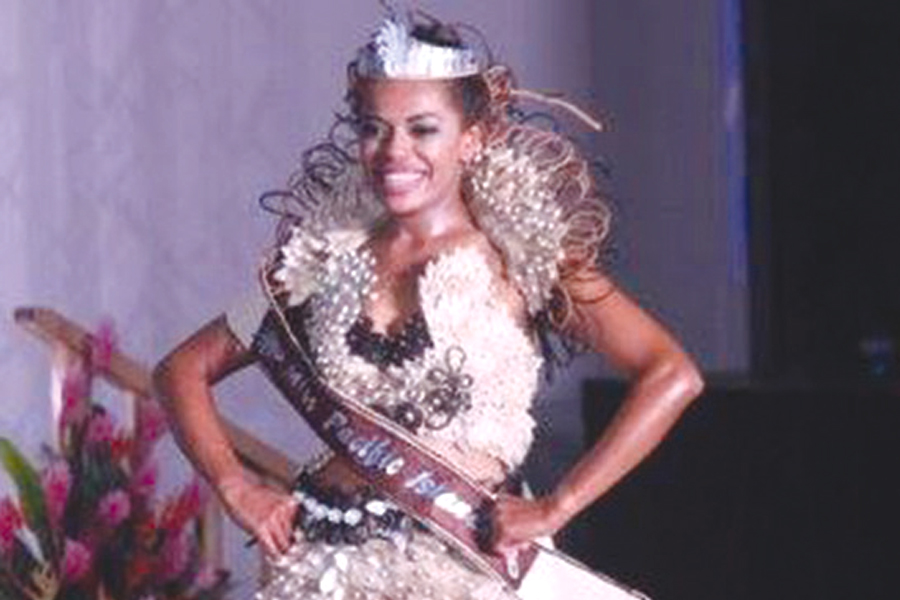
2016 Miss South Pacific Islands Miss Anne Christine Dunn.
BY SAMIE WAIKORI
2016 Miss South Pacific Islands Miss Anne Christine Dunn.
MISS South Pacific will visit the country at the end of this month.
Solomon Island Pageant Director, Ms Joyce Konofilia told local media during a press conference yesterday that Miss South Pacific, who also Miss Fiji, will be in Honiara for three days.
It is understood the Miss South Pacific Islands Board have approved a request by the Solomon Islands Pageant organiser for the region’s queen to visit Solomon Islands.
Ms Konofilia said during Miss Anne Christine Dunn’s stay in Honiara she will give awareness on the roles of Miss South Pacific Islands especially to the local pageants.
“The awareness is very important especially to our local pageants in case we win South Pacific Pageant Show we know the role of Miss South Pacific Islands.”
She said the focus of her awareness will be on women issues as she will have the opportunity to talk with certain organisations.
She is also likely to visit government ministries, women organisations, charitable organisations, tourism sectors and other organisations.
She said currently they are preparing for her arrival especially on the logistics for her visit.
THE closed Perch Christian School has taken its issue to the doorsteps of the Prime Minister’s Office.
Director of the school Ms Lydia Yeo has written to Prime Minister Manasseh Sogavare, copied to the Deputy Prime Minister, Minister for Education, Minster for Infrastructure Development, HCC Mayor and his Clerk on her stand on the issue pleading the nation’s leader to step in and help resolve the mess.
Perch Christian School in East Honiara was closed due to continued threat by the Honiara City Council (HCC) on the school authority.
Ms Lydia said yesterday, “Closure of Perch Community High School is in response to HCC threat to demolish the school infrastructure.”
She told Island Sun that yesterday was the last day of HCC’s seven-day notice, thus the school has obliged with its closure.
She vows to fight to the end because she views this as injustice to the children.
Her letter reads, “The Perch Education Authority resolves during its recent meeting to close down the school from its normal activities due to continues threat from HCC and others who conflicts of interest in the said location of the school.
“On 7th September 2017, HCC issued a seven day’s notice, threatening to demolish the school fence, library building and other school structures within the compound.
“These threats are very serious in nature and we wish to condemn these in the strongest terms.
“We have been providing quality education for thousands of students for the last seventeen years.
“These threats are aimed at disrupting the activities causing safety risks to our students, teachers and working staff.
“This is unacceptable, and borders on insanity of the HCC whose citizens will be adversely affects by such an action.
“We are appealing to you Honorable Prime Minister to provide appropriate support to ensure our school is free from these threats.
“Despite several calls to the Ministry of Education to support us in our difficulties it seems that they have not provided the environment conducive for us to negotiate and work amicably.”
She assures students, parents, guardians and supporters that “the school has temporary closed its door indefinitely and will be opened when these threats are address”.
Ms Yeo said yesterday that her only plea to responsible authorities is to work amicably on the issue and find a better solution to solve the issue.
She said the school benefits the country and disrupting it is not the answer to the issue.
HONIARA residents are imploring the Honiara City Council (HCC) to reconsider its decision to close down the Perch Christian School in East Honiara.
One such concerned citizen, Mr Jones Baea, tells Island Sun that the children are in the frontline of the issue and are suffering, whether HCC realises it or not.
He furthers, the closure directly abuses the rights of the students, and the longer it is allowed to linger, the abuse likewise continues.
The teachers and auxiliary staff along with their families are also affected since they are out of jobs.
Parents and guardians who have struggled to put their children their will also have their hard work gone to waste.
Mr Baea elaborates that the school also plays a key role in the country’s future and development, since it is training a good number of future leaders, who will no doubt be traumatised by the incident.
He pleads HCC to consider these implications and review its stand on the school’s closure.
WANTOK System (or nepotism) has invaded the government system and is identified as a major influential driver of poor services.
Solomon Islands Public Service Satisfaction Survey Report, which was launched in 2016 and brought to light again during the Government Ministry leaders forum yesterday, shows wantok system topping the graph on issues affecting service delivery.
Respondents to the survey highlighted, among other things, the following as key impediments to better service delivery: wantok system (94 percent), acceptance of bribe/imposing of a commission (92 percent), lack of accountability (90 percent), lack of leadership (89 percent), and lack of strategic forethought and planning (90 percent).
The report says these lead to weak governance and leadership, ineffective organisations and business processes, weak communications process, staff lacking required competency, delays in service provision, bad staff work ethics, poor customer service, inadequate or mismatch of resources relative to service demands, lack of infrastructure, poor quality service and the negative effects of our wantok systems.
The Public Service Commission survey report – Solomon Islands Public Service Satisfaction Survey also identified a number of issues that suggest ministries and agencies may not be well positioned to be responsive to the needs of the people in the country.
The report can be substantiated by the findings of the PSC survey report 2016 as well as reports especially those series RAMSI people survey reports.
Responding to the survey, the Democratic Coalition for Change Government (DCCG) instructed policy secretaries to undertake major review of all ministries with the objective of establishing relevance in terms of their effectiveness in pursuing national development objectives and in the setting of the country.
In 2016 the Cabinet granted its approval that ministries, in collaboration with MPs, must undertake functional reviews, this is basically to ascertain their effectiveness in the implementation of the DCCG policy.
At the moment the government is pushing to review, restructure and reorganise the public service to ensure effective and efficient service delivery of goods and services.
Evidence of the critical issue have been displayed during the two-day Government Ministry Leaders forum which ends yesterday.
At the political level, the DCCG government realised that inefficiency in public service delivery is a recurring issue that must be addressed.
This instruction could mean that SIG ministries and agencies, as they are currently structured and organised, are becoming irrelevant to meet the needs and demands of our citizens in the 21st century.
Solomon Island Government (SIG) machinery constitute a total of 23 ministries coordinated under the OPMC, six agencies with a total workforce of 7942 to implement Government policy and touch lives of our people.
THE petition signing against the withdrawal of the Anti-Corruption Bill which started on Sept 8, 2017 remains on a strong hold as signing continued yesterday.
The campaign’s leading figure, Dr Huddie Namo said the petition signing coordinated by the civil society organisation is to remind the government that the people of this country are calling for the return of the bill.
In addition, he says they will not stop and will continue with their work in advocacy and education until the bill makes its way back into parliament.
“Still, we want to be proactive, at least present the petition to the PM to show people’s wish for DCCG to bring back the bill.”
On another note, Mr Namo explained that if the government brings back the Bill in October then the move will be very much appreciated.
“If DCCG, the government of the day, brings back the bill in October then that’s fantastic.
Duff Islands Taumako tribes members and Fara’ngaw tribe members prepare the Traditional Bamboo raft vessel for sailing trials offshore of Mamula Beach in Taitung, Taiwan
Duff Islands Taumako tribes members and Fara’ngaw tribe members prepare the Traditional Bamboo raft vessel for sailing trials offshore of Mamula Beach in Taitung, Taiwan
A group of five Duff Islanders of Temotu Province have recreated history by successfully linking their canoe making and sailing traditional knowledge, technology and skills with Fara’ngaw Tribal Nations of Amis ethnic group in Taitung County of Taiwan.
Led by Dr Simon Salopuka and Hon Stanley Tehiahua, Member of Provincial Assembly for Ward 13 in Temotu Province, the group includes Ambrose Miki, Captain of Tepuke the traditional sail canoe of Duff Islands, Joselyn Tatara Laua a weaving specialists, and Harry Vanosi a young Vaka Canoe designer/builder and sailor.
The sailing cultural project is part of studies undertaken by Professor Jesse Chiunghsi Liu, CEO of Foundation of Ocean Taiwan, about the Austronesian cultural group migration and peopling of Pacific Islands by tribesmen.
Studies have shown many archeological, linguistic, anthropological evidences, and DNA patterns of human, animals and plants suggest Taiwan was the original source from which the Austronesian peoples set off to settle the vast Pacific Ocean west of Taiwan, and the Indian Ocean south-east of Taiwan.
How did they voyage to settle in islands of Pacific and Indian Ocean, successfully navigating the vast oceans and also reached northern Philippine, Boneo, Malaysia, and Vietnam carrying with them the famous Taiwan jade jewelry, about 4,000 years ago?
The bamboo raft vessel sail built using Taumako tribes materials and Fara’ngaw tribes sail design.
Professor Liu believes the bamboo sailing boat was the common navigating vessel at that time, because this type of boat constructed with bamboo and powered by the quadrilateral sail were popular in Taiwan, Vietnam and Philippine islands before War World II.
Indigenous Taiwanese tribes lost the bamboo sailing boat culture several hundred years ago. It was their strong desire to restore the culture and sail again, that the Foundation of Ocean Taiwan invited the Taumako Vaka Valo culture group of Duff Islands in Temotu Province, Solomon Islands to Taiwan in August this year.
With the assistance of Raranges Hoki Na Tungaw, the Administrative Chief of Fara`ngaw nation the Taumako group joined forces with master bamboo canoe builder of the Fara’ngaw tribe nation to reconstruct the traditional sailing vessel. The work started on August 19 and was successfully completed before the group departed Taiwan on September 8.
The materials for the sail was brought in from Duff Islands, while the sail design was that typically used by the Fara`ngaw builders themselves.
The two groups then worked together to stitch the sail over hours of thoughtful calculation, meditation and discussion.
A ceremonial launching of the vessel and sail was held on August 31 presided over by elders of the Fara’ngaw tribe, and witnessed by officials from the Taitung County Administration officials, officials and student representatives from the National Taitung University Community College for Austronesian Culture, and members of the public.
Solomon Islands Ambassador to ROC Taiwan His Excellency Joseph Waleanisia represented the Solomon Islands government.
A crew which included two members each from Taumako and Fara’ngaw tribes then took the vessel on several trial sailing sessions in an artificial lake in Taitung.
Members of Taumako Vaka group pose with Professor Liu (back third from left), HE Ambassador Waleanisia (back row second from right), Mrs Lichai Lin, President of Foundation of Ocean Taiwan (third from right in front row), and two Officials from Taitung Community College of Austronesian Culture Studies.
Following the trial sessions in the lake, and under the testimony of Mrs. Lichai Lin, President of Foundation of Ocean Taiwan, the group successfully sailed the bamboo along Mamula beach during the noon time of September 5.
Two more trips were made the following day, before the group agreed that the sail worked brilliantly in powering the bamboo vessel in the open sea.
This was the first successful voyage since Taitung Austronesian Community College restored the Fara’ngaw sailing boat in 2014.
Earlier the Fangarau tribe had built a similar vessel in 2007 and invited traditional sail designer and canoe builder from South Africa.
The latter tribesmen traditionally built and used similar sails in the past and the expectation was the African would help restore the traditional sail piece to sail the bamboo vessel in the open sea.
The sail designed and built by the South African however failed the initial test to sail the vessel. The vessel capsized when they tried to sail the vessel in the artificial lake in Taitung County, and so the project was immediately abandoned.
This project is truly a historic achievement, according to Dr Salopuka and Professor Liu. It symbolize the successful blending together of traditional canoe building skills, knowledge and technology of Solomon Islands Taumako cultural nation, and Fara’ngaw tribal nation.
It was not only a marvelous outcome but one that is truly historical and goes to prove how people-to-people diplomacy conducted in the form of cultural interchange of cultural knowledge and skills promotes a peoples; identity and integrity and therefore bring countries and people closer together in the common pursuit of mutual respect, peace, unity and prosperity.
PUBLIC have been urged to mobilise and have their voices heard on matters of national interest.
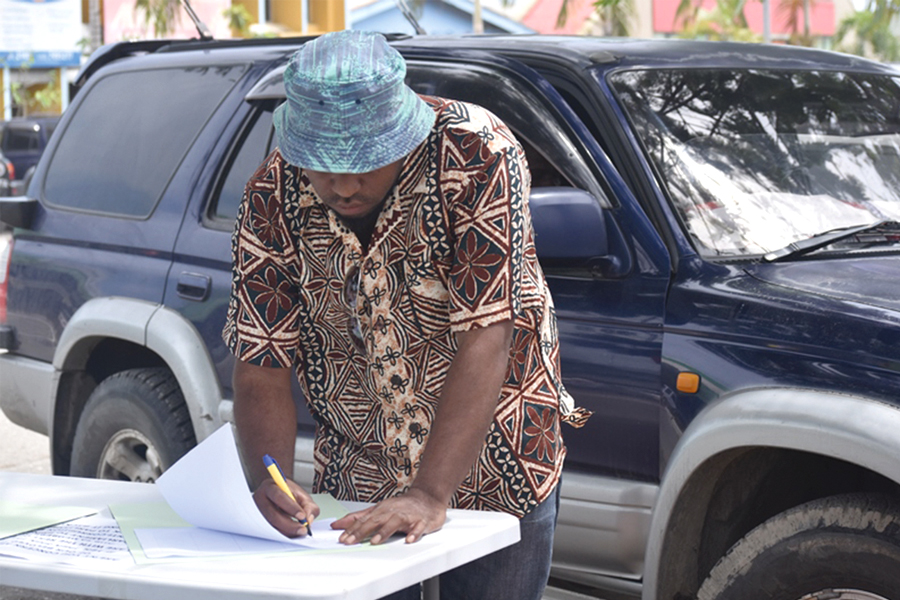
Member of parliament for West Makira Hon Derrick Manu’ari, signing the petition to have government return the anti-corruption bill to parliament yesterday, said that we must not be complacent with what government promises since it has proven to be inconsistent in living up to them.
The ongoing petition signing against the withdrawal of the Anti-Corruption Bill commenced yesterday.
Manu’ari said while he supports the petition he also encourages citizens to mobilise and have their voices heard on things of national interest.
He added that a lot of MPs especially those from the opposition and independent group are in support of people who are in the fight against corruption.
Speaking on the government’s statement about the return of the bill, he said that there is no guarantee that such will take place because the government has been inconsistent in what they have said and done.
In addition, Manu’ari stressed that the biggest loop in this anti-corruption bill scenario is the government raising the hopes of people, making them think that the bill would be passed in parliament only for it to be withdrawn instead.
Moreover, he said that the Prime Minister’s statement on members of the opposition group filling in the ears of his ministers about what would happen regarding the bill is misleading.
In this regard, Hon Manu’ari alluded that government ministers are capable of reading the bill themselves thus are in no need of the opposition group or any party to read or explain anything to them.
“We have nothing to do with the withdrawal of the bill,” he said.
The Member of Parliament for West Makira also mentioned that the withdrawal of the anti-corruption bill was motivated by quest for political survival.
Audit finds SI Ports Authority without key policies
By Alfred Sasako
SOLOMON Islands Ports Authority (SIPA) does not have key polices despite it being the nation’s oldest State-Owned Enterprise (SOE), an external audit has found.
KPMG Fiji, which last year audited SIPA’s accounts for the year ending September 30, 2015, in the middle of SIPA’s tumultuous period, said such a situation raises “serious concern considering the nature and significance of its operations and the volume of transactions”.
Island Sun has obtained a copy of the audit report.
”Policies and procedures for the key processes for SIPA is not only critical but fundamental to the effectiveness and efficiency of activities carried out. We noted that the key policies for SIPA are non-existent and this is a serious concern considering the nature and significance of its operation and the volume of transactions.
“The following issues had occurred due to the lack of effective policies and procedures. Numerous instances of significant breaches in the norms due to the lack of an effective procurement, tender and payments processes. The matters raised against Mr Colin Yow is a notable example of significant losses absorbed by SIPA due to non-existence of policies and procedures,” KPMG said.
It recommended that Management “consider developing the following as a matter of high priority:”
Procurement and Tender
Delegated level of authority
Fixed asset management
Project Management
Finance; and
Corporate Governance
In response, Management said it would engage an external party to “develop policies and processes” for the six areas KPMG has identified.
“These should enable SIPA operations and activities more aligned to international practices. These will also help reduce wastage, fraud risk, instil efficiency and can be used as a learning tool not only to the Finance staff but other departments as well,” Management said in its response.
Whether or not Management has carried out the recommendations is not clear.
Many of these issues have now polarised the relations between staff and management and have the potential bring down the organisation.