Home Blog Page 1571

Birdwatching and traditional ‘visi’ fishing on Isabel

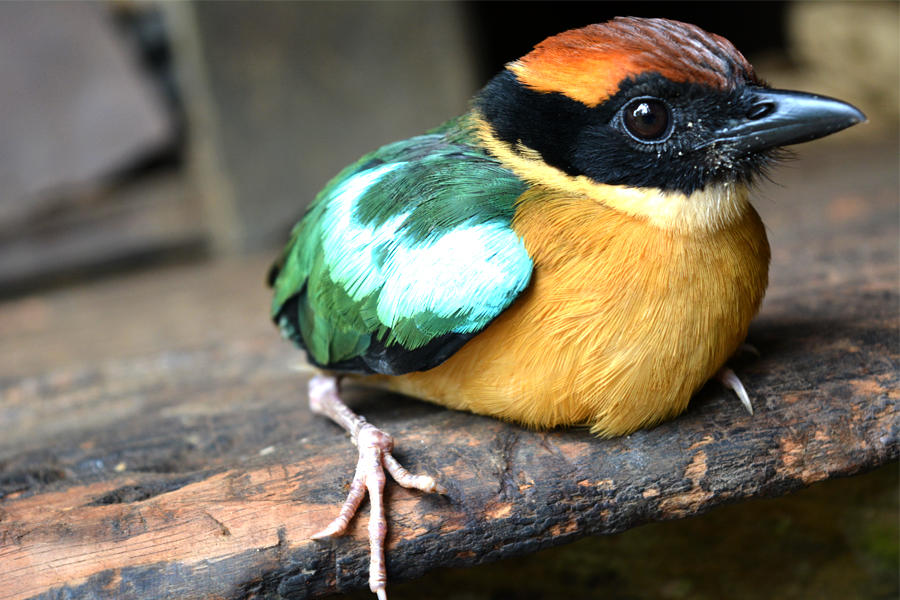
Black-faced Pitta is endemic to Isabel, Choiseul and Bougainville

BY PRIESTLEY HABRU

Black-faced Pitta is endemic to Isabel, Choiseul and Bougainville

TIROTONA village, located just a few kilomteres inland and uphill from Isabel Provincial township of Buala is fast becoming a hub of bird watching in Solomon Islands.

The major drawcards for tourists are the rare species of birds like Black-faced Pitta, Solomons Frogmouth, Fearful Owl, Imitator Goshawk and Sanford’s Sea-eagle.

Other birds tourists want to see are Woodford Rail, Solomon Boobook and Myzomela according to owner of Mae Holo Bird Watching Roger Manehage.

Mae Holo and Bubuli Bird Watching owned by Gerard Kidia are currently the two bird-watching ventures at Tirotonga Village with two more establishments expected soon.

Both Mae Holo and Bubuli bird watching businesses provide accommodation and cheap packages that include pick up at the Fera Airstrip to food, accommodation and trips inland to watch the colourful birds.

Tirotonga Village, visible from the air is the hub of birdwatching on Isabel

One of the sought after birds to watch is the elusive Black-faced Pitta which is only endemic to Isabel and Choiseul islands in the Solomon Islands and Bougainville which is part of Papua New Guinea.

According to the 2016 International Union for Conservation of Nature (IUCN) Red List of Threatened Species, the Black-faced Pitta was once reasonably common, at least on Bougainville. Forty specimens were collected there before 1938. But since then it was not recorded until 1994 when three birds were heard calling at Tirotona on Santa Isabel. Searches and interviews on Choiseul and Bougainville were unsuccessful until it was recorded on Choiseul in 2014.

In its latest assessment, IUCN stated that the conservation status of this species is not well understood: It is categorised as ‘Vulnerable’ on the basis of its very small known population, but if research shows its population is falling, this would warrant the bird being reclassified in a higher threat category.

More than 10 tourists have come to the hilltop village of Tirotona so far this year either through Mae Holo or Bubuli birdwatching arrangements.

Apart from these two bird watching businesses, fellow villager Freda Pooti has a descent accommodation with four rooms, kitchen and laundry facilities for tourists and guest alike who wish to visit Tirotona Village.

A still photo from an aerial video showing Buala Town on the bottom left and nearby coastal villages and Tirotonga Village visible at the top left corner

Situated along the mountain range above Buala Town and surrounding coastal villages toward the east, Tirotona Village is a picturesque home with mostly sago-palm thatched houses and few iron-roofing hamlets overlooking Maringe Lagoon that includes Fera Island which hosts the local airstrip toward the western tip.

The Maringe Lagoon which consists of Jhokau, Tasia, Fera and Sulei islands are surrounded by beautiful coral reefs, mangroves and a few pockets of white sandy beaches especially at around Fera Airstrip.


Traditional ‘Visi’ Fishing Technique

Whilst in Buala Town or watching bird at Tirotonga Village, tourists can listen to stories, experience or even witness a traditional fishing technique still practised by nearby coastal village of Nareabu.

No tourists or guests have actually been invited to see this fishing technique let alone document or film ‘visi’ as it’s called, but by paying a courtesy visit to chief and elders of Nareabu Village, you can be allowed to see the preparation and might even be invited to the actual fishing method that only uses traditional vines and coconut leaves.


Reuben Tatemana, left and Godfrey Tafolehe, right, are among Nareabu elders who organise ‘visi’ expeditions.

Narebau Village Chairman and Chief Reuben Tatemana said ‘visi’ is a fishing technique that has been passed down from their ancestors and can only be done on special occasions such as a huge church gathering, wedding or during Christmas.

Tatemana said preparation for the ‘visi’ usually takes place three to two weeks before the actual fishing expedition.

“Men, women, young people and basically the whole Nareabu community partake in the preparation on an allocated day as agreed by the elders. What happen is that we will sew the fresh coconut leaves along a 200 to 300 metres vine using ropes extracted from a local tree,” he explained in his local ‘Cheke Holo’ language of Isabel Province.

Whilst the coconut leaves are sewn into the long vine strip, women and girls are not allowed to step or stand over it as was the tradition.

He said up to two or three 200m-300m fishing net-like coconut leaves would have been prepared before the ‘visi’ fishing day takes place where only men and boys are allowed to perform.

Freda Pooti outside her accommodation lodge.

One the selected day for the ‘visi’ one or two canoes with outboard motor powered engine would load the traditional net and transports it to the preferred location within the reefs of Maringe Lagoon. It can only be done on certain periods of the day and night when it is between low and high tides.

A person referred to as ‘jahoi’ would pull the first end of the vine, whilst the other end is tied to a canoe and the rest of the men would help in pulling the traditional net starting from the deep end of the reef toward the shallow part.

At the shallow part, a group of men and boys would be standing with a ready-made hand woven net made from local vines to block the fish been chased ashore and surrounded by the coconut leaves net-like been pulled at both ends and in the middle by the rest of the men.

Roger Manehage’s Accommodation.

Both ends of the traditional coconut leaves net would be pulled closer and closer so as to narrow the gap for the school of fish to be caught in the middle, blocked also by the woven net held steadfast by the other party in the shallow part of the reef.

A variety of fish would be trapped inside the small space as the nets have been narrowed to shut off any space. The men would then pick the fish trapped inside the space surrounded by both the net-like coconut leaves and the woven net.

Fish caught through the ‘visi’ are actually terrified by the sound of the coconut fronds been pulled ashore and trapped as the men pulled and narrowed the long vine with coconut leaves toward the shallow reef.

The first canoe load of fish back to Nareabu Village would be shared amongst fellow villagers. The ‘visi’ would continue two or three times into the day even during the night and the early hours of the morning. These later catches would then go toward the stock of feeding hundreds or even thousands of people coming for that special occasion they have organised at Nareabu.

Part of Tirotonga Village.

A pre-dominantly Anglican Church followers on Isabel Province means Nareabu Village celebrates Saint Barnabas as its Patron Saint around June each year, so you might be lucky to see the preparation of ‘visi’ or experience it yourself if you seek the permission of Chief Tatemana.


CONTACTS:

Bird Watching:

Mae Holo Bird Watching –Roger Manehage Mobile: (677) 7564911, Email: [email protected]

Bubuli Bird Watching – Gerard Kidia – (677) 7259744

Fred Pooti Accommodation – (677) 7802783


Visi Fishing:

Reuben Tatemane: 7113997

Godfrey Tafolehe: 7253414


Kelo – a cultural practice to settle feud and make peace in Choiseul

0
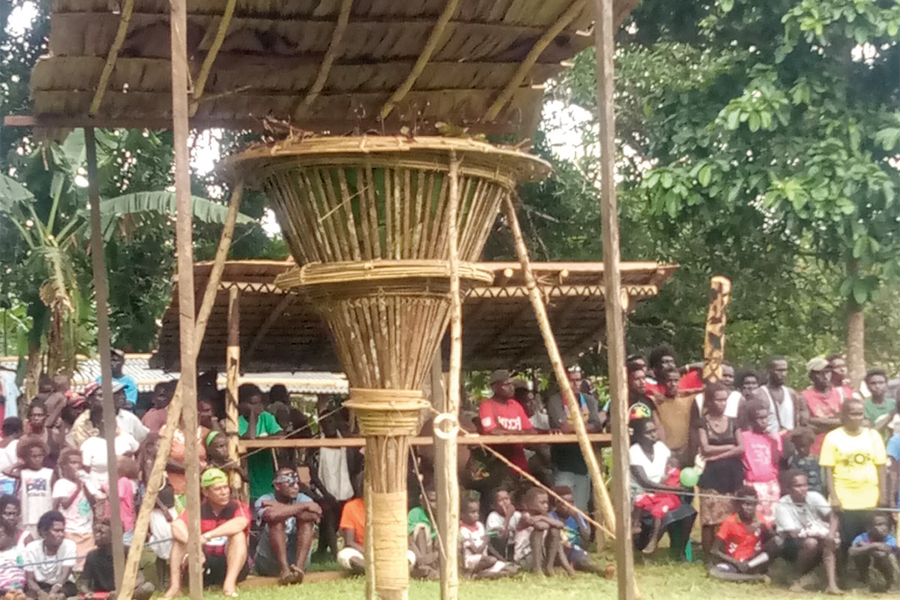
A Kaqe was constructed during the Choiseul Province Second Appointed Day at Ogho village, Choiseul Province on 24th February 2017
A Kaqe was constructed during the Choiseul Province Second Appointed Day
at Ogho village, Choiseul Province on 24th February 2017

A traditional ceremony still practised today in Choiseul (Lauru) Province called ‘kelo’ is to bring peace, unity and strengthen relationships.

During the head hunting era before Solomon Islands was colonised by Europeans, Kelo was the last event that bought about peace in Lauru and the significance of this ceremony has been upheld and passed down over the years.

The Kelo ceremony can happen when a feud has to be settled to restore peace between rival tribes and groups. It can also be performed during event such as laying of tombstone for a dead relative.

It is mainly to strengthen relationships.

The recent one I witnessed was at Ogho village during the Choiseul Province’s Second Appointed Day on 24th February 2017.

Women dancers on the giving party (Givers of the Kaqe) ready to welcome the Party to receive the gifts
Warriors guarding the Kaqe on the background to receive the incoming party

By the end of the kelo ceremony a harmonious atmosphere and absence of tension would bring happiness between the warring parties and that’s when a huge platform of food is built called kaqe.

When and if the kaqe is erected then that is supposed to be the end of the enmity.

When fighting happened, pig is put on top of the Kaqe which is a sign that the hostility is over and there is peace.

Kaqe is built by selected few who have acquired the skills from their forefathers and over the years have passed on the knowledge to this generation.

It is prohibited for people to stay underneath the kaqe during the kelo ceremony as doing so would result in fatality such as getting sick and eventually die. The kaqe is a sacred symbol of peace that must be respected according to Lauru peoples’ custom.

The guilty or the losing party in a conflict would be the ones who would organise the kelo ceremony and this cultural tradition is still respected and practised around the island of Lauru today.

Left to Right: Hon. David Tome Minister of Provincial Government and Choiseul Province Premier Hon. Jackson Kiloe after the Premier chop down the Kaqe before they receive the gifts on behalf of the Government of Solomon Islands
Left to Right: Chief Gideon Panisaga of Bangara village, Chief Francis Kavakesa of Voruvoru village with white shell on forehead and two other warriors getting ready to escort party to receive gift from the Kaqe.


— By Basilio Solevudu

Authorities investigate Takwa clinic

0

BY LYNTON AARON FILIA

MALU’U clinic and Killu’ufi hospital in Malaita province will carry out investigations following rumours of drugs being sold to patients at the Takwa clinic.

Kilu’ufi hospital were only made aware from Island Sun publication and discussions in Lau/Mbaelelea forum that the community at large is facing difficulties in accessing free medical services especially drugs.

Patients of the clinic had recently come out to voice their concerns over why they had to pay for drugs which came from government services.

This then sparked a hot debate in the local Facebook forum.

Island Sun contacted Kilu’ufi hospital and they relayed to the paper plans of sending a team to the clinic to investigate reports this week.

Kilu’ufi supervising Director of Nursing Mr Richard Maegerea said concerning Takwa clinic’s issue they will start investigations this week, and it will be led by special team from the Malu’u clinic.

He said they depend entirely on the report that will be compiling before making any decision.

Maegerea said if practice of selling of drugs for patients at Takwa clinic is true it will be deal seriously which will results in severe penalties or terminate instantly.

According to Lau/Mbaelelea forum, they are calling for thorough investigation from authorities, and this clinic were only Lau/Mbaelelea constituency clinic that serve them.

They also suggest committee manned the clinic should consider this issue as well and work closely with authority responsible.

Malu’u clinic cannot be reached for comment because they don’t have any landline telephone.

Public told to respect Commonwealth Street

0

BY JARED KOLI

LACK of respect to public vicinity at the Commonwealth Street in Point Cruz, Honiara has prompted calls for public to respect the area.

The Island Sun yesterday paid a visit to the Commonwealth Street and caught up with three Solomon Islands Ports Authority (SIPA) auxiliary workers busy cleaning up all sorts of wastes, including plastic bottles, betelnut stains and cigarette butts.

One of the workers, William Kere said they are faced with huge pile of rubbish every day.

“I want to appeal for the public to have respect for this area. We must change our attitude and respect public properties that are made for us,” Mr Kere said.

He said the area should be kept clean all the time, because it is the first place cruise tourists visiting Honiara would set their eyes on.

“This is a gateway to the capital so it must be kept clean all the time. We should appreciate what others have done for us and respect it by throwing wastes in bins provided.

“Currently, vendors also use this spot for selling betelnut and cigarette, some even sell bottle of mineral water here for as low as $3.00, this should be stopped immediately,” he said.

Mr Kere called on the Honiara City Council (HCC) to do routine check on the vicinity and apprehend betelnut and cigarette vendors.

CIP rolling for new forms 6 and 7

0

BY BARNABAS MANEBONA

Central Islands Provincial Government will be liaising with the Ministry of Education and look into the budget within the Provincial government for the goal of more Forms Six and Sevens.

CIP’s Premier Hon Patrick Vasuni said they will have consultations with CIP schools Administrations and also check on areas such as land dispute that would disturb developments.

According to the Premier, the Provincial Government has already assisted McMahon Community High School’s (CHS) new form six with five new laptops during the end of last year.

Additional laptops and school materials for learning will be handed over to McMahon’s form six this coming March.

Siro, Yandina and Paibeta CHS’s in the province are the targets of a three year plan according to CIP’s Executive Government.

PM thankful for Australia

0
The Prime Minister Hon. Rick Houenipwela also joined The Australian High Commissioner, His Excellency Roderick Brazier in cutting of the Australia Day celebratory cake last week at the Australian High Commissioner’s residence.

PRIME Minister Hon Rick Houenipwela was the guest of honour during the Australia Day function held at the residence of the Australian High Commissioner last week.

In his opening remarks, the Prime Minister stated how grateful he is on behalf of the Government and people of Solomon Islands, to the government of Australia and her people for the long standing association and friendly relationship enjoyed between the two countries and their citizens.

Houenipwela further expressed his appreciation for the ongoing discussions and the continuous support as well as direct assistance to Solomon Islands in critical areas of health, education, infrastructure, energy, governance, electoral reform, and telecommunications.

The Prime Minister also acknowledged the strong and close bilateral relationship enjoyed by the two countries.

“Australia is also a major, active player through its development assistance and aid programs in the Oceania region which Solomon Islands also benefits from both,” he said.

“To this end, Your Excellency, Solomon Islands wishes to thank the Australian Government for the ongoing bilateral support and also looks forward to developing the regional framework to ensure that our part of the world is safe, secure and a place where people can enjoy their future.

“The former British Prime Minister Lord Hamilton once said that in international relations there are no permanent friends but permanent interests.

“However, in the case of the special relationship between Australia and Solomon Islands, I would rather describe it as exemplified by the saying, ‘a friend in need is a friend indeed’.”

“Solomon Islands will not forget,” he said.

The Prime Minister further acknowledged Australia’s many triumphs and achievements over the years in socio-economic, political and sporting spheres, extending best wishes, success and further prosperity in the years ahead.

“We will continue to stand by you as we continue our journey together for the betterment of all our peoples,” he said.

–OPMC PRESS

Boost for young statistician

0
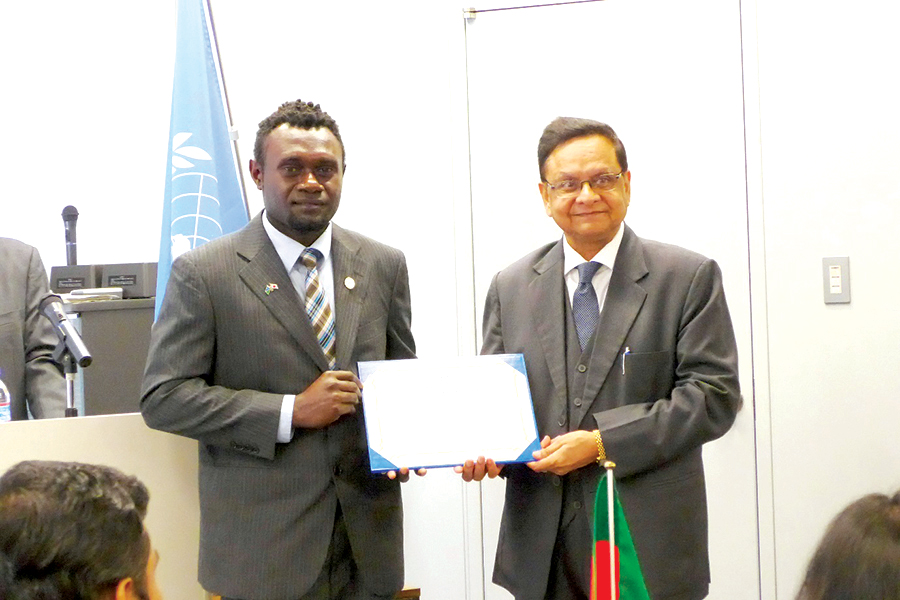
Josephat Tako receiving his certificate from the UN SIAP Director, Ashish Kumar.

“IT’S a boost for me,” says young and enthusiastic Statistician Josephat Tako.

Young Tako works as an assistant statistician within the Social Demography Unit in the National Statistics Office (NSO), Ministry of Finance & Treasury (MoFT).

Recently he attended and successfully completed a second group training programme on Improving Capability in Producing Official Statistics for Monitoring the Post-2015 Sustainable Development Goals (SDGs) held in Chiba, Japan.

The programme runs from August 21 to December 15, 2017.

It was conducted by the United Nation Statistical Institute for Asia and Pacific (UN SIAP), in alliance with the Japan International Cooperation Agency (JICA), the Ministry of Internal Affairs and Communications (MIC) of the government of Japan.

The training involved theory and hands-on (practical) task with a total of 27 statisticians from 15 countries attended.

The participants are from; Asia & Pacific- Bangladesh, Ghana, Cameron, Congo, Indonesia, Kyrgyz-stan, Lao People’s Democratic Republic, Malaysia, Myanmar, Samoa, Solomon Islands, Tajikistan and Timor-Leste.

The training aims at strengthening the capacity of national statistical systems to produce data, apply statistical methods to produce official statistics and indicators and interpret and use these for monitoring progress in achieving Sustainable Development Goals (SDGs).

Young Tako said the programme is really a bonus for him as it help enhanced his statistical knowledge and skills.

“The training has offered me a great learning opportunity and experience.

“The lessons taught really boost my statistical knowledge to be more effective and efficient in serving the National Statistics Office (NSO) and the country as a whole,” he said.

Tako vowed to utilise the knowledge and skills acquired and help his colleagues in producing official statistics and indicators, interpret and use these for monitoring progress in SDGs and also to produce official statistics that would help policy-makers for future planning.

He said what interest him is the fieldwork/field study based on the Japan household survey.

“I acquired much from the fieldwork.

“It enriched my skills and sure I got new experiences on Japan household survey and methods they used to collect official data.

“In fact, household survey is one of the main duty of the statistics office, as performed by statisticians.

“I believe if we could learn from Japan’s strategies, it would create a way forward for Solomon Islands with regards to improving and defining new strategy for the country’s data collection approaches.

“For me, the training is worthwhile and I am happy to say that I took all values as much as I could, not only about technical skill but also moral lessons.”

The programme also includes a field trip to Hokkaido Prefecture/Miyagi Prefecture from November 13 to 15, 2017 for all the participants.

The purpose of the outing is;

  • To increase participants’ knowledge on the statistical activities of the prefectural government offices and in particular, the field operations of the Family Income and Expenditure Survey, and
  • To enhance participants’ understanding of the role of statistics on the economic and social situation of the prefectures through the activities of manufacturing corporations/academic in Japan.

The field visit involves observation and making courtesy visits to the Japan Statistics Bureau and the Office of Policy Planning (Statistical Standards) of the Ministry of Internal Affairs and Communications and the National Statistics Centre, industrial establishment, academic institutions, other Japan’s statistics divisions and have talks on Japanese Statistical System.

Meanwhile, Mr. Tako thanked UN SIAP in cooperation with JICA and the Japanese Government for the opportunity and for all the support rendered to him during the course of the training.

“As there is a global commitment to working towards achieving the SDGs under the slogan ‘No one left behind’, so I am hopeful that development partners including Japan will continue to support and cooperate with developing country like Solomon Islands to attain these goals and targets.”

Tako also expressed his sincere gratitude to the Government Statistician Douglas Kimi for the trust he has placed on him and the support the NSO rendered that makes his study programme a success.

–SINSO PRESS

SINU halts SIG students from registration

0

BY LYNTON AARON FILIA

SOLOMON Islands National University has halted Government funded students from registering, it is reported.

As SINU begins its registration for this year, students under SIG scholarship are not allowed to register, both continuing and new ones.

From last week and this week, many government sponsored students were sent home because of government’s outstanding tuition fee with SINU last year.

SINU has made such move because the government has a massive outstanding tuition fee with the institution.

Speaking with the Students Association President Mr Reginald Ngati, he said many of the affected students are those under MP scholarship.

Ngati said SINU is putting their registration on hold until government fixes its outstanding tuition fees.

He said as a body established to man student’s welfare they are calling on the current government to address their issue.

“All government sponsored student, SINU now did not allow them to register, and they demand government must paid half or full tuition fee from last year including this new semester,” Ngati said.

He said it is important that student must continue with their academic, and SINU needs that money for its financial year as well.

“They need that money before student can come for registration, so every ongoing students will have to wait upon the government, and lot of SIG sponsored student were send because of this,” he adds.

Ngati said this kind of issue are unfair to students where government should consider.

“To me it’s two thing, either government continue sponsoring student or close your scholarship so that student are not affected in their education,” he adds.

Ngati said the SINUSA will continue to monitor the situation purposely to ensure government and SINU come into resolution for students to continue with their academic.


Push for introduction of RTC

0

BY BARNABAS MANEBONA

PUSHING to introduce a Rural Training Centre (RTC) at the Russell Islands is one of the provincial education tasks according to Central Islands Premier Hon Patrick Vasuni.

The CIP Premier said this during outlining the provincial education activities and programs for 2018.

He said plans for the education development of the province cannot be materialised if there is lack of co-operation between all stakeholders.

“Quality education can only be achieved through mutual co-operation by the National Government and Provincial Government including support from teachers, parents, guardians and education Officers,” said Hon Vasuni.

Education authorities and school leaders on LEAP mentors workshop

0
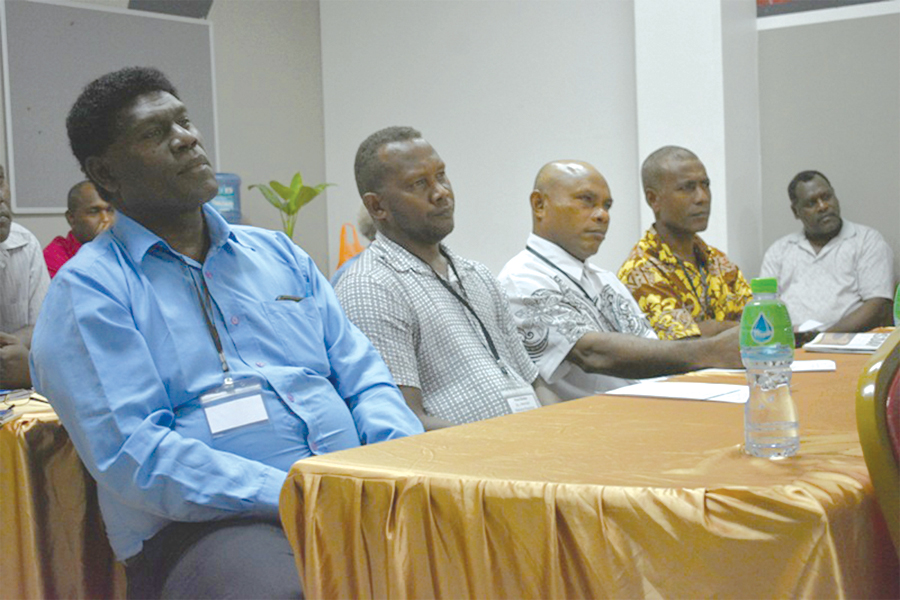
Male school leaders from provinces on yesterday’s officially opening of mentors induction workshop

BY MAVIS NISHIMURA PODOKOLO

LEADERS Education Authorities Project (LEAP) and Provincial Education Authorities (PEA) are currently holding a weeklong workshop in Honiara.

Spearheaded by the Leaders Education Authorities Project (LEAP), it is an initiative under the Ministry of Education and Human Resources Development (MEHRD) and was funded for by the New Zealand Government.

Speaking at the opening of the workshop Permanent Secretary for Ministry of Education and Human Resources Development Dr Francis Rodie, says the workshop is to improve schools opportunity to learn literacy and also a space whereby mentors will be able to familiarise themselves with LEAP policies, reference materials, trainings and coaching schedules.

“The idea behind workshop is to help improve students’ opportunities to learn literacy and to strengthen the work of the PEA and school leadership.

“To increase the literacy standards or competencies of our primary schools is so that pupils can achieve the standard we set.

“And also it is a fundamental skill for learning and ability to live a fulfilling and meaningful life and student’s levels of primary education need help to attain the literacy competencies and standards set,” Rodie said.

Professor Kabini Sanga adds it is good to have new school leaders and PEA’s undergo this workshop because it will enable them to help tackle Solomon Islands literacy and leadership challenges in education from authorities to pupils.

He strongly urged participants to deliberately mentor other Solomon Islanders and students after this weeklong workshop when needed to.

The workshop commenced yesterday.