THERE is a reported increase in admitted cases in Gizo following the recent bad weather.
Western Province Medical Health Director Dr Dickson Boara encourages mothers to take extra care of their children as the Gizo hospital sees an increase in admitted patients with fever and body ache.
This surge is being blamed as an aftermath of the recent bad weather.
Boara said, “We must look after all our children from sickness that mainly affects our children under five years old and this age group did not know what they are doing so parents you’re responsible.
“It’s an entire responsibility for parents must take extra care for our children and teach them with proper hygiene practices at homes and schools.”
He said if parents see symptoms such as dizziness, vomiting, along with the fever and body aches, then they must immediately bring their children to the hospital.
SAMBORA community is concerned with the hold up in its school’s grant, which is said to be due to non-retirement of its 2015 grant.
The current headmistress, Mrs Louisa Pagepitu, adds to the community’s call on the national education ministry to consider the situation they are in.
They allege that the problem began with the former headmistress [name withheld] who allegedly misused the grant, and did not retire it.
Mrs Pagepitu says the school has not received its grants 2016 and 2017, adding this has impeded much on the school’s progress and development.
She explained that school administration plus teaching and learning resources are lacking at the moment.
This situation has forced her to advice parents and guardians to buy stationaries for their children, because the school cannot provide.
Meanwhile, community members of Sambora Village are calling on the Ministry of Education and Human Resources Development (MEHRD) to investigate and address the reports of school grant misuse by the former headmistress.
It has been under the plans of Ngella Constituency and its provincial government to build permanent roads in which constituents are looking forward for its development.
Local Ngella citizens in waiting are also re-suggesting for their Provincial and National Government through their MP to step in and utilise logging roads in the Constituency before companies creating them leave.
Their suggestion comes after learning that Central Islands Province (CIP) had missed out on the National Transport Funding (NTF) for this year 2018 again.
“Relevant authorities should now work with the Agriculture and other Divisions including having meetings with communities and land owning groups on how these roads can be utilised,” said concerned Ngella citizens.
“That way there can be access ports to the inland for plantations, farming, small scale timber milling and other areas that would help develop the constituency.”
RENBEL’S full assembly meeting has been set to convene on Bellona next Wednesday.
It is expected that the first item of this meeting will be the tabling of a motion of no confidence against Premier Collin Singamoana and his executive.
Provincial assembly member for Ward 9, Nick Taika, is the mover of the motion.
The provincial opposition camp expects premier Singamoana to clear about 15 points.
Among other things, the opposition group question how funds intended the upcoming Solomon Games have been used.
Premier Singamoana has earlier come out and welcomed the motion, challenging the mover to bring his documents to the meeting.
Provincial speaker Brian Sa’oba confirmed all (10) provincial members have been issued notices of the meeting.
The government looks to easily defeat the motion given its number. The opposition camp informed this paper that moving a motion on the current government is an opportunity to check on the government.
This is the first full assembly meeting to be held outside Tigoa, Renbel’s provincial headquarter on west Rennell.
LALOATO Community High School (CHS) in Guadalcanal Province is now focusing for a better standardised system in their schools education.
School Principal Mr Ishmael Tabeti during celebrating the Official opening of their new boy’s dormitory last week said they need to further strategically systemise their methods of daily administration from top to bottom lines for improvement.
“These strategies cannot be achieved if there are no infrastructural developments. We need improvements in our working and living conditions. Thus, I want to declare that we need change. Change for a better and standardized system in our schools and education system,” said Mr Tabeti.
He reminded the school that the dormitory they have built is just a small step in achieving infrastructures for Laloato CHS.
“This success taken is just the beginning. But you must stand for more than that. You must find your place in promoting the change in our school as the change we now speak off is the change our nation demands.
“The change we need to see in our schools and the change we need to see in our communities and along the coasts of Weather Coast.”
The dormitory project is under Japan’s Grassroots and Human Security Project Scheme contributing SBD$494,341.50 in total last year.
Embassy of Japan representative attending the handing over ceremony expressed their appreciation of the strong leadership by the School Principal and all Board members in handling the project properly from its beginning reaching completion.
“Education is the essential of development. Under the Japan Grassroots and Human Security Projects Scheme, School Projects is one of the priority areas to focus on basic human needs of the people of Solomon Islands,” said the Embassy of Japan representative.
WATER issue faced by Aligegeo School for the last six decades has now been solved.
This follows a partnership work on a water project for the school currently carried by Malaita provincial government and Caritas Australia.
Malaita Provincial Chief Health Inspector, who is also responsible for the project, Ms Gloria Siwainao says the project is progressing, expected to be completed by May this year.
She said currently the project reaches its piping phase, where piping is now in the school compound.
Ms Siwainao said towards the end of last year they completed piping outside of the school from where the water will be sourced.
“The project is a pore-hole and province has the first attempt on it before Caritas Australia assisted.
“The province with the support of the PCDF funding they founded the initial phase of the project.
“After that Caritas Australia upon request made by my office, came and support the rest of the project which costs them around $2 million,” she said.
Siwainao said the Caritas Australia came with a new design for the project and conducted assessment and recommendation on the work required under the project.
She said they came in with their engineers and other expertisee who carried out work on specific technical areas under the project.
Siwainao said now the project is near completion as the 68,000 gallon storage tank for the pore-hole already erected.
She explained that piping is currently going on and they also waiting for pump (machine) for the pore-hole as expects to arrive soon from Australia.
Siwainao said as long as the pump arrives, they will install it and source the water to the school before May as stated.
However, she thanked Caritas Australia for their support, the province and each individual for their support toward the project as near completion.
THE continuation of the Voir Dire trial into the case against men alleged of robbing homes and attacking individuals in May and June of 2015 is for June 11.
Yesterday defence lawyers Jenny Namo and Clifton Ruele confirmed in court their availability for the trial.
This is for the defence lawyers to continue with their case.
Presiding Principal Magistrate Jim Seuika after setting the trial adjourns the case to March 27 for an interim mention.
This is the case against Frank Firimolea and his other co-acused.
Frank Firimolea, Fred Taebo Dara, and Lawrence Liliva and a 15-year-old juvenile, are facing various charges in relation to the armed robbery on different dates in May and June 2015.
Prosecution alleged that during those months, there were a number of armed robbery and break-ins cases reported to police from the Nggosi area, west Honiara; to Ranadi, east Honiara.
The incidents involved a group of armed masked men between the ages of 15 to 30.
It was alleged this group invaded homes of expatriates, businesses people, as well as those of Solomon Islanders and removed valuable properties and money.
A number of home owners sustained injuries during the robbery incidents and some have to be flown overseas for medical treatment.
APCC Director General Dr Uron Salum pictured on centre with PS Jimmi Saelea and PS Riley Mesepitu during their
Pacific Coconut Community workshop at Mendana Hotel recently
BY LYNTON AARON FILIA
APCC Director General Dr Uron Salum pictured on centre with PS Jimmi Saelea and PS Riley Mesepitu during their Pacific Coconut Community workshop at Mendana Hotel recently
STRONG niche markets are emerging for Virgin Coconut Oil which is described as the fastest growing product with high value on the global market, it is reported.
The Asia and Pacific Coconut Community (APCC) in a Pacific Coconut Community workshop here recently said Virgin Coconut Oil is now the fastest growing product in Asia-Pacific and globally.
The prices range from USD$4,000 to USD$6,000 and MT FOB Manila, with consumers also becoming increasingly aware of its health benefits which causes the hike in demand, APCC said.
APCC also adds, demand for coconut continues to grow high and Pacific island country members under the APCC need to prepare and think of re-planting coconut trees.
APCC Director General Dr Uron Salum said the market on coconut globally is growing, meaning someone out there is paying the product of coconut in terms of oil, drinking and eating.
“It’s the most precedes drink to have, what happening now is market is going up, there’s no sign of market going down. Situation going now globally is coconut production is decline,” Salum said.
In the meantime, Salum said Philippines is the highest producer of virgin coconut oil with export rate growing from 103 metric tonnes in 2003 to 36,332 MT in 2015.
Export earning explored from USD$8.34 Million in 2011 to USD$129 Million in 2015 reaching over 42 export destination, he adds.
Salum said for US markets of Virgin Coconut Oil it accounts to 59.7 percent, Netherlands 10.1 percent, Canada 8.5 percent and balance to Europe, China, Japan, Singapore, Australia and South East Asia.
With this figure, Salum encourages the coconut sector in Solomon Islands that coconut production plays pivotal role for the country and future of coconut processing industry which is one of the highest thing to watch for.
“My request to Solomon Islands is turn around and use coconut because it is the oldest crop in this country and people know it, use it as proper catalyst for development to socio-economic, social and cash economic development,” Salum said.
Permanent Secretary for Ministry of Commerce, Industries, Labour and Immigration Mr Riley Mesepitu said they will collaborate with Ministry of Agriculture and Livestock to look at ways to revive coconut industry here.
He said country already has sectors in place but the challenge is production which is crucial to work closely with local farmers and re-planting coconut trees.
Meseputi also adds challenge country including farmers currently face is the invasive rhino beetle but it is area to consider seriously.
DIRECTOR General of the Asia and Pacific Coconut Community (APCC), Dr Uron Salum calls on Solomon Islands to make use of its yearly membership with the organisation.
APCC has its Head Office in Jakarta, Indonesia, and Solomon Islands is a member.
Every year, the country pays a certain amount of US dollars for its membership fee.
Solomon Islands joins another nine Pacific Island countries.
Over the years, Solomon Islands has not fully utilised the opportunities available with the APCC, thus Salum calls for the country to start making use of its membership.
“I like to be lot of help to Solomon Islands that’s why I’m here and you do use your membership in APCC to get that help.”
Salum said Solomon Islands’ Ambassador to Jakarta is one of the opportunities to tap on as he knows very well about coconut now.
He said one of the reasons for visiting Solomon Islands especially coconut sectors both government and private is to motivate and influence leaders to actively make use of its membership with the APCC.
Permanent Secretary for Ministry of Agriculture and Livestock, Mr Jimmi Saelea thanked Dr Salum for an impressive presentation which alerts coconut sectors in the country to better for Solomon Islands.
Saelea also said they will work closely with Ministry of Commerce including private sectors to raise the profile of coconut industry here.
Re-planting is one area they will look at and working collaboratively with donors and local farmers to address present issue of invasive rhino beetle which put coconut industry under threat here, PS Saelea said.
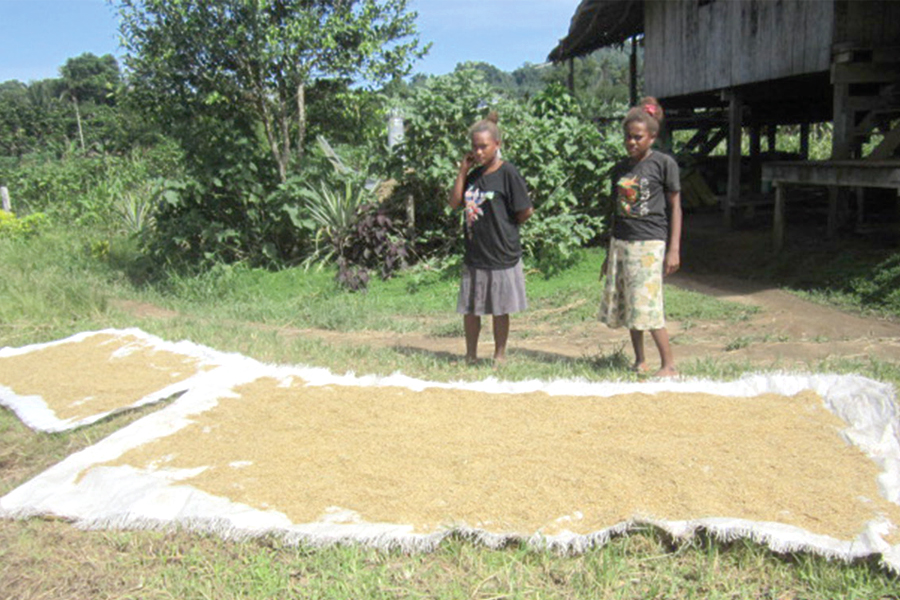
Rice sun dried outside Hula’s home at Gama district in Isabel province.
By Mike Puia
LOCAL rice farmer, Eddie Hula, from Isabel Province is encouraging locals to grow rice.
Mr Hula, from Isabel’s Gama District, is one of the few locals who are successfully growing rice.
He said growing rice is easy and can help sustain the family.
“My family had no problem with rice. We have plenty to eat and we spare money to buy other needs,” Hula said.
Hula, father of four children, started growing rice in 2006. Currently, he has a huge rice farm where about 200 people work in.
“I grow and eat my own rice. I am tired of eating free rice,” Hula said.
Hula is the owner of Folo farm. He grows mainly Taiwan’s R71 rice in his farm.
The R71 rice is one of the types of rice that is grown in the region. The most popular one is the Australian rice that is packed in Solrice bag.
Hula said he got the R71 rice from Taiwan’s technical farm in Honiara.
He said the R71 rice has high production and is resistant to pests.
“R71 is the best rice to grow. It does not need chemical and it suits rural and commercial farming,” Hula said.
He has a demonstration farm where farmers in the district usually come to and learn how to plant rice and other crops.
Hula said when he harvests the demonstration farm; he would share seedlings to 38 stakeholders.
“I usually distributed 60 kilograms of rice to a farmer. This caters for a farm of one hectare,” Hula said.
In 2017, he said he attended training where he learned how to make home-made rice grinder.
Hula can now harvest the rice, grind and pack the rice for food, planting or sell.
Local rice farmer from Isabel Province, Eddie Hula, with a home made rice grinder (Kisa).Rice supply at Hula’s homeRice sun dried outside Hula’s home at Gama district in Isabel province.