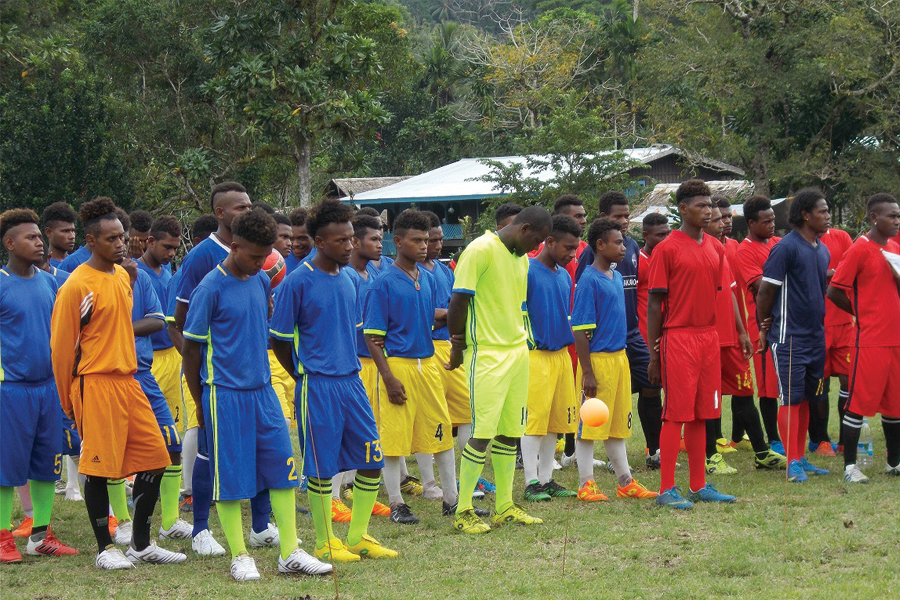
Officials who witnessed the Grand Opening of the 2018 Kakamora Cup Challenge.
THE Kakamora Cup Challenge in Makira Ulawa Province will enter day three of competition today at the Manita Sports Ground in West Makira.
The grand opening of the Kakamora Cup Challenge was successfully done on Tuesday afternoon at the Manita Sports ground and was witnessed by more than 400 people including participating teams according to Makira Ulawa Football Association (MUFA) Vice President Mr Roxley Tara.
Mr Tara said pool matches for the competition will take place this week and expects to enter the finals next week.
He adds that MUFA will use the tournament to select players for the provincial Real Kakamora squad for this year’s Solomon Games.
“This is the highest football tournament hosted by MUFA in the province. This year we have agreed to send a U-23 football team for the Solomon Games,” Tara said.
“This year’s competition will be interesting because the selection for the provincial Real Kakamora squad for the Solomon Games will also be done during the tournament.
Teams parade during the opening ceremony.Team Central West
“As soon as the tournament ends names for the Real Kakamora U-13 man training squad for the Solomon Games will be made known public,” he adds.
Meanwhile results from day one of the competition on Wednesday are as follows:
Game 01 – Ulawa vs Manita – Pool A – Manita won by 2 goals to 1
Game 02 – Bauro West vs Starharbour – Pool B – Star Harbour won by 5 goals to 1
Game 03 – Arosi 1 vs Arosi Kings – Pool A – Arosi Kings won by 4 goals to 1
Game 04 – East Haura vs Aorigi – Pool B – Draw 1-1
Teams competing in the 2018 Kakamora Cup Challenge are as follows:
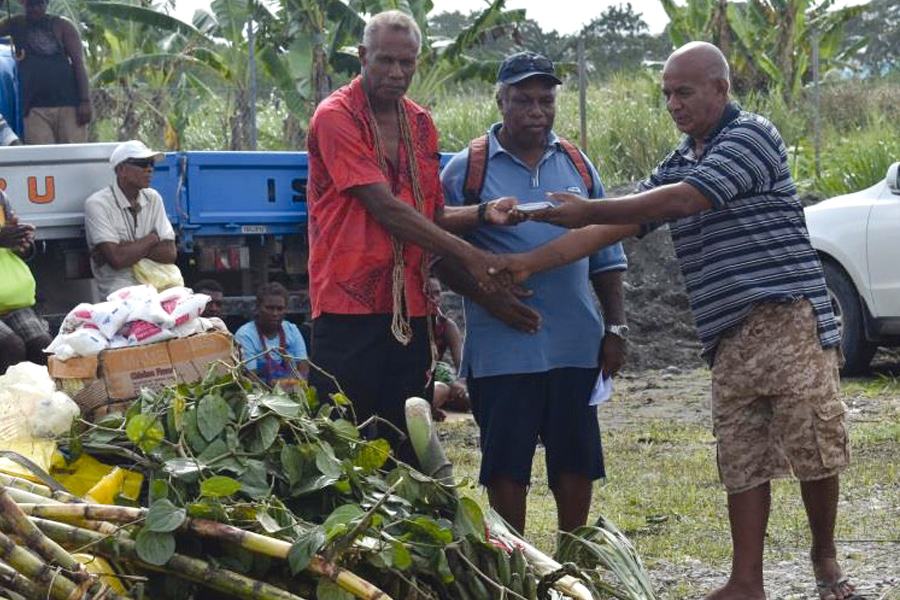
Guadalcanal tribal leaders accepting shell money and chupus presented to
them by members of the Gilbertese community.
BY MIKE PUIA
MEMBERS of the Kiribati community in Honiara have all the reasons to celebrate on Thursday.
Not only it’s their Independence Day but, their wish to return to the land they called “second home” at Foxwood, on North Guadalcanal, has finally been fulfilled yesterday.
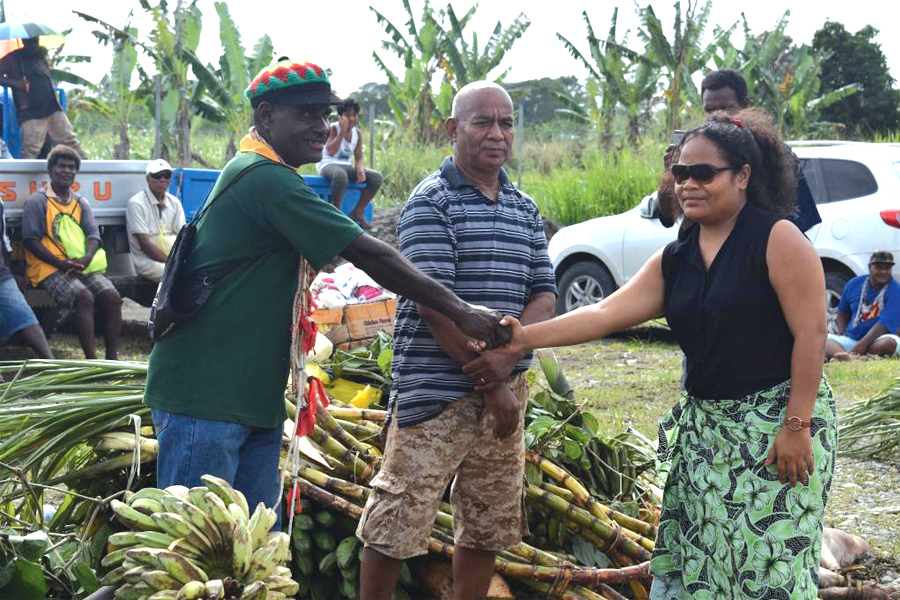
Members of the Kiribati community presented shell money, chupus and cash to Ghaobata tribal leaders and the door to return to where they once settled was opened.
The people of Kiribati were allocated a land area at Foxwood by the colonial government in the 1970s. They were given a Perpetual Estate (PE) title.
Guadalcanal leaders enjoying the entertainments provided by members of the Gilbertese community.
Kiribati people settled there for years. There were even intermarriages taking place.
When the ethnic crisis broke out on Guadalcanal, 19 years ago, they abandoned the land for fear of their lives.
Not until peace was restored in 2003, when the Regional Assistance Mission to Solomon Islands (RAMSI) arrived, that they wanted to return.
Their long wish to return was settled yesterday during a reconciliation and recognition ceremony.
For members of the Kiribati community, it’s a ‘thank you for accepting us back’ ceremony while for the indigenous people on North Guadalcanal it was a ‘welcome back’ ceremony.
Guadalcanal tribal leaders accepting shell money and chupus presented to them by members of the Gilbertese community.
Chiefs representing tribal groups within Ghaobata House of Chiefs, Member of Parliament for North Guadalcanal Mr Samson Maneka, Guadalcanal province’s deputy premier Mr Peter Araonisaka, representatives from the Office of the Prime Minister, officers of the Royal Solomon Islands Police Force, Guadalcanal Post Conflict Reconciliation, Rehabilitation and Restoration Association president Mr Joseph Sangu and members of the communities round Foxwood witness the ceremony.
Speaking at the ceremony, MP for North Guadalcanal Mr Maneka thanked chiefs and leaders in the region for their wisdom in making sure the Kiribati people return.
Being a former Minister for the Ministry of National Unity Reconciliation and Peace, he said it has been his wish to see peace prevailed in the constituency.
Kiribati community members shaking hands with members of Foxwood and nearby community at a ceremony welcoming Kiribati community members back
Maneka said the event fulfilled his dream for the constituency to enjoy love and peace.
He said there will be ups and downs but he trusts leaders, especially chiefs and leaders of the constituency and that of the Kiribati community will ensure there is peace.
Maneka assured the Kiribati people that as their MP, he will make sure they enjoy their stay.
Deputy Premier of the province, Mr Araonisaka, encourages his people to show caring attitude toward the people of Kiribati who returned to their land.
He said they were with them but situation forced them to leave and now they are back.
Araonisaka said the chupus and gifts the Kiribati people presented is a huge thing, based on Guadalcanal tradition, and so it must be respected.
He added “you are now part of Guadalcanal”.
Respected elder from the Kiribati community in Honiara, Mr John Bakeua, made a powerful and emotional respond.
Bakeua said their people were once North Guadalcanal brothers and sisters until the country’s dark days.
He said had there were no dark days they are still with North Guadalcanal people.
Bakeua said the speeches from Guadalcanal leaders have strike them to the nerves.
He said there are no words to say thank you for the assurance and acceptance given to them.
Bakeua said the ceremony presents a new light and life for his people.
“I can only assure you that your culture will be our culture,”
Beside the chupus, the Gilbertese community also hand over money as token of appreciation to Guadalcanal tribal
leaders. Photos by Mike Puia
By Mike Puia
LEADER of Foxwood community on North Guadalcanal has conveyed their apologies to members of the Kiribati community in the country.
Chief Andrew Kuvu made the apology during a reconciliation and acceptance ceremony at Foxwood community yesterday.
The ceremony marks the return of Kiribati people to their land at Foxwood – a land they were forced to abandon during the ethnic crisis on Guadalcanal in 1999.
Kuvu said the people of Kiribati are not new to them.
Members of the Gilbertese community at Foxwood, North Guadalcanal, during the ceremony on Thursday.
“This is your old home. Welcome back,” Kuvu told members of the Kiribati community who were present at the ceremony.
He said they are sorry for what had happened which forced the Kiribati people to move out 19 years ago.
Kuvu said during the past years the Kiribati people were their brothers and sisters.
He said the ceremony will re-unite them with Kiribati people.
Kuvu, who is also the chairman of the community, said he looks forward to the time their people will join hands with the Kiribati people and enjoy their stay.
He urged his people and those in nearby communities and members of the Kiribati community who were present at the ceremony to respect and take care of each other.
Beside the chupus, the Gilbertese community also hand over money as token of appreciation to Guadalcanal tribal leaders. Photos by Mike Puia
PAIWAN tribe from the Republic of China (Taiwan) during the 6th Melanesian Arts and Cultural Festival showcased a tradition costume made from tree bark.
The costume is one of the cultural identities of the Paiwan tribe, which is one of Taiwan’s 16 tribes.
The tree barks are pounded and designs and patterns are woven into them.
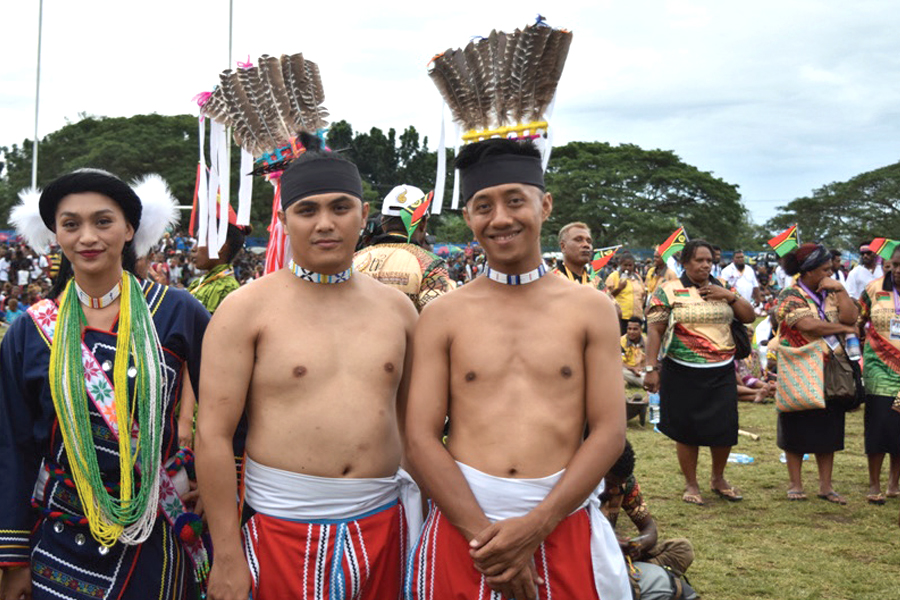
This year’s MACFest saw representatives of the Paiwan tribe and the Amis tribe, who displayed and shared their cultures with other participants by way of dances, singing and items.
Island Sun team met with the Director General for Indigenous People Cultural Development Centre, Council of Indigenous People in Taiwan Mr Tseng Chih Yung and explained Paiwan’s costume is made of tree bark.
Diversity of culture at closing of 6th MACFest.
It was then used in square cloths made up of hemp, cotton or wool, he explained.
Mr Yung said men’s clothes include Chinese-style crew neck long-sleeve shirt, short skirt and outer rectangular cape draping over shoulder.
At important ceremonies people from Paiwan will wear hat, long jacket, male leg covering and shoulder belt, carrying a knife with them.
For female, clothes include one-piece dress with right collar and a crewneck, long skirt, leg covering, headband, elaborate wreath or forehead band.
Paiwan chiefs and noble families are entitle to certain patterns such as human head, human finger or hundred-pace snake that indicate their distinct noble status.
Members of the Paiwan tribe
The special status of the chief and nobility is shown in costume, hand tattoo and wrist tattoo which they use to decorate their body.
Common people can also obtain their privilege to tattoo their body and hand after they honored for some achievement.
Paiwan is known for its family name, the concept of family and strict hierarchy which involves politics, marriage, religion and art in the society.
Paiwan people celebrate Millet Harvest Festival.
Besides, the Vuculj group of Paiwan celebrates ‘Five-Year Ritual’ every five years and invite ancestral spirits to come and visit their offspring.
It is also called the Ritual of the Union between people and Gods.
Deputy Commissioner for Ministry of Forest and Research Mr Terrence Titiulu (right) pictured with the new book
materials developed as outcome from the IGECIDDM project.
BY LYNTON AARON FILIA
Deputy Commissioner for Ministry of Forest and Research Mr Terrence Titiulu (right) pictured with the new book materials developed as outcome from the IGECIDDM project.
MINISTRY of Forest and Research has commended the successful implementation of the Integrating Global Environment Commitments in Investment and Development Decision Making (IGECIDDM) Project in the country.
The project is a partnership between GEF, United Nation Development Programme and Solomon Islands Government with a timeframe of three years, from 2015—2018.
Deputy Commissioner Mr Terrence Titiulu said the project has been a great boost to the Government’s awareness programmes.
He said government has benefitted particularly when facing difficulties with cash flow to implement its awareness programmes.
Titiulu said such project has pulled together key ministries—MECDM, MAL, MoFR, MJLA LALSU including SINU which made a positive collaborative to conduct effective awareness programmes to country’s target areas.
He also adds that it was realised that all are working towards addressing the same environmental issues such as climate change, biodiversity loss, land degradation caused by unsustainable logging and mining, non-subsistence agriculture, invasion of invasive plant and animal species.
Titiulu also said that during the project’s timeframe it helped educating public on where to seek help or collaborate as well as what their right are under the various laws regulating these issues.
Minister for Environment, Climate Change, Disaster Management and Meteorology Dr Culwic Togamana also commended thee UNDP, SINU, MECDM through his PS, and MEHRD for the great work done.
He adds the IGECIDDM project has left behind tangible outcome for developing book materials which education generation now and future about importance of conserving environment.
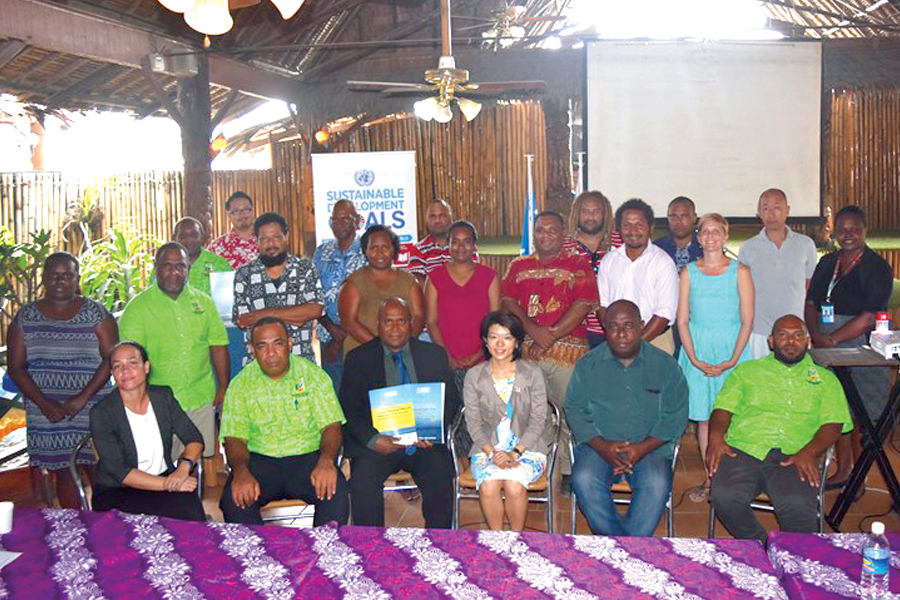
Group photo of the partners of the Integrating Global Environment Commitments in Investment and Development
Decision Making (IGECIDDM) Project
BY LYNTON AARON FILIA
Group photo of the partners of the Integrating Global Environment Commitments in Investment and Development Decision Making (IGECIDDM) Project
SOLOMON Islands Government and the United Nations Development Programme have concluded its three-year project which resulted with sets of commitment towards environment issues.
The Integrating Global Environment Commitments in Investment and Development Decision Making (IGECIDDM) Project which are implemented under SIG and UNDP have lapsed.
Despite its closure, Minister for Environment, Climate Change, Disaster Management and Meteorology Dr Culwic Togamana called for adoption of the concept.
Togamana during the project closure workshop at King Solomon Hotel yesterday explained Solomon Islands is a country blessed with rich terrestrial and marine resources.
He said alongside Philippines, Indonesia and Papua New Guinea, Solomon Islands is part of the ‘Coral Triangle Initiative’ with highest marine biodiversity in the world.
“Behind PNG, the country is also a host to the second highest number of flora and fauna species in the world and such information supports the notion that we are one of the few countries blessed with a rich biological diversity,” he adds.
In Solomon Islands, Togamana said key threats include unsustainable resource harvesting.
For example forest through legal or illegal logging and now mining due to population growth and macro or micro economic and social pressures that come with it
Also large agricultural developments coupled with widespread subsistence farming, as well as climate change.
In realisation of these threats repeated calls have been echoed over the years for sustainable and proper management of our environment and resources, he said.
This has led to some awareness and researches being conducted to help gauge and support communities who are interested in seriously considering sustainable management of their resources.
Togamana said SIG has been collaborating with international partners and local organisations to try and address the threats.
The ratification of Multi-Lateral Environmental Agreements (MEAs) such as the Rio Conventions—UNFCCC, UNCBD, UNCCD is an example of the international collaboration.
He said domestically, amongst others SIG has enacted key laws such as the Environment Act and its regulations and the Protected Areas Act.
Also, important policies have been developed and endorsed by the cabinet, he adds.
The key ones cabinet endorsed include the Climate Change Policy, the National REDD+ Readiness Roadmap, the Climate Change NAPA, and the NBSAP.
However, challenge people facing currently there is a very huge gap between how these laws and policies transpired to the provincial or rural level.
Provincial Governments and rural population did not even understand the purposes of the laws and policies which weaken their ability to actively participate in utilising or implementing them.
Looking at this trend, Minister Togamana said there is a need for nationwide awareness.
UNDP Country Manager Ms Azusa Kubota said the project showcase one of the many on-going collaborations between UNDP and the Solomon Islands Government.
She explained despite the project lapsed it signified continue collaboration of SIG and UNDP to address significant global environmental issues such as climate change, biodiversity loss and land degradation.
She said, “One of the key objectives of the project is to increase public awareness and understanding of the conventions through the REDD+ process.”
She adds result from the partnership with the Solomon Islands National University and the Government, the project developed Resource Text Book and Teachers Guide.
Ms Kobota explained the materials create so that young people and future generations are aware of the national and global environmental issues.
Most importantly, sustainable practices to conserve country’s natural resources, she adds.
WESTERN province Gizo Bio-security Division has stepped up the fight to stop the spread of the coconut rhinoceros beetle in the province.
This comes after the Division of the Ministry of Agriculture and Livestock spotted few sites within Gizo town last month.
Mr Ataban Zama said the Bio-Security Division have tried to quickly address the spreading of the beetle.
“Most farmers are worried over their coconut plantains and copra production will drop as the deadly Rhinoceros beetle found its way in Gizo.
“We are currently monitoring the situation and we encourage the general public to look after all our traps that we locate within Gizo.
“I would like to call on those of you spot any symptoms or signs of Coconut must quickly come forward to our office or contact any officers so that we can quickly monitor the situation.”
The Division strongly warns passenger ships, landing crafts and foreign vessels to be closely monitored.
A man between his 30s and 40s has been found safe and alive at the Betikama area on Wednesday morning.
Supervising Police Commissioner Juanita Matanga revealed yesterday that on July 10, White river Police Post received a report saying that a male person has been missing since July 5.
The missing person was with others who went hunting at the Kongulai area; relatives became worried when he failed to return.
However at 10am on Wednesday morning the missing hunter was found safe and alive at the Betikama area, Ms Matanga said.
“Police are again called on people to inform relatives of their whereabouts and must ensure to communicate with families of where you go to avoid panic and stress of relatives,” Matanga said.
Teachers representing schools in the central region of Malaita province to a one week counselling training in Auki.
BY SAMIE WAIKORI
Auki
Teachers representing schools in the central region of Malaita province to a one week counselling training in Auki.
SCHOOLS in the central region of Malaita province will soon introduce counselling programme for its students.
Teachers are currently undergoing a counselling training in Auki.
National Adolescent Health Programme Coordinator, Ms Nancy Pego said during the training earlier this week that the training is a follow-up to a family life education training MHMS and MEHRD had previously held.
The first training was to find out possible options on how to teach reproductive health in schools due to its sensitivity.
Pego said the topic of reproductive health was within the syllabus, but due to cultural barriers it would not be implemented as yet.
She said the possibility reached was for the two ministries to work together especially health workers to assist teachers in schools when it comes to the topic.
She said it was reported by teachers that there are lots of problems affecting students in schools, and one important area identified was to provide counselling for problems the students face.
“Sometimes students are absenting from schools and teachers continue to punish them or even expel them without knowing there’re problems within them.
“Teachers sometimes send students to clinics for medical attention and to their parents and guardians to sort out their problems.
“Without knowing some of the problems there are very simple that teachers if having counselling skills they can talk to students and solve the problems,” Pego said.
She said those are the areas they see important for teachers to equip with counselling skills so they can deal with the students’ problem.
Pego said the MHMS and MEHRD are working together on the programme by assisting each other to ensure students to benefit out of the programme.
She said as the training will complete, they hope teachers will go back and serve their various schools with the counselling knowledge and skills they’ve learnt.
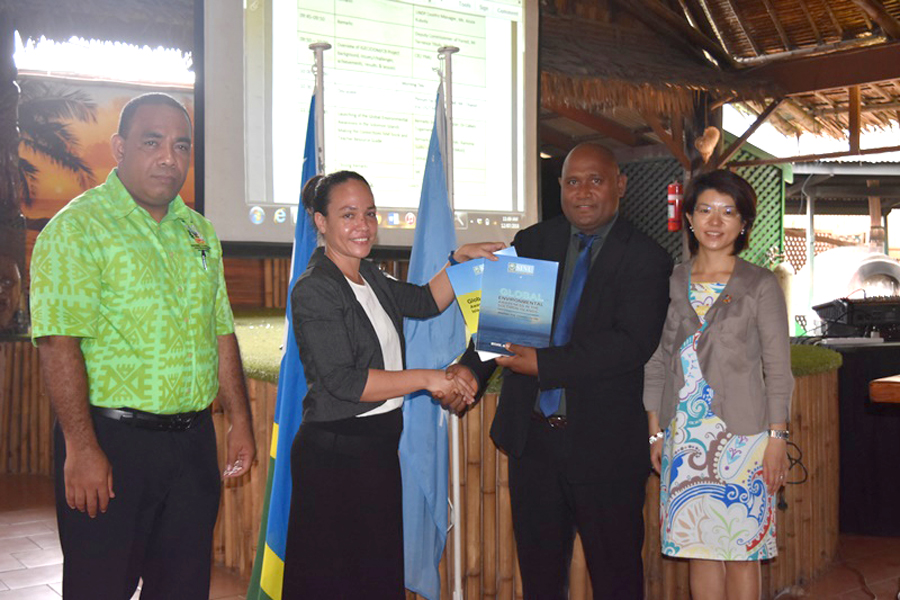
Minister Dr Culwick Togamana handing over the text book and teacher’s guide to the SINU’s Acting Dean for School of Natural Resources and Applied Science Dr Ramona Sulifo’oa along with PS Melchior Mataki and UNDP Country Manager Ms Azusa Kubota.
BY LYNTON AARON FILIA
GLOBAL Environment issues can now be taught at the Solomon Islands National University and secondary sectors across the country as additional materials.
Minister for Environment, Climate Change, Disaster Management and Meteorology Dr Culwick Togamana officially launched and handed over the books to SINU’s Acting Dean on Thursday.
The textbook and Teacher Resource Guide entitled ‘Global Environment Awareness in Solomon Islands-Making the Connections’ is an outcome from the Integrating Global Environment Commitments in Investment and Development Decision Making (IGECIDDM) Project.
Ministry of Education and the SINU senate have endorsed the book materials to be used in the university and high schools throughout the country.
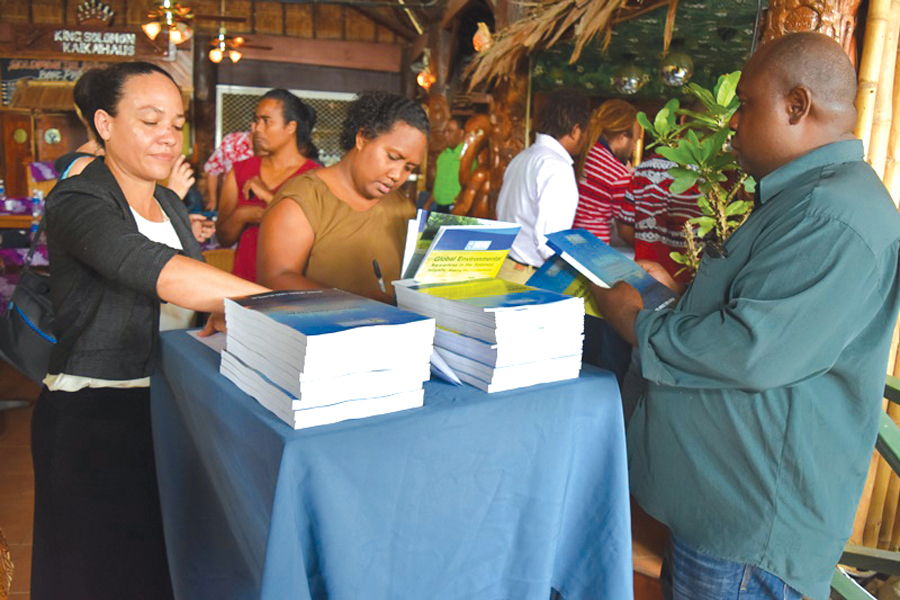
Officers signed up to collect the book materials
Togamana said they are useful materials and SINU lecturers and high school teachers should take ownership of it.
“I believe materials will enable students to think critically and understand how and why global environmental issues are affecting Solomon Islanders’ welfare socially, economically and environmentally,” he said.
He adds, the materials will better equip high school teachers to teach their pupils more effectively and enable the transfer of knowledge on environmental issues.
Togamana said environment taught at schools is necessary background knowledge to make informed decisions about use of the environment and the effect of human activities on the environment.
SINU’s Acting Dean for School of Natural Resources and Applied Science Dr Ramona Sulifo’oa said development of the materials is applicable to current and future generations.
She said the text book and teachers guide is important for SINU particularly the SNRAS and secondary sectors across the country.
“We thanked UNDP for organizing to give SINU 100 copies of the text book and the teachers resource guide and we look forward to future collaboration with the government and UNDP,” she said.
Minister Dr Culwick Togamana handing over the text book and teacher’s guide to the SINU’s Acting Dean for School of Natural Resources and Applied Science Dr Ramona Sulifo’oa along with PS Melchior Mataki and UNDP Country Manager Ms Azusa Kubota.
UNDP Country Manager Ms Azusa Kubota said, “Information in the text books will enable students to think critically about why global environmental issues (for instance global warming) should be a concern, how they affect our lives and what we can do as global citizens to mitigate the impact.
“The teacher’s resource guide will equip high school teachers to disseminate and transfer knowledge effectively, especially in the rural communities without access to resource materials.
“For citizens of a country that is vulnerable to climate-induced disasters, it is important to know that actions at the community level have direct impact on a global scale,” she said.
“Everything in today’s ever shrinking world is inter-connected, and attaining sustainable development requires citizens who think global, act local,” Kubota said.
Development of the materials is a result from the consultation of the REDD+/Rio Conventions awareness workshop conducted with teachers and student of Temotu in 2015.
Students shared environment topics are not taught much due to lack of resources such text books and internet catchment but with the books it ease the challenges.