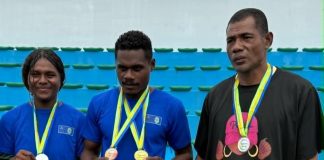
BY TONY IROGA
More than 25 community members from four communities in Ghaobata Ward, North Guadalcanal completed a three-day artisan training programme this week.
The training was held at Ghaobata School in North Guadalcanal Constituency and catered to participants from Tumorora, Bebe, Bubulu and Popoloi communities, along with representatives from nearby villages with the aim to improve sanitation and reduce open defecation in rural Guadalcanal.
UNICEF Solomon Islands WASH Programme Officer Erick Hale said the training was designed to equip community representatives with practical skills that they can take back to their villages.
The programme, supported by the United Nations International Children’s Emergency Fund (UNICEF) Solomon Islands in partnership with the Guadalcanal Provincial Government’s Environmental Health Division, trained participants to build affordable, durable and climate-resilient rural toilets using locally available materials.
“The purpose of this training is to transfer skills and knowledge so community members can build affordable and climate-resilient toilets using materials that are available in their own communities,” Mr Hale said.
He said many people believe building a toilet requires large amounts of money, but there are simple ways to build them hence, reducing construction costs while improving sanitation.
During the training, participants learned both theory and practical skills, including sanitation planning, climate-resilient toilet construction, mold preparation, slab casting and pit lining. They will now return to their communities to put those skills into practice.
He said improving sanitation is critical, as only about 35 per cent of Solomon Islands households currently have access to improved sanitation facilities.
“The remaining 65 per cent still do not have access to improved sanitation. Our expectation is that participants will return home and help improve sanitation standards in their communities,” he said.
He encouraged communities to support trained artisans by providing the tools, materials and leadership needed to continue the work.
“Community ownership is essential. It is no use learning these skills if people return home without the support needed to improve sanitation in their villages,” he said.
He said UNICEF remains committed to improve the wellbeing of children by supporting better health, education and sanitation through local partners.
“UNICEF focuses on the welfare of children. We want children to grow up healthy, attend school and live in communities with safe sanitation. That is why we work through partners such as Leave and Learn and closely with the Guadalcanal Provincial Government,” he said.
He said the training contributes to Sustainable Development Goal 6, which aims to ensure access to clean water and sanitation for all.
He thanked the participants, community leaders, the Solomon Islands Government, UNICEF and development partners for supporting efforts to improve sanitation across the country.
He also stressed the importance of continued monitoring and follow-up after the training.
“Every activity must be followed up. We need to monitor progress, learn from challenges and continue supporting communities so these new skills make a lasting difference,” he said.
Photo credit: Tony Iroga
For feedback, contact: [email protected]
Editor: [email protected]