The Solomon Islands will host the 25th Asia-Pacific Heads of Maritime Safety Agencies (APHoMSA) Forum from April 13–17 at the National Aquatic Centre in Honiara.
The forum is organised by the Solomon Islands Maritime Authority (SIMA) with support from the APHoMSA Secretariat, a statement from SIMA yesterday said.
This event will bring together over 50 maritime leaders and senior officials from 21 Asia-Pacific countries along with five partner organisations.
The forum marks a significant milestone for the nation’s maritime sector and highlights Solomon Islands’ growing leadership in ocean governance.
Maritime transport is important for the country’s connectivity and livelihoods, and hosting APHoMSA reflects the confidence of member states in Solomon Islands’ role in regional cooperation, the statement said.
Delegates will engage in technical discussions on maritime safety and development, while also experiencing the country’s warm hospitality and rich maritime heritage.
The Western Province Health and Medical Services has activated its Disaster Health Response Team as of Wednesday, stepping up efforts to maintain critical health services in the aftermath of Tropical Cyclone Maila.
Director of Health and Medical Services, Dickson Boara, confirmed that the team has already convened twice on Wednesday and again yesterday to coordinate response strategies amid ongoing adverse conditions.
He said discussions have largely focused on ensuring the safety of health workers while maintaining the continuity of essential medical services despite the impact of the cyclone.
Boara said all hospital staff, including doctors, nurses, and support personnel, are continuing their duties safely, although some have faced significant challenges.
“We know that some staff faced extreme danger. Their houses are partly damaged, while others are exposed to hazards such as rising sea levels, fallen trees, and landslides.
“In light of this, we have advised staff to either remain at the hospital or stay in their homes with extra precautions in place,” he said.
Boara also confirmed that Gizo Hospital is currently operating under Emergency Mode, with priority given to urgent and life-threatening cases.
“All staff are on standby to respond to cases 24/7,” he said.
Boara said patients with minor health concerns can still access services at the hospital, with on-call doctors available to attend to their needs.
The activation of the Disaster Health Response Team marks a critical step to ensure that health services remain accessible as Western Province continues to recover from the effects of Tropical Cyclone Maila.
A tropical cyclone warning remains in force for Western Province as Severe Tropical Cyclone Maila continues to linger south west of the province.
Solomon Islands Meteorological Service warning number 19 at 12pm yesterday said the category-four system was located 175 kilometres west-southwest of Ranongga Island.
MET service said the cyclone is moving west-northwest at around 4 knots, tracking slowly towards the southeastern part of Papua New Guinea.
Authorities warn that gale force winds of 34 to 47 knots are expected across Western Province, bringing very rough seas, moderate to heavy swells up to five metres, and possible coastal flooding.
MET said winds of 20 to 25 knots are expected, increasing to 30 knots over Choiseul and Isabel provinces.
These areas may also experience moderate to rough seas, swells of up to three metres, and potential coastal flooding, along with periods of heavy rain and thunderstorms.
The Meteorological Service advised that the severe weather could trigger landslides and flooding, particularly in communities near hillsides, rivers, streams, and low-lying areas.
Sea travellers are urged to take safety precautions as poor visibility is expected, while motorists are advised to exercise extreme caution and avoid crossing flooded rivers and streams.
The public is also encouraged to share information with people living with disabilities.
THE Director of Western Province’s Health and Medical Services, Dickson Boara, urges communities across the province to prioritise post-disaster planning to prevent the spread of diseases following recent natural disasters.
He stressed that maintaining good health practices after a disaster is critical, warning that poor conditions often lead to a rise in illnesses such as malaria and diarrhoea.
“Health is very important, and preventive measures are paramount during this time,” Boara said.
He said contaminated water sources are a major concern after disasters, often leading to diarrhoeal diseases.
Boara strongly advise communities to boil all drinking water to ensure it is safe for consumption as a precaution.
He also said that Malaria is a growing issue in the aftermath of disasters, with cases already reported to be high in some areas.
Boara encouraged residents to stay warm and consistently sleep under mosquito nets to reduce the risk of infection.
He called on people to make safety a priority in all aspects of daily life as recovery efforts continue.
Mr Boara advised contacting the health advice line on 60906 for support.
“For those requiring medical guidance, especially individuals with long-term or chronic conditions, call 60906.
“People who seek health and medical services can also call this number and our experts will be there to help,” he said.
Boara said health issues such as malaria and diarrhoea commonly increase after natural disasters making preparedness and preventive action essential for community wellbeing.
He said his office will continue to monitor the situation closely while working to support affected communities across Western Province.
A fragile calm has returned to Gizo, but for many residents, the morning light revealed a heartbreaking scene, one that will not be forgotten anytime soon.
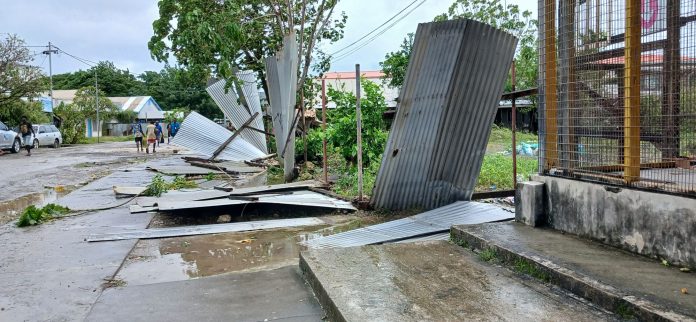
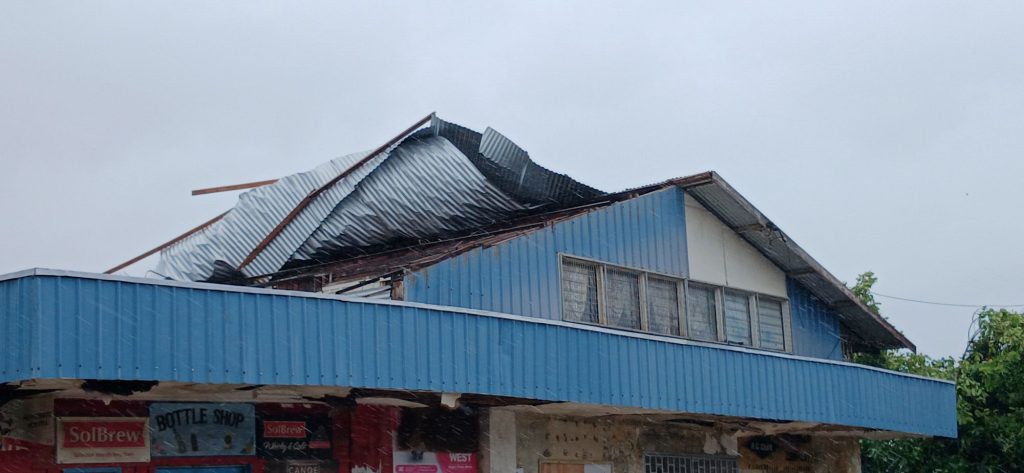
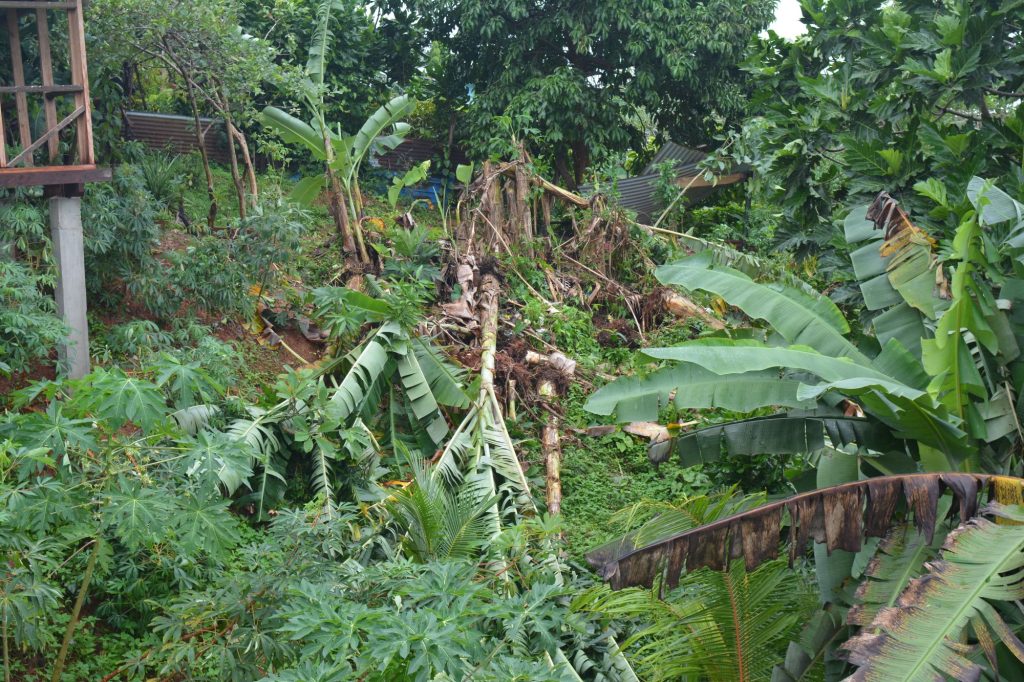
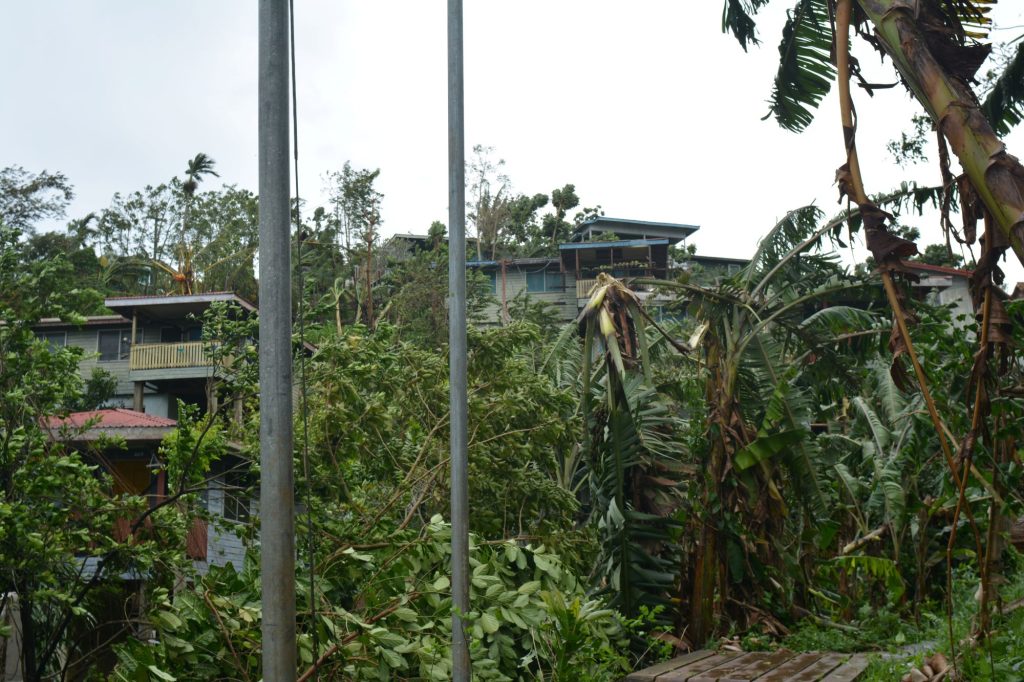
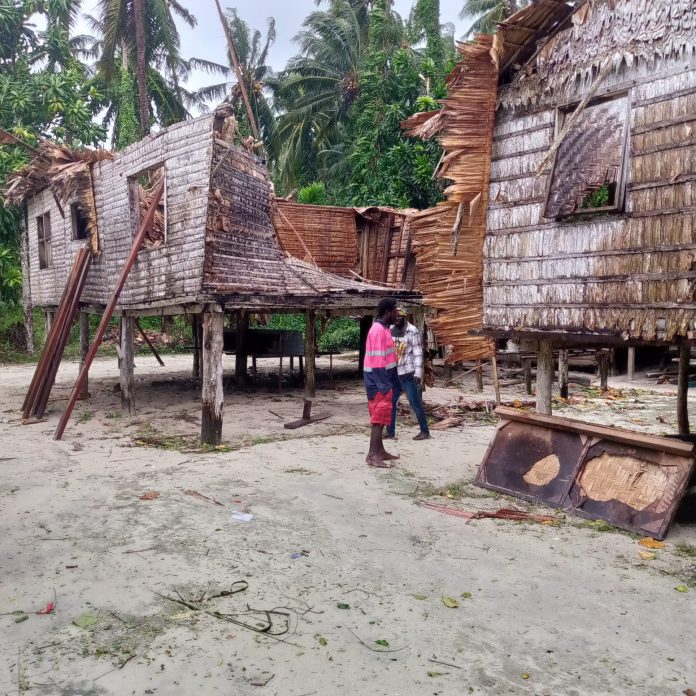
Families woke up to find parts of their homes damaged, fruit trees ripped from the ground, and debris scattered across once-familiar surroundings after a long and terrifying night as Tropical Cyclone Maila tore through the island.
What stood the day before as places of comfort and livelihood now bore the scars of nature’s fury.
The cyclone began its assault at around 2pm on Wednesday, lashing the small island with relentless winds that continued into yesterday morning.
Strong wind ripped through the roof of a building, Photo by Ben BiluaThe impact of strong winds on banana trees, Photo by Ben BiluaWind rail left fruit trees destroyed, Photo by Ben Bilua
For hours, fear gripped communities as roofs rattled, trees snapped, and the sound of the wind drowned out all else.
Those most exposed to the powerful winds had no choice but to flee.
Families hurriedly evacuated to safer grounds, seeking shelter at the Seventh Day Adventist Church Hall and Gizo Primary School.
In the chaos, one family from a nearby island beside Nusatupe made a desperate journey to Gizo just before the cyclone struck, escaping what could have been a far worse fate.
At the busy MSG building, market vendors abandoned their stalls and ran for safety, eventually finding refuge inside the M.V Fair Queen.
Others, like residents of Paeloge, moved inland under dark skies, taking shelter in a small village at Mile Six, unsure of what they would return to.
When the winds finally eased, silence slowly replaced the roar of the storm.
By late afternoon, a sense of normalcy began to creep back into the town, but it was a different kind of normal.
Across Gizo, people emerged cautiously, surveying the damage with heavy hearts.
Yet amid the destruction, a quiet resilience began to shine through.
Neighbours checked on one another. Families gathered what remained.
And slowly, piece by piece, residents began the difficult task of rebuilding, patching broken roofs, clearing fallen trees, and restoring a sense of home.
Though the scars of Cyclone Maila remain visible, so too does the strength of the people of Gizo, standing together, determined to recover, and holding on to hope after a night that tested them all.
Health and education services across Western Province have been severely disrupted as Tropical Cyclone Maila left behind a trail of chao in communities.
Schools and clinics have been forced to close following widespread damage caused by the powerful system, raising concerns about access to essential services in affected areas.
Gizo Primary School has remained closed since last week as a precautionary measure to ensure the safety of students amid strong winds and hazardous conditions.
Rural health clinics have also been significantly affected, with reports confirming both partial and complete destruction of facilities.
Director of Western Province Health and Medical Services, Dickson Boara, said damage assessments from rural areas indicate serious impacts on health infrastructure.
“Clinic at Tubi lost its roofing. The clinic’s roof was blown away when the cyclone reached its peak earlier this week,” he said.
Boara said Ugele clinic was also destroyed after being inundated by seawater during the height of the cyclone.
Communication with health workers in remote communities has been a major challenge, with some nurses still unreachable due to damaged communication networks.
Boara has called on community leaders to support frontline health workers during this difficult time.
“These nurses are delivering services to all people of Western Province under very challenging conditions. Health is important and we must support them to ensure services continue,” he said.
Authorities are continuing to monitor the situation as efforts to restore services and assess further damage remain ongoing.
Magistrate Mrs Pauline Smith Taroimae, on Monday, April 30, imposed a fine of $100 on a man found guilty of operating a public service bus with dark-tinted glass when the matter came for sentencing at the Juvenile Court room.
The offender, Sammy Abeta of Ngali Fesi Village, Malaita Province, at 11am on January 12, 2026, at the central market bus stop area, during an HCC operation, was spotted driving his public bus that was licensed to carry passengers for reward (bus fare) with a dark tinted window glass.
The offender was then accordingly charged as the licensee (owner).
The $100 fine was imposed upon the offender after the court took into account his extenuating factors such as; he is a first-time offender, he was remorseful, and was cooperative with the law enforcement officers when told to remove the black tint from his public bus.
The Honiara City Council (Regulation of Business License) Ordinance 2011 has conditions which prohibit the licensee operator (public vehicle owner) from using tints on the windscreens and windows of the bus when licensed to carry passengers for reward (bus fare).
The main reasons behind the removal of tinted glass on public transport came about as a result of safety concerns raised for women and girls travelling at night in light of the alleged abduction incident in 2024.
The regulation conditions also aim to improve the visibility and safety for passengers.
These had prompted the introduction of the ordinance which later came into effect on December 2, 2024. That same day, there was a mass protest from disgruntled taxi and bus owners in response to the ordinance condition requiring the removal of tinted windows from buses and taxis.
It follows, the public transportation within the Honiara city was disrupted with workers and daily commuters who rely on public transportation were forced to walk.
Despite the controversies surrounding the regulation conditions, the HCC Prosecutor Mr Harry Bisafo, told Island Sun that the business conditions are still effective and hence, it is compulsory for all public tinted vehicles including buses, taxis, 3-ton, 2 ton or a semi-trailer, not to have black-tinted wind screens. Except for private vehicles.
Mr Robert Madeo, Director of HCC law enforcement unit also told Island Sun that his team will continue to enforce this business license conditions on all public buses and taxis.
Consequently, any licensee operators licensed to carry passengers for reward who failed to comply with the license Conditions is liable to Maximum Penalty fine of $5,000-00.
Prosecutor Mr Harry Bisafo from the HCC is prosecuting the matter while the offender was self-represented in court.
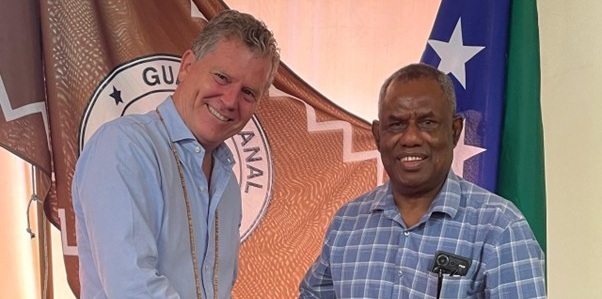
British High Commissioner to Solomon Islands, HE Paul Turner met with the Guadalcanal Provincial Government last week to discuss the current Review of the Provincial Government Act and proposals for greater devolution of responsibilities to the provincial level.
HE Paul Turner held discussions with Provincial Premier William Atu who has been at the forefront of the debate on central and provincial government responsibilities.
Mr Turner said it was important to get the balance right so that Government was still able to oversee strategic issues whilst Provincial Government could be more responsive to the citizens’ needs in their immediate areas.
Turner conceded it was not easy to get the balance right and said the UK itself had been on its own journey on devolution for many years with more powers being given to assemblies in Scotland and Wales.
But he said in the end it was important to have a functioning local government as this was key to efficient delivery of services and to improving people’s lives.
All the premiers were called to a meeting with the Ministry of Provincial Government and Institutional Strengthening (MPGIS) last August to discuss the new Provincial Government (Amendment) Bill 2025.
Premiers collectively made a submission to MPGIS on their thoughts of the new Bill, including for a push for more powers to regulate economic activities – particularly forestry and mining – as well as operationalising of a new Revenue Sharing Scheme.
Such a scheme is seen as the foundation for a more equitable financial decentralisation.
The debate continues but Turner said the UK was happy to play a role in working with the Ministry and Provinces to work through different options.
Given its dispersed geography, he said he saw a functioning provincial government as one of the crucial issues for Solomons in ensuring democracy is seen as working for everyone.
SEVERE Tropical Cyclone Maila has left a trail of destruction across Shortland Island, with entire communities in Ward 2 of Western Province reeling from its impact.
Member of the Provincial Government for Ward 2, Francis Sevio, confirmed that all 11 communities under his ward have been badly affected by the powerful system.
He said the cyclone brought intense winds, rising sea levels, and destructive waves.
Sevio said coastal villages bore the brunt of the cyclone, with storm surges forcing families to flee their homes and seek refuge on higher ground.
He described the disaster as unprecedented for the area.
Sevio said several families have been left homeless after their houses were destroyed.
“This is the first time we have experienced such a disaster. It was very frightening, but I acknowledge our local leaders who acted quickly to lead people to safety,” he said.
According to Sevio, the storm surge pushed seawater deep into villages, even reaching graveyard sites.
He said the affected communities include Aleang, Nuhu, Pirumeri, Harehare, Maleai, Gaomai, Komaleai, Laomana, Koliai, Nila, and Tuha, all of which have reported varying degrees of damage.
Sevio said food gardens were destroyed by strong winds and flooding, while drinking water sources have been contaminated by debris and saltwater intrusion.
He said people are now facing serious challenges, particularly shortages of food and clean water.
“Some villages have been particularly hard-hit, leading to severe food shortages,” Sevio said.
He acknowledged the support from national and provincial leaders, expressing gratitude to both the Member of Parliament and the Member of Provincial Assembly for their assistance during the crisis.
“We extend our gratitude to the MP and MPA for their support in addressing urgent needs in the most affected villages,” Sevio said.
He stressed that immediate assistance is now critical to help affected families recover and to begin rebuilding efforts across Shortland Ward 2.
“Urgent action is needed to support our people and restore our communities,” Sevio added.
The workers strike at Ports Authority (SIPA) yesterday was called off in the mid-afternoon after the matter was referred to the Trade Dispute Panel (TDP).
TDP is the independent tribunal, under the Trade Disputes Act 1981 (Cap 75) that resolves industrial conflicts between employers and employees. Its primary purpose is to provide a specialised alternative to formal court procedures, which are often more time-consuming and costly.
The matter is expected to appear before the TDP for conciliation Monday next week, April 13. It is understood following SIPA’s referral to the TDP, the Workers Union of Solomon Islands (WUSI) representing SIPA workers also made a counter-referral.
The 16-hour strike had incurred losses “estimated to be in the millions” for SIPA.
“Adding to that is loss in productivity and idle time,” SIPA Media Officer Lowen Sei told Island Sun yesterday.
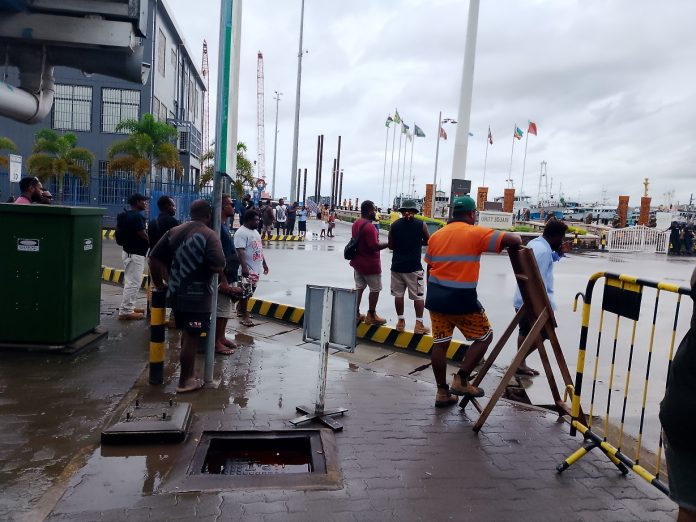
The strike saw workers assemble at the Unity Square while gateways of the domestic and international wharves were closed. It is understood that nearly 400 of SIPA’s 499 workers joined the strike.
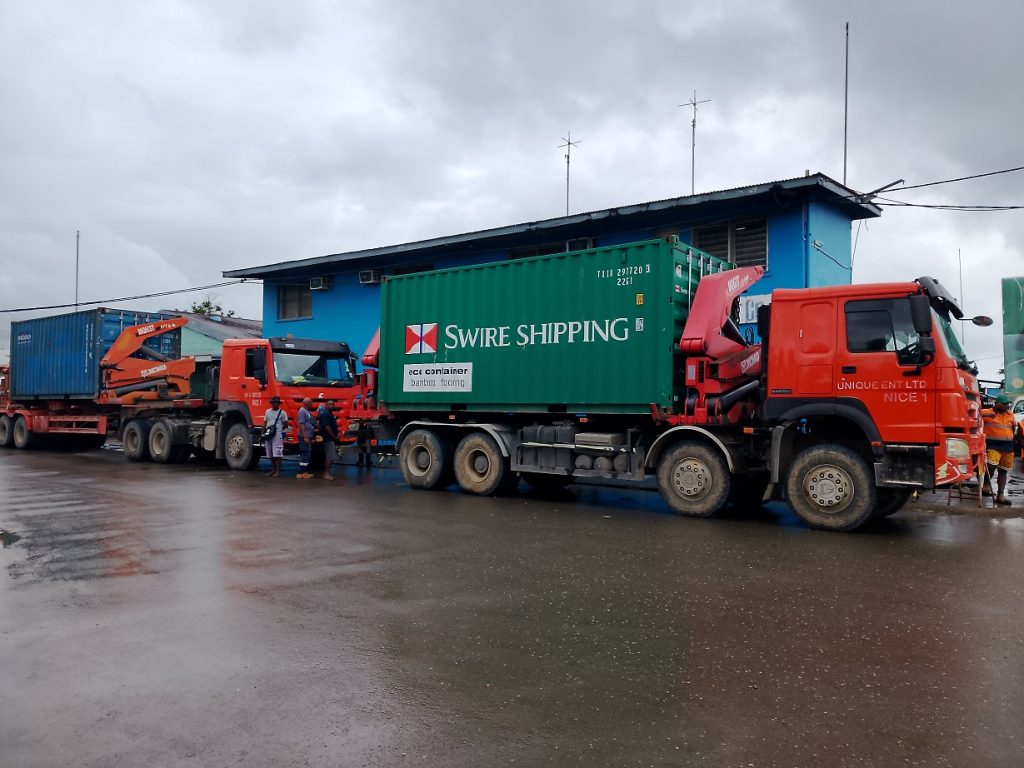
Side lift trucks lining up along the road during strike. Photo credit – Tony Iroga
No Ports business could proceed, and side-lift trucks lined up along the roads leading to the ports area.
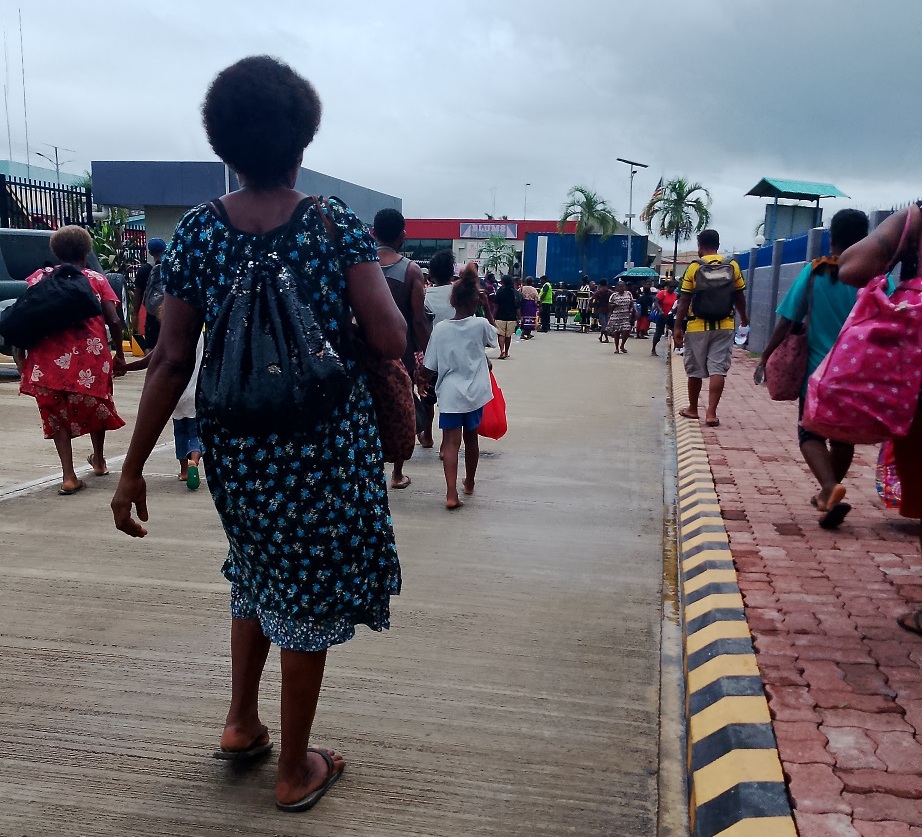
Public and ship crews use pathways by the Terminal and carpark after domestic wharf entrances closed. Photo credit – Tony Iroga
Ship crew, passengers and members of public exited the domestic wharf through the carpark behind the Terminal.
“Honiara Port have resumed as normal as of 4pm today, following the strike action taken by workers earlier today,” a statement by SIPA yesterday evening said.
“The strike has now been called off, and the matter has been formally referred to the Trade Dispute Panel (TDP) for conciliation. All staff have since returned to their assigned duties, and normal port operations have resumed.”
What led to the strike
WUSI General Secretary Adrian Tuhanuku had told Island Sun the strike was decided on with the SIPA workers’ inhouse committee after negotiations with SIPA Management failed.
The strike notice had been initiated on February 25 this year. A 14-day extension followed on March 24 to allow for more negotiations. The extension lapsed on Wednesday, April 8.
WUSI said there are three sets of issues it is advocating for on behalf of the SIPA workers.
The first, which pertains to the strike, is a log of claims which date back to 2018.
The other two matters do not pertain to the strike and are to be negotiated with SIPA management and the ministers of the Ministries of Finance (MoFT) and Infrastructure Development (MID). These include alleged misconduct by some senior officers and broader issues such as the sufferance wharves.
WUSI fought for the SIPA workers’ log of claims through three chief executive officers (CEO).
The first two CEOs had not recognised WUSI as a legitimate representative of the workers.
However, a secret ballot vote on March 17, 2025 saw 374 out of 383 workers choosing union representation by the Workers Union of Solomon Islands (WUSI).
Following this, SIPA was forced to sit with WUSI and dialogue over the workers’ claims, and the new and current CEO signed the recognition agreement of WUSI representing SIPA workers last year.
But, disagreement arose when SIPA demanded that the log of claims be back-dated to 2024. WUSI refused to budge and argued that the log of claims should be back-dated to 2018.
Failure to reach a compromise led to WUSI deciding to issue the 28-day strike notice on February 25, 2026.
Further negotiations could not come up with resolutions and a 14-day extension was given, starting March 24.
One of the contributing factors to why negotiations failed is the slow and ‘time wasting’ pace of dialogue between WUSI and SIPA because SIPA was represented by its Human Resources Officer (HR) and lawyer.
These two personnel do not have authority to make decisions. This authority rests with the CEO.
During negotiation meetings, attendants would include WUSI officials, in-house committee members of SIPA workers and the SIPA HR and lawyer.
A lot of items could not be decided on because the SIPA representatives did not have the authority to decide.
If the CEO was present, the decision on the items would have been made straight away because the CEO would give his decision there and then, WUSI secretary told Island Sun.
SIPA however said yesterday it was still negotiating when the strike occurred.
“Multiple meetings have been held between Solomon Ports Management, and WUSI to discuss the log of claims submitted, with the most recent submission received on Tuesday, 7th April 2026. During these discussions, Solomon Ports Management presented counter-offers for consideration. However, agreement could not be reached at that time. WUSI indicated that its Workers Committee and general workforce would meet on Wednesday, 8th April 2026, to deliberate further and provide a response regarding future discussions. No formal response was received, and strike action was subsequently initiated on Thursday, 9th April 2026.”
The log of claims
SIPA in its statement yesterday said the log of claims centred on disagreements over financial incentives for the workers.
“We also wish to clarify recent media reports regarding the grounds for the strike. The strike action was centred on matters relating to wage increases for the period 2018–2025, allowance adjustments, bonuses, and COVID-19 related payments. Solomon Ports confirms that no other matters formed part of the official log of claims submitted by the Workers Union of Solomon Islands (WUSI), contrary to suggestions made in recent media articles,” SIPA said.
According to the WUSI February 25 strike notice, the workers’ claims included more:
– Deliberate Avoidance and Delay of Settling negotiations on Terms & Conditions of Service of the Employees of SIPA.
– Preferential Award of Benefits to employees (eg. Education funds, Special advances, School fees, Bonus payment, Acting Allowance, etc)