BY IRWIN ANGIKI
The workers strike at Ports Authority (SIPA) yesterday was called off in the mid-afternoon after the matter was referred to the Trade Dispute Panel (TDP).
TDP is the independent tribunal, under the Trade Disputes Act 1981 (Cap 75) that resolves industrial conflicts between employers and employees. Its primary purpose is to provide a specialised alternative to formal court procedures, which are often more time-consuming and costly.
The matter is expected to appear before the TDP for conciliation Monday next week, April 13. It is understood following SIPA’s referral to the TDP, the Workers Union of Solomon Islands (WUSI) representing SIPA workers also made a counter-referral.
The 16-hour strike had incurred losses “estimated to be in the millions” for SIPA.
“Adding to that is loss in productivity and idle time,” SIPA Media Officer Lowen Sei told Island Sun yesterday.
The strike saw workers assemble at the Unity Square while gateways of the domestic and international wharves were closed. It is understood that nearly 400 of SIPA’s 499 workers joined the strike.
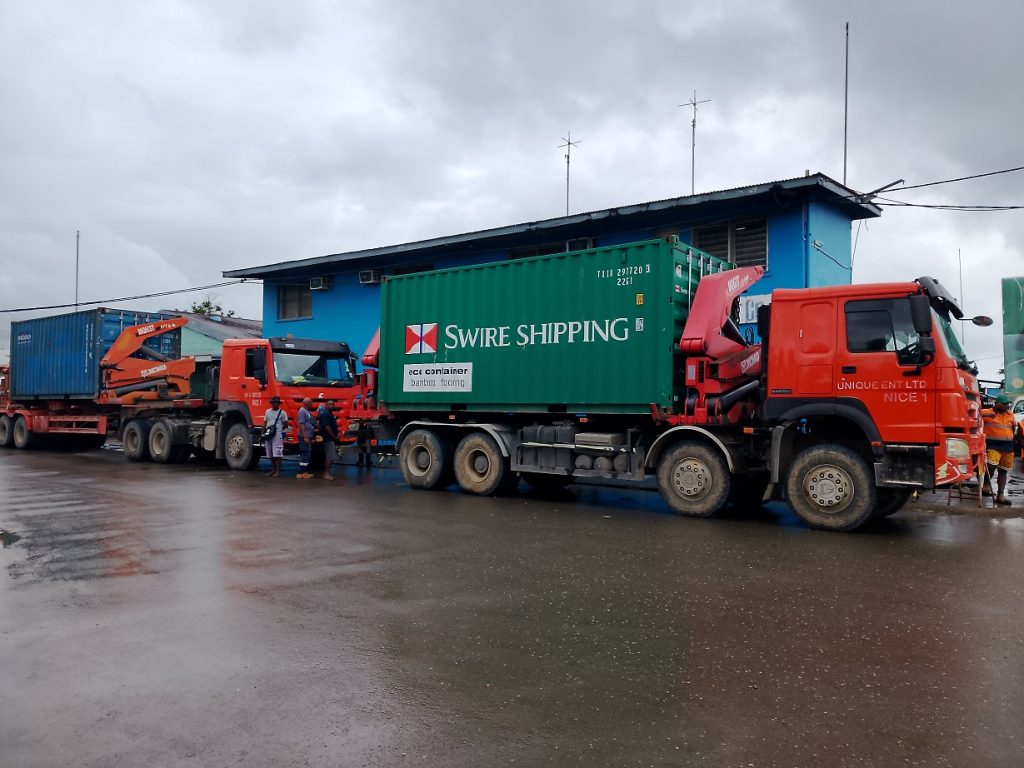
No Ports business could proceed, and side-lift trucks lined up along the roads leading to the ports area.

Ship crew, passengers and members of public exited the domestic wharf through the carpark behind the Terminal.
“Honiara Port have resumed as normal as of 4pm today, following the strike action taken by workers earlier today,” a statement by SIPA yesterday evening said.
“The strike has now been called off, and the matter has been formally referred to the Trade Dispute Panel (TDP) for conciliation. All staff have since returned to their assigned duties, and normal port operations have resumed.”
What led to the strike
WUSI General Secretary Adrian Tuhanuku had told Island Sun the strike was decided on with the SIPA workers’ inhouse committee after negotiations with SIPA Management failed.
The strike notice had been initiated on February 25 this year. A 14-day extension followed on March 24 to allow for more negotiations. The extension lapsed on Wednesday, April 8.
WUSI said there are three sets of issues it is advocating for on behalf of the SIPA workers.
The first, which pertains to the strike, is a log of claims which date back to 2018.
The other two matters do not pertain to the strike and are to be negotiated with SIPA management and the ministers of the Ministries of Finance (MoFT) and Infrastructure Development (MID). These include alleged misconduct by some senior officers and broader issues such as the sufferance wharves.
WUSI fought for the SIPA workers’ log of claims through three chief executive officers (CEO).
The first two CEOs had not recognised WUSI as a legitimate representative of the workers.
However, a secret ballot vote on March 17, 2025 saw 374 out of 383 workers choosing union representation by the Workers Union of Solomon Islands (WUSI).
Following this, SIPA was forced to sit with WUSI and dialogue over the workers’ claims, and the new and current CEO signed the recognition agreement of WUSI representing SIPA workers last year.
But, disagreement arose when SIPA demanded that the log of claims be back-dated to 2024. WUSI refused to budge and argued that the log of claims should be back-dated to 2018.
Failure to reach a compromise led to WUSI deciding to issue the 28-day strike notice on February 25, 2026.
Further negotiations could not come up with resolutions and a 14-day extension was given, starting March 24.
One of the contributing factors to why negotiations failed is the slow and ‘time wasting’ pace of dialogue between WUSI and SIPA because SIPA was represented by its Human Resources Officer (HR) and lawyer.
These two personnel do not have authority to make decisions. This authority rests with the CEO.
During negotiation meetings, attendants would include WUSI officials, in-house committee members of SIPA workers and the SIPA HR and lawyer.
A lot of items could not be decided on because the SIPA representatives did not have the authority to decide.
If the CEO was present, the decision on the items would have been made straight away because the CEO would give his decision there and then, WUSI secretary told Island Sun.
SIPA however said yesterday it was still negotiating when the strike occurred.
“Multiple meetings have been held between Solomon Ports Management, and WUSI to discuss the log of claims submitted, with the most recent submission received on Tuesday, 7th April 2026. During these discussions, Solomon Ports Management presented counter-offers for consideration. However, agreement could not be reached at that time. WUSI indicated that its Workers Committee and general workforce would meet on Wednesday, 8th April 2026, to deliberate further and provide a response regarding future discussions. No formal response was received, and strike action was subsequently initiated on Thursday, 9th April 2026.”
The log of claims
SIPA in its statement yesterday said the log of claims centred on disagreements over financial incentives for the workers.
“We also wish to clarify recent media reports regarding the grounds for the strike. The strike action was centred on matters relating to wage increases for the period 2018–2025, allowance adjustments, bonuses, and COVID-19 related payments. Solomon Ports confirms that no other matters formed part of the official log of claims submitted by the Workers Union of Solomon Islands (WUSI), contrary to suggestions made in recent media articles,” SIPA said.
According to the WUSI February 25 strike notice, the workers’ claims included more:
– Deliberate Avoidance and Delay of Settling negotiations on Terms & Conditions of Service of the Employees of SIPA.
– Preferential Award of Benefits to employees (eg. Education funds, Special advances, School fees, Bonus payment, Acting Allowance, etc)
– Salary structure not reviewed since 2018
– Preferential appraisal
– Unfair and preferential disciplinary
– Sexual harassment
– Nepotism – current employment recruitment
– Covid allowance
Photo credit: Tony Iroga
For feedback, contact: [email protected]
Editor: [email protected]