Home Blog Page 1353

New Zealand aid and development assistance appreciated

0

DEAR EDITOR, the New Zealand Government has recently signalled some important long-term approaches to assist Pacific Island states in meeting the challenges of climate change, plastic pollution and in development assistance.

I have found that quite often such news of regional assistance, with a few exceptions, is buried in our local newspapers in general topics having a loose bearing on regional happenings.

Because of the substantive proposals made by the New Zealand Government, I think it is important that the proposed measures outlined in Wellington should be given better prominence and why I am venturing to quote from news broadcasts from Radio New Zealand to illustrate my concerns.

Here are a few examples.

NZ signals long-term Pacific climate change strategy: Quoting Radio New Zealand International – 18 May 2018, “New Zealand’s Foreign Affairs Minister says the government has agreed to a long term approach to assist Pacific Island states in meeting the challenges of climate change.

“Winston Peters said the cabinet’s strategy would assist the Pacific with development assistance that focuses on practical projects for climate change adaption and mitigation.

“This includes building better infrastructure and developing disaster preparedness.

“The government will also look at ways to avert climate displacement of people.

“According to Mr Peters, the approach was a response to the wishes of Pacific leaders who are concerned with protecting their people’s social and cultural identity.

“The government said it would also support the “progressive development of international law to protect Pacific Island coastal state rights in the face of sea-level rises”.

“We cannot ignore the risks faced by our Pacific Island neighbours who are uniquely vulnerable to the impacts of climate change,” Mr Peters said.

“Supporting Pacific peoples’ desire to remain in their own countries translates into prioritising regional and country-level-initiatives that build resilience and adaption to climate change.”

“According to the minister, the government’s approach will put New Zealand at the forefront of a wider Pacific regional effort to be a world leader in responding to climate change.” Copyright © 2018, Radio New Zealand

A significant boost in New Zealand’s foreign aid: Quoting Radio New Zealand International – 11 May 2018, “A significant boost in New Zealand’s foreign aid budget has been heralded as part of a transformative shift in the country’s relations with Pacific islands.

“The 30 percent increase, primarily for the Pacific, was announced yesterday by foreign minister Winston Peters.

“Foreign aid will be hiked by $US500 million ($NZ714 million) over the next four years, increasing support for multilateral and humanitarian agencies.

“Mr Peters said it was time to reverse the pattern of under-investment in the Pacific which over the past nine years left New Zealand open to criticism that it had abandoned its neighbourhood.

“Moving away from the previous government’s focus on economic development, more money had been earmarked for responding to climate change and other emergencies, he said.

“The director of the New Zealand-based Council for International Development, Josie Pagani, said the funding supported a new emphasis on partnership in New Zealand’s relations with the Pacific.”

“This is moving us beyond a very 20th century approach to aid and development where it is a hierarchy, where we are seen as a donor, we come in, we hand over money to an aid recipient, and they’re very grateful,” said Ms Pagani.

“I think the change here is that you’ve got a government and an approach which is in line with development good practice, which is where local people get to say what’s right for their communities and how they want to develop.

“Shifting beyond… an aid relationship where you’re dependent on aid to something where you’re truly independent. That’s in New Zealand’s best interests. We want a region that’s prospering, a region that’s free from any of the stresses and the strains that we’re seeing in the world today where there’s a lot of insecurity.”

The Cook Islands finance Minister Mark Brown said his country welcomed the change from New Zealand.

“This is in line also with what the Cook Islands development priorities are,” he said.

“Although we were looking over the last number of years to grow the prosperity of our countries, it’s also important that we ensure there is balance in the social aspect as well, and that we don’t leave people behind as the country is prospering.”

“New Zealand’s move came as Australia also announced a significant aid increase to the region, considered by many observers a response to China’s growing influence in the Pacific.

“But collaboration between aid partners was the best way to enable Pacific states to achieve their development goals, Mr Brown said.

“For us, the use of blended finance, if you like, which is sources of development finance from different sources, and being able to put it together to produce an output that benefits our countries, is something that we’ve been doing for a number of years now.

“So it’s encouraging to have these commitments from New Zealand to work on a partnership basis”

“With New Zealand making more funding available for regional NGOs, Pacific civil society is expected to play a greater role in defining what is needed in their communities.

“Executive director of the Suva-based Pacific Islands Association of NGOs (PIANGO) Emele Duituturaga said New Zealand’s “Pacific Re-set” was music to their ears.

“The change in position on climate change – this is the number one issue for the Pacific – that was very welcomed,” he said.

“The ‘Pacific Reset’ strategy, while we’re still waiting to see what that sounds like, that’s very welcomed from PIANGO’s point of view and Pacific NGOs.

“New Zealand, for a very, very long time supported civil society and NGOs in the Pacific and when there was a change in direction of the government, a lot of that funding had gone. So this is wonderful and great news.”

“The new funding will lift New Zealand’s overseas development assistance to 0.28 percent of its gross national income, still well below international averages.”

New Zealand Preventing disaster: Pacific maritime safety: Quoting Radio New Zealand International – 11 May 2018, “New Zealand Defence Force aircraft are spending hundreds of expensive hours every year looking for missing fishing boats and ferries in the Pacific.

“While there are moves afoot to improve maritime safety in the region, some say it’s time for a total rethink on where aid money is going.

“Latest annual figures from the defence force for 2015 to 2016 show New Zealand defence planes spent over 200 hours scouring the vast Pacific Ocean for small fishing boats and other vessels.” Copyright © 2018, Radio New Zealand

Thank you New Zealand!

Yours sincerely

FRANK SHORT

Disability rights and needs in the Solomons

0

DEAR EDITOR, in a press statement from the Office of the Prime Minister and Cabinet in September 2015 it was stated that the SIG could ratify the UN Treaty for the Protection of Persons with Disability (CPRD)

The PM at the time, the Hon. Manasseh Sogavare, made the statement when speaking with Casper Fa’asala, the President of People with Disability Solomon Islands (PWDSI)

The then PM was told the PWDSI was  wishing  to protect the rights and dignity of persons with disabilities and the UN convention clearly identifies the rights of persons with disability and sets out obligations for state parties to promote, protect and uphold those rights.

Mr. Fa’asala also reportedly reminded Mr. Sogavare that the Solomon Islands Government had accepted the recommendation to ratify the CRPD in 2011, based on a report to various international institutions by the PWDSI on the situation of human rights of people with disability in Solomon Islands, but no action had taken.

Mr. Fa’asala added, the Government could be committed to protecting, promoting and upholding the rights of people with disability in Solomon Islands and it would only be by the ratification of the convention by the Solomon Islands Government that other instruments to implement the convention in Solomon Islands could be pursued. 

“If we do not ratify that convention, it will be hard for us to domesticate the obligations therein.

 “We cannot just wait until the instruments come before ratifying the convention. It does not fall in that protocol,” Mr. Fa’asala had explained to Mr. Sogavare.

It is understood Mr. Sogavare then said, “Ratification of the CRPD can be done in Solomon Islands and transmitted to the UN.  Furthermore any decision by the government to ratify this convention does not even need to be approved by Parliament. All we need is a Cabinet Paper for endorsement by Cabinet and we will proceed to be a signatory to the CRPD.”

It is with the greatest respect, now in 2018, that I ask the incumbent Prime Minister, the Honourable Rick Hou, and his administration when will the Solomon Islands Government move towards the ratification of the CPRD?

I pose the question because as soon as the CPRD is ratified the possibility exists of the PWDSI obtaining funds from the Disability Rights Fund to further projects in support of local disabled persons and to better accord them the human rights dignity they deserve in life.

At the time of writing, the Solomon Islands Deaf Association, with over 100 members, gets very little recognition and struggles to maintain its programmes for the deaf.

In March, the Association received a generous cash donation from Mr. Alfrence Fatai, a Councillor for Vura Ward.

At the time of making his donation, Mr. Fatai said “Though they are disabled in terms of speaking or hearing, they have all the right as normal humans to enjoy and be part of our society, and I wish them the best in their future” he added.

I add my thanks to Mr. Fatai for his support of the deaf community.

Thanks are also due to the Solomon Islands Red Cross Association and to the San Isidro at Aruligo, as well as other individuals and organizations for extra support.

It would be very much appreciated if more people would offer cash donations to the Deaf Association to facilitate the Association’s administration and support programmes.

I was very pleased to read most recently that the U.K. government has said its new funding to the Pacific would “support human rights institutions to meet international standards and help improve governance. Women, young people, persons with disabilities, and other minority groups will all benefit.”

I very much look forward to the British Government’s continued help to persons with disabilities in the Solomon Islands, especially as, it seems, there is likely to be more funding available.

Yours sincerely

Frank Short

US advice – Infrastructure and Development Projects in the Region should not leave countries in debt

0

DEAR EDITOR, Solomon Islands Prime Minister Rick Houenipwela most recently praised Japan’s initiative for its connectivity in providing quality infrastructure in the Pacific region.

Specifically, on the cultural dimension of sustainable development, the Prime Minister reportedly said Solomon Islands and other PIF members are looking to strengthen the very basis of their own sustainable development by seriously taking into account their specific and unique cultural dimensions.

“These cultural dimensions will include the consideration of policies, formulation of plans and the implementation of sustainable development programs.

“One in which sustainable development has a working rationale in which it stipulates that the interdependence of economic, intellectual, political, environmental and cultural dimensions must be considered together in the making of policies and plans for the future of Solomon Islands and its people,” he said.

Following closely on the heels of the PM’s statements, Matthew J Matthews, the US Deputy Assistant Secretary for Australia, New Zealand and the Pacific Islands is quoted by Radio New Zealand has having said, “Infrastructure development aid projects in the Pacific region should not leave island countries with debt.”

The US Deputy Assistant Secretary for Australia, New Zealand and the Pacific Islands was expressing concern about Chinese soft loans to Pacific countries.

Mr Matthews said the US urged China to adhere to the development approach of the World Bank and Asian Development Bank in the Pacific.

Quoting more from the Radio New Zealand news bulletin on 22 May 2018, Mr Mathews went on to say it was essential for the long term economic prospects of Pacific Islands that infrastructure and development assistance projects are free and fair.

“Projects, regardless of the donor, should be transparent,” he added

“They should [have] high standards and high impact and follow international rules and norms that are designed to ensure that projects in the region provide economic sustainability and the ability of borrowers to repay loans in a timely fashion and generate greater economic potential for the countries in question,” Mr Matthews commented.

“Clearly, China has dramatically increased its funding into the region. A lot of lending.”

“We want to make sure that that lending takes place in a way that’s constructive and that helps grow the economies in the Pacific Islands makes them healthier, make them more prosperous,” Mr Matthews said.

“If they can follow that kind of pathway, great… if they look at the approach of Australia and New Zealand, the United States, Japan, other traditional donors in the region that have been working you know over the longer term to improve economic outcomes in the Pacific, I think will be a good place.”


Yours sincerely

Frank Short

Shortage of Hospital Beds at the NRH need not be

0

DEAR EDITOR,

Radio New Zealand presented a news bulletin this morning, 24 May 2018, which highlighted the situation at the National Referral Hospital in Honiara and photographs accompanying the report showed many hospital patients sleeping on the floor in the corridors and on the floor in other rooms due, it claimed, to an acute shortage of beds.

I was deeply shocked to see those pictures and to learn of the critical shortage of beds, images reminiscent of scenes I had first witnessed more than 50 years ago when working as a young policeman in Africa.

With the very kind support of the Solomon Forest Association (SFA) 100 hospital beds will be shipped from Wellington by my partner charity, Take My Hands, in June.

The critical shortage of hospital beds could have been overcome with help from New Zealand if only the second stage payment of NZ12,500 had been paid in relation to the two-phase payment requirements set out in the MOU signed between the MOHMS/TMH and myself as Coordinator of the aid support.

When the first payment was made several containers of medical equipment and medical supplies reached the NRH but shipments ceased once the second payment went unpaid.

It has also to be said 48 hospital beds and new mattresses were delivered to the NRH by TMH after the SFA met an appeal I had raised for help in shipping a 40 ft container about 2 years ago.

TMH is able to acquire hospital beds in extremely good condition from hospitals throughout New Zealand when the hospital authorities there seek to make administrative changes.

I would, please, urge, the MOHMS/NRH to make payment of the outstanding second phase payment on the MOH so that I can quickly supplement the already provisioned 100 hospital beds for early shipment to Honiara.

The cost savings to the MOHMS are huge in acquiring much needed fully serviceable hospital equipment and supplies from TMH compared to having to buy new equipment.

Yours sincerely

Frank Short

Japan vows support to protect illegal fishing in Pacific waters

0

BY MAVIS NISHIMURA PODOKOLO

JAPAN will continue to support the Pa¬cific Island Coun¬tries (PIC) in improv¬ing their capacity to protect their waters from illegal fishing, says Prime Minister Shinzo Abe.

Mr Abe said this before the joint summit of the 8th Pacific Islands Leaders Meeting (PALM8).

He made this comment in light of increased concerns by Solomon Islands and other Pacific Island Countries (PICs) on the limitation of policing activities on their large and resource-rich Exclusive Economic Zones (EEZ).

Mr Abe said: “Japan will be unstinting in its assistance towards improving countries’ capacity to “protect the seas”, including each country’s le¬gal enforcement capabilities.

“Where Japan wishes to place emphasis from now is, first of all, establishing the rule of law in the maritime order.

“I would like to ask all the leaders here to give special consideration to Japan’s fishing activities.

“At the same time, regarding as¬sistance to enhance your guarding capabilities and your capacity to converge resources, I believe Japan has a role it can play,” he said.

Currently, the region receives sup¬port in the form of patrol boats from Australia and New Zealand to police its EEZs.

Nursing director’s position queried

0

BY GEORGE MANFORD

AUKI

IT is more than two years since the Nursing Director’s post at Kilu’ufi hospital had been vacant. Since then, only a senior staff is currently in office acting as Director.

Island Sun Auki was informed that applicants have applied for the post but till now, no one has been able to fill in that position.

It is understood that the Director’s position is important to oversee the nurses’ responsibilities and services provided at the Hospital.

Currently without a Director, procedural matters are now lacking and there is a call for the position of the director of nursing to be sorted out immediately so that nurses can able to do their job properly.

ACOM Bishops and clergy end three day training

1

BY LORETTA BRIGIDIA MANELE

ACoM Bishops and Clergy Training at Heritage Park Conference room

MORE than thirty senior bishops and clergy members from nine dioceses of the Anglican Church of Melanesia (ACOM) ended their three day training at the Heritage Park Hotel yesterday.

The training aims to equip them with better understanding of the context of carrying out work in their ministry and to have them build strong leadership teams committed to their various areas of responsibility.

This is according to ACOM’s press release statement.

As expressed, chancellor of the church highlighted that the key focus of the training strives on growing leadership teams, capacity building and effective administration to spur vision setting and strategy development within their respective dioceses.

Topics covered included understanding the context of their ministry, order and structure within the church, bundling collegiality amongst the leaders, and how they can set vision and strategy for their mission.

The report also stated that in assessing the context of their work, four guest speakers were invited to present their perspective of the church and ministry in the country.

“These include the Chairman of the leadership Code Commission, the acting Permanent Secretary of the Ministry of Education and Human Resources Development, and the Attorney General. The Church sincerely thanked these senior government officers for highlighting some of the pressing issues which the Church together with other stakeholders must help address as part of their mission work”, said the press statement.

The training was facilitated by Bishop Ross Bay, Bishop of Auckland, Hon Chris Allan, NZAC Deputy Chair and Hon Lyn Stevens QC, Chancellor of the Anglican Church of Melanesia.

It is a training following previous trainings including the Bishops Training which was held in Vanuatu in August 2016 and a training held in Honiara in April 2017.

FAO support SIG addressing negative impacts on forestry and climate change

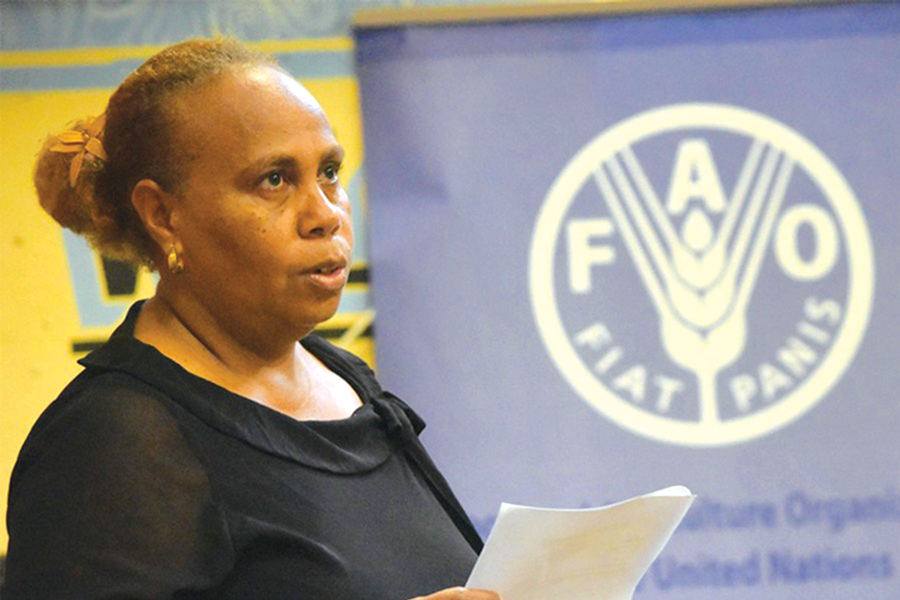
Mrs Rosemary Kafa

BY LYNTON AARON FILIA

Mrs Rosemary Kafa

THE Food and Agriculture Organization (FAO) has been working with the Solomon Islands Government on ways to sustainably manage our forest.

In an inception workshop with Guadalcanal provincial leaders on Wednesday 23 May 2018, Mrs Rosemary Kafa from the FAO assured provincial leaders they have been working with the SIG on a project that relates to conserving forestation.

Mrs Kafa said FAO is a United Nations Institution with a mandate to work on forestry, agriculture and natural resource management.

She said FAO under its Forestry Department has set mandate to support member countries to implement sustainable forest management by providing policy advice, technical knowledge and reliable information.

This was mainly meant as contribution towards forest and trees to sustainable livelihood, she said.

Mrs Kafa said for the Implementation of the project, it is mainly focus on addressing issues such as climate change mitigation. This is through a measure designed to enhance forest carbon stocks and increase adaptability of communities.

The project also looks at capacity gaps in biodiversity conservation, sustainable land management and sustainability forestry management.

“Conservation and protected area management work is very important for Solomon Islands, and it is anticipated that lesson learnt and experiences from other project of similar nature will be shared with Solomon Islands through FAO in-country and regional activities,” she said.

Mrs Kafa adds cooperation by stakeholders and communities are crucial for the successful implementation of the project.

She says FAO will continue to support SIG and its citizen in sustainable development and management of its natural resources through their technical team based in Apia and Papua New Guinea.

Permanent Secretary for the Ministry of Environment, Climate Change and Disaster Management Dr Melchior Mataki acknowledged the project partners in the country who are targeting forestry and climate change issues.

SIELA conducts Policies and Legislation workshop for HCC

0
Facilitator, Ms Mauli and co-facilitator, Mr Lappy Hite speaking to HCC heads of divisions.

BY LORETTA BRIGIDIA MANELE

SOLOMON Islands Environmental Law Association (SIELA) yesterday proceeded into the second day of its “Policies and Legislation Workshop” for Divisional Heads within Honiara City Council’s (HCC) Management.

The workshop is tailored to provide information on environmental-related laws from SIELA including the participation of partner and enforcement agencies namely; the Ministry of Environment, Climate Change, Disaster Management and Meteorology (MECDM), the Ministry of Fisheries and Marine Resources (MFMR), the Ministry of Forestry and Director of Public Prosecution Office.

HCC Heads of Division working in groups.

It seeks rigorous discussions and group activities to better understand the roles of Honiara City Council and identify possible partnerships and collaborations that link the different legislations with the work of the council.

It was in the workshop that Mr George Titiulu, HCC’s Head of the Environmental Health Division talked on offences under the Pure Food Act 1996.

He said that offences under the Act include; the display of expired goods, mandatory labelling and unhygienic conditions of eating outlets.

Facilitator, Ms Mauli and co-facilitator, Mr Lappy Hite speaking to HCC heads of divisions.

Mr Titiulu said under their power, they can seize goods, condemn them, enter places and demand closure and investigate issues.

The penalties for these offences as he explained are; a fine of $1000 for a first time offence, $1500 if the offence is still committed the second time around and $2000 if the offence continues to be committed.

Mr Titiulu stated that recently they had to close down a number of eating outlets because they committed the offence of operating under unhygienic conditions.

Mr George Titiulu notes down discussed points as fellow HCC offical looks on.

He mentioned that one of the challenges they have come across is the issue of foreign food labelling.

Mr Titiulu said collected fines from offences under the Pure Food Act 1996 when totaled almost reach $100,000.

Meanwhile, SIELA chair and facilitator of the workshop, Ms. Senoveva Mauli expressed that it was a first time opportunity for some of the participants.

“We note, the important role of this agency and are keen to continue this partnership”, she said.

The workshop which kicked off on May 23rd will conclude today with focus on group activities involving Honiara City Council’s (HCC) enforcement team.

St Nicholas seniors enjoy a glimpse of Taiwan and Mandarin phrases

Ms Li with one of the students.

BY LORETTA BRIGIDIA MANELE

Ms Li with one of the students.

ON May 18th, St Nicholas College students spent their afternoon learning a language spoken by 1.2 billion people across the globe, Mandarin.

SINU’s Mandarin teacher, Ms Li Kuei-Mi expressed that the students were quick learners who were eager and happy to learn.

Students were made to understand the Taiwanese culture and language through presentation of videos and interaction that involved singing Mandarin songs and each having a go in belting out Mandarin phrases which they learnt in just two hours.

One of the students, Victoria Piva said the day’s activity was very interesting and meaningful because she enjoyed it.

She adds that after watching the video clips she is now motivated to learn Mandarin. In doing so she will also learn a new culture.

Another student, Yan Shuyee, spoke of how fun and enjoyable the presentation was.

Meanwhile, fellow student, Bronwyn Townshend also found the presentation interesting and she enjoyed seeing different things from a different culture.

The school’s Science teacher, Mr Samuel Avui said that through the awareness activity they discovered the language and cities in Taiwan.

“I have learned something new, culture, and big cities, landscape is good, I have learned a lot of things. My favorite part is the singing in Mandarin language”, he said.

Eddie Raru who is a Malaria technician at GPPOL is one of Ms Li’s students who assisted her throughout with the lessons she carried out.

He said this activity is helpful for the students.

“Because we have to make them aware what’s going on, you need to go to more schools, to let more students know what Mandarin is. I study Mandarin because I wanted to know different life styles from different countries, I think it’s another gateway to go further in life or in career” he said.

School Principal, James Lengi stressed that it is in the school’s interest to have their students speak different languages as learning languages develops critical thinking.

“We all understand very well what Asia is to the Pacific in terms of business, economy, politics, etc., now that we have common ground, we need to understand each other, in order to do so, we must learn different languages available to us”, he said.

Ms Li stated that she is grateful the Principal had accepted her request for this activity.

She said although activities were conducted in the afternoon, the students were still enthusiastic in the presentation.

“These students are quick learners, eager and happy to learn, three of them have even prepared and performed a Mandarin song, that’s very impressive”, said Ms Li.