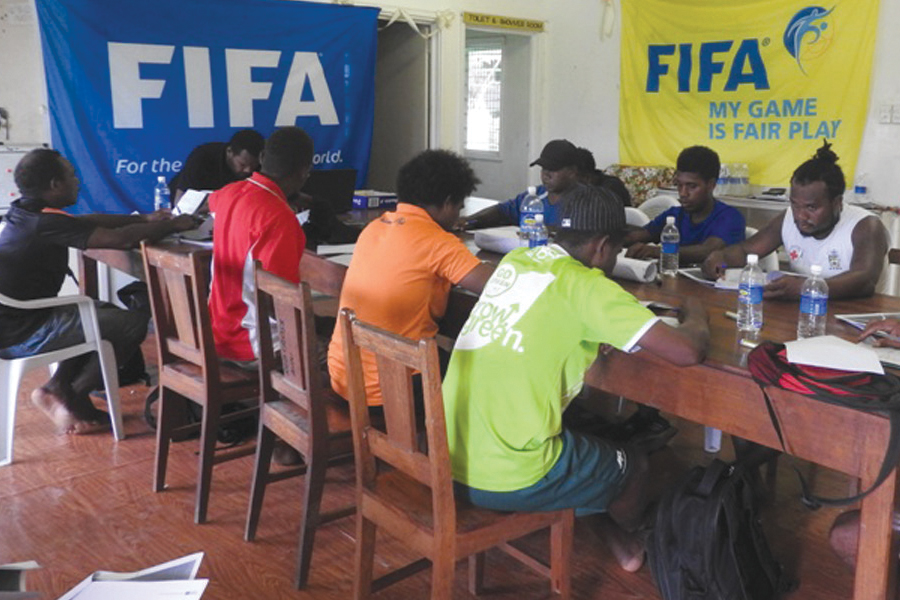
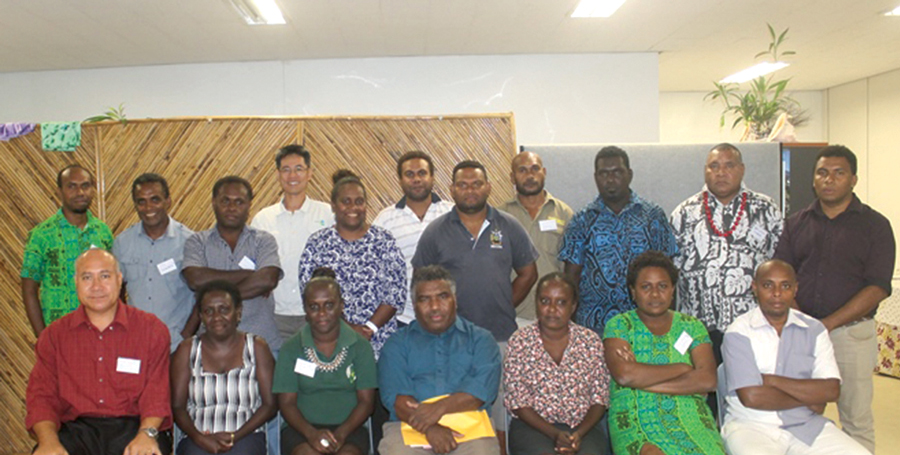
Local futsal coaches attending a futsal coaching session currently underway in Auki.
BY SAMIE WAIKORI
Auki
Local futsal coaches attending a futsal coaching session currently underway in Auki.
A four days Oceania Football Confederation (OFC) futsal coaching training is underway for futsal coaches in Malaita Province.
The workshop is being held in Auki and is conducted by Solomon Islands Football Federation (SIFF) Futsal Development Officer Jerry Sam.
Sam said the main objective of the training is basically to aid futsal coaches in Malaita understand their roles regarding session planning.
“I do believe that coaches are the key in a team and if they don’t understand session planning there’ll be no training session.
“And this training will also enable coaches to make proper planning when looking after their team.
“It requires that coaches must at all-time plan ahead or prepare for training session with their players,” he said.
Sam emphasised on session planning as the main topic covered by the course and holds a lot of importance in any coaching, either football or futsal because it holds the idea you can tell a team.
The training also covers the roles of coaches.
Sam said the training is level one OFC certificate course and participants are expected to be issued with certificates upon completion.
The training began on Monday and will conclude on Friday 1st May.
Participants attending the workshop include coaches representing various futsal clubs in the province.
The training is being made possible following a request made to SIFF by Malaita Football Association (MFA) due to growing popularity of the sport in the province.
THE proposal for a new rural training centre could lead to an upgrade of the Global Harvest School in east Honiara.
This was highlighted by Pastor John Hugo of Global Harvest School.
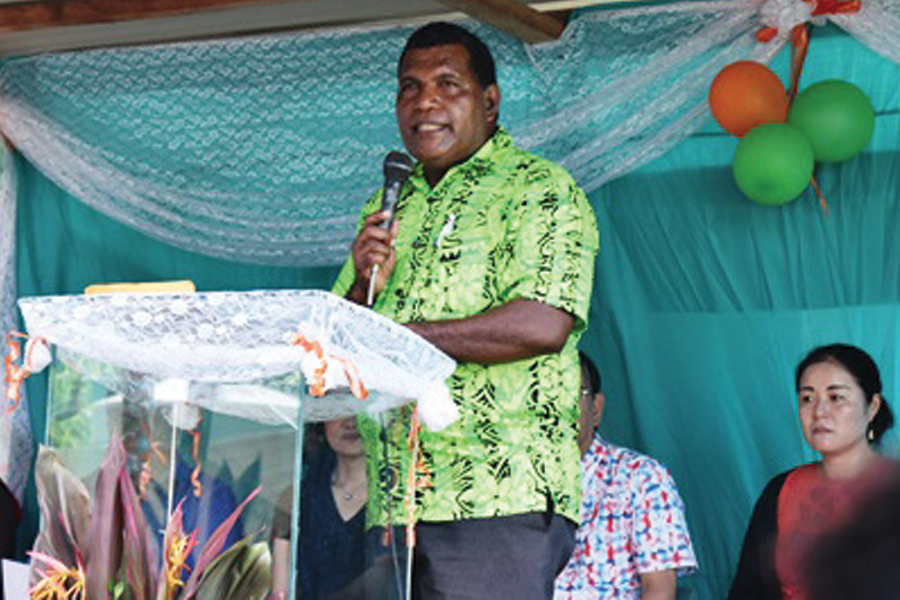
Speaking during the official handover of a newly built six room double storey building classroom for the school at Gilbert Camp, Pr Hugo says this could be seen as a dream but he would like to pose it as a challenge for stakeholders to envisage such development aspects to cater for everyone, whether in the formal or informal education sector.
He said with the presence of key SINU and MEHRD figures, this could someday pave way for new developments in education within the vicinity or even within the bounds of Global Harvest School itself.
He believed that such dreams when coupled with similar visions as that of the Japanese Government could really enhance the Human Resource development aspirations of Solomon Islands in the years to come.
With such aspirations Hugo said once established, vocational education and training (VET) will aim at creating opportunities for productive employment and providing access to adequately paid work, which enable people to lead a self-determined life.
“It also helps to implement the right to work.”
He also stated that education is also seen by most as a major catalyst.
Thus, a focussed and coherent vocational education and training policy can make a significant contribution to gender equity and job creation as well as to health and environmental improvements.
He adds, for some years now, there has been renewed interest in secondary and tertiary education.
“This demand results from the outcomes of primary education, which has placed heavier pressure on secondary educational systems, because a growing number of primary school-leavers are entering the labour market directly or need further training.
“The steady growth of the informal sector is also coming to the attention of international education-policy debate.”
THE Barana National Nature Park will change the face of its society and become an attractive environment, which has been lost with activities of deforestation.
It has been years, the Barana community of the Central Guadalcanal province has lost its beautiful flora because of logging and timber milling.
Now the community of Barana have their eyes open to see the importance of turning into a park as an effort to restore its forest and generally the environment.
Currently main activities taking place there is timber milling and logging including gardening, mainly people from borderline area.
With the initiative of the Secretariat of the Pacific Regional Environment Programme (SPREP) to establish a National Nature Park, it’s a welcome approach for the community for preserving forest and environment.
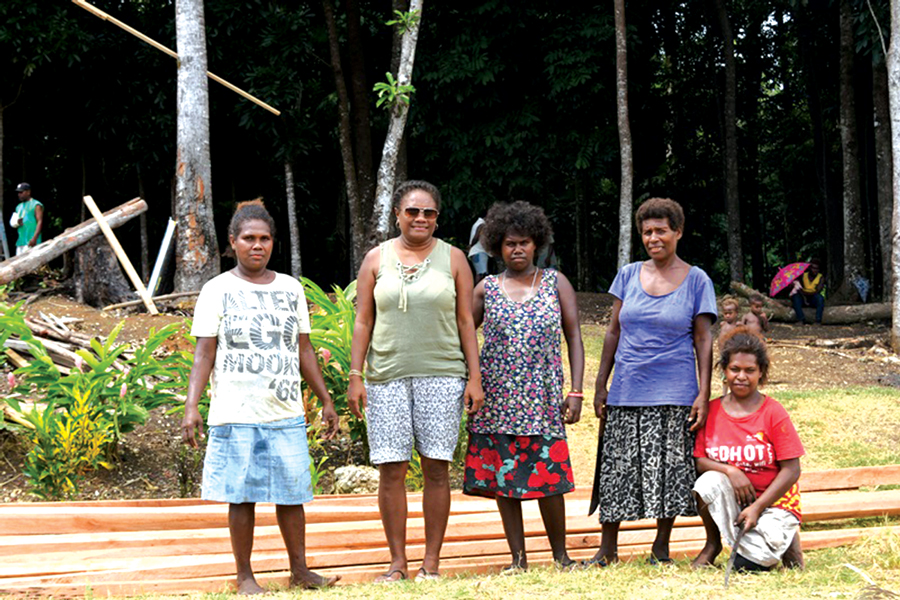
Vice Chairlady for Barana SPREP Coordinator Committee Ms Melinda Kii said the national park will also include those who are actually milling to educate them on reforestation.
She said they will have a common understanding with the timber millings and loggers – if they cut down one tree, then replant with one to three trees.
She adds, having this common understanding helps sustainability of the environment and preservation of flora to keep the park appealing for citizens and oversea travellers.
People from the Green Valley, Adaliua and Borderline do their gardening around the proposed national park which is another challenge.
Kii said such is dependent entirely on whoever holds that piece of land.
But she said they have one general understanding as to relocate them or give other blocks of land on the park for them to do their farming.
She said their gardening also plays an important role towards the national park; if people access the premises can do their marketing for garden foods fresh from the ground.
Kii said the community will benefit a lot from this initiative.
She said SPREP’s project is a community based initiative, and there will be trainings, workshops and tanks given to the community at large.
WORK against the coconut rhinoceros beetle (CRB) is picking up pace.
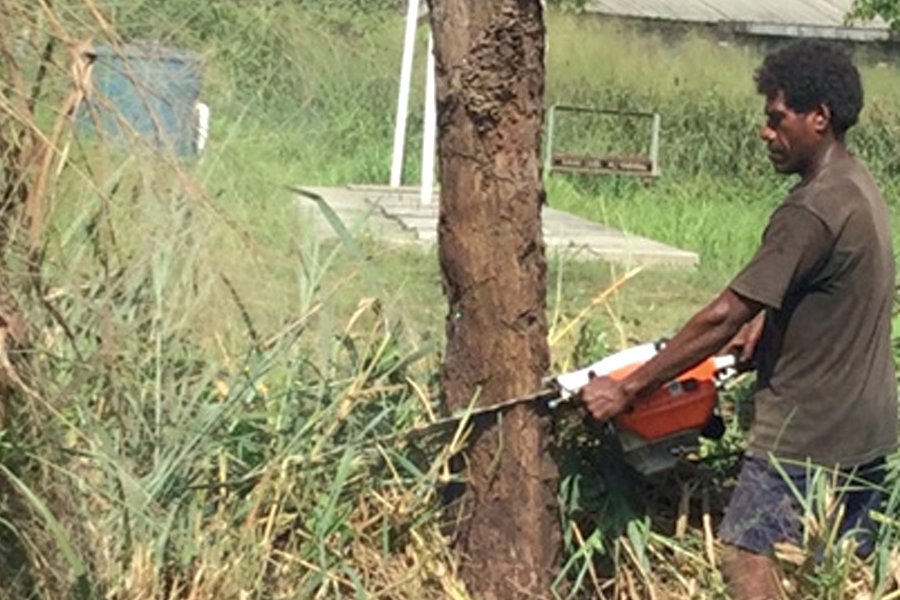
Led by the staffs of Biosecurity Solomon Islands (BSI), they have begun work on cutting down and destroying dead and rotting palms in and around Honiara, beginning in the land around Henderson.
It will soon move into town and from which then will be extended to infected rural areas over the next few months.
While on operational, BSI is requesting everyone to cooperate with the workers and help them access the rotting trees and logs, as they are the primary breeding site of the Coconut Rhinoceros Beetle (CRB) as easily as possible.
Since the only way effective to manage CRB populations is to reduce the number of beetles attacking palms and slow down the spread to new sites, it is essential that all potential breeding sites are destroyed.
All dead standing palms will be felled and all palms lying on the ground will be cut up and removed for destruction, and once owners want to keep logs for personal use this will be permitted but it will be the responsibility of the owner to check the logs for rots and larvae periodically.
It is equally the responsibility of all householders to check all other potential breeding sites (rotting vegetation, compost and chicken manure) and kill any larvae found.
Coconuts
All these sites should be turned over each month to expose any larvae within.
These larvae must be killed straight away.
Already large numbers of larvae are being found at the tops of the dead palms.
Frequently as many as 40 larvae of different life stages have been collected from the top one metre of palms.
This means a palm of 10 metres in length could lead to the emergence of more than 400 beetles.
Ms Melinda Kii with the women of the Barana community with background of the propose National Nature Park
BY LYNTON AARON FILIA
Ms Melinda Kii with the women of the Barana community with background of the propose National Nature Park
SOLOMON Islands’ World Environment Day will be celebrated in the Barana community with the opening of the Secretariat of the Pacific Regional Environment Programme (SPREP) Administration block.
This is the first time in the history of Solomon Islands that a global event such as World Environment Day will be celebrated with rural people particularly the Barana community of Guadalcanal province.
The event is celebrated globally under the theme “Beating Plastic Pollution”.
The SPREP Admin Block opening also coincides with the celebration, a site visit to the proposed National Nature Park located at the Barana’s hill top.
Site preparation is going well with support from the Ministry Environment, Climate Change and Disaster Management, Guadalcanal Province, and SPC and inputs from the community.
Vice Chairlady for Barana SPREP Coordinator Committee Ms Melinda Kii said Barana community is privileged the World Environment Day will be celebrated there.
She said the event is a half-day programme but the Barana community is thrilled to host the World Environment Day in their community.
“It’s a pride for us that the global event had happen at our community level which involves rural people and this makes us feels part of the global event, and we want to make best out of it and a memorable one,” Ms Kii said.
She thanked the government and stakeholders for choosing Barana to celebrate the world environment day and take time out to spend it with the rural people.
The event will educate people to understand the significance of the environment and ideas of replanting and conservation.
Awareness on plastic and rubbish management will also be conducted and ways to keep natural environment maintain its flora, she adds.
Barana women are ready to put on traditional performances with primary students joining the Solomon Islands Scout Association for a parade and flag rising.
The event will also include planting of trees in three attractive locations that embrace astounding views to the mountains, valleys, Honiara city and ocean.
THE Gizo-Raru local fishers association constitution is expected to be launched tomorrow in Gizo, Western province.
All fishers around Gizo and Rarumana Island are welcome to participate in the day’s activities.
Chairman Amon Tauman said the launching will be held at the Gizo main wharf area starting at 2pm.
“All fishers around Gizo and Rarumana Island are welcome to participate in the day’s activities. Registration for membership will be open and for fishers around Gizo and Rarumana Island subscription fee is $50.
“Other interested fishers group from other Islands affiliation fee is $100.”
Activities for the day include a float parade from Malakerava, PT109 to the wharf area. Losa’s Band and Tamure group will also be performing.
He said awareness on the overfishing problem, fishers’ registration and information on the Gizo-Raru fisheries association for sustainability fishers constitution are the highlights on the day.
CULTURE is one factor of attraction for overseas visitors, and the theme: Past Recollections, Future Connections is fitting for the 6th MSG Festival.
This is according to the Melanesian Arts and Festival’s (MACFEST) chairperson and Permanent Secretary for the Ministry Culture and Tourism Mr Andrew Nihopara.
He said this is indicated in the Solomon Islands Visitors Bureau International Visitor surveys.
With The MACFEST’s theme, Nihopara said it is very fitting for the 6th MSG Festival as our cultures are our past.
“Not only that but also country’s future in terms of how people connect with other people around us and how we connection our past, current and future generations, he adds.
“As we are in a much globalised world with many external influences, our past in terms of our cultural heritage and practices must use embraced to help shape our future directions.”
Looking at the importance of designing the theme, Nihopara said Solomon Islands cannot ignore its past, “therefore the recollection of our past determines our future with each other”.
He said in terms of tourism development such event translates as very significant for tourism development because this is a very important avenue which our own people can involve and participate in the tourism sector.
The cultural industries provide a very important avenue for our women, youth, rural and urban people to engage in some forms of formal businesses that are culturally-based, he said.
On the national level, Nihopara said culture and tourism is growing, and it has already become a very significant sector for people’s engagement.
“While this will contribute towards tourism interest, on the reverse, tourism will also help to facilitate the growth of this sector as we get more and more visitors into Solomon Islands.”
Solomon Islands are counting down the days to the festival.
Honiara is expecting approximately 2000 visitors who will be attending the Melanesian Arts and Festival commence on July 1—14.
The event will also coincide with the country’s 40th Anniversary.
UNDERSECRETARY of the Ministry Of Health and Medical Services Dr Nemia Bainivalu says his ministry is deeply committed to ensuring health of women and girls through access to proper sanitary products.
He expressed this statement at the recent occasion of the World Menstrual Hygiene day commemorated this week in Honiara.
“My ministry is deeply committed in ensuring the health of women and girls through access to proper sanitary products to women and by improving access to safe sanitation facilities for women.
“This initiative of supporting them (women and girls) to have good Menstrual Hygiene Management (MHM) with regards to access safe sanitary products is one important aspect my ministry has considered.”
He said this is to assist them (women and girls) to manage menstruation hygienically and their dignity and on how they can improve their self-confidence while contributing to their health.
“Because good menstrual hygiene is therefore crucial for their (girls and women) health, education and dignity, which requires access to appropriate material and facilities,” said Bainivalu.
He furthered, they (women and girls) also sometimes unfortunate to articulate their needs and the problems of poor menstrual hygiene management health due to the taboo surrounding menstruation in the society and the lack of information on the process of menstruation, the physical and physiological changes associated with puberty and proper requirements for managing menstruations.
He said this shows that there is a need for his ministry and its partner ministry, donors and bilateral agencies to step in and work closely with them (women and girls) to address the needs and problems of poor menstrual hygiene management which have been ignored or misunderstood by the society.
Bainivalu also underscored that beliefs and norms of family and communities with regards to menstrual hygiene management needs a change as well.
“This is because women and girls have the right to know about so many issues which touch them directly or indirectly now or later,” he said.
DR Nemia Bainivalu, undersecretary of the Ministry of Health and Medical Service (MHMS) has called on the Ministry of Education and Human Resources Development (MEHRD) to consider procuring re-usable pads and provide them at a subsidised rate for girls in every school across Solomon Islands.
He made this call seeing the importance of the Menstrual Hygiene Management for female students in every school in the country.
Bainivalu suggested that this idea can be achieved through including training programmes on the production of re-usable cloth pads in the curriculum of the Rural Training Centre (RTCs), at the Solomon Islands National University (SINU) as a training programme and at other identified locally owned enterprises to enable the MEHRD to procure these needed materials and distribute them in every school.
He said this need indicates huge potential of inter-ministerial convergence and collaboration, especially between the MEHRD, MHMS and the Ministry of Women Youth Children and Family Affairs (MWYCFA) to come together on this important issue to address it and help to achieve the Sustainable Development Goals (SDGs).
“I am willing to discuss with my counterpart in MEHRD and work a way forward and am willing to work with donors and at how production of sanitary pads can be made into a productive social enterprise benefiting our females.
“I appeal to MEHRD to seriously consider providing re-usable pads in schools may be at a subsidised rate. This will hugely improve the convenience of girls,” Bainivalu said.
Moreover, he conveyed huge appreciation to the United Nation International Children Emergency Fund (UNICEF) to have the Menstrual Hygiene Day recognised in Solomon Islands.
“I request them to provide support in raising the profile of this issue, support us with curriculum development on the Menstrual Hygiene Management (MHM) and take forward the recommendations from the study.”
Mr Saminela Fonua (far left), Mr Joe Horokou (fourth from right) and stakeholders at the BCH workshop.
BY LORETTA BRIGIDIA MANELE
Mr Saminela Fonua (far left), Mr Joe Horokou (fourth from right) and stakeholders at the BCH workshop.
THE first national Biosafety Clearing House (BCH) Capacity Building workshop took place at Kairos Conference room on Wednesday.
Officially opening the program was Ministry of Environment, Climate Change, Disaster Management and Meteorology’s (MECDM) Director of Environment and Conservation Division, Mr Joe Horokou who emphasised the importance of protecting our biodiversity against threats posed by Living Modified Organisms (LMOs).
Initially, he stated that Solomon Islands ratified the Convention of Biodiversity (CBD) on October 3, 1995.
“In addition to the umbrella agreement, the CBD elaborates its obligations relating to biosafety in the Cartagena Protocol on Biosafety. The Biosafety Protocol was adopted by the CBD COP in 2000 and entered into force on 11 September 2004.
“Solomon Islands ratified and signed the Cartagena Protocol to the Biosafety in July 2004,” said Horokou.
He said that a major reason for the country in signing the protocol was the recognition of the importance of protecting our biodiversity against threats posed from Living Modified Organisms (LMOs) taking into consideration that biodiversity is the basis of our people’s livelihoods.
“There are emerging and existing issues that our country faced with genetically modified organism or living modified organism and it should be a concern to all of us for our livelihood and well-being,” he said.
Horokou explained that as a starting point the country has developed a Biosafety Framework which is committed to the Cartagena Protocol and more importantly to the need of having a proper mechanism in place at the national level for coordination and dealing with modified organisms (LMO) issues.
In relation, he voiced that it sets a direction through policy, legal, administrative and technical instruments to ensure an adequate level of protection in the field of safe transfer, handling and use of living modified organisms resulting from modern biotechnology.
The Director mentioned that this was developed with the consideration of the potential adverse effects on the conservation and sustainable use of biological diversity and the risks to health of Solomon Islanders.
He said that there are many grey areas that relevant stakeholders need to identify and collaborate to address if we are to move forward in finding better ways to combat issues of GMOs and LMOs in the country.
Horokou stated that this workshop is a huge opportunity for Solomon Islands to improve its capacity in areas of information sharing, access and collation.
He appealed to partner ministries and relevant stakeholders at the workshop to make the most of the workshop and learn as much as possible about the protocol and its related issues of GMOs and LMOs.
The workshop was facilitated by Pacific region’s expert in Biosafety from Tonga, Mr Samiuela Fonua.
This BCH workshop is an UN Environment project funded by Global Environment Facility.