Home Blog Page 1342

SI reassured of security by Australia

Senator Payne presenting a gift to the acting Prime Minister Manasseh Sogavare.

ACTING Prime Minister Manasseh Sogavare was paid a courtesy visit by the Australian Defence Minister Marise Payne at the Office of the Prime Minister & Cabinet in Honiara, on Thursday.

Mr Sogavare welcomed Senator Payne and her delegation who are currently on a Pacific tour to increase its engagement with its Pacific partners.

Acting & Deputy Prime Minister Sogavare took the opportunity to highlight the importance of regional security and the important role played by Australia in the region.

Sogavare also conveyed on behalf of the Government and people his acknowledgement to Australia’s leading role in the Regional Assistance Mission to Solomon Islands (RAMSI) over the past 14 years.

Acting PM Sogavare and the Australian Defence Minister during the meeting.

“We have had our share of experiences in law and order during the civil crisis. We fell but we got up again and we are grateful for Australia through RAMSI for helping us recover from the crisis,” he said.

Sogavare said Solomon Islands dared not to go down that path again.

He said in terms of security in the region, it should and it must be a joint responsibility to keep the Pacific region safe.

The acting Prime Minister also spoke highly of the South Pacific Intelligence Dialogue (SPID) held in Honiara last week which discussions had centred on promoting and encouraging peace and security in the region.

Sogavare has also raised issues on the SI/PNG border and maritime security.
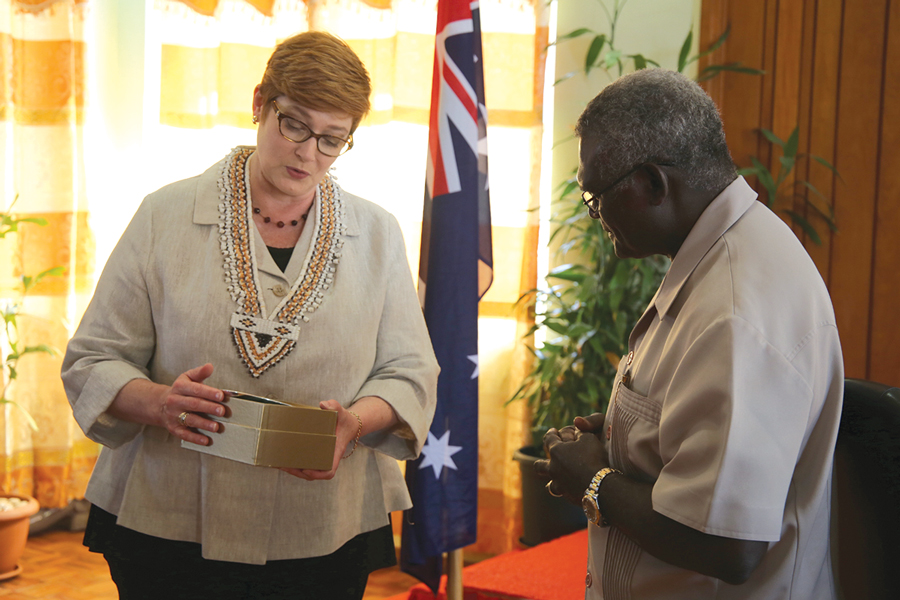
Senator Payne presenting a gift to the acting Prime Minister Manasseh Sogavare.

The Australian Defence Minister Senator Payne in response reiterated Australia’s commitment to regional security.

She said Australia will be reinforcing its security in the region.

“Australia is appreciative of the progress Solomon Islands has made in the last 14 years and the positive transformation of the RSIPF,” she highlighted.

Senator Payne also assured the acting Prime Minister that Australia will continue to work closely with the Solomon Islands in the areas of maritime security and border security.

“The partnership with Solomon Islands is very vital to Australia,” the Defence Minister said.

Meanwhile, Sogavare has also welcomed the Australia’s coast watchers initiative that is currently providing visible and physical presence at the western border.

–OPMC PRESS

Undersea cable project ‘forced down our throat’: senior official

Undersea cable

By Alfred Sasako

THE multi-million dollar optic fibre undersea cable project linking Papua New Guinea and Solomon Islands with Australia was “forced down our throat”, a senior government official has told Island Sun.

The official who spoke on condition of anonymity said Prime Minister Rick Houenipwela never consulted senior technical officers who were handling the project.

“He [Prime Minister] simply buckled under pressure from Canberra,” the official said.

“The Prime Minister never consulted us. It was after a telephone conversation with Prime Minister Malcolm Turnbull that he agreed with Canberra to block Huawei from the project. It was then that he told us to work on the new arrangement.

“You could say the project was forced down our throat. And when the boss succumbed to Canberra, we have lost our sovereignty, independence and our rights to make decision,” the official said.

Australia and Solomon Islands yesterday signed a contract to block Huawei from the project, effectively giving Canberra the upper hand in determining the pace and level of economic development for Solomon Islands.

The 4,000 km cable will connect Solomon Islands to Papua New Guinea and then to Australia. Huawei won a contract to build the cable in 2016, which so irritated Australia that its Department of Foreign Affairs offered to run a new tender and to pay for two-thirds of the link.

Reports say the decision will cost Australia’s foreign aid budget upwards of AU$100 million, with the spending designed to counter China’s growing influence in the region.

Australia’s Foreign Minister Julie Bishop has characterised the cable contract, signed during Solomon Islands’ Prime Minister Rick Houenipwela’s visit to Australia, as “a simple matter of competition”.

“We offered them an alternative to an undersea cable project, we believe it is cheaper, faster, more reliable than the competitor,” Bishop told the Australian Broadcasting Corporation’s AM programme two days ago.

“It’s a competitive world … we want them to have alternatives,” she added.

Australia’s handling of the project has drawn criticisms within and outside Australia with one questioning Ms Bishop’s claim that the network would be “cheaper, faster and more reliable than its competitor”.

“Sounds like some BS that would come from Malcolm Turnbull [Australia’s Prime Minister],” the anonymous observer said.

“I’ve never seen Australia build ANYTHING cheaper or faster than China, and if Turnbull gets his hands on it, it’ll be a 3rd world solution like his version of the NBN that Australia got stitched up with,” the person said.

Australia’s efforts in blocking anything with links to the Chinese government are not new. It is part of an elaborate scheme to keep a close eye on China’s activities in the Pacific.

Maepioh ousted in election

Former Western Province Premier Hon. Wayne Maepio

BY MAVIS NISHIMURA PODOKOLO

Former Western Province Premier Hon. Wayne Maepio

WESTERN province’s premier Wayne Maepioh has lost his provincial ward seat in Wednesday’s election.

Maepioh is currently the province’s caretaker premier.

He lost his seat by a margin of 32 votes to newcomer Mr Pitiri Sute, who won with 583 votes.

Sute succeeds Maepioh as MPA for ward 23 Gatokae.

Maepioh had taken the province’s helm from former premier Robert Kuve on August 9, 2016, after Kuve stepped down to medical reasons.

Meanwhile, deputy premier Maloney Lopoto has also lost the ward 15 Munda seat to newcomer Mr David Gina.

MACFest Committee praises New Caledonia

0
PS Andrew Nihopara

By Gary Hatigeva

PERMANENT Secretary for the Ministry of Culture and Tourism and Chair of the Melanesian Arts and Culture Festival (MACFEST) committee, Andrew Nihopara has acknowledged New Caledonia’s contribution to support the hosting of the 6th Melanesian Arts and Culture Festival.

The MacFest Chair expressed this following the fulfilment of New Caledonia’s part from a signed agreement between the two nations, under the Melanesian Spearhead Group (MSG) Cultural Cooperation Agreement, for the providence of fireworks and sound system for the event.

In an exclusive interview regarding this, Nihopara explained that this agreement has made a significant relief to the MacFest committee’s budget, as it could not afford to include the fire works within its hosting budget due to its high cost.

“But thanks to the MSG Cultural Cooperation Agreement, which was further endorsed in the Ministers of Culture Meeting in December 2017, the FLNKS through the New Caledonia Government stepped in to provide the 1.3 tonnes of fire works for opening and closing ceremonies and also for the 40th independence anniversary celebrations on the 6th of July,” the relieved Chairman further expressed.

He said the container of the donated fireworks have arrived in the country in late May, along with their technical crew, and as part of the deal, MACFEST is meeting the accommodation and food cost of the technical team of three people.

He added that also as part of the agreement, MACFEST is also meeting the logistics support for the movement of the team and the fireworks to the various locations, which vary between Lawson Tama, the Panatina Grounds and the Ports area.

He however assured that the Royal Solomon Islands Police Force (RSIPF) has taken custody of the fireworks materials since their arrival in the country for safe keeping.

“This support by New Caledonia will ensure that the MACFEST is colourful, Honiara residence will enjoy the fireworks during these important occasions and most importantly, the Festival will have the flavour of what a real festival should be,” Nihopara further explained.

Meanwhile, he added that further to the supply of the fire works, New Caledonia is also making a significant contribution under the Cultural Cooperation Agreement with a further 2 tonnes of state-of-the-art sounds and lighting equipment.

“This contribution is very significant due to the fact that given the limitation in the available budget for hiring of such equipment, the MACFEST Committee planned a huge scaling down of the need for equipment to be hired.

“The support from New Caledonia with the sound and lighting equipment again has enabled the plans to stage have equipments available at all the performance venues and stages during the 10 days festival.

“Like for the fireworks, New Caledonia is also sending in the technical crew for the set up of the sounds and lighting equipments.

“All the sound equipment will be temporarily imported into the Solomon Islands for the purpose of the Festival and after the conclusion of the Festival, the equipment will be packed into the containers again and freighted back to New caledonia.

“For the containers of fire works and sound ” lighting equipment, the New Caledonian government also meet the freight costs into the Solomon Islands and they are also meeting the backward freight of the equipment.

“MACFEST only meet all the on-the-ground costs in Honiara,” the MacFest Committee Chair further explained.

He then reiterated that with New Caledonia’s contributions, there is a huge relief of the MACFEST budget for the Committee to concentrate on the priority costs of hosting the events and the necessary infrastructure for the event to successfully take place next month.

“There will be a formal convey of appreciation to the New Caledonia Government during the 6th Ministers of Culture Meeting in Honiara on the 28th of June 2018,” he further added.

On the other hand, the MACFEST Committee is also looking forward to the assistance by the other MSG Countries in this regard under the MSG Cultural Cooperation Agreement in the coming week.

Fooling our donors

Parliament

New scheme created to return government MPs next election

BY ALFRED SASAKO

FOREIGN governments and lending institutions long known for their opposition to fraud and abuse of public funds may be unknowingly funding a scheme reportedly designed to return Government MPs at next year’s poll.

The scheme involves the creation of another monster known as the Constituency Machinery Grants (CMG) being administered by the Ministry of Rural Development (MRD).

At least some $268 million of donor funding has been transferred into the new scheme, designed to return Government MPs at the next election.

The funds were from the National Transport Fund, which this year has a zero budget.

Australia, New Zealand and the Asian Development Bank (ADB) co-funded the National Transport Fund under the Development Budget.

ADB administers the NTF in conjunction with the Ministry of Infrastructure Development. It is not clear whether these donors are aware of the scheme. Donor funding to this year’s Development Budget fell by 52 percent, causing a lot of difficulties for project funding.

The Solomon Islands Government’s contribution to the NTF this year is roughly about $40 million, but this has not been paid because there is no longer a National Transport Fund, Island Sun was told yesterday.

Instead, the government is using the newly created CMG to legitimise the use of the donor funds, a businessman told Island Sun.

“The CMG would be the vehicle to fund all infrastructure projects in each MP’s constituency, using the funds which are no longer tied down to conditions set by donors for the use of the National Transport Fund.

“These constituency infrastructure projects are then put out on tender merely as a formality. Each government MP is involved so that kickbacks from these contracts are pooled for electioneering purposes,” sources with inside knowledge of the scheme told Island Sun.

“Winners of these tenders are largely pre-determined. So if you are not connected with any Government MPs, tough luck,” one source said.

The sources said one senior politician has already begun his share of the scheme by undertaking infrastructure projects in his own Constituency without the knowledge of the Ministry of Infrastructure Development.

“This individual is using his own machinery to do the variety of projects he has chosen to undertake in his Constituency without tender. The funds being used in these so-called constituency infrastructure development projects are supposed to be closely monitored by donors.

“But it seems they are looking the other way,” the sources said.

The creation of the Constituency Machinery Grants is certain to kick a fuss amongst the public given the amount of money politicians received over the 12 years or so.

The figures below show what Transparency Solomon Islands has uncovered in its recent report. It found that:

Year     Total SIG Budget     Per Constituency (SBD)

2000     5 Million                   $100,000

2001     5 Million                   $100,000

2002     10 Million                 $200,000

2003    10 Million                 $200,000

2004     10 Million                 $200,000

2005     10 Million                 $200,000

2006     10 Million                 $200,000

2007     50 Million                 $1,000,000

2008     105 Million              $2,100,000

2009     105 Million               $2,100,000

2010     105 Million               $2,100,000

2011     105 Million               $2,100,000

2012     260 Million               $5,200,000

2013     300 Million               $6 million

2014     300 Million               $6 million

2015     330 Million               $6.6 million

2016     350 Million               $7 million

2017     325 Million               $6.5 million

Solomons at risk from plastic in the ocean

0

DEAR EDITOR, an article in the Island Sun newspaper this week gave some stark statistics on the estimated amount of plastic in the ocean which, according to the UN Environment Agency, it was claimed 13 million tones end up in the seas.

The Sun’s article went on to describe the threat plastic poses to coral, marine wildlife, to the planet and to humans.

Real evidence of the threat plastic poses to marine wildlife became evident in Southern Thailand in the past week

A small male pilot whale was found barely alive in waters close to the border with Malaysia. It was found to have swallowed more than 80 plastic bags and despite efforts by the Thai Department of Marine and Coastal Resources the whale died.

An autopsy revealed the 80 plastic bags weighed up to eight kilograms (18 pounds) in the creature’s stomach.

A marine biologist said the bags had made it impossible for the whale to eat any nutritional food.

Solomon Islands is hugely dependent of its fishing industry and fishing as a source of food but currently uses too much plastic and one must question how many marine animals are perishing already in local waters after ingesting plastic?

It is very much hoped the current review of legislation, including the Environment Act, will soon lead to practical and cost effective ways to curtail the use of plastics and begin recycling plastics currently disposed of as domestic and industrial rubbish.

I have noted moves in the right direction have begun in the Western Province and in Vanuatu

The New Zealand government recently proposed helping its Pacific island neighbours with rubbish disposal to prevent plastic pollution in the ocean and I would encourage the Solomon Islands government to get such assistance.

Yours sincerely

FRANK SHORT

Teacher absenteeism

0

DEAR EDITOR, within the last couple of weeks ago the students of Mbokonavera community high school have raised a complaint in the public media about the issue of poor and non-attendance of teachers in the classroom learning periods that contributed poorly towards the students’ academic preparation for the coming national form 3 & 5 exams for this year 2018.

The students have the right in raising those issues because they have been paying for their education as a form of school fees by their parents and guardians.

I belief this is a national issue that experienced almost in every schools nation-wide.

The non-attempt towards addressing of this matter can greatly deprive the rights of the students towards the potential and quality education that enhance future educational prosperity that also beneficial for our nation in term of trained human resources that help to mandate the welfare of the nation.

The issue of non-attendance towards classroom lesson periods without good reasons is a negligence of duty an offend that deserves some forms of discipline measures to be taken by the school administration to control such unacceptable attitudes.

It doesn’t make sense in keeping teachers that cannot perform but hold on to teaching posts as secured source of income earning while the students learning continue to be victimised.

The best option to be taken by the teachers who cannot be able to uphold the integrity of the teaching profession with poor working attitude is to resign and look for other job opportunities elsewhere thus giving replacement spaces for other potential and proactive teachers who can do better.

The school administration must understand their roles to do the right thing and that is to be proactive in its duties or else teachers may take advantages of its weaknesses that abuse the learning of the students.

The non-attempt towards addressing teachers absenteeism in our school learning environment only reflect badly on the school administrations that is non-functional and failed to up hold their roles and obligation when it comes to monitoring and discipline policies of the school that promoting quality education.

Any abnormalities that may rise in the school learning environment should be dealt and answerable by the school administration for the good of the learning of our children.

The education authorities who look after the various individual schools have to assess and evaluate the work of the school administration to make sure they perform to an acceptable standard so that the academic welfare of each school is well managed.

Those young educated elites who wish to go into teaching profession must be prepared to suffer for the good of the nation by meeting challenges such as poor teachers working condition that contribute greatly towards the poor working attitudes that affect performance of many teachers nation-wide.

The issue raised by the Mokonavera CHS students should be taken in board by Honiara town education authority to make sure teachers and administration provide quality learning deserved by the students in that particular school.


Jacob Ofasia

Talise Market

David and Goliath

Nende community celebrates victory over bauxite mining on their land


By Alfred Sasako


THEY are little known even in their own native Solomon Islands. But members of the community on the tiny island of Nende in Temotu province are today celebrating a rare victory.

An Australian-based company had just lost its bauxite prospecting licence over the community’s land.

Reports say the Nende Community has been fighting for three years to keep Pacific Bauxite out of their community. They got just that.

It is not clear whether there are provisions in the Mines and Minerals Board for an appeal.

Work by Australian exploration companies in the 1960s, and the British and Solomon Islands geological surveys up to and including the early 1980s, identified bauxite deposits in residual soils on up-lifted limestone reef platforms on Nende.

Pacific Bauxite began extensive auger drilling and pit sampling there in 2016.

Large   bauxite deposits were discovered.

Highlights of the company’s work show:

  • First phase auger drilling and pit sampling confirms extensive bauxite mineralisation at the Nendo Project;
  • Identified areas of mineralisation are significantly larger than historically defined;
  • Main area is approximately 12km x 12km and growing;
  • Average results from all samples include:
  • 21 percent Aluminium Oxide and 1.7 percent rx Silicon Oxide (for Laboratory results +40 percent Aluminium Oxide & <5 percent rx Silicon Oxide)
  • 35 percent Aluminium Oxide and 4.22 percent tot Silicon Oxide (for Field XRF results +40 percent Aluminium Oxide & <7 percent tot Silicon Oxide
  • Deposit exhibits average depths of +3 metres, with some areas +6metres
  • Strong public support for Project activities – ongoing community engagement and awareness
  • Pacific Bauxite is targeting high-quality bauxite amenable to direct shipping and low-cost development

The results were announced by the Australian Stock Exchange (ASX) on July 7, 2016.

At the time it said it identified the presence of widespread high-quality bauxite mineralisation over a large area on the western end of Nendo Island.

The main target area presently defined by this work is approximately 12km by 2km and remains open to the east, within similar terrain.

“Results indicate the tenor of [Aluminium Oxide] content is fairly consistent, with little variation throughout the soil profile.”

“Importantly, results show that mineralisation has low impurities and low reactive silica content,” the report said.

“The Company believes there is good potential to identify large areas of high-grade direct shipping bauxite mineralisation within the Project area.”

Field XRF Results for Al2O3

“The result of the Company’s initial phase of reconnaissance exploration attempted to cover as much ground as possible in the shortest period of time, without a particular focus on areas of potentially higher grade mineralisation.”

On May 19, 2016, the Australian Stock Exchange announced that Pacific Bauxite had commenced field work at the Nendo Bauxite Project.

The exploration program formed part of the due diligence process for the Company’s option to acquire a 50 per cent interest in private company Eight South Investments Pty Ltd. Eight South, formerly Au Capital Mining Pty Ltd was the holder of the mineral tenure over the Project.

A condition precedent of the agreement with Eight South is that the initial exploration activities completed by Pacific Bauxite identify the capacity for the Nendo Project to host resources of a minimum eight million tonnes of bauxite at greater than 45 percent total Aluminium Oxide and less than 5 percent total SiO2 (Silicon Oxide or silica).

Pacific Bauxite’s recent phase of exploration included sampling of hand-dug pits and hand-auger holes to test the residual soil profile in areas historically identified as favourable for bauxite deposits.

The Company said then that its personnel have worked closely with the local people to identify areas of high-quality bauxite which are amenable to low-cost development.


Practice parliament for women opens

0

BY BARNABAS MANEBONA

MORE than 50 incumbent, intending and aspiring women candidates filled the National Parliament yesterday for the opening of the five days “Practice Parliament for Women” program.

Tim Breese the Acting Commissioner of the New Zealand High Commission in his opening speech asked what is the value of more women in parliament.

“More women in government equal better government.

“Governments are more open, free, transparent and successful with more women,” said Breese.

Speaker of Parliament, Ajilon Jasper Nasiu, being one of the key addressors during the opening program welcomed the women participants with great enthusiasm and confidence that in the near future, together, will be breaking the glass ceiling open in Solomon Islands.

The opening program was also addressed by HE Mr. Shigeru Toyama, Ambassador of Embassy of Japan, Ms Azusa Kubota the UNDP Country Manager, as the key note address was given by the Speaker of Parliament.

“This is our place and we should be here,” said Rose Liata, participant and Provincial Minister for Women in Malaita Province.

“The only barrier is culture, and when our people are educated on their constitution and the role MP’s should be playing as helpers to their communities, the barriers will break down,” said Mrs Liata.

According to Vois Blong Mere Solomon (VBMS) in their Press Release yesterday, it is an exciting time for women’s representation in parliament as the afternoon session featured a Panel discussion with Honourable Freda Tuki and the newly minted Honourable Lanelle Tanagada.

Mrs Tanagada’s election marked first time two women having held seats, concurrently, in National parliament.

“Be the voice for the voiceless, be the one who will touch lives, be honest, be humble and maintain your integrity,” Mrs Tanagada implored the participants.

“We must be the voice for the voiceless, champions of our women and the vulnerable.”

The five days program will educate participants in election procedures, ethical campaigning, working with media, good governance, separation of powers, law making processes and Parliamentary procedures.

Practice parliament is the work of a coalition of Solomon Island’s women organisation’s as well as UNDP, the High Commission of New Zealand and Embassy of Japan.

“Women’s rights organisations, like WRAM, are preaching equality of opportunity. We want credit to be given where credit is due. We should not select a man over a woman just because he is a man,” Pionie Boso the Practice Parliament for Women Working Committee member and WRAM Program Manager said.

“Rigid gender norms, traditions, structural barriers and stereotyping have blocked gender equality for too long.”

“Our participants are strong and capable women. It is pleasing to see that we have a few young women and girls here as well, young women who are keen to learn and skill themselves for the Future.”

“Solidarity is an important factor here. By bringing these women together, we hope to strengthen their resolve to be the change so many of us wish to see in our country.”

If one would like to see the participants in action, the Practice Parliament will conclude with a public debate on the Environment Act 1988–‘RESOURCES AND INCLUSIVE DEVELOPMENT’, starting 8:00am Friday at the National Parliament.

My mission fulfilled: Marasinghe

0

BY LYNTON AARON FILIA


SINU’S Acting Vice Chancellor Professor Basil Marasinghe has finished what he had come to do for the new institute.

Marasinghe said his three-year contract with the Solomon Islands National University is now lapsed and he is in Australia as a happy man who had contributed successfully to SINU.

“My Mission was to convert a College of Higher Education to a fully pledged University has been fulfilled.

“This achievement was made possible by commitment and support of academic and non-academic staff, hardworking senior managers and support of students.”

Marasinghe said although SINU was given university status on January 1, 2013, when he arrived in June 3, 2015 for practical purposes, it was still a Solomon Islands College of Higher Education (SICHE).

He explained during the first three years not a single new academic programme or a significant infrastructure project had commenced.

Given the duty as Acting Vice Chancellor from 2016—2018 there are tangible developments seen because of the team work of SINU board and staffs throughout.

Marasinghe said from 2016—2018, 30 new academic programmes were introduced followed by 10 bachelor’s degree programmes offered at SINU.

20 percent of academic staff are abroad conducting studies leading to masters and doctoral degrees.

Some staff are studying online and SINU pays their fees. Some other staff are conducting research leading to PhDs in SINU.

Now SINU conducts postgraduate degrees in emergency medicine and also in health.

In terms of development projects of infrastructure and students amenities, Marasinghe said nearly 20 projects commenced during the last two years and most of them have been completed and others are nearing completion.

Fisheries Complex commenced, completed and declared open, and although this project was largely funded by South Korea, SINU too had to spend $10million, he said.

The science, teaching and research complex is expected to be by end of June which completely funded by SINU, he said.

Education Complex—this world class facility is fully funded by SINU (SBD120.0 million); it will be ready in 3 months before the scheduled date.

Students amenities development includes study huts built for every school, 12 computer labs set up for five schools and Panatina Pavilion now refurbished.

Dormitory in Ranadi Campus which has not been used for over 5 years has been refurbished.

Fences for Panatina and Kukum Campuses almost completed except where there are issues with illegal settlers, and fence at the Ranadi Campus has been completed.

Library for Panatina Campus is ready, and funds have been allocated and contracts haven signed to refurbish dormitories in Panatina and Kukum Campuses.

Funds have been allocated to purchase new beddings for dormitories.

He said it must be noted that in most of the universities in the Pacific region and in the world, beddings are not provided and students have to bring their own beddings. 

“When I arrived in SINU 3 years ago, occupancy in dormitories was less than 30 percent now all the dormitories are fully occupied but we will have to build more dormitories soon,” he said.

Until 2016, SINU Accounts have never been prepared and sent to be audited by Auditor General.

Now   the accounts from 2013 – 2016 have been audited by Auditor General. 2017 accounts will be forwarded to AG shortly.

PAYE taxes to the Inland Revenue have not been paid since SINU was given university status.

This has been done and now and SINU is up-to-date with PAYE taxes.

Assets of SINU have been done now by registered assessors (which was never done since SICHE days).

Preparing Annual Reports from 2013 to 2017 are done.

For the first time Students Handbook was published in 2017.

Students gave their fullest cooperation to the management and they are appreciative of infrastructure and students amenities developments.

For the first time since SICHE days a students’ protest and a strike ended in a total failure.

The overwhelming majority of the students rejected recent calls for boycott of lectures and the situation in all three campuses has been peaceful.