DEAR EDITOR, further to my recent letters in the Solomons media concerning transnational drugs trafficking occurring in neighbouring island states, it is reported today, Monday, 30 July 2018, by Radio New Zealand that another huge seizure of cocaine with an estimated street value worth $US 20 million was found in Fiji.
Quoting Radio New Zealand – 30 July 2018. “Fifty-three bars of cocaine, with a street value of more than $US20 million, have been found in Fiji
“Police commissioner, Sitiveni Qiliho, said the discovery was on the northern island of Vanua Levu.
“Brigadier General Qiliho says 58 bars of cocaine have also been found on two islands in Tonga and they are the same quality as the caches found in Fiji.
“He says worrying quantities of methamphetamine have been found in Fiji since January.
“It’s the third multi-million dollar drug bust in Fiji this month.
“Fiji and Tonga sit on what’s been dubbed a narcotics highway between the Americas and Australia and New Zealand.” Copyright @ 2018, Radio New Zealand.
LEADER of a team from the International Monetary Fund (IMF) that has been conducting consultation in the country over the past week says the government needs to re-look at the number of scholarships it issues yearly.
Deputy Division Chief of IMF’s Surveillance Policy Division, Ms Alison Stuart, made this comment yesterday.
Stuart said the size of spending on scholarships is an issue.
She revealed the fact that it accounts for two-thirds of the education budget for 2017; this spending scale is huge compared to other countries when talking about students the government sends abroad for study.
Stuart said some good criteria need to be in place so that few selected students sent abroad achieve high completion.
She said there is a need for greater focus on primary and secondary education, as it appears primary and secondary have been given less priority.
Stuart said beside the Constituency Development Fund and the National Shipping Grant, scholarship remains high while the development budget has seen a sharp cut.
She added there is a need to re-direct spending in the 2019 budget to priority areas in line with the country’s National Development Strategy with the aim to cut spending on CDF, shipping grant and scholarship.
PERMANENET secretary of the Ministry of Culture and Tourism Andrew Nihopara says finance and limited resources are key challenges that hinder the growth of tourism sector in the country.
Nihopara was making reference to a report which noted that of the 160 accommodation providers operating in the country only 10 percent can be sold to overseas wholesalers by the Solomon Islands Visitor Bureau, as 90 percent fall well below international standards.
He said his ministry is rolling out the Minimum Standard platform to upgrade accommodations.
But, he said it depends on the availability of funding and resources to support the programme.
He explained that the cost and logistics of getting around to some of our beautiful but very remote areas is very high.
Nihopara said it is essential that the focus on the roll-out of the Minimum Standards targets facilities that are already attracting or hosting tourists and other important guests.
“This is important because we would be focusing on upgrading existing businesses that are already playing in the market.
“We would like the upgrades to be executed through partnership between the Ministry and the operators through some cost-sharing arrangements that would be mutually agreed to.”
He said having upgraded accommodations that meet globally compatible minimum standards is crucial.
“In order for us not to confuse our visitors and also to increase the competitiveness of types of accommodations that we have on offer.”
He said the main objective of having good standard accommodations is to ensure that visitors or clients are not dissatisfied with their stay while in the country.
“Having standard accommodations ensures that we are offering rooms that meet the minimum expectations of our customers and charged at a reasonable rate. Customer satisfaction and enhancing our competitiveness are two crucial reasons why having accommodations that complies with the minimum standards is important.”
The Aoke/Langalanga MP and BLC Chair, Matthew Wale in Parliament during Monday’s debates, cautioning the government of the need to see Whistleblowers are guided and groomed to take take up responsibilities as party implementers to the Anti-Corruption Act.
MEMBER of Parliament for Aoke/Langalanga and Chairman of the Bills and Legislation Committee (BLC), Matthew Wale has urged for the government to see that those charged with the responsibility to be whistleblowers, are properly equipped with laws and regulations that are relevant to the purpose of reporting acts or related matters to corruption.
This the Aoke/Langalanga MP highlighted when contributing to the debate session of the Whistleblowers Protection Bill 2016, currently being before parliament for deliberation.
With the call for equipping of whistleblowers, Wale said this should include thorough trainings and awareness in the context of Solomon Islands constitution, to relevant acts, to regulations and ordinances, and organisations’ structural policies.
He said the call is a matter that the government must take into serious consideration as it is evidently clear that a lot in government ministries do not have a clue of most or all the laws and regulations governing the system.
He said over the years, during inquiries into various standing committees of parliament, he has been very impressed with what he described as, “the lack of in-depth in the knowledge of many senior public officers about their responsibilities under the constitution and the various laws charged to their departments”.
“In each ministry sir, it is very important for all officers to have an in-depth knowledge of all the laws and regulations they are tasked with implementing.
“When an officer is transferred to another ministry, Mr Speaker, it is important that that particular officer undergo training to quip him or her with in-depth knowledge of the laws that the new ministry he or she moves go and is also charged with implementing,” the Aoke/Lanagalanga MP pointed out.
He added that a Whistleblower is supposedly a person within an organisation or agency with knowledge of illegal, unethical or corrupt conduct in that agency and is willing to expose that conduct, and such a person has a higher loyalty to the constitution, the laws, the values to public trust and principals that government is founded on.
“It is important that there’s training so that public officers better understand the constitution, the laws, the mechanism and process and the boundaries that must b respected in their particular government agency.
“So it is also important that all public officials are trained to understand, respect and protect the public trust placed in government.
“The whistle blowers higher loyalty, Mr Speaker is to the public’s trust in government,” the BLC Chair reiterated.
Wale further added this higher loyalty demands that when those possessing and exercising government, and public office and statutory powers, when they abuse, misuse or otherwise misdirect such powers, that such conduct is reported to law enforcement for investigation and prosecution.
He further pointed out and stressed that by equipping the mandatory or authorised whistleblowers with thorough training, or training, it should be able to give them thorough knowledge of applicable laws.
He then highlighted that in this way, public officers will be more likely to see clearly when breaches occur, and then are able to report them, and that he said, makes good governance and effective laws, especially with the Anti-Corruption Act, which aims to help the country fight corruption head on.
The Whistleblowers Protection Bill 2016 was laid on the floor for debates yesterday and resorted into the Committee of the Whole House, but committee proceedings were suspended and Parliament was adjourned.
Parliament according to its provisional order paper, will resume this morning with a Question and Answer Session before going straight into a highly anticipated, whole day of committee proceedings of the Bill.
The house is also expected to receive the second reading of the Strata Titles Bill, which the government is hoping to have it debated, laid before the Committee of the Whole House, and put for its third reading by Thursday.
TRAFFIC offences recorded in Honiara have decreased to 21 cases from July 20 to 26, 2018.
This is compared to 77 cases during the previous week.
“It’s good to see that traffic incidences decreased from the previous week recording a decrease of 56 cases,” says Director National Traffic Department, Inspector Brian Surimalefo.
“Apart from other offences careless driving seems to be an issue here. For this reporting week we have charged eight offenders for careless driving.
“We are starting to experience drivers driving too fast given the good road conditions. I urge vehicle drivers to drive with care and with safety.
“We will continue to carry out our duties on our roads, and I want to remind the general public to continue to work together with us.
“Abide by our traffic laws, they are imposed to safe guard us. By doing this we will have safer roads for our communities.”
AUSTRALIA is supporting the Solomon Islands Government in a SBD16.6 million upgrade of its Financial Management Information System.
Australia funded the initial roll-out of the Financial Information Management System in 2011 which has led to significant improvements in the delivery of government services.
This includes the automation of payment and financial reporting processes, and more timely access to accurate financial information for the Ministry of Finance and Treasury and line ministries.
Deputy Prime Minister and Minister for Finance and Treasury, Manasseh Sogavare said, “We are grateful to Australia’s ongoing support to strengthening public financial management.
“The upgrade will bring much needed improvement to government business processes across whole of government which will lead to improved service delivery.”
Upgrading the Financial Management Information System will have many benefits for a range of Solomon Islanders.
The upgraded system will be designed to meet the government’s financial business processes and help to automate and improve the efficiency of these processes.
It will also make financial information more readily available to line ministries, and be more secure and user friendly.
The upgraded system will improve interface with other SIG information management systems such as Customs asycuda and Inland Revenue management system and transport management system.
This integration will allow for quicker processing times for customers.
The Australian High Commissioner, his Excellency Roderick Brazier noted ‘we’re happy to support this project as it fits with the Australian Aid programmes’ support to public financial management and will enable the government to more effectively deliver services to all stakeholders.
The project will be implemented over three years, with the upgraded system to go live in 2020.
THE International Monetary Fund (IMF) has expressed concern over the lack of transparency around the Constituency Development Fund (CDF).
This is the second time the IMF raised concern about the fund, largely contributed to by the Republic of China (Taiwan).
A team from the IMF has been in the country holding discussions on the 2018 Article IV Consultation.
Announcing some of their key finding, team leader Mrs Alison Stuart, said what the CDF is spent on and how well this fund is spent is not clear to the people.
Stuart said while it is important that this fund helps rural areas, it’s hard to know how effective it is being used.
She said greater transparency of the CDF would improve accountability and help identify remaining gaps in the provision of services to the rural areas.
Stuart encourages the government to follow principles that are already set out by the Commonwealth.
Among other things, these principles include transparency of fund and accounting for how the fund is used.
She said following Commonwealth principles can help everyone to understand if this fund is utilised well.
Stuart said this will help provincial, national and donors to see what level in the service provision gap that needs to be filled.
“Since there is no transparency in this fund and so it is difficult to see how fund is used,” Stuart said.
She said if there is transparency, issues around how funds are used can be alleviated.
CDF is used in other economy. It is an alternative method of delivering services to rural areas. This fund is higher than what goes through the provincial government.
Stuart said the CDF Act needs to be passed in parliament so as to help address some of the issues around this fund.
THE newly formed provincial government of the Western province is proving it’s here to act and not merely talk, with its latest announcement that illegal card games will be banned across all ‘government controlled areas’ in the province.
The law comes into effect tomorrow, August 1, 2018.
This decision hits hard for many who are engaged in the practice, which is usually disguised as fundraising activities.
This includes Korovou in the Shortland Islands, Gizo, Ringi, Poetete, Noro, Munda and Seghe.
Western provincial secretary Jeffery Wickham told Island Sun Gizo yesterday the Western Provincial Government has a committee that acts according to the Games and Lottery Act.
“This committee puts guidelines on the regulation of gambling – Kura. Currently it is suspected that there a number of games that contravene Sections 14 and 15 of the Gaming and Lottery Act. These games operate under the guise of raising money for community groups.
“An order will soon be given to police for the arrest of any person who contravenes this Executive Decision. These people will be prosecuted.”
The provincial government will monitor these card games daily in the province.
GOOD news for smallholding teak tree farmers in the country as the ministry of forestry announces greenlight for the export of the natural resource.
This is according to a statement received by this paper from the Malaita provincial forestry office in Auki.
“As the Forest Resource and Timber Utilisation Act (FRTUA) is silent on harvesting of established forestry plantations on customary land now privilege has given to teak farmers.
“Therefore, in order to do that the only provision that out growers can use to harvest their plantations or woodlots in the absence of an appropriate legislation or regulation is the Minister’s power provided for by section 4 1 (c) of the FRTUA.
“And using that power the applicants (company or association) can be exempted from committing forest offences from felling trees without a felling licence.
“Thus, the minister has instructed that under section 4 1 (c) permit will only granted to farmers if they met the following requirements through submissions to the office of the minister.
“Application to harvest forestry (teak) plantations or woodlots must be a registered company or association.”
Maps of the forestry plantation areas required and inventory data must be determined by a forestry officer with the tree growers or owners (diameter and volume).
Harvesting plan must involve detailed harvesting schedule, machines, labour, infrastructure, transportation, export point, export product (round log or processed product), environment protection and markets.
Benefit sharing model and investments that looked at revenue use for infrastructure, livelihood and development projects.
Consent is also required from each forestry plantation owner that includes list of plantation areas, owners name and signature.
In customary land where forestry plantations are scattered within tribal consent on the access and harvesting of plantation trees is required (addressing land ownership issues).
And there also a development consent required from the Ministry of Environment, Conservation, Disaster and Meteorology divisions.
According to the statement, addressing the required conditions in the submission will enable a company or an association’s application to dealt with accordingly.
It stated that the Exemption Order (EO) and the Legal Notice (LN) will include the required information and without their submissions the EO and LN will luck information and genuine.
The statement emphasised that assessment of all teak harvesting application are in progress and all application must meet the criteria before being granted with permission.
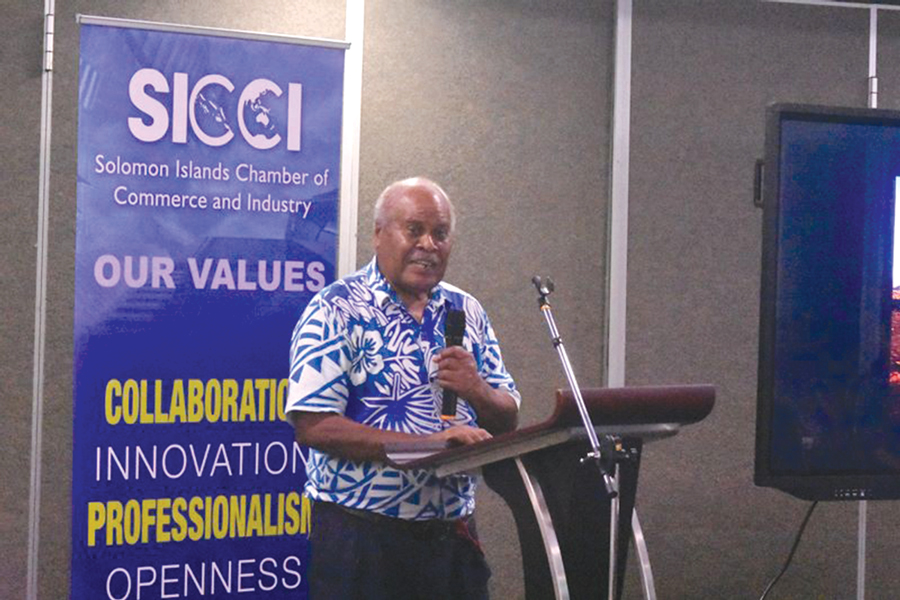
Coordinator for CRB Taskforce Mr Donald
Wate shares government stand on the
fight against CRB during the BA5 event
SICCI and GPPOL hosted last week
BY LYNTON AARON FILIA
Coordinator for CRB Taskforce Mr Donald Wate shares government stand on the fight against CRB during the BA5 event SICCI and GPPOL hosted last week
THE Coconut Rhinoceros Beetle (CRB) has reportedly arrived at the Rennell and Bellona province.
The Ministry of Agriculture and Livestock through Biosecurity division suspected has received information from communities in Rennell that the pest has been sighted there two weeks ago.
MAL’s Director for Bio-security Mr Francis Tsastia however said that they are yet to verify these reports.
“CRB now in Renbel, reports received from the communities but it need to be confirmed.”
Tsastia made the statement during the ‘Business After Five’ event which convened members of the Solomon Islands Chamber of Commerce and Industry at Heritage Park Hotel last week.
Coordinator for CRB Taskforce Mr Donald Wate said currently government through its taskforce has established a MAL Operational Plan set out for pest management.
He explained the pest management systems are sanitation (reducing existing populations), internal quarantine (limiting further spread) and development of long term solutions.
Wate said implementing such a programme is complex and large which involves integration of pest management techniques such as sanitation, movement control, and identification and establishment of bio-control agents.
He also adds that the work will be carried out by several organisations including government and the private sector.
“This work goes beyond the Job Description of any existing government post and requires an individual with energy, initiative, drive and organisational leadership qualities, but not necessarily technical pest control expertise,” he said.
SICCI and GPPOL hosted the BA5 event with its members last week as a drive for the national campaign against the CRB.
The event convened members to listen from a presentation by GPPOL and Biosecurity highlighting updates regarding the pest.
Infested sites include Guadalcanal (2014-2015), Malaita (2016), part of Russell Islands (2016-2017), Savo (2016), Ngella (2016), Ulawa (2017), Gizo (2017), Shortlands (2000) and Renbel (2017-2018)(to be confirmed).