Home Blog Page 1196

Fiji survives early Samoan scare

0
Fetuao Belcher of Samoa (right) is being challenged by Nikhi Pillay of Fiji during yesterday’s contest at Lawson Tama Stadium. PICTURE BY BENZ NEWMAN.

BY ROMULUS HUTA

Fetuao Belcher of Samoa (right) is being challenged by Nikhi Pillay of Fiji during yesterday’s contest at Lawson Tama Stadium. PICTURE BY BENZ NEWMAN.

FIJI squeezed past Samoa with a 3-2 defeat after overcoming an early scare that could have seen the final result ended up in an imaginable upset as Pool B competition of the OFC Under-16 Championship gets underway at Lawson Tama Stadium yesterday afternoon.

The Samoan side, which only arrived in Honiara two hours prior to kick-off, shocked the Fijians when they led 2-0 in the first 17 minutes via a double from Lotial Mano.

Mano capitalised on a rebound from the cross beam following a free kick sent from the left by Jarvis Filimalae in the eighth minute to put his side infront.

Nine minutes later Mano added the second with a screamer launched from outside the box.

Fiji regrouped following the two-goal deficit and managed to pull one back through Eshan Kumar a minute before the halftime, leaving the scoreline to go at 2-1 on the recess.

Three minutes after the hour mark, Fijian striker Josiah Sela found the equaliser with a simple tap in after receiving a pass on the left and 15 minutes later, he fired home the winner from the spot.

The late winner gave a sigh of relief to the Fijian side as expressed by head coach Yogendra Dutt in the post-match conference.

“We’re pleased to come out with a win and now we’re relieved after getting three points.

“We expected the match to be tough and it was tough.

“During halftime, I told the boys to keep the ball and progress forward to score goals and it happened in the second 45 minutes.

“We’ll review the performance from this match and discuss with other members of the coaching team if we are to make some changes to the line-up ahead of the second match,” Dutt said.

Dutt’s Samoan counterpart, Martin Tamasese admitted that they have lost a good fight against Fiji.

“There’s no excuse for the loss. We’re doing a really good fight against Fiji and unfortunately we lost it.

“I think the boys are really tired and we’re trying to hold on for a win or a draw but unfortunately, we lost to a good team.”

The Samoan team had experienced a problem with their arrival here where a part of the team arrived on Saturday while the rest of the team have just arrived two hours before the 12noon kick off.

Initially, the match was scheduled for 10am yesterday but had to be moved to 12noon due to the team’s late arrival.

“The weather played a bit part of our loss today because the rest of the team have just arrived 10 o’clock this morning (yesterday). It’s something to do with the delay in flight booking and that affected our performance.

“We’re just going to leave everything as it is and look forward to the next game. Atleast we feel the weather now so for our second game against New Caledonia, we will be looking for a good result,” Tamasese said.

The win pushed Fiji to go top of Pool B table and equal on three points with Tahiti, who defeated New Caledonia 2-1 in the other match.

The OFC Under-16 Championship will go on a break today and will resume for Pool A round two matches tomorrow morning with PNG and Vanuatu kicking things off in the earlier fixture while the 3pm game will be between host nation Solomon Islands and New Zealand.

Sea level rise is real for Lord Howe Islands

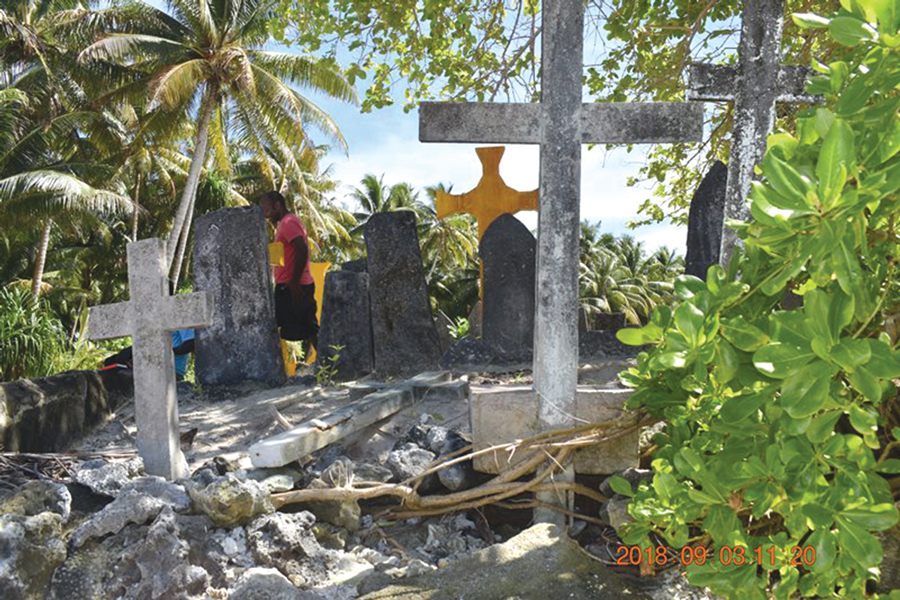
Sea level rise have had impacts on cemeteries sites

BY MAVIS NISHIMURA PODOKOLO

THE people of Lord Howe islands are struggling to adjust to the effects and impacts of climate change.

Sea level rise and salt water intrusion are some of the effects felt by the people.

From promises made in the past by governments and visiting stakeholders, the people are now losing hope and support from these key people in the country.

In an exclusive interview with Chief Peter Kalali of Lord Howe islands, he reveals that sea level rise and issues of climate change are real to the people.

Some of affected coastal settlers in LordHowe

Kalali said Lord Howe communities are facing the brunt of climate change and for sure cannot be avoided.

He said they will continue to face the changes caused by human activities not of their making.

Kalali said saltwater intrusion is now having its effects on agriculture sectors. Local crops for consumption is now scarce, commercial businesses not making profits anymore and their water sources are not safe due to ground water salinisation .

He said as the sea continues to rise, their beautiful islands, the people and their culture is also under treat.

Kalali said sea level rise has contributed to the loss productivity of their land and the increased rate of shoreline erosion is uncontrollable which has been the main cause for ground water salinization

Sea level rise have had impacts on cemeteries sites

He said as the sea continues to rise, their beautiful islands, the people and their culture is also under threat.

He said there is nothing much they can do about it to combat nature, but they simply undergo an initiative of prayer, caring and sharing whatever they have in terms of foods, water and land to neighboring families and communities.

“We only live through the climate change and sea level rise through prayer, caring and sharing with our neighboring families and communities within Lord Howe,” said Kalali.

He adds for now the situation is getting worse and they are likely to have many of their coastal settlers relocated.

Coastal settlers facing sea level rise threats
Effects of sea level rise has affected road access between Island to island as a result people are risking their lives crossing waters
Effects of sea level rise on Coastal land.
Increased rate of food crops scarcity due to climate change secondary effects on agriculture
Ground water source dried up and is mixed with salinity

Awareness talks to communities in Malaita

0
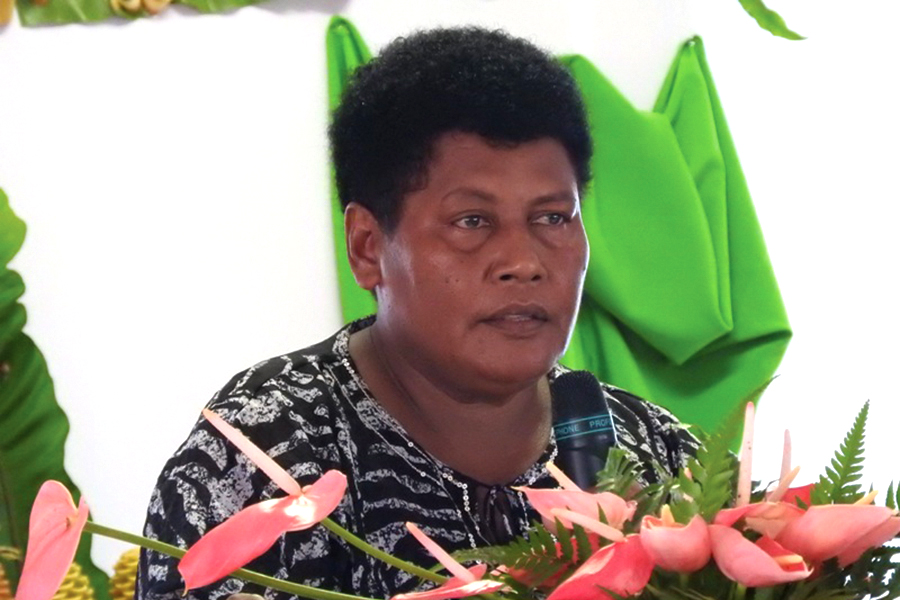
President of Malaita Provincial Alliance (MPA) who also the President of Malaita Provincial Council of Women (MPCW), Ms Martha Rurai.

BY SAMIE WAIKORI

AUKI

President of Malaita Provincial Alliance (MPA) who also the President of Malaita Provincial Council of Women (MPCW), Ms Martha Rurai.

THE Malaita Province Council of Women recently galvanised its alliance with stakeholders in Auki to carry out awareness to communities in the province.

President of MPCW, Ms Martha Rurai said the programme looks at assisting people with areas of need in their communities.

She said the team leading the programme has representatives from various stakeholders in Auki who can assist in their specific field of work upon request from communities.

“What we do was that, we call on communities to identify certain areas of need in the community and assist them through awareness talk.

“Like recently, the community of Gwounaru invited us to talk on areas of law and order. We went there and held sessions on crime prevention, community policing and community strengthen to them.

“The same for Fouabu community in west Kwara’ae where we also provided some very important talks to the people,” Rurai said.

She said one thing about the team was it represented and aligned people from all works in Auki.

“For example, if a community requested us to talk on certain area on health, a person from that specific field from health authority in Auki was represented to facilitate the talk.

“In the meantime, chances also given to other team members to talk on their areas of work that also needed for the community,” Rurai said.

She said the initiative has came about so that everyone to work together and to be on a same note to help the people in the province.

Rurai said each stakeholder has their own programme and can do so, however this programme is to support their programme in a unify way.

She said the programme came under the umbrella of MPCW and it looked at empowering people to become self-sufficient in their communities.

Rurai said so far two communities been visited and this weekend they will go to Malu’u and Manakwai with the programme.

She said they have no funder for the programme, however, use resources at their dispose to reach out with it.

Pursuing answers to Solomon Islands youth unemployment situation

0

DEAR EDITOR, in once more writing in furthering my concern for the plight of the unemployed youth in the Solomon Islands and, without in any way wanting to be seen as interfering in local and external politics concerning the working of the Solomon Islands Government in its relationship with development partners and foreign governments, I would like to ask what has happened to the proposal to institute Special Economic Zones in selected areas of the country?

Are Special Economic Zones still a feature of the National Development Strategy (NDS) 2016-2035 which was officially launched some two years ago?

When introduced, the NDS presented five broad objectives that were envisaged to contribute towards achieving an overall vision and long term objectives, including poverty alleviation and jobs.

While it might be argued that many young people in the Solomon Islands ought to change their mindset about farming as a source of employment and realize that farming work has the potential to create more income than paid employment in the formal work sector, there is also the fact that rural and customary land needs to be made available for commercial and agricultural development.

The prospect of Special Economic Zones heralded the local belief that jobs would become available and especially when the former Taiwanese Ambassador to the Solomon Islands gave more than a hint of Taiwanese support for the creation of local Special Economic Zones on the model of those created in Taiwan.

It might be recalled that in July 2016, former Prime Minister Manneseh Sogavare announced that his government would soon put in place legislation to guide the establishment of Special Economic Zones.

On that occasion, Hon Sogavare said he had told the visiting Papua New Guinea-based Counsellor of the Chinese Embassy that Chinese investors should be interested in forming partnerships to invest in the SEZs.

Mr Sogavare said the idea was to zone the country into various economic areas so different provinces could enter into activities that would be specifically feasible for their people.

He said the government would use the Public Private Partnership Development Concept when creating the SEZs.

In his National Day speech in July the same year, Ambassdor Victor Yu was quoted as having said:

“As for Taiwan’s development: Taiwan was an agriculture society like Solomon Islands, but we are on a mountainous island with limited arable land and no natural resources. What we have are 23 million people. Over a few decades, Taiwan has fostered its engineering competence, managerial know how, and ingenuity by developing human resources through education.

“By setting up special industrial zones, Taiwan attracted foreign investment and gradually established its own industrial base. Then through more investment in R&D, Taiwan managed to upgrade itself into a knowledge-based high-tech economy of today.

“This is Taiwan’s model of economic development to share with Solomon Islands. I am very glad to see one of the Solomon Islands’ government development strategies is to establish Special Economic Zones to attract foreign investment. This may be the way to Solomon Islands’ economic development. We are earnest to see its fruition.”

It has been noted, I understand by the World Bank that the Solomon Islands is at a critical juncture in its development trajectory.

The very high degree of international engagement in the post-conflict period has been considerably scaled back, in terms of both financial assistance and the supplementation of state capacity.

At the same time, Solomon Islands is likely to embark on a transition from logging to mining as the key driver of growth.

All the foregoing having been said and a NDS in place, I respectfully pose the question what practical and achievable development strategies are in hand which will help Solomon Islands young people acquire paid work in either the agriculture sector or formal work place in both the short and longer term?

Yours sincerely

Frank Short

Matanikau River – a natural beauty so polluted and Honiara’s embarrassment

0

DEAR EDITOR, if you are in Honiara, take a walk down to one of the two bridges that links the east bank to the west bank of the Matanikau River: take a good look and capture the natural beauty of the flow of the river and how nature, over many years had been able to carve the landscape and course of the river fitting enough only to the Creators’ purpose for life’s’ survival – ecosystem.

Matanikau River, flows through the heart of Honiara Township, nurturing and feeding the diversity of life that inhabited its ecosystem. Its banks were once graced with beautiful rain forests providing a canopy for the early settlers of the Matanikau area and the wild animals that once roamed that cooler rainforest of the riverbank. During the day and at night, it is a natural conditioner, cooling the city’s’ surroundings and making life a little more bearable under the scourging heat of the sun.

For the early settlers of Matanikau, the river had been a long life companion whose physical attributes could be seen, heard, felt, taste, smelt and understood within the language of their day to day needs for survival.

For them, the river was their store house of fish, shellfish, prawns, mud crabs and fresh water eels.

Throughout history, the river has been used as a major source of transportation, water, food, and livelihood for a larger part of Honiara people living around the Matanikau area.

Today, the plight of Matanikau River can now be seen, heard, felt, taste and smelt for the worse.

Despite its natural beauty, Matanikau River downstream is heavily poisoned by human activities and its current state seems irreversible.

Our attitudes toward one of natures’ lifeblood have been very disastrous and irresponsible.

That situation is a pointer warning us of the emerging ecological crisis that could eventuate if we continue to disregard the `signs of time’.

Polluted water transforms nourishment into poison. Absence of water kills very quickly, but not quickly enough for the terrible suffering of thirsty people and land.

With increasing population and human activities, effluent discharges from the Tuvaruhu sewage and the ongoing dumping of household rubbish into tributaries around Green Valley via Zion to Vara Creek that flows into Matanikau River, the water has became so saturated with garbage to the extent that its eco-system could hardly mitigate its own survival.

Sooner, the river will be unable to support any more aquatic life and surely what others enjoyed seeing yesteryears and today would merely be something our future generation would only read about them in textbooks.

Ironically, human beings made in the Image of God, made environment adapt to them rather than them adapting to the environment: other living things adapt to environment.

We are treating our river, in an inhuman, godforsaken manner precisely because we see ourselves as masters over creation.

Our faith in God challenges us to be proactive in caring for what matters most for us.

Human beings should transform nature with the understanding that it is a gift from God, knowing that once the transformation is effected, the creation must be offered back to God.

As Christians, do we really care about what God has blessed us with: are we going to rehabilitate Matanikau River or over dose it?

Care of water resources are matters of grave importance for the entire human family, all of us Christians need to contribute positively to the welfare of Matanikau River.

By AM Junia,

Port Adam, Small Malaita

Taiwan investment team coming

0

A team from the Republic of China (ROC) will visit the country in the coming weeks to scope for business opportunities here.

According to Prime Minister Rick Houenipwela, it’s an investment visit.

Prime Minister Houenipwela and ROC’s Vice Minister of Foreign Affairs José María Liu had been having sideline talks about investments when they attended the recent Pacific Islands Forum (PIF) meeting in Nauru.

Prime Minister Hou said ROC’s interest to invest here is not new.

He said already a ROC company had signed an agreement with the Solomon Islands Ports Authority on a plan to setup a solar factory here.

The ROC Company is already here finalising its plan to setup the factory.

According to Prime Minister Hou, it’s a big factory that will manufacture solar and other renewable equipment.

Voters urged to use the objection and omission phase

0

By Gary Hatigeva

AS the registration phase reaches its half way mark, frustrated electors throughout the country are being urged to hold their grudges and frustrations for the Objection and Omission phase of the registration cycle, to point out issues related or are directly done in the face of cross border registrations.

This comes following the mounting frustrations over what many continued to report, alleging an increase in the number of people moving in mass to register in constituencies they don’t reside or have no connections to, which according to allegations, has become very obvious, and angers many.

The issue of cross constituency movement has also attracted wide spread debates and heavy criticisms from the general public, who expressed for something to be done about.

This has unfortunately witnessed so many people taking, what has been described as, the matters of the laws into their own hands, and this according to reports, is a result of a frustrated portion of the voting population who felt they have continuously being denied or overshadowed by those who are involved in the cross border practice, in terms of benefits.

But the authority in earlier statements, been reminding people to refrain from taking these electoral matters in to their own discretion and wait for the right time allowed by the electoral laws, to deal with such issues.

Understandably, this matter is a frustrating thing for people to witness or experience, and also a sentiment many are sharing, but the registration if things are to go by the law and the registration phases, is just one part of the cycle.

People have also been reminded to take note that there are three phases to this registration cycle, and they include the registration of voters, both new and transfers followed by a provisional list, which is currently underway, the Omission and Objection, and then the final version in the lists of names for elections.

According to the Solomon Islands Electoral Commission (SIEC’s) movement plan for the registration process, all registrations programs should be completed by the end of this month (September), followed by the posting of provisional lists, where electors of the 50 constituencies are expected to look through before the Objection and Omission process, which will include public hearings.

Voters and intending candidates are however urged to fully utilize this phase, as it is the only legal avenue available under the laws to remove names of people who are or may be subjected to the cross border registration issue or have not satisfied Section 55(2)(b) of the Constitution.

People can also use the objection period to call for the removal of names or persons from lists if they feel Section 4, subsection 2 and 3 of the Electoral Act 2018, are being breached.

This section defines the status of being an ordinary residence in a constituency and other related matters qualifying electors to register and vote in a constituency.

They then stressed that after this period, the final list is locked down and there is no turning back, and so any activities done to sabotage the registration or the voting processes, are all illegal and will be dealt with under the full force of the law.

Meanwhile, a good number of lawyers spoken to on this, have suggested for people who felt being disadvantaged by the cross border issue, to get hold of what they may have witnessed and strongly felt are in breach of the electoral laws, as evidences and put to test the legal system, after the elections.

ROC, SI talks Taipei-Honiara flight

0

By Mike Puia

The government is working on formalities with the government of the Republic of China (ROC) to have direct flights from Taipei to Honiara.

Prime Minister Rick Houenipwela confirmed in a press conference in Honiara yesterday that work on this direct route is progressing.

Prime Minister Houenipwela recently meets ROC’s Vice Minister of Foreign Affairs José María Liu and they talked about many things.

Among other things, they discussed direct flight between the two cities.

The only issue that will determined how long this would happen is the Henderson airport and terminal standard.

Currently, Japan is on a project to upgrade the Henderson airport and terminal.

Prime Minister Hou said when our airport and terminal are ready in terms of air service agreement then big aircraft from Taipei will start arriving here.

He said this will stop people from Taipei or Honiara transiting in different countries before arriving in the two cities.

POB accountant Esanka Fernando is still here

0

By Alfred Sasako

ESANKA Fernando, the Pan Oceanic Bank (POB) Accountant who was reportedly fired by the Board, told Island Sun on Monday he was still with the bank.

“I am the Accountant and I am still with the Bank,” he told Island Sun at the Hyundai Car Park in Honiara yesterday afternoon.

Mr Fernando was said to be one of the three top officials the POB Board fired on 31st August this year for alleged misuse of POB funds. The others were the Executive Officer (CEO), Suresh M Amarasekera who reportedly flew out of the country on Sunday.

Mr Amarasekera refused to answer questions regarding his sudden departure. All he could say was his contract was up. He was seen talking to officials of BRED Bank two days before he left.

The POB Board reportedly sacked the trio for alleged “misappropriation of (the) bank’s funds, assaulting local staff, lack of performance and misbehaviour/misconduct”.

At the car park encounter yesterday, Mr Fernando questioned the source of the information, saying it was wrong.

Island Sun called him about four times for an interview on Monday afternoon, but he never took the calls.

Solomon tuna rated 5th largest in Pacific

0

BY LYNTON AARON FILIA

SOLOMON Islands’ tuna fisheries is rated the fifth largest in the Pacific islands countries.

According to National Marine Ecosystem Service valuation, skipjack is the dominant commercial tuna species in Solomon Islands.

It makes up 64 percent of the annual catch, followed by yellow-fin with 25 percent, albacore – seven percent, and big eye – four percent, the report shows.

It is reported that nearly 100 percent (99 percent) of the commercial tuna catch is harvested by foreign fishing vessels, mostly by purse seine.

With regards to yellowfin, scientist report that yellow-fin stocks show signs of overfishing and bigeye stocks are becoming dangerously small but that albacore and skipjack stocks remain healthy.

Although skipjack makes up majority of tuna catch in the Solomon Islands, it represents only 30 percent of the total value, it said.

The net economic value of the tuna fishery in the Solomon Islands amounts to USD$221,089,000 (~SBD$1,659,827,300).

Although there are some local processing facilities, much of the catch is trans-shipped to distant markets, limiting positive economic impact of the industry for the Solomon Islands.

With regards to licensing of foreign vessels, SIG has earn significant revenue of more than SBD$217 million in 2014 (USD$29 million).

Besides, the industry provides some employment on fishing vessels, and at the processing and canning facilities.

Membership to the Parties of the Nauru Agreement (PNA) is improving sustainable and greatly increasing revenue earned from foreign vessel licences, it said.