Home Blog Page 1189

PM graces consecration of new Bishop of Auki Diocese

0
PM Hou congratulating the newly appointed Bishop of Auki Diocese during his consecration on Sunday.
PM Hou making his speech when congratulating the new Bishop Peter Houhou

PRIME Minister Rick Houenipwela has congratulated the Most Reverend Bishop Elect Peter Houhou describing him as a ‘true son of Solomon Islands’.

Bishop Houhou is the first native Solomon Islander to be appointed as Bishop of Auki Diocese and the first to hold this post in the history of the Catholic Church in Solomon Islands.

Speaking during the consecration of the Bishop in Auki, Malaita province, Prime Minister Hou congratulated Reverend Houhou on behalf of the Government and people of Solomon Islands.

“It is with great joy that I accepted the invitation to be present at this august occasion of the installation and consecration of the first indigenous Solomon Islands Catholic Bishop.

“As Prime Minister it gives me great sense of pride to be here to witness this momentous and historical celebration. It is another milestone achievement in the 450 years history of the Catholic Church in Solomon Islands.”

The Prime Minister said the historical event is no doubt a celebration of a fundamental achievement of the Catholic faith in Solomon Islands and to Solomon Islands as a country.

“I say this because we are witnessing our very own son being recognised by the universal church through the working of the Holy Spirit, to take up his cross and follow the footsteps of our Lord Jesus Christ. We praise God for this wonderful gift to the Christian family here in Solomon Islands,” he said.

The Prime Minister added that Solomon Islands is so blessed, and fortunate to be a free and fair society when it comes to our religious beliefs and practices.
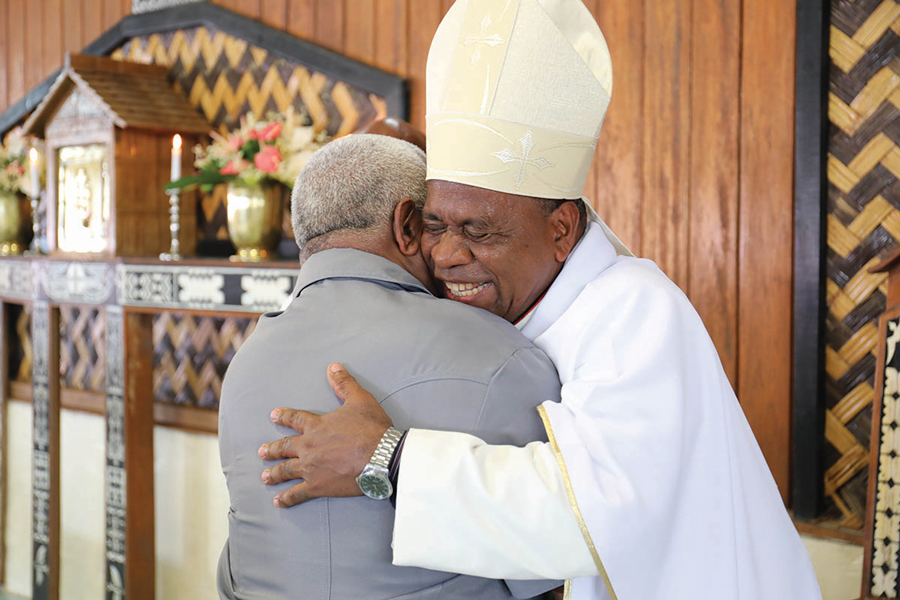
PM Hou congratulating the newly appointed Bishop of Auki Diocese during his consecration on Sunday.

“You are chosen to serve the people of God in this part of the country. Malaita as we all know is the most populated of our provinces. This brings with it both opportunities and challenges.

“I am confident with your able and astute leadership, the Church here in Auki and Malaita as a whole, and with God’s guidance, you be able to face these challenges with confidence,” the Prime Minister said when congratulating the new Bishop.

Prime Minister Hou also encouraged the newly elected Bishop to work closely with the national government and its agencies, to find opportunities that the Church and the Government would be able to work collaboratively in the service to the people.

Thousands of people from around Malaita, Guadalcanal and Honiara came to witness the historical event.

Most Reverend Houhou when making his speech, pledged to work faithfully to serve the Church and the people.

He has also acknowledged the Prime Minister and Madame Rachel for travelling all the way from Honiara to witness the occasion.

“Thank you for gracing this occasion. It signifies the humbleness from you as our leader to be here today,” he said.

Also accompanying the Prime Minister is the Minister for Fisheries and MP for West Are’Are John Maneniaru and officials from the Prime Minister’s Office.

–OPMC PRESS

PLMAM calls for more seasonal worker jobs

0
Australian High Commissioner Roderick Brazier

BY MAVIS NISHIMURA PODOKOLO

Australian High Commissioner Roderick Brazier

PACIFIC nations have called on Australia and New Zealand to increase the number of people they employ in their regional seasonal workers schemes.

The call is the end result of the second Pacific Labour Mobility Annual Meeting which wrapped up in Honiara last week.

The outcome statement from PLMAM, which was released on Friday, looked at how seasonal worker programmes could be improved.

“Pacific Island countries called on Australia and New Zealand to continue give preference to workers from the Pacific,” the PLMAM document said.

They also welcome the increase in the number of Pacific workers in the employment programmes as a “win-win solution for workers and employers”.

Trade Commissioner Joseph Ma’ahanua told the Island Sun that the meeting had been successful.

“The outcome statement is centered around issues on improving access in areas of visa, areas relating to how superannuation could be fitted into in the schemes, areas relating to information sharing and so forth,” he said.

Pacific nations also agreed that superannuation, which is Australia’s retirement savings scheme, needs to be discussed further to deal with the challenges faced by regional workers in getting their superannuation back.

The meeting also agreed to tackle the issue of remittances, or money transfers, as a matter of priority.

Australian High Commissioner Roderick Brazier said the Australian government will continue to help the Solomon Islands increase the number of workers in its employment programmes.

“We want to help Solomon Islands in reaching this needed target and also we think that Solomon Islands has a large, young, willing, diligent work force that can participate in the Australian economy as well.

“We love to see Solomon Islands reach those numbers, 5000, 6000, 7000 going to Australia helping to improve their lives and the lives of their families,” Brazier said.

He said while the number of Solomon Islanders going to Australia had increased to 176 in 2017-18, the numbers of workers was low compared to Tonga and Vanuatu.

The meeting was attended by Pacific nations, Australia and New Zealand, employers, seasonal workers and academics.

The statement also recognised the importance of PLMAM as a key regional forum

The meeting also considered the setting up of a regional body for labour mobility with clear mandates and responsibilities.

Solomon Islands, Tonga, Samoa and Vanuatu have all offered to host the proposed regional labour mobility secretariat

BSP calls on businesses to support breast cancer awareness

0
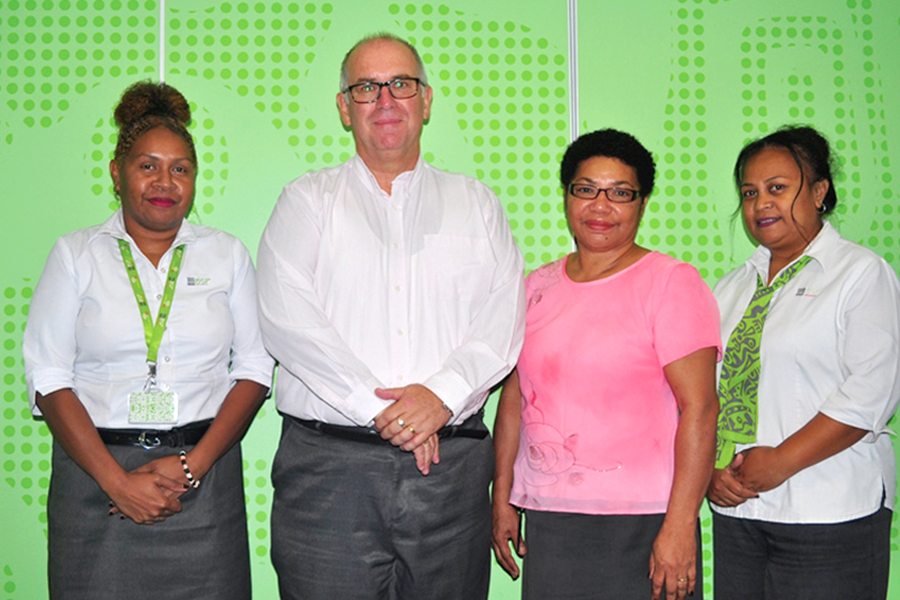
(LEFT - RIGHT) Freda Fa’atoa, David Anderson BSP Country Manager, Sai Foanaota and Christina Tumuri.

BY MAVIS NISHIMURA PODOKOLO

(LEFT – RIGHT) Freda Fa’atoa, David Anderson BSP Country Manager, Sai Foanaota and Christina Tumuri.

THE Bank of South (BSP) in Solomon Islands has called on businesses operating in the country to wear something pink in aid of Pinktober.

The call was made in a press interview with the BSP Country Manager David Anderson last week in Honiara.

Manger Anderson said Pink Ribbon Charity works on escalating breast cancer alertness across the Solomon Islands as it has become one foremost medical concern which women and girls of this nation and the hospital workers are currently facing today.

Anderson adds for these reason workers are encouraged to wear something pink in spreading breast cancer awareness in Solomon Islands.

He said hence BSP calls on all business operating in the country to support this charity and encourage their employees.

With that is pleased to recommend that BSP staff in the country will be celebrating Pinktober again this year on October 26.

Anderson further explains as part of this celebration they will wear pink and donate $10 to First lady Pink Ribbon Charity in which BSP will tie workers donation on a $ for $ basis.

Health and welfare of Solomon Islanders written from the heart

0

DEAR EDITOR, for a good number of years I have contributed to your newspaper my concerns relating to the health, welfare and medical needs of the people in the Solomon Islands.

Having constantly in mind such concerns I initiated contact with the charity organization in New Zealand, Take My Hands and with Lions Clubs.

Take My Hands has become my close charity partner and I retain strong bonds with Lions Clubs.

Take My Hands for at least the last three years has supplied the Solomon Islands Ministry of Health and Medical services with invaluable medical equipment and medical supplies that have essentially gone to assisting the needs of patients at the National Referral Hospital (NRH).

Lions Clubs has donated 6000 pairs of spectacles which have gone to the National Referral Hospital and been distributed to those needing eye glasses but not necessarily having had the means of acquiring their own.

The NRH and medical services in the Solomon Islands needs constant support and I think that, apart from aid in the form I have tried to secure, I believe it is only timely that I draw attention to the health factors that not only would reduce the need for medical attention but to those health related issues that ordinary Solomon Islands should be taking to protect their health and the health of their love ones.

I have already written about the manner in which the habit of eating too much imported food products containing too much fat and too much sugar has contributed in no small measure to obesity, high blood pressure and diabetes.

Such non-communicable diseases (NCD) are wholly preventable if only a more traditional diet of vegetables, fruit and protein like fish are eaten.

Smoking and drinking alcohol, including kwaso all contribute to health concerns such as obesity, liver disease and cancer.

If alcohol is taken it should be in moderation but drinking kwaso is risky and the habit not only against the law but very often high in alcohol content which dangerously heightens blood pressure.

Chewing betel nut is proven to carry a high risk of cancer, mouth disease, tooth decay and obesity.

Most often lack of exercise leads to becoming over weight and, combined, with the habits of drinking alcohol, chewing betel nut and not having a proper diet containing high levels of fat and sugary products ultimately leads to illness which could have been prevented.

Prevention is better than a cure, so the old saying goes, and I would very much hope that Solomon Islanders of all ages, but especially the younger ones, start to think positively of the life changing steps they can take to protect their health and, in turn, avoid getting sick and adding to the pressure already burdening our health services.

Yours sincerely

Frank Short

Furthering the idea of a Solomon Islands National Youth Orchestra

0

DEAR EDITOR, I raised the idea of creating a Solomon Islands National Youth Orchestra in letters to the local media last week and I have been greatly encouraged to pursue the ‘dream’ by mail I have received from several members of the public who believe such an orchestra formed by youths, already with the inherent musical talents, interests and enthusiasm would be beneficial.

I have written to the British Council with offices in New Zealand to enquire whether the British Council, with an interest in furthering art in the wider Pacific region, would be interested in aiding the project aim I have outlined.   I wait to get a response.

As the Ministry of Women, Youth and Children Affairs is the local Ministry responsible for the National Youth Policy, which includes musical activities, with support from the Culture Division of the Ministry of Culture and Tourism, I very much look forward to being able to develop my ideas with the two Ministries to see how we might combine to get the idea of a home grown National Youth Orchestra off the ground in further music development and promotion.

I cannot preempt anything that I might receive by way of help from either the British Council or the two Ministries I have mentioned, but I do believe it would be essential to have a dedicated, qualified and motivated local person to coordinate things from the onset and to be able to oversee the selection and supervision of the youths that would make up the youth orchestra.

Alternatively, a volunteer professional from overseas could be encouraged to come to the Solomon Islands to undertake what I believe would be an exciting, interesting and uplifting opportunity to work with the young musicians selected to form the orchestra.

Perhaps, the Solomon Islands Music Federation could advise whether the possibility of getting a local person to do the necessary work, or say how a suitable VSO might be approached and recruited.

I know that VSO personnel have come to the Solomon Islands for a number of years from Australia, the UK , the USA, Taiwan, Japan and New Zealand and all have contributed in their own way to making life better for individuals, communities and the country as a whole.

As I wrote previously, the group of talented musicians in the UK stand ready to help in whatever way possible with the creation of a Solomon Islands National Youth Orchestra, especially with music training and education, but await news that local efforts to see to the implementation of my ‘dream’ have developed sufficiently to consider holding fund raising concerts in the UK.

Yours sincerely

Frank Short

Evidence of oral cancer and other dangers linked to chewing betel nut

0

DEAR EDITOR, the chewing of betel nut is a popular habit of many people in the Solomon Islands but there is increasing medical evidence of the habit’s dangerous use in terms of health risks.

Many overseas studies, including those conducted by the World Health Organization (WHO) have shown a convincing link between betel nut use and cancer of the mouth and esophagus

Betel nut users are also at higher risk of developing incurable oral submucous fibrosis.

This disease causes stiffness to occur in the mouth and eventually the complete loss of jaw movement.

The regular chewing of betel nut can also cause gum irritation and tooth decay.

Most recent studies conducted in the US by the American Society for Clinical Nutrition found a strong connection between betel nut and increased risk of cardiovascular disease (heart disease) and obesity.

Health organizations and governments around the globe are taking increasing steps to increase awareness of betel nut risks.

Taiwan, for example, fines people there who are found spitting betel nut juice and require them to attend withdrawal classes.

Habits are often difficult to curtail but given the real evidence available of the serious health risks associated with chewing betel nut it is perhaps time for Solomon Islanders to think very carefully of their fondness of regularly chewing betel and think of the implications to their health and well being.

Yours sincerely

Frank Short

Catholic Church consecrates first ever local bishop

0
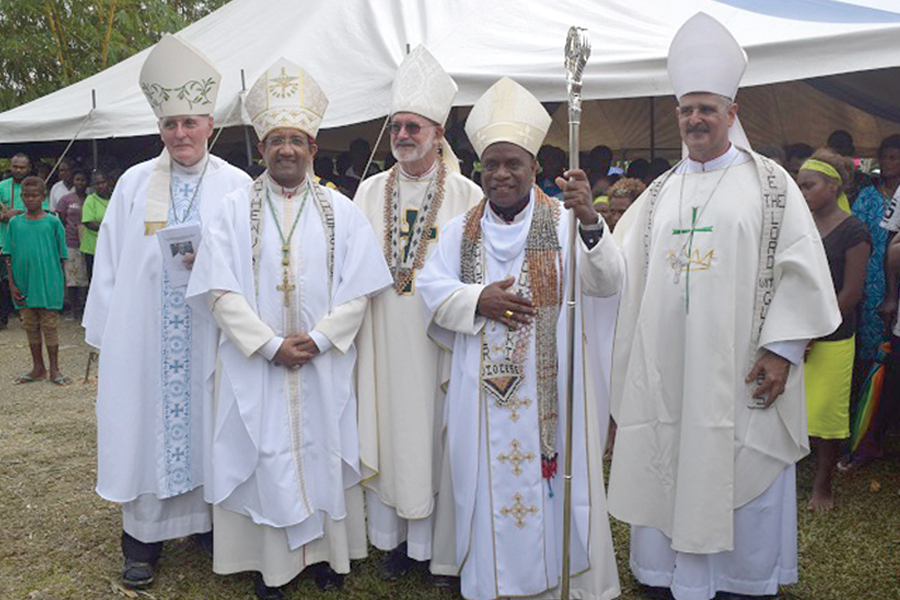
Bishop Peter Houhou poses for a photo with the archbishops.

SOLOMON Islands Catholic Church yesterday celebrated the Episcopal Consecration and installation of its first-ever native priest as Bishop at the St Augustine Cathedral at Faasitoro in the Auki Diocese, Malaita province.

The consecration was officiated by the Pope’s representative the Apostolic Nuncio of Solomon Islands and Papua New Guinea (PNG), His Excellency Archbishop Mathew Kurian Vayalunkal, assisted by Archbishop Christopher Cardone OP, Archbishop Douglas Young of the Archdiocese of Mount Hagen -PNG, and Archbishop Emeritus Adrian Thomas Smith SM, and diocesan and religious priests from the Archdiocese of Honiara, Diocese of Gizo and Auki Diocese.

In Vayalunkal’s homily, he welcomed the newly consecrated Bishop and assured him of the many challenges, joy and blessings ahead and encouraged his Lordship to trust totally in God.

“This is the day that the Lord has made let us rejoice and be glad in it. It is the day of great joy for the Diocese of Auki and the Catholic Church of Solomon Islands. It is a great blessing to have a new native Bishop for our Diocese and I assure you that the Holy Father is spiritually joining us today in this special occasion.

“I would like to welcome you this morning as a new native church leader to lead your Christian people and work in collaboration in the development of the Catholic Church in Solomon Islands. As a Bishop you are called to lead the flock and put your entire live in the hands of God.

“A Bishop must be someone who must bring people back to the hope of finding the truth.

“This is the challenge of the Bishop in the Catholic Church and that is the mandate of every man who are called to be a successor of the apostles.

“The mother church entrusts you with three important responsibilities which are to teach, sanctify and to love the people of God. Let me invite you to try to be the apostle, and always be someone who live with his sheep in the good times and bad times.”

Reverend Peter Houhou is part Ulawa of Makira Province, Marau on Guadalcanal and Are’are in Malaita province. He was born on October 10, 1966 at Porokokore village in Marau sound, Makina parish. His father is late Luke Iawai and his mother is late Salome Sautarei’a of West Are’are, Malaita province.

He attended primary school in 1974 to 1979 and commenced his formation at Nazareth apostolic centre in 1985 to 1990 before prolonging his vocation to the Holy Spirit seminary Bomana in Papua New Guinea   (PNG) from 1991 to 1998.

He was ordained as priest at Makina parish on July 3, 1999 and was first assigned as a parish priest at Ruavatu Parish from 1999 to 2000.

He extended his priesthood role to Makina Parish for almost six years from 2000 to 2006 and later was appointed to become the Parish Priest of Visale Parish from 2006 to 2015.

He was appointed as a Vicar General and Administrator of the Archdiocese of Honiara from 2015 to 2018.

Attending the event were the Prime minister of Solomon Islands Rick Houenipwela and Lady Hou with his government delegation, Premier of Malaita Province Peter Ramohia and his wife, the Minister of Fisheries, John Meneniaru and his wife, and many other distinguished guests.

BY CAMILLUS KOLE

CATHOLIC MEDIA

Cuban scholarship no longer for medicine

0

BY GEORGINA KEKEA

THE Ministry of Education, Human Resources and Development (MEHRD) has decided NOT to send any more students under Cuba Scholarship scheme in medicine.

MEHRD Permanent Secretary (PS) Dr Franco Rodie says the scholarship was concentrated in training doctors but the Medical Board of the Ministry of Health (MHMS) decided not to focus the training in medicine anymore.

“It is anticipated that this bilateral cooperation would expand to other training needs of the country such as sports, engineering, tourism, agriculture and disaster management,” Rodie told Island Sun.

He said given the huge number of returning Cuban medical graduates, the National Referral Hospital has highlighted the need to better manage the training of doctors and the support required to ensure quality supervision and monitoring of the doctors’ internship programme.

Since the Medical Board of MHMS has decided not to focus the training in medicine, MEHRD is now providing support to students pursuing studies in biomedical engineering.

Biomedical engineering, or bioengineering, is the application of engineering principles to the fields of biology and health care.

Bioengineers work with doctors, therapists and researchers to develop systems, equipment and devices in order to solve clinical problems.

So far, two students had been sent to Cuba to pursue the biomedical engineering programme.

Solomon Islanders had been studying in Cuba for free since 2007, as it is a beneficiary of Cuban medical aid.

SI could have done more for West Papua: Academic

West Papuan Flag

BY GEORGINA KEKEA

THE incoming director of the Centre for Pacific Islands Studies at the University of Hawaii told ABC that declining support for West Papuan independence in Melanesia is a clear sign of Indonesia’s growing influence.

Dr Tarcisius Tara Kabutaulaka told Evan Wasuka of ABC that it is a sign of Indonesia’s growing political influence in the region.

“I think it’s a reflection of the influence of Indonesia particularly in the Melanesian Spearhead Group and I have always had the opinion that the inclusion of Indonesia in the MSG was a mistake. It was spearheaded by Fiji and Fiji has a very close relationship with Indonesia,” Tara said.

In 2017 Solomon Islands stood up front among Pacific Island countries at the United Nations General Assembly in supporting West Papua’s bid for self-determination.

Former Prime Minister, Manasseh Sogavare told the 72nd United Nations General Assembly (UNGA) that Solomon Islands position on the plight of West Papuan people, are premised on principles that Solomon Islands continues to uphold.

“Solomon Islands condemns the human rights violations in West Papua. Our Sustainable Development Goals that promote the notion of no-one left behind is synonymous to empty promises unless we, in the United Nations, take active steps to address the plight of the peoples of West Papua,” Sogavare said.

He also reiterated Solomon Islands vital support for West Papua’s fundamental right to self-determination and called upon all countries and international organisations to support West Papuan self-determination.

This year however groups in support of West Papua say Solomon Islands’ tone towards West Papua ‘was more subdued’.

At the 73rd UNGA, Prime Minister Rick Hou instead speaks of Taiwan being left behind.

“Madame President, while we speak of leaving no one behind, we still close our doors to Taiwan and continue to contradict our principles by leaving Taiwan’s 23 million people behind,” Hou said and continued to make a lengthy talk on Taiwan’s eligibility to be recognised by the UN.

For the West Papua issue, Hou said Solomon Islands recognised Indonesia as a sovereign country and respects Indonesia. However he vaguely mentioned the human rights issues in West Papua. To this, Tara says Solomon Islands could have done more for West Papua at the UNGA when it reaffirms its support for Indonesia’s sovereignty.

“At the same time ask the United Nations to look into the West Papua issue both the human right issue as well as the demand for self-determination for West Papua,” Tara said.

The recent statement by the country’s Prime Minister at the 73rd UNGA has met some backslash from the public at large. Some say Solomon Islands government had been inconsistent in its position on issues and is easily swayed.

A report on the West Papua issue, carried out by the current government is yet to be released.

BSP banks to roll out domestic violence policy after shock survey results in SI

0

PAPUA New Guinea’s Bank of the South Pacific is looking to introduce a domestic violence policy covering PNG and all regional branches after a company survey at BSP Solomon Islands showed 92 percent of all 260 staff believe their colleagues are affected by violence at home.

The policy will cover thousands of employees in Papua New Guinea branches and Pacific banks in the Cook Islands, Samoa, Vanuatu and Tonga.

Given the prevalence of gender based violence in the Solomons, “It was no surprise to us that some thought it was (affecting colleagues and their work) but the 92 [percent] result was practically everyone, and that’s a serious impact for the livelihood of all staff and the business as a whole,” says BSP Solomons CEO David Anderson.

He was amongst presenters at the launch of a Women at Work (Waka Mere) progress report in Honiara this week as Pacific delegates attending annual regional Labour Mobility meeting in the Solomons for 2018 have also raised the need to address gender dimensions around sending seasonal workers to Australia and New Zealand. The Waka Mere initiative aims to help businesses tackle gender inequality and domestic violence impacts in the workplace.

The Waka Mere project takes it cue from World Bank partnerships aimed at mainstreaming gender into businesses, with reports from HR managers and employee surveys across 15 companies employing more than 6,000 workers in the Solomons.

While the overall results of all employees surveyed showed 75% agreed domestic violence was affecting the ability of some colleagues to come to work or perform at their best, the BSP Solomon’s 92 percent finding was “a huge surprise” for Anderson and his HR team.

The BSP Solomons CEO says the other surprise came when the team looked to BSP head office in PNG to adapt a policy for the Solomon Islands context, and found the organisation didn’t have one – hence the move to roll out a comprehensive policy for all BSP countries.

While the bank is the only one of the large companies surveyed so far to have equality in terms of numbers of women at work- almost 50-50, the Waka Mere initiative has sparked a ‘game-changing’ wave of awareness amongst all staff on the less visible nature of abuse at home, says Anderson.

“Go back 12 months, and if you asked our staff about domestic violence they would say it’s just physical and hitting, and that’s what they thought. Then, to talk to them about domestic violence also being verbal, and about intimidation– that if you don’t do this, this is the conserquence….staff were very surprised to learn these were also considered domestic violence– it’s been very helpful.”

After sharing to the launch how the bank has assisted in a few cases, Anderson says providing staff with awareness on recognising, reporting and accessing help is part of helping out.

“We can only do so much. We are not trained to be experts or advisors in domestic violence, and all we are trained to do and can do, is support staff, tell them what they can do and point them to a number of organisations in the Solomon Islands who can assist,” says Anderson.

In his presentation at the launch he pointed out several cases where the bank had supported staff through their choices to ensure their safety,

The cost of going that extra mile is not the issue, he says.

“It’s not a matter of what it will cost. It’s a matter of getting it right for the staff. If I go back to the 92 percent who said they believe staff were impacted by Domestic violence, that’s a cost to the bank because they are not working to their maximum capacity so assisting the staff to resolve this issue will resolve their private life and hopefully the staff will be a more productive member and of more use to the organisation.”

Solomon Islands Chamber of Commerce executives Dennis Meone and incoming CEO Atenasi Ata have welcomed the progress report and are keen to expand it beyond the 15 pioneers featured to the full membership of more than 220 chamber members.

Ata challenged employers to picture the improved productivity when both men and women are valued equally in the workplace– “supported by systems and processes that are more nuanced to the Solomon Islands reality, this is the unrealised potential for human resource and therefore for business that SICCI emphasizes through Waka Mere.”

She says the project is showing how the private sector “is in perfect step with Government” legislation and policy aimed at ending gender violence in the country.

By Lisa Williams

HONIARA