Home Blog Page 1155

BSP banks to roll out domestic violence policy after shock survey results in SI

0

PAPUA New Guinea’s Bank of the South Pacific is looking to introduce a domestic violence policy covering PNG and all regional branches after a company survey at BSP Solomon Islands showed 92 percent of all 260 staff believe their colleagues are affected by violence at home.

The policy will cover thousands of employees in Papua New Guinea branches and Pacific banks in the Cook Islands, Samoa, Vanuatu and Tonga.

Given the prevalence of gender based violence in the Solomons, “It was no surprise to us that some thought it was (affecting colleagues and their work) but the 92 [percent] result was practically everyone, and that’s a serious impact for the livelihood of all staff and the business as a whole,” says BSP Solomons CEO David Anderson.

He was amongst presenters at the launch of a Women at Work (Waka Mere) progress report in Honiara this week as Pacific delegates attending annual regional Labour Mobility meeting in the Solomons for 2018 have also raised the need to address gender dimensions around sending seasonal workers to Australia and New Zealand. The Waka Mere initiative aims to help businesses tackle gender inequality and domestic violence impacts in the workplace.

The Waka Mere project takes it cue from World Bank partnerships aimed at mainstreaming gender into businesses, with reports from HR managers and employee surveys across 15 companies employing more than 6,000 workers in the Solomons.

While the overall results of all employees surveyed showed 75% agreed domestic violence was affecting the ability of some colleagues to come to work or perform at their best, the BSP Solomon’s 92 percent finding was “a huge surprise” for Anderson and his HR team.

The BSP Solomons CEO says the other surprise came when the team looked to BSP head office in PNG to adapt a policy for the Solomon Islands context, and found the organisation didn’t have one – hence the move to roll out a comprehensive policy for all BSP countries.

While the bank is the only one of the large companies surveyed so far to have equality in terms of numbers of women at work- almost 50-50, the Waka Mere initiative has sparked a ‘game-changing’ wave of awareness amongst all staff on the less visible nature of abuse at home, says Anderson.

“Go back 12 months, and if you asked our staff about domestic violence they would say it’s just physical and hitting, and that’s what they thought. Then, to talk to them about domestic violence also being verbal, and about intimidation– that if you don’t do this, this is the conserquence….staff were very surprised to learn these were also considered domestic violence– it’s been very helpful.”

After sharing to the launch how the bank has assisted in a few cases, Anderson says providing staff with awareness on recognising, reporting and accessing help is part of helping out.

“We can only do so much. We are not trained to be experts or advisors in domestic violence, and all we are trained to do and can do, is support staff, tell them what they can do and point them to a number of organisations in the Solomon Islands who can assist,” says Anderson.

In his presentation at the launch he pointed out several cases where the bank had supported staff through their choices to ensure their safety,

The cost of going that extra mile is not the issue, he says.

“It’s not a matter of what it will cost. It’s a matter of getting it right for the staff. If I go back to the 92 percent who said they believe staff were impacted by Domestic violence, that’s a cost to the bank because they are not working to their maximum capacity so assisting the staff to resolve this issue will resolve their private life and hopefully the staff will be a more productive member and of more use to the organisation.”

Solomon Islands Chamber of Commerce executives Dennis Meone and incoming CEO Atenasi Ata have welcomed the progress report and are keen to expand it beyond the 15 pioneers featured to the full membership of more than 220 chamber members.

Ata challenged employers to picture the improved productivity when both men and women are valued equally in the workplace– “supported by systems and processes that are more nuanced to the Solomon Islands reality, this is the unrealised potential for human resource and therefore for business that SICCI emphasizes through Waka Mere.”

She says the project is showing how the private sector “is in perfect step with Government” legislation and policy aimed at ending gender violence in the country.

By Lisa Williams

HONIARA

September payments push JQY coffers past $239m-plus mark, documents show

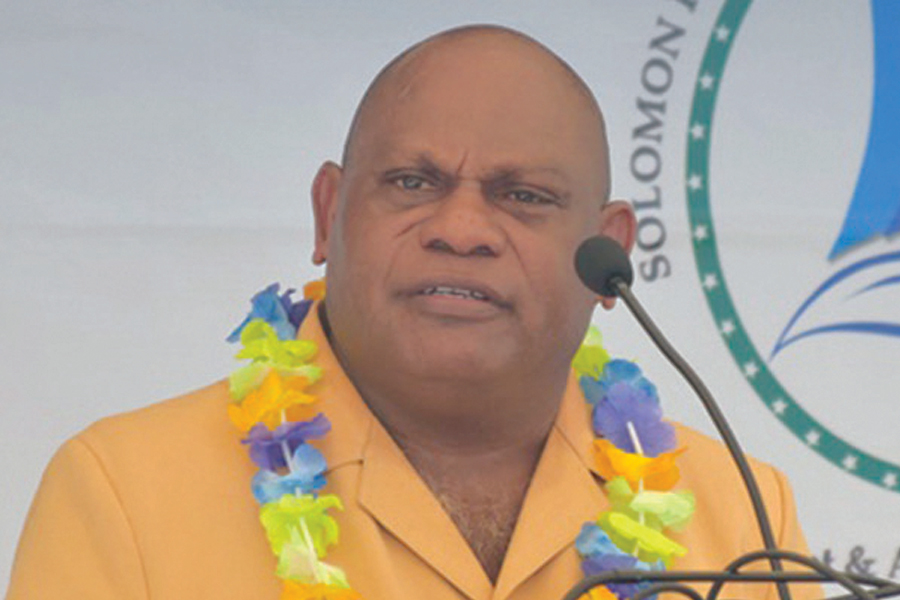
Minister of Ministry of Infrastructure and Development, Honorable Stanley Sofu

By Alfred Sasako

GOVERNMENT payments to JQY Enterprise Ltd have pushed the company’s seven-year earnings past the $239-million mark, documents obtained by Island Sun show.

These payments were from the tax-payer funded Constituency Fund (CDF) grants. The Ministry of Rural Development (MRD) pays JQY directly on the order of individual MPs.

According to the documents, East Kwaio and Small Malaita were the last two constituencies whose invoices for payments pushed JQY’s takings to $239,145,967.49 as of September 21 this year.

Their combined fundings were for equipment under the broad heading of transport. Small Malaita Constituency was designated the larger amount of SBD5.3million from the Transport Fund, formerly the Shipping Grants, administered by the Ministry of Infrastructure Development (MID).

The payment was approved and went through on September 21, 2018. It was made through EFT (electronic funds transfer) BSP Credit reference number EFT GL082789, the documents show.

East Kwaio Constituency payments totalling $3,675,000 appeared to have been split in two and were made out to JQY Enterprise Ltd on September 10 this year. It carries the Purchase Order Number of 422795, Requisition Number HQR/0296/2018 and Invoice No. 407684.

But they are not the only two constituencies benefitting from JQY’s services – a government preferred supplier. Other constituencies have also paid for materials for their housing scheme as well as solar from JQY over the years, the documents show.

Meanwhile related documents which Island Sun has also obtained show only $8,994,317.24 in funding were paid into the East Kwaio Constituency bank account between 2012 and 2018.

In that period the Constituency received CDF grants totalling $44.3 million, according to published figures on the social media.

Each of the 50 constituencies received a total $44.3 million in the seven years to September this year. It is made up of:

2012 – SBD5.2 million;

2013 – SBD6 million;

2014 – SBD6 million;

2015 – SBD6.6 million;

2016 – SBD7 million;

2017 – SBD6.5 million; and

2018 – SBD7 million (yet to be audited).

Based on these figure, some $29 million is unaccounted for in the case of East Kwaio Constituency funding over the 2012-2018 period, unless there are bank accounts the Ministry of Finance is unaware of.

The documents show the last payment of $42,000 went into the Constituency Bank Account on August 12 this year.

The source of the last payment is the Ministry of Education and Human Resources INV Development, suggesting it could be part payment from the Constituency Scholarship Fund. The payment carries the Purchase Order No. 427319, Requisition No. MEHRD/Acc/152/2018.11, Invoice Number MEHRD/2323/18 with the Voucher No. 403484.

It is not clear whether much of the East Kwaio Constituency funding had gone through JQY Enterprise Ltd. This does not seem to be the case as payment records show only $6,606,121.33 was paid to JQY in the 2012-2018 period on behalf of East Kwaio.

In the same period (2012-2018), payments totalling $5,305,762.66 went into the personal bank account of the MP for East Kwaio and Minister for Infrastructure Development, Stanley Festus Sofu MP, the documents show.

Large payments in the MP’s bank account came from the National Parliament and the Office of the Prime Minister which disburses Taiwan’s secret funds to ministers and government backbench. The last payment of $303,000 was made into the account on September 21 this year.

MEHRD to continue improve monitoring and management of SIG-scholarship

Permanent Secretary for MEHRD, Dr Franco Rodie.

BY GEORGINA KEKEA

THE Ministry of Education and Human Resources Development (MEHRD) will continue to improve the monitoring and management of SIG-scholarship.

Permanent Secretary (PS) Dr Franco Rodie when responding to Island Sun’s query on scholarship for students in Philippines said MERHD have reduced the number of scholarships for students there already.

He said the outcome of the review conducted in 2017 by MEHRD has resulted in a reduced number of scholarships for students to study in Philippines.

“For 2019, around nine students will have the opportunity to study in Philippines,” Rodie said.

He said however data has shown that the students’ performance have actually improved for the last four years.

“For instance, in 2014, a total of 300 students were terminated or suspended from their programmes,

2015, a total of 200 students, 2016, a total of 150 students, 2017, we only have 70 students either terminated or suspended,” Rodie wrote to Island Sun.

He said MEHRD-NTU will also continue to manage and facilitate the constituency scholarship allocation through the normal scholarship processes.

“Selection of candidates will adhere to and comply with the scholarship selection criteria and processes.”

Rodie said for 2019, there are 100 scholarship opportunities available for the fifty constituencies in Solomon Islands. A reduction from the 200 scholarships that was usually awarded each year by a constituent’s MP.

Last year (2017), Rodie told the Public Accounts Committee that MPs will not interfere with the selection process, a comment to which the PAC agreed to.

“Scholarships are for high achievers thus it cannot be awarded to just anyone who wants to pursue studies,” Rodie told PAC last year.

Slight rise in Honiara inflation for August

0

ANNAUL headline inflation for Honiara has indicated a slight surge of 0.3 percent in August, 2018.

This means only a 0.1 percent points increase was recorded compared to the previous month (July) inflation of 0.2 percent.

Releasing the Honiara Consumer Price Index (CPI) statistical report for the month (August) last week, Government Statistician, Douglas Kimi said: “Through the year to August 2018, the Honiara CPI increased by 3.2 percent.”

He said food and non-alcoholic beverages rose by 0.9 percent with the main contributors to the movement in the group were Vegetables +6.6 percent, Potato and Tuber +17.0 percent, Fresh Fruits +4.9 percent, and Fish and Sea Food +1.7 percent at the Honiara Central Market.

“Other contributors include Oils and Fats +2.7 percent and Non-Alcoholic Beverages +0.8 percent at retail outlets. These outweighed declines in Bread and Cereals -1.1 percent, particularly rice -0.6 percent,” Mr Kimi stated.

Other major changes in other sub-index include:

  • Alcoholic Beverages, Tobacco and Narcotics +3.2 percent

The main contributor to this group was narcotics +50.2 percent, particularly betel nut +64.5 percent. This outweighed falls in tobacco by -7.6 percent.

  • Housing, Water, Electricity, Gas and Other fuels by -1.6 percent

The main contributor to the fall in this group was electricity charges -7.7 percent, kerosene -1.4 percent and diesel by -2.1 percent.

  • Furnishings, Household Equipment and Routine Household Maintenance by -2.1 percent

The main contributor to the decline in this group was Glassware, Tableware and Household utensils -14.8 percent especially plastic utensils -21.0 percent and cooking pots -27.1 percent. These outweighed price rises in household appliances +2.5 percent and tools and equipment by +0.1 percent.

  • Transport -0.3 percent

The main contributor to the fall in transport group was operations of personal transport equipment -0.9 percent, predominantly fuel and lubricants by -0.9 percent.

Kimi added that apart from the above, price movements elsewhere in the consumption basket were insignificant.

“The overall annual headline inflation rate for the month of August 2018 calculated on a 3 months moving average basis was 2.6 percent, up 0.4 percentage points from 2.2 percent the previous month. The corresponding inflation rates for imported and other items were 0.7 percent and 3.5 percent, respectively.”

Kimi added that the main underlying rates of inflation based on a 3 months moving average for the month of August 2018 were observed between -0.2 percent and 1.0 percent while the headline inflation rate was at 2.6 percent.

–SINSO PRESS

Kurukuru maintains watch over Solomon Island waters

0
Commissioner of Royal-Solomon Island Police Force Matthew Varley

BY GEORGINA KEKEA

THE Kurukuru joint maritime operation is reportedly successful with Patrol Boat Auki having patrolled the country’s waters for the past 10 days.

Police Commissioner, Matthew Varley is quite pleased with Operation Kurukuru.

In his weekly media conference, Varley says he is quite happy with the police maritime team for a successful operation.

He said the past 10 days, Patrol Boat Auki had been patrolling the waters of Solomon Islands mainly to look for Unreported, Unregulated, illegal (UUI) fishing boats.

Operation Kurukuru is an annual joint exercise of Pacific Forum nations, intended to combat illegal fishing.

“The operation was coordinated by FFA and a police maritime officer was involved in the coordination side as a watch keeper in the coordination centre,” Varley said.

He said officers on Patrol Boat Auki boarded 14 foreign fishing boats in this operation.

“13 vessels and one yacht.”

Varley said the officers mainly boarded the vessels to check for licences and the boats compliance to the country’s laws.

Solomon Islands was reported to lose out on billions of dollars from IUU fishing. The first Kurukuru exercise took place in 2005.

For 2018, Varley said several of this exercise had been done already via operation Kurukuru.

Global handwashing day today

0

BY GEORGINA KEKEA

TODAY October 15 marks Global Handwashing day. Up to 70 percent of cases of diarrhoea may be associated with poor food hygiene thus this day is deemed very important.

Food-borne illnesses are said to be a major cause of death in low income settings, particularly among children under five.

Contamination of food can also lead to a wide range of illnesses and outbreaks, many of which are particularly dangerous for pregnant women, fetuses, and people with compromised immune systems.

In a statement by bodies responsible for this activity today, they highlighted that hygiene promotion activities have shown improved food hygiene behaviors and reduced contamination in food.

“One study with mothers in Nepal showed that food hygiene behavior change, including improved handwashing, is feasible through a behavior-centered intervention process,” the report said.

The report said, critical food-related times for handwashing with soap includes: before cooking or preparing food, before eating, and before feeding someone (including breastfeeding).

“Caregivers should wash their own hands at all critical times, and model or enforce good handwashing behavior for children. Caregivers include parents, siblings, other relatives, school or daycare professionals, and others.”

Research indicates that existing routines can be modified to help form new habits.

For example, a meal can serve as a ‘trigger’ moment for handwashing. Habitual handwashing is more likely when handwashing facilities are established, and time is set aside for handwashing before eating, to help develop a group norm.

This year, Solomon Islands joins the rest of the world to mark the Global Handwashing Day. The theme focuses on the links between handwashing and food – including food hygiene and nutrition.

In Honiara, activities to mark ‘handwashing day’ will be held at the national art gallery. An invite from the Health Promotion department in the Ministry of Health and Medical Services (MHMS) says students from various schools will be also be part of the formal program to mark this global event.

The MHMS is calling on the general public to be a part of this event which will take place from 9am to 1pm.

SINU sets deadline

$40.8M outstanding fees forces university to take action


DEBTS totalling $40.8 million has forced the Solomon Islands National University (SINU) to put its foot down on a deadline – October 31, 2018.

The institute warns that after this date, it would be forced to ‘take hard and unpleasant decisions’, which may include barring students from sitting their final exams next month.

SINU is reportedly faced with severe cash flow problems for the months October to December 2018 due to these outstanding fees.

In a media statement, SINU says this is largely due to non-payment of school fees. To date, the following corporate sponsors are yet to settle the school fees for 1st Semester and 2nd Semester 2018.

  1. Constituency Scholarships through Members of Parliament – $14million
  2. Guadalcanal Province Education Authority – $8million
  3. Private & Self Sponsored Students $6million

Total – $28million

In addition, several government ministries are yet to settle the school fees totalling to $12.8million for 2nd Semester 2018. In general the total outstanding fee is $40.8million.

Consequences of the severe cash flow problem are that university is not in position to meet its commitments to Student Course Materials, Students Meal Costs, Utilities, Staff Leave Passage, Repairs and Maintenance, etc.

SINU says it owes substantial amounts of money to various contractors, and under the current scenario it is impossible to clear the dues to contractors that might result in many ongoing works coming to a halt.

On its part SINU has already introduced several cost cutting measures, but this is not enough and can only go so far.

Through this press release SINU is once again asking all MPs, Guadalcanal province education authority, privately sponsored students and the relevant ministries to immediately clear their outstanding dues to the University.

“The deadline to settle your outstanding fees is October 31, 2018,” the SINU statement said.

“Failure to act may lead the University to take hard and unpleasant decisions. One likely scenario is that affected students may be barred from sitting in the final examination in November this year.

“On behalf of the Senior Management, the Vice Chancellor wishes to acknowledge the support from sponsors, Individuals and suppliers that have committed to support the university thus far.”

Meanwhile, responding to an email enquiry by Island Sun, permanent secretary to the Ministry of Education, Dr Franco Rodie said, “I do not have much comments to make except to say that payment of tuition fees for SIG sponsored students have been raised by my Ministry and waiting MOFT to make the payments. I would also like those who are yet to settle their sponsored students to do so quickly.”

Rafa leads Olympic boot race

0

Despite losing three matches in Youth Olympics campaign

BY ROMULUS HUTA

Raphael Le’ai once again proved himself an attacking threat. Credit: FIFA via Getty Images

RAPHAEL Le’ai’s superb display which saw him hauling in a hat-trick and a brace at the Youth Olympic Games in Argentina on Thursday was not enough to salvage a dominant outcome for the national under-18 futsal side as they succumbed to a 10-4 loss against Russia.

The loss makes it three in a row for the national representatives who sits at the bottom spot in the futsal competition’s Group B in the event currently taking place in Buenos Aires.

Le’ai, who becomes Solomon Islands’ most consistent performer at the competition now has seven goals registered to his name after scoring twice in the opening 9-2 loss to Iran and once in their second 11-6 loss against Costa Rica.

The seven goals put Le’ai at the top of the scoring chart at the Youth Olympics.

The third loss points Solomon Islands to the exit door of the competition despite having a match to spare.

In yesterday’s contest, it didn’t take long for Russia’s Danil Karpiuk to open the scoring, less than a minute in fact, with the Russian opening proceedings as he intended them to continue, according to reports from FIFA.

Karpiuk was the author of a further two goals in the first half, claiming his hat-trick, and was joined on the scoreboard by teammates Pavel Sysoliatin, Maxim Okulov and Pavel Karpov before Solomon Islands were able to hit back with one of their own which came, of course, courtesy of Le’ai.

Ilia Fedorov then scored one of his own to give Russia a 7-1 lead going into the half-time break.

It was then Solomon Islands who were first off the blocks in the second half as Le’ai netted his second.

However Russia weren’t done yet with a further two different players scoring and Okulov got his brace.

Le’ai for his part continued his scoring ways, notching a further two goals to take his tally for the match to four.

However despite their defensive performance Solomon Islands were left looking at a 10-4 defeat at the hands, or feet as it were, of the Russians.

Sharing his thoughts following performances in the first three matches, under-18 futsal head coach Stanley Puairana said lack of concentration costed them.

“It’s a good experience for the boys but I think it comes down to lack of concentration and focus on our game plan. Our boys need to pick up quick and when they fell back, that’s when we began conceding goals. But overall, the boys played well against the world’s bests,” the young coach stated.

Puairana also commended inform goal po111111acher Le’ai, who continues to bring in goals despite losing matches.

“Le’ai is a hardworking player who always likes to score goals. He always remains positive and believes in his abilities to get goals. He’s combining well with key partner Franskter Rukumana who also has a very high transition going forward. They have been playing together for a long time and in most occasions share good passes.”

Solomon Islands remain as the crowd favourites every time they take it to the court in all their previous matches.

Solomon Islands Chef de Mission to the Buenos Aires Games, Morris Maitaki said the boys performed with their hearts out for the country and only to fall short on wining their matches.

“I think these boys have put up spirited performances in their recent matches despite the losses.

“The team spirit is still high within the camp and I’m so grateful to see them displaying good sportsmanship.”

Solomon Islands will play its final pool game against Brazil on Sunday.

GPPOL taking lead for battling CRB

Destroying of the CRB at the GPPOL plantation.

BY LYNTON AARON FILIA

THE Guadalcanal Plains Palm Oil Ltd (GPPOL) has been stepping up to fight against the invasive Coconut Rhino Beetle (CRB).

On Tuesday 9 October, Island Sun joined other media organizations in the country for a field visit to get firsthand information about the status of CRB attacks towards palm trees.

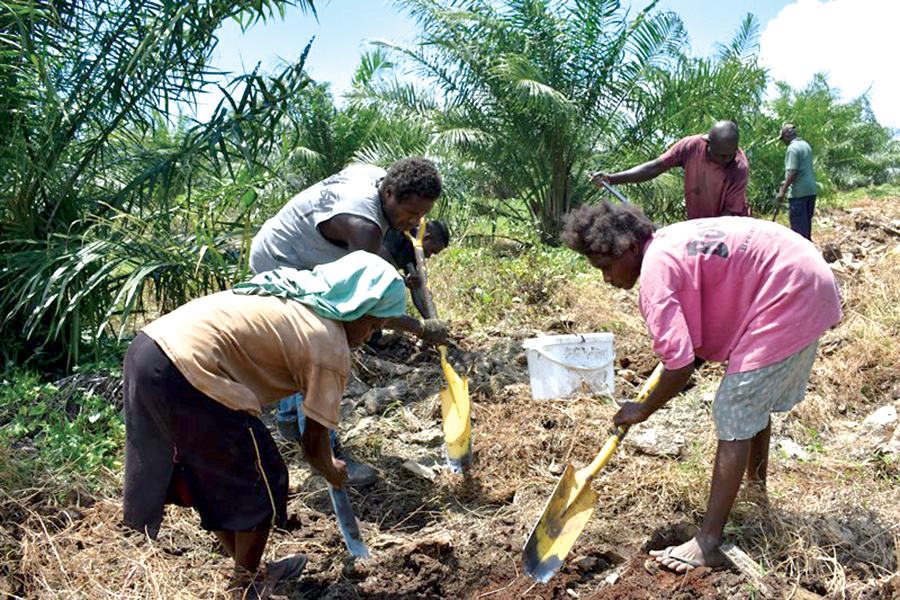
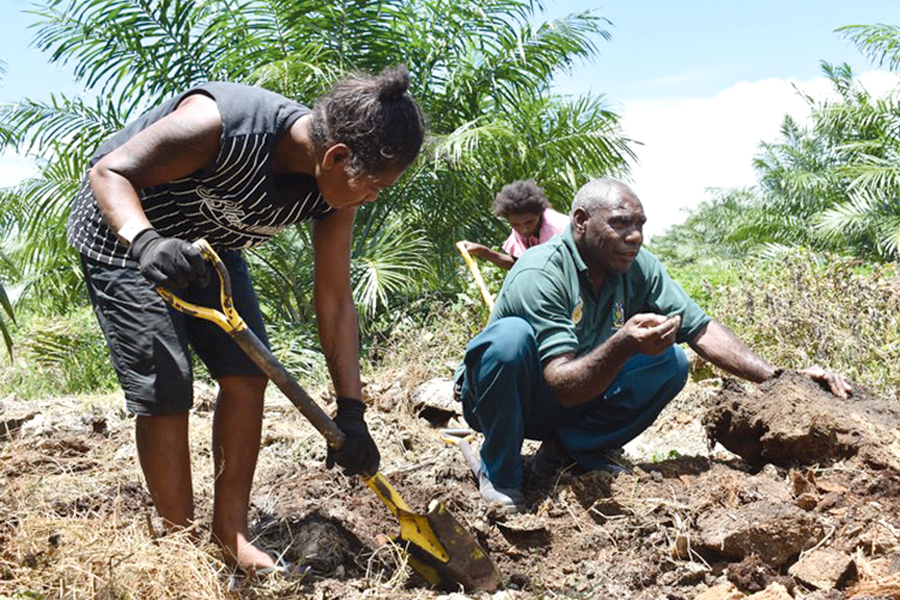
At the moment, GPPOL has been taking initiative to kill and burn the CRB. They also employ people to concentrate only on fighting CRB.

An activity conducted includes chemicals, cleaning up and destroying of the breeding sites by excavator; the beetles love piles of rotten vegetation especially dead, decaying, palms.

Officer from the Solomon Islands Biosecurity assisting a female employee from GPPOL collecting the CRB. PHOTOS BY LYNTON AARON FILIA

Currently GPPOL 2800 palm trees had been chopped down because they were infested with the CRB. 3800 palms will be chopped down soon. This covers about 325 hectares.

Following that, 14 hectares was already replanted with another 3,800 palm ready for replanting.

GPPOL’s Manager for Technical Service Department Alfred Pokana said their challenge for controlling CRB is people turns to spoil its traps.

He said they have been installing one trap per two hectares in the fields but people will always spoiled it which is difficult for to catch beetle.

Pokana said their goal is to reduce the population of CRB.

“This is the first time GPPOL has experienced such a situation. One thing about this pest, we did not have any experience to deal with, so it takes us by surprise,” he said.

Destroying of the CRB at the GPPOL plantation.

Besides, Pokana explained that currently their activities for reducing CRB’s population is mainly on sanitation and it is really effective.

“Our activities are mainly on sanitation in trying to damage their breeding sites, going through the rubbish and looking for larvae and adult beetle,” he said.

GPPOL Operating Manager Mohamad Azahar Saat adds that dealing with CRB is relatively new for them but there has been good sign of recoveries of their palm trees.

He said their challenge is that they are not scientist but planters. He said the way forward is to look at alternatives such as chemicals, virus and destroying breeding sites.

However, Saat said there should be a wider awareness carried out to coconut plantation farmers as well.

“So as treatment is taken, beetle flee outside the boundary and feed from the coconuts then will return that is why we need to work with farmers, government and other stakeholders in the country,” he said.

Meanwhile, the media team also visited the Biosecurity lab at the Henderson Airport, and discovered Solomon Islands Biosecurity has been testing for virus in the CRB.

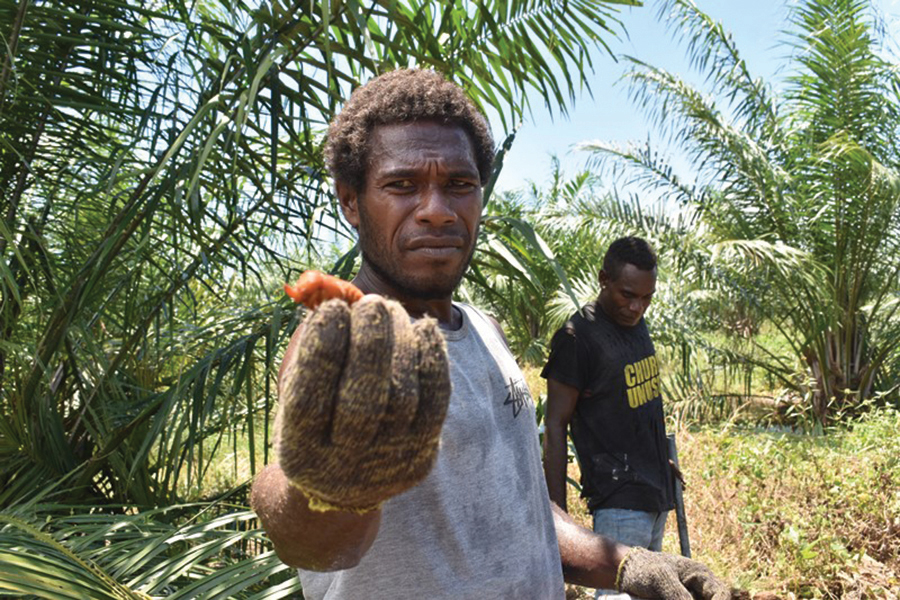
A employee from the GPPOL showing a larvae beetle while destroying their breeding sites.
CRB was discovered while employees destroying its breeding sites.

Cataract remains leading cause of blindness in Solomon Islands

0
Members of the public come for the eye test

BY LYNTON AARON FILIA

Members of the public come for the eye test

CATARACT remains the leading cause of visual impairment in Solomon Islands. This is despite progress made in surgical techniques at the Regional Eye Centre.

The National Referral Hospital Medical Superintendent Dr John Hue said, the country’s top causes for blindness and visual impairment is cataracts.

He said, “The top causes of blindness and visual impairment in the Solomon Islands in the age group of 40 years and above are cataracts meaning clouding of the natural lens in the eye.

Hue also adds, “Another leading causes are refractive errors means need of glasses and diabetes which cause blood vessels to leak and bleed in the eye causing.”

He said as a result it will cause poor vision and blindness and eye infection and injuries also cause visual loss but such are largely treatable.

Meanwhile, the key message for preventing blindness and visual impairment are;

  • If you are having visual difficulties please visit an eye clinic near you
  • If you 40 years of age and above, have an eye check to see if you need reading glasses
  • All people living with diabetes must have yearly eye checks
  • Keep your eyes clean
  • Do not apply custom medicine to your eyes
  • Have regular eye checks at your nearest eye clinic

According to the World Health Organization, people who at risk for blindness begins at aged 50 and above.

WHO also stated that 81 percent of all people who are blind or have moderate to severe vision impairment are aged 50 years and above.

With an increasing population of older people, WHO stated that more people will be at risk of vision impairment due to chronic eye diseases.

Meanwhile, as part WHO’s Action Plan 2014—2019, number of regional workshops were conducted to enable member states shared lessons learned and monitor progress against the action plan.

In addition, WHO is currently developing a World report on vision, which is expected to be launched towards the end of 2018.

Other priority areas of work include the prevention and management of diabetic retinopathy and the building of human resource capacities for eye care.