Home Blog Page 1150

Inundation a real threat for small island nations

0

BY ELLISON VAHI

GLOBAL warming, long in the media forefront, has recently become a thought-fuelled debate.

Recent efforts by such international, and interrelated, organizations as the United Nations Environmental Program, the World Meteorological Organization, and the Intergovernmental Panel on Climate Change (IPCC), have helped create essential standards for discussion, clearly establishing the present and anticipated effects of global warming. Although the spread of tropical storms due to higher temperatures may be more important for Pacific Islands, a greater threat is the long predicted rise in sea levels.

According to the IPCC, sea levels will rise between 0.3 and 1.0 meters by 2100, with a best guess estimate of 0.5 meters. This would double the number of world populations at risk from flooding with a 1.0-meter rise, the number triples. For the smaller island nations, especially the low-lying atolls, where nearly all land is within a few meters of sea level, rising seas cause storm damage, freshwater contamination, and flooding, if not total inundation. Increased coastal erosion worsens flood risk by endangering natural protective features such as sand dunes, mangroves, and barrier islands. Others claim that the Pacific rises less than two millimetres a year. According to Wolfgang Sherer, director of Australia’s National Tidal Facility of Flinders University and part of a Pacific-wide sea level monitoring program, blames the 1999 submersion of two uninhabited islands in Tarawa, Kiribati on localized overuse of freshwater under each atoll, not on global warming caused by industrial nations.

While the Pacific Islands are united in their desire for further anti-emission measures and protective aid, larger industrial nations, have yet to implement already agreed upon reforms.

Researchers frequently cite insecure data in order to de-link sea levels and flood damage from global warming.

One important limitation on the South Pacific Forum’s voice is its exclusion from the Antarctic Treaty System (ATS). Signed before many of these states had achieved independence, ATS gave control of the Antarctic to 43 nations and limited its development to scientific research. Scientists have recently informed foreign ministers from the ATS countries that the West Antarctica Ice Shelf is poised to slip into the ocean, causing a rise of six meters in their lifetimes.

This would mean the total loss of the Kiribati, the Marshall Islands, Tokelau, Tuvalu, and Tonga, as well as large swaths of the Cook Islands, Micronesia, Fiji, French Polynesia, and the Solomon Islands.

Counter measures for flood protection include population and crop relocation to higher ground uncontaminated by salt water. Mitigation, creation of flood ways for drainage, and development of more stable rice crops are all projects currently underway in endangered areas.

While many believe that reducing the adverse effects of natural disasters should be addressed as part of sustainable development programs, the fate of many Pacific nations is uncertain enough to discourage the same foreign investments that would be needed to prevent damage.

The Pacific Islands are not the only areas threatened by floods. Sixteen of the world’s largest cities with populations of more than 10 million are located in coastal zones, and coastal populations are increasing rapidly worldwide.

Adverse effects of climate change needs community to work together

0
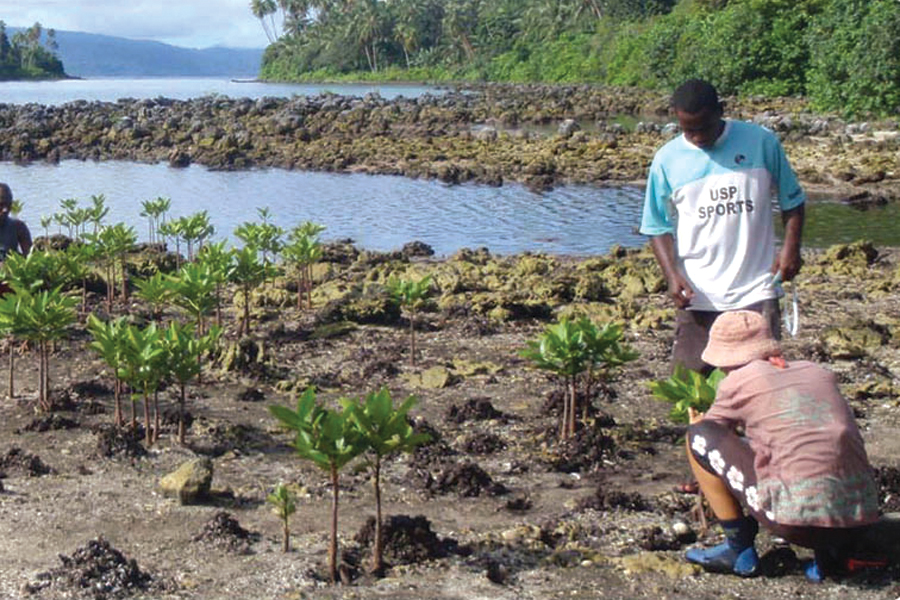
Plant mangroves to protect coastline from erosion.

BY GEORGINA KEKEA

Plant mangroves to protect coastline from erosion.

STUDIES in communities on climate change issues found that communities need to have the strength to confront the issues collectively.

In a study in communities in Roviana, it was found that people need to work together when it comes to adaptation to climate change.

The report found that some communities in there are highly vulnerable to sea level rise with more than half of the village land, inundated if the sea level rises by 50cm.

In a booklet by the Pacific Adaptation Strategy Assistance Programme project in the Solomon Islands, it speaks on the issues of climate change in Roviana.

The lagoons of Roviana and Vonavona are said to support human populations for 15,000 years already.

The history in tribal warfare, religious diversity, WWII, high rainfall, tectonic uplift/subsidence and tsunamis has made the human and ecological communities strong and resilient.

However an assessment conducted more than five years ago found a number of issues are now reducing this strength and making the Roviana area more exposed to climate change.

Changes in weather observed over recent years by community members and recorded in the PASAP project includes more rain, unpredictable seasons, more wind and hotter temperatures.

For its marine life, Roviana has a healthy and diverse marine ecosystem that contains 920 hectares (ha) of coral reefs, 1495ha of seagrass, more than 5000 ha of sparse seagrass and corals amongst sediment, rubble, rocks and algae.

However, coral bleaching and disease is already impacting Roviana and will continue to increase with climate change.

“Nusa Hope Marine Protected Area (MPA) the most well enforced reserve is the only MPA that has less bleaching and disease surrounding reefs. More coral disease and bleaching on offshore reefs compared to the lagoon”, the report said.

Another finding from the project also revealed that lagoon areas experience less disease/bleaching because lagoon corals naturally experience big temperature of changes.

“The actions needed to safeguard the marine ecosystem in Roviana includes protection of herbivore populations that are required to maintain coral reef health, new marine reserves including connections between coral reef, seagrass and mangrove ecosystems as well as protection of lagoon passages as corals there are resistant to temperature fluctuations”, the report said.

While there are also other issues raised, the issue of drinking water is one that needs community support.

Access to clean drinking water is an essential requirement for healthy communities.

However the report found that sea level rise will cause salt water to come into low-lying groundwater wells, making them unsuitable for drinking.

Also community water supply from streams with a forested catchment and from wells located away from the coastline will be very important for the people there.

With these findings, it is important for the Roviana people to keep healthy forests in water catchment areas and not to allow logging operations within 200m of streams or anywhere in water catchment areas.

“Maintain a diversity of water sources (rainwater, wells, stream supply)”.

Whilst some of the factors are externally driven, many can be addressed at the local level through community based adaptation.

The report says through a consultative process, they have been able to identify local actions that will re-enforce existing community strengths.

Actions includes strengthening of marine ecosystems by improved management of mangrove ecosystems, protection of coastal ecosystems through limitation of removal of mangroves adjacent to villages and coconut plantations as well as practice good gardening.

“Better land use planning to limit agroforestry encroachment onto garden lands, training in soil fertility improvement methods, documenting traditional knowledge of garden practices and bushfoods for future generation”.

The report on climate change issues in Roviana calls for greater cooperation from the people there and encouraged them to look after their resources properly.

For Solomon Islands, sea level has risen by a massive 8mm per year since 1993. Temperatures continue to rise since 1951 by 0.15 degrees Celsius per decade, leading to more hot days while the country also experience extreme rainfall days. The storms are also said to be less frequent and more intense.

Giving time, education and investment support to our youth

0

DEAR EDITOR, Jay Bartlett, Board Chairman of the Solomon Islands Chamber of Commerce and Industry (SICCI) made a statement at the official launch of the Young Entrepreneurs Council Solomon Islands (YECSI) at the Mendana Hotel in Honiara on Friday October 12, 2018, which I fully endorse.

He was quoted as having said, “To take full advantage of Solomon Islands’ youthful population we need to make decisions on education, training, policy and programs particularly by building job-relevant skills that support entrepreneurship and innovation.”

Mr Bartlett went on to add, “It is important that we fully understand the population situation we face and the implication it poses for socio-economic growth and development,”

“As a country we currently face a serious skills deficit needed to support economic growth and we need to reconfigure the training supply system that is demand responsive.”

Importantly, in my view, Mr Bartlett said, “Our youth demand our efforts, time and investment and the time to act is now.” Source: Solomon Star news.

In my desire to aid the growth, education and arts training of the youth, with a special interest in seeing the early creation of a National Youth Orchestra, I would appeal to the SICC as well as YECSI and the two Ministries of Women, Youth and Children Affairs and Tourism to help me get a NYO off the ground and to see it prosper and grow in the months and years to come and so prove beneficial to the needs, talents and aspirations of the young people that need “our efforts, time and investment”.

Yours sincerely

Frank Short

PM welcomes new CT scan proposal for NRH

0

DEAR EDITOR, it is very rarely that I wake up, scan through the daily news reports and instantly feel like celebrating.

Today is the exception because after many months of writing to advocate the acquisition of a CT scan for the Solomon Islands National Referral Hospital (NRH) I came across this wonderful piece of news.

Quoting from the Solomon Star newspaper of 10 October 2018 the story read.

Prime Minister Rick Hou has welcomed commitments by an Australian philanthropist to purchase a new Computed Tomography (CT) scan for the National Referral Hospital (NRH).

Lady Primrose Potter the Australian philanthropist shared with the Prime Minister her willingness to raise funds to purchase the CT scan; when she met with the Prime Minister at the Office of the Prime Minister & Cabinet recently.

She said the CT scan is vital equipment, a diagnostic imaging test used to help detect diseases of the small bowel, colon and other internal organs and is often used to determine the cause of unexplained pain.

Lady Potter said it is a state-of-the-art equipment that is fast, painless, non-invasive and accurate.

“I am willing to assist and I will do my best to help raise funds to purchase a new CT scan for the NRH,” she said.

Prime Minister Hou said he has always wondered why Solomon Islands never had this important machine in place over these years.

The Prime Minister said this if purchased would go a long way in helping citizens in this country.

He said it will also cut costs of sending people overseas and also provide surgeons accurate results when testing patients.

“This is welcoming news and I hope we can be able to work together to get this machine into the country as soon as possible,” the Prime Minister said.

Primrose Potter, Lady Potter AC is an Australian philanthropist and arts administrator. She is particularly associated with The Australian Ballet. She is the widow of Sir Ian Potter.

Lady Potter is currently Patron-in-Chief of The Solomon Foundation, a charity that supports various social development projects in The Solomon Islands.

She was founding Honorary Patron of the Melba Foundation, Founding Patron of the Victorian Opera Company, and Patron of the Australian Centre for Contemporary Art.

In the Queen’s Birthday Honors 1988, Lady Potter was appointed an Officer of the Order of Australia (AO) for service to the arts and the community.

In 2003 she was promoted to Companion of the Order (AC) for leadership and for encouragement of support for critical community growth through fundraising and philanthropy in the arts, sciences, education and social welfare.

In February 2010 The Australian Ballet named its headquarters in South bank, Melbourne, the Primrose Potter Australian Ballet Centre, to honor her 35 years of service to the organisation.

She has also been awarded honorary doctorates from Australian Catholic University, and Monash University.

Lady Potter was also accompanied by Ian Hosking the founder of the Solomon Foundation.

Mr Hosking has been very instrumental in connecting Solomon Islands with Lady Potter which the Foundation has made vast contributions to the Solomon Islands over the years. Copyright @ 2018, Solomon Star news.

My heartfelt thanks are extended to Lady Potter and the Solomons Foundation for considering to help the National Referral Hospital acquire a much needed and long awaited CT scan.

Yours sincerely

Frank Short

BSP supporting breast cancer awareness

0

DEAR EDITOR, “The Bank of South (BSP) in Solomon Islands has called on businesses operating in the country to wear something pink in aid of Pinktober.

“The call was made in a press interview with the BSP Country Manager David Anderson last week in Honiara.

“Manger Anderson said Pink Ribbon Charity works on escalating breast cancer alertness across the Solomon Islands as it has become one foremost medical concern which women and girls of this nation and the hospital workers are currently facing today.” Quoting an extract from the Island Sun newspaper – October 15, 2018

I extend my appreciation to BSP and the Country Manager, David Anderson, for supporting a breast cancer awareness campaign in the Solomon Islands.

Breast cancer is the second most common kind of cancer in women

The good news is that mammograms can help find breast cancer early.

Mammograms (X-Ray pictures) are used as a screening tool to detect early breast cancer in women experiencing no symptoms.

They can also be used to detect and diagnose breast disease in women experiencing symptoms such as a lump, pain, skin dimpling or nipple discharge.

Most women can survive breast cancer if it’s found and treated early.

Yours sincerely

Frank Short

Putting JQY’s position as service provider in perspective

0

COMMENTARY

By Alfred Sasako

THE extent of public funding to JQY Enterprise Ltd – a government preferred supplier outlet – angered many members of the public. Some no doubt have their own businesses and are expectant of equal treatment, by politicians who represent them in Parliament.

While the pros and cons have merits, the public appears to have confused the issue of running a business with patriotism. These are fundamental issues and do not need a degree from the Harvard Business School to understand this.

The first irrefutable fact is this. JQY is a business. It provides a service. Everyone ends up at its New Chinatown premises because the company runs a business that provides a service customers need.

That much should be clear. It should be recognised and accepted. Patriotism, on the other hand, is another matter. In fact, many expect their political representatives to show them what patriotism is and what it demands of each citizens.

I have no real issue(s) with the amount of money JQY rakes in every year from hardworking taxpayers. Admittedly, it is a lot of money – some $239 million-plus as at the end of September this year. The source of the funding is just as controversial – the Constituency Development Fund (CDF) grants co-funded by the Solomon Islands Government and Taiwan.

JQY provides a service. It is that service that customers buy all the time. In stating this, I am reminded of what was attributed to World Boxing Legend, the late Mohammed Ali.

He said and I quote, the money we pay for services we use is the rental we pay for living on earth. In other words, nothing is free. We pay for everything we use.

Having had a close look, as I have, at Government computer print outs of what we spent so much money on using one supplier as is the case, raises a lot of questions.

For me the real issue in all this is not so much about how much money was injected into JQY or any other outfit for that matter. Rather, I am more interested to know whether the goods and services for which we pay, have been delivered.

Has JQY Enterprise Ltd delivered the goods and services for which taxpayers have paid? That to me is the $239million-plus question. And this is where the focus should be.

In fact, there are unconfirmed reports that JQY actually received two forms of payments from the government and others. One is in the form of the CDF grants, which is real hard cash, coming directly from the Ministry of Rural Development, the other from politicians and others in the form of private cheques.

The private cheque is a growing portfolio. Many of these cheques bounced. They were paid by leaders who wanted to buy coffins for the death of a Constituency voter. But because JQY does not sell coffins, the cheques were cashed with JQY only to find later the cheques bounced.

There is now a joke making the rounds that by accepting these cheques, JQY is slowly buying its own coffin. Given the size of what it has received over the years in terms of CDF grants payment from government, the company may have already weathered any potential storm(s).

What is needed now is an investigation – a forensic audit to be particular. Because given the amount of money involved and the duration of such transactions, only a forensic audit would uncover any anomalies. Anything short of a forensic audit would be a laughing stock.

Did JQY deliver the services for which payments were made? If not, where has the money gone – are but some of the leading questions that must be asked. These questions are prompted by the absence of development, economic or otherwise, in rural Solomon Islands today.

National youth parliament to build confidence of young leaders

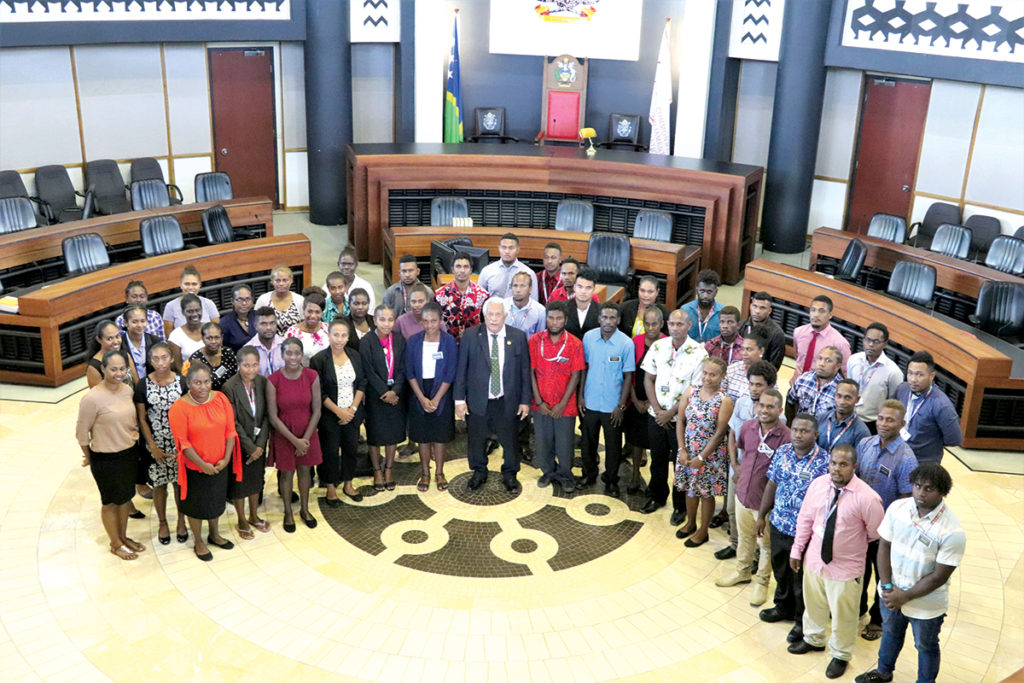
National Youth Parliament participants and speaker of the National Parliament of Solomon Islands Ajilon Jasper Nasiu in the Parliament Chamber on October 15, 2018. Photo by Merinda Valley/UNDP.

AS part of efforts to engage youth in national politics, 50 young women and men are currently gathered in Honiara for the 4th National Youth Parliament.

More than 50 percent of the global population are young people under 30, but according to the Inter-Parliamentary Union, they make up less than two percent of the world’s members of Parliament.

Since its inception in 2009, the National Youth Parliament has involved youth from across the country biennially to learn about the three arms of the state and parliamentary democracy procedures.

Of 130 applicants, 25 women and 25 men were selected to participate in this year’s four-day programme. The youth participants represent all nine provinces of Solomon Islands in terms of places of origin.

In opening the National Youth Parliament today, the Speaker of the National Parliament of Solomon Islands, Ajilon Jasper Nasiu, said the National Parliament embraces youth participation through its education programme.

“By providing a forum in which youths can express their ideas, concerns and expectations, it develops confidence, encourages teamwork and promotes a broader awareness among young people of community issues and processes of government through which those issues can be addressed,” Mr Nasiu said of the National Youth Parliament.

“For some of you, this will define your future and develop your interest to take part in political leadership.”

Nasiu added, “I take this occasion to acknowledge the United Nations Development Programme (UNDP) through the UN Peacebuilding Fund (UNPBF) project with UN Women. The support demonstrates commitment towards youth inclusiveness in the region and Solomon Islands.”

National Youth Parliament participants and speaker of the National Parliament of Solomon Islands Ajilon Jasper Nasiu in the Parliament Chamber on October 15, 2018. Photo by Merinda Valley/UNDP.

In her remarks at the opening, UNDP Solomon Islands Country Manager Azusa Kubota emphasised the importance of youth involvement in the nation’s politics and development.

“Please do not be spectators of what is happening around you in communities and in the world. Get involved. Take it personal. It is your future, so do what you can as a young leader and be the advocate in your community to make a positive change towards the Sustainable Development Goals,” Ms Kubota said.

“With youth making up about 70 percent of the country’s population, collectively, that is a big voice, and it must be heard.”

During the programme, sessions on the separation of powers and parliamentary democracy in the country will prepare participants for a debate in the Parliament Chamber on Thursday.

The 4th National Youth Parliament is facilitated by the National Parliament of Solomon Islands in collaboration with the Ministry of Women, Youth, Children and Family Affairs and made possible with support from the Australian High Commission, the Queen’s Young Leaders Programme through Oxfam and the UNPBF project.

–UNDP, UN WOMEN PRESS

Young Parliamentarians learn about three arms of the state

0

By Gary Hatigeva

THE 50 selected youth participants for this year’s 4th National Youth Parliament (NYP) session were given the opportunity to learn firsthand the existence and importance of the three arms of the state.

The 4th NYP started three days ahead of the debate proper to give time for participants to cover key components of parliament and its function, while at the same time understand the roles of parliamentarians.

Yesterday’s session comes as part of these ongoing trainings and preparations for the major debate session due to take place in the chamber of Parliament this Thursday.

Youths were told that the three arms operate as one or are interconnected but are three separate arms known as the separation of powers, and that these are the pillars that the country is operating under.

They are the Legislature, which represents the members of Parliament, the Executive representing the Government, and the Judiciary, which represents the Courts system of the country.

Participants also learnt that one arm cannot interfere with the function of another in their respective roles and responsibilities but can do check and balances on each other.

As Youth Parliamentarians or representative in Parliament, participants get to understand the roles they are taking on as one arm of the system, which is being a legislature.

They were also given the history of the establishment of the National Parliament of Solomon Islands, with insights to how the term parliament came into existence and used by countries that have parliaments, which was derived from a French term of a place where people get together to debate or discuss issues.

Youth participants also get to further understand the insights of a parliament, its structure and how meetings are coordinated for both parliament debates and committee proceedings, where the Speaker is the head of parliament, gets to preside over meetings of the house.

It was also highlighted during these presentations that MPs are not there to supply copper and materials but to represent the voice of his or her electorates to legislate issues affecting the people and the country.

In the presentation, it is revealed that parliamentarians are to represent all Solomon Islanders through their elected MPs and voice of the people

Youths were also informed that only parliament can make, enact, amend and repeal laws governing the country.

Youths were also told of the three groups that make up parliament, and they include the independent, opposition and the government benches.

They have also learnt that within the government bench has two groups of MPs, which consists of government ministers or ministers of the crown, and government back benchers.

Participants were also informed of the importance of making numbers to rule or form government in parliament, a process they will cover in the final day of this program, before the debate session.

Youths get to understand the roles and responsibility of the opposition group, who according to parliament facilitators, does a check and balance on government’s legislations and give alternative views on laws and issues brought for parliament’s deliberations.

Participants also covered ‘The Experiences and Application of Parliamentary Democracy in the Solomon Islands’ during yesterday’s session and the two major topics according to these youths, have really given better insights to what makes the country a nation under a democratic governance system.

Participants and other youth Organisation reps asked questions and other matters of related to parliament and the independence of the three arms.

The session according to organisers, was very encouraging as most the participants were eager to understand parliament and have more formal understanding of governance, which they (organisers) are anticipate a very good debate session comes Thursday.

The NYP is expected to debate a number of topics during this week’s sessions, but are mainly prepared or geared to dig deep into debating the topic, which looks at ‘Introducing Compulsory Voting in Solomon Islands for the sake of peace-building and social inclusion’.

As for today’s session, youth parliamentarians continue with their preparations, and are expected to cover Parliamentary Committees by get the feel of being part of this procedure.

They will also be covering the electoral process, a sample of how motions are brought before parliament for deliberations, and discuss matters surrounding Youth Affairs, both locally and internationally.

Speaker commends gov’t support to youths

0

By Gary Hatigeva

SPEAKER of the National Parliament of Solomon Islands, Ajilon Jasper Nasiu has given huge commendation to the Solomon Islands Democratic Coalition for Change Government (SIDCCG) in its support towards youths of the country.

The speaker highlighted this when delivering the key speech to mark the official opening of the 4th Youth Parliament yesterday, which currently underway at the National Parliament.

He told a packed gathering of mostly youth participants and guests that the current government is a strong supporter of youth participation in decision making, and it is also reflected in its recently launched National Youth Policy.

“So, with the recent launching national youth policy, I would like to commend the government through the Ministry of Women, Youth, Children and Family Affairs for ensuring that our youths have a place in your policy agenda,” Mr Nasiu stressed.

In acknowledging the Ministry’s representatives present at the official opening, the Speaker pointed out that the group’s attendance gives a clear picture of the government’s high recognition for the youths of this country.

“Your attendance further cements the commitment of the current government, in ensuring that both parliament and other oversight institutions recognise the importance of youth engagements in all sectors of the country.”

On the same note, the Speaker extended his commendation to the United Nations Development Programme (UNDP) through its Peace Building Programme and the UN Women.

“Your support is another fine example of the ongoing commitment towards youth inclusiveness in the region and more specifically, in Solomon Islands,” he added.

Nasiu also acknowledged both the Oxfam and the Australian High Commission office for their support, which he thought will go a long way in shaping the participating youths, whom he is certain, some will become future leaders and better citizens of the country.

“I have no doubt that your support will not go empty handed as the knowledge and skills the participants will learn on parliament and leadership, shall go a long way in preparing them for the future,” the Speaker said.

Before declaring the official opening of the event, the Speaker took time to wish all youth participants the best of luck as they will deliberate and discuss in the remaining days of the programme.

Census office setup soon

0

A separate bureau to coordinate the 2019 National Population and Housing Census operations will be soon be established.

The office will be located within the current National Statistics Office (NSO).

Government Statistician, Douglas Kimi said establishing of the office will happen by next month, November.

He said once the office is establish, there will be a lot of administrative activities, secondment and appointment of staff to be done not only from the NSO but other departments within government to supervise the Census office positions.

Meanwhile, Mr Kimi said since this is a biggest nationwide census survey envisioned to take in records of every citizens no matter what age category and cultural background, it is important that everyone must support and collaborate with the NSO and field officers who will be out in the field for data collection.

He said this is a crucial undertaking to ensure the country have an updated population counts thus collaborative effort and support is indeed appreciative in this regard to guarantee a successful census.

Kimi said unlike other big events in the country like the Election registration which targets only specific age group with other surveys/events, Census is different and the biggest ever occasion as it take record of every individual citizen of a country. The date for the 2019 national census count is yet to be set.

The NSO is also calling on development partners and donors to support the coming 2019 Census in terms of funding and technical assistance.

Also as part of the 2019 census planning and preparatory work, the NSO is currently undertake the Village Resource Survey 2017-2018 and the Household listing exercise.

The VRS has a long history in the NSO.

Initiated in the 1980s, it was then con¬ducted in 1995-1996, then in 2007- 2008 but due to resource constraints the results were only used internally in preparation of the past censuses; the present VRS 2017- 2018 is the fourth one in the series.

The VRS and household listing col¬lects information on services to the village including mapping and also collect information on the location of households by GPS and the number of people per household by gender.

This is the basis for Census enumera¬tion areas (EA) demarcation in 2019.

The survey will play the role of assist¬ing the Solomon Islands Government (SIG) in providing quality data at the village level, which is essential, to see the impact of development, and guide its development efforts and pol¬icy – makers in the future, to improve the livelihood and standard of living for all Solomon Islanders.

The survey now in its final phase and nears completion.

The Solomon Islands Government (SIG) through the Ministry of Finance & Treasury (MoFT) is funding the VRS 2017/18 project.

–SINSO PRESS