MPA for Ward 18 South Rendova Hon. George Solingi Lilo
BY ALFRED PAGEPITU
GIZO
MPA for Ward 18 South Rendova Hon. George Solingi Lilo
HON. George Solingi Lilo, MPA for Ward 18 South Rendova applauds the Executive Government for heeding the PAC call to allow for due Assembly process in dealing with the Revised Budget Estimate in Western Province.
Lilo in contributing to the Assembly last week said, as a matter of fact, the 2018/2019 Draft Revised Budget Estimate was tabled on 24th October. All accompanying documents were submitted over the next few days. The Committee, however, began its deliberations on 24 October to assess the budget papers and set-up the hearing schedule.
Lilo said the public hearings begun on Friday 26th October to Monday 5th November 2018. He said the initial was insufficient for the Committee to conduct a comprehensive inquiry into the 2018/2019 Draft Revised Budget Estimate, hence, the reason for extension into two weeks.
“Before I comment on the Budget itself, I wish to briefly sketch the background to the thrust of my statement and I would like to do that by outlining some fundamental issues from which the Government has drawn its assumption in the formulation of the Draft Revised Budget.”
“Most critical issue that has directly impinged on the Revised Budget is the absence of the Executive Government’s Policy Document the hat should shape the budget outcome during the budget preparation process,” he added.
“This is a serious matter because in the absence of this policy intervention, the budget is being influenced by the preceding year’s policy performance,” said Lilo.
He said by then, the preparation of the 2019/2020 Appropriation Bill would have due and ready for debate on the second or third week of March 2019 as required by PGSP assessment criteria.
THE Malaita Provincial Government has put in place three important pillars for their proposed work on the financial reform.
Provincial Secretary, Mr Jackson Gege recently said the province has turned its focus on improving its capability and attention on some key areas that needs improvement under the reform.
He said the areas includes the governance system, finance and human resource where an upsurge improvement is needed.
Gege said improving the governance system will look at the province’s procurement system like rules and laws that must be followed properly.
He added that finance is another area where province must have adequate capacity in order to source it activities or carry out its obligation.
Gege said human resource is also important for staff to have adequate skills and knowledge to perform to expectation.
He said at the moment the province do not have adequate skills and knowledge in these areas.
“We actually subdue to the system when there is pressure,” Gege said.
He said being trapped in the system doesn’t mean that they have to be there. They must struggle and find a way out of it for the good of the province, Gege said.
Gege said this is the idea behind the reform as they are trying to move the province to a new chapter.
WHILE members of Parliament are anticipating $400,000 terminal grant each any time soon, government Lawyers are anticipating a sit in strike on the 4th of December 2018.
Again the cause for strike is the terms and conditions of service for government lawyers.
Since 2012, the Government Lawyers Association (GLA) has been pushing for a scheme of service to improve their terms and conditions of service. Six years on, they are still singing the same song, but now with a raspy voice.
Just in October (last month), a strike notice was issued by government lawyers, ie; Lawyers from the agencies, the Attorney General’s Chamber, the office of the Director of Public Prosecutions, the Public Solicitors Office, the Law Reform Commission, the Office of the Public Trustee (under Registrar General’s Office) and the Policy section of the Ministry of Justice and Legal Affairs.
It is no secret that lawyers are struggling with extreme workload and are the ones tasked to consult, and write up policies/laws that government (MPs) takes to parliament to deliberate on.
On top of that, the judicial sector is constantly faced with challenges to keep experienced and/or lawyers in the sector. Much of government’s advisers in the judicial sector are a group of young Solomon Islanders. Most experienced lawyers have already left the government to establish their own businesses where the grass is greener.
The latest of government’s dedicated and long serving lawyer that had handed in his three months resignation recently, is based in Auki. He’s absence will be greatly felt by the Judicial sector.
Throughout the years, GLA has been pushing the Ministry and Government to address their scheme of service.
In 2012, GLA says government had been sleeping on this issue. In 2018, government is now said to drag its feet in this issue, with Island Sun reliably informed that a proposed salary structure for government lawyers is before the Ministry of Commerce, Labour and Immigration.
However because of the complexities surrounding this issue (as a draft National Wage policy is also in the making), work has not been able to progress as expected.
Without addressing the MOU and a scheme for lawyers, government and the people will lose out on the much needed service of lawyers (in the form of public solicitors etc.).
The requirements and challenges on the role of lawyers are quite high, and what is needed is to ensure a lawyer is able to perform his/her function to a level where the right quality service is delivered. This guarantee is missing.
Island Sun has not been able to get comments from the Permanent Secretary of Justice and Legal Affairs to find out the status or progress of the said ‘scheme of service’ or the strike notice when this paper goes to print.
However it is understood that in 2012, the Memorandum of Understanding signed between Government and GLA obligates the government to review the full conditions of lawyers’ services.
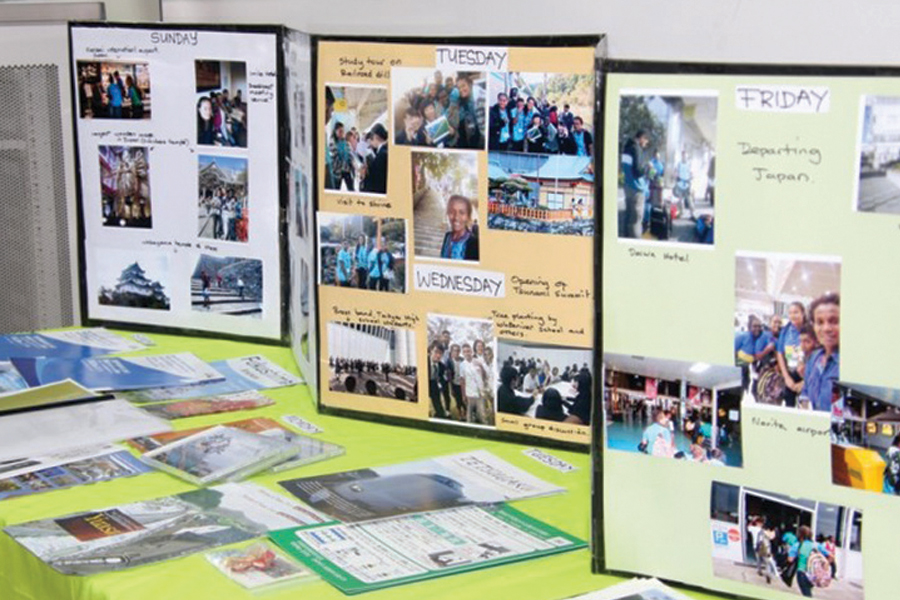
A display of activities students participated in while in Japan.
BY LORETTA BRIGIDIA MANELE
SCHOOLS should have natural disaster plans to help them prepare for natural hazards in the future.
Jonathan Tafiariki, Deputy Director of the National Disaster Management Office (NDMO), says it is important schools have disaster plans.
He said his office has carried out a program called the “safe school program”. In this program, they have worked with schools and help guide the development of their natural disaster plans.
He said Florence Young Christian School is one school which has been fully participating in developing their own plan.
Tafiariki mentioned that they are also aware that other schools are also working on theirs.
He says it is highly important that schools have measures to ensure that they are prepared so that families whose children are at school when a natural disaster takes place do not panic.
Tafiariki said this is concerning especially when most of our schools are located along the coast.
With this being the case, he says in time of tsunami warning, roads will be flooded with vehicles because parents will be searching for their children knowing that schools do not have natural disaster plans.
Tafiariki furthers that if schools have natural disaster plans, they would have the trust of parents and the situation would be much different.
A display of activities students participated in while in Japan.JICA officers.Students from White River delivering their presentation.
Guest of Honour Hon Stanley Sofu dilivered his speech during the launching
FUNDING for the construction of a new wharf in Ugi has been approved. This was revealed by Hon. Stanley Sofu, Minister for Infrastructure Development (MID) in his address to the people of Ulawa/Ugi on the launch of their new ship.
Sofu said a contractor has been awarded to construct the wharf. MID is currently awaiting formalities, Sofu said.
Meanwhile, Member of Parliament for Ulawa/Ugi William Marau said roads around Ulawa will be tar sealed soon.
This comes after the MID approved funding for road upgrades on the islands, Marau said.
Marau said the road upgrade will go in line with other infrastructure development projects on the islands.
He said work on improving the road will possibly start early next year.
TRAVELLING to attend the World Tsunami Awareness Day was a remarkable trip says White River Community High School’s Social Science teacher, Ashlyn Sese Hou.
Ashlyn was with five of her Form four students who had represented the country in this year’s High School Students Summit on “World Tsunami Awareness Day” in Wakayama, Japan.
She said what they had learnt from the summit was how schools can help prepare for natural disasters like earthquakes and tsunamis.
Hou highlighted “awareness drills” as an important area where schools in Solomon Islands can also carry out in their school.
She said this is something that needs to be promoted in schools from kindergarten to secondary level of education.
Hou explained that if students are well versed with awareness drills which include maps showing safety zones, they would know where to run and move to higher grounds in times of natural disasters.
She also mentioned that if people were already prepared they can escape death.
In this regard, Hou commends Japan for its work in making them more aware about measures to tackle natural disasters.
Hou stressed that given Japan’s status as a country with an aim to promote international understanding and raising awareness of natural disasters, Solomon Islands is fortunate to be part of the summit.
She added that while they learnt a lot about natural disasters and prevention measures they were also fortunate to visit a high tech country that has changed their way of thinking.
Hou said after departing Japan, they returned to the country as changed individuals with new vision and spirit about spreading the message of tsunami awareness.
She is positive that results of this trip will be evident in years to come.
It is understood that Honiara High School students represented the country in last year’s summit.
Hou thanked the government of Japan and Ministry of Education and Human Resources Development (MEHRD) for selecting White River Community High School to participate in this year’s event.
Gold Ridge Mine Board members and executives present the Project Feasibility Study and supporting documents to the Hon. Minister Bradley Tovosia,
Minister of Mines, Energy and Rural Electrification and the A/Director of Mines, Mr Joseph Ishmael.
THE Feasibility Study developed by Golder Associates, demonstrates that Gold Ridge Project is economically viable and technically feasible.
Yesterday, Gold Ridge Mine Executives met with Honorable Minister of Mines, Energy and Rural Electrification Bradley Tovosia to deliver the much anticipated Feasibility Study to the Solomon Islands Government.
With a capital cost (including the start-up cost) of around AUD 140 million, a 13-year life of mine (LOM), and with the assumption of a long-term gold price of USD 1,300 per ounce, the financial model demonstrates that the project will be cash flow positive in its fourth year of operation.
Given the Gold Ridge ores are mostly fresh ore, as opposed to oxide ore, the flotation process is recommended initially to produce gold concentrate while refinery onsite options are being further assessed.
The benefit of the flotation method to produce gold concentrate is first that no cyanide will be used in the production process which means that the environmental impact of the project is significantly reduced.
Gold Ridge Mine Board members and executives discuss the economic, environmental and social benefits for landowners, Solomon Islands Government and investors of the Gold Ridge Mine Project Feasibility Study with the Hon. Minister Bradley Tovosia, Minister of Mines, Energy and Rural Electrification and the A/Director of Mines, Mr Joseph Ishmael.
Secondly, the method means that GRML can recommission the mine and reach full production two years quicker which lets the project reach a cashflow positive position for the benefit of government, landowners and investors much sooner.
The redesigned and refurbished process plant will have a processing capacity of 2.5 million ton per annum. The processing design builds on the metallurgical test work carried out by Xiamen Zijin Technology of Mining and Metallurgy Ltd. (Zijin) in late 2017 and the process plant refurbishment and redesign work undertaken by China Nerin Engineering Co. Ltd in 2018.
An independent study by the Griffith University in Australia shows that the total macroeconomic impact of reopening the Gold Ridge Mine and injecting new capital is expected to generate significant economic benefits for the Solomon Islands economy.
It is estimated that the initial investment will contribute around 59 percent of the total forecast foreign direct investment for 2020. Based on previous gold mining experience in the Solomon Islands, the project is estimated to directly contribute around 9.3 percent of the GDP of the Solomon Islands in 2020, and about 6 percent of GDP annually over the life of the mine. Gold exports are expected to make around a 17 percent contribution to total exports.
Gold Ridge Mine Board members and executives present the Project Feasibility Study and supporting documents to the Hon. Minister Bradley Tovosia, Minister of Mines, Energy and Rural Electrification and the A/Director of Mines, Mr Joseph Ishmael.
The project production phase will initially employ approximately 250 to 300 direct jobs with 70 percent of the unskilled and semi-skilled roles forecast to be employed from the local catchment and the Solomon Islands.
The project’s indirect employment impact through the demand for workers and services by the mine and across the supply chain is the creation of approximately 6,723 job opportunities.
The Feasibility Study identified that there is also significant potential to extend the life of the operation through future exploration.
“This project represents a significant nation-building opportunity for the people of Solomon Islands with significant economic and social benefits of the project for the landowners and communities of Gold Ridge if carefully managed.” said Mr Naezon, a Director of Gold Ridge Mining Limited (GRML) who represents the interests of the Gold Ridge Mine landowner catchment who have a ten percent equity share in the mine.
“We have studied the lessons from the past and we know the factors needed to ensure the mine’s success” said Mr Allen Wang, Director-Elect and GRML’s Assistant Chief Executive Officer.
“The project requires an uncompromising focus on gold recovery and cost management; responsible tailings and environmental management; and the embedding of the landowners and communities of Gold Ridge as true equity and development partners” said Mr Wang.
For landowners to realise the benefits of the mine however, requires them to take their respective project responsibilities. A key responsibility of landowners and Chiefs at this stage is the removal of pit miners who are illegally panning for gold in the pits.
Landowners must also show commitment and be empowered to save and invest for the long-term and to ensure that equitable and inclusive royalty and dividend distribution mechanisms are put in place to share in the wealth generated from the mine.
“We will play our part, to turn Gold Ridge Mine into a profitable long-term operation, for the benefit of landowners, the Solomon Islands and investors, and we need landowners to underpin and reinforce this opportunity and for all key stakeholders to support us”, said Mr Richard Gu, Director of GRML and Chairman of AXF Gold Ridge Pty Ltd.
“We call on the Solomon Islands Government and the donor community to rally behind the project, and in particular, to support the landowners, communities, women and youth of Gold Ridge to derive long-term benefits from the mine”, said Mr Gu.
GRML are progressing a number of plans to demonstrate the company’s long-term commitment to the project and landowners. The plans cover environmental, tailings and social performance management, future planned exploration, local employment and workforce localisation, local buying and business development and community and landowner development.
Gold Ridge Mine is a brownfield open pit gold mine located in Guadalcanal Province, Solomon Islands.
LC Lokoiola being escorted before the launching program begins
BY MAVIS NISHIMURA PODOKOLO
THE Member of Parliament for Ulawa/Ugi Constituency, Honorable William Marau has been praised for facilitating much needed infrastructure for Ulawa/Ugi.
Through assistance by the Ministry of Infrastructure and Development (MID) and through the Rural Constituency Development Fund (RCDF), Marau was able to deliver the projects to his Constituency of Ulawa/Ugi.
Marau has been providing a number of projects for his Constituency with one of them being the delivery of LC Lokoiola that was launched earlier this week. Also a market house and two warehouses in Ulawa and Ugi including the purchase of vehicles for land transport for the two islands.
Speaking on behalf of the people of Ulawa and Ugi, Toswel Tahisau in relation to the market house said, it will provide shelter for them during bad weather.
Tahisau said women will now be able to sell their products in a conducive environment.
He said beneficiaries of these facilities must work together to care and make good use of these facilities.
Tahisau said the people of Ulawa and Ugi are also thankful for the standard warehouse both in Ulawa and Ugi.
“These storage buildings have now served their purpose in which people are benefiting from now,” he said.
Betrina Roraimae of Ulawa Ugi Council of Women says they applaud Hon Marau and the Constituency Management for fulfilling one of their (women) key priority needs which is the market house.
Roraimae said this is a great achievement especially for women and children of the two islands.
Few other projects are still progressing like Hydro power lighting system and the housing schemes. Some will start next early next year.
I was pleased to read a report in yesterday’s Island Sun newspaper which foretold that the Solomon Islands Government will, next year, launch another report on the implementation of the Convention on Biological Diversity.
I will be keen to learn what the government has done, and intends to do further, to address biodiversity decline and pollution at home.
I mention pollution in relation to the protection of the environment because of what I have come to learn of the pollution of the Mataniko River being used as a dumping site for household rubbish and other forms of garbage, including plastics.
What should be a pristine river is now so badly polluted by rubbish, I am reliably told, all forms of life in the river may have died or are continuing to die.
I know that a start was made to raise public awareness of keeping the river free from pollutants such as rubbish but gather despite some good progress with a river clean-up project the Mataniko river still remains relatively polluted from liquid and solid waste from human settlement, residential areas and shops operating and living adjacent to the river.
It is clearly an ongoing challenge to the local authorities and the volunteers to bring about a change in mindset about the disposal of rubbish into the river and they should be congratulated on their efforts to date, but much more needs to be done to eradicate the waste disposal continually occurring.
Tonight, Thursday, 22 November 2018, I will be mindful of what I have written about the pollution in the Mataniko River because of a thoughtful ceremony taking place in Thailand called Loi Krathong.
The ceremonial festival is celebrated annually throughout Thailand on the evening of the full moon of the 12th month in the traditional Thai lunar calendar.
The festival may have originated from an ancient rural ritual paying respect to the water spirits and these days a way of expressing regret for having in any way polluted or misused the river.
During Loi Krathong, which generally last three days, Thai people go to a river, canal or pond where they float hand-made krathongs, made from a banana tree trunk and banana leaves, held together with pins, and decorated with flowers. They usually make a wish when placing their krathong on the water.
These days, krathongs are more often made of bread so it will disintegrate after a few days and can be eaten by fish. Banana stalk krathongs are also biodegradable.
Some krathongs are decorated with elaborately-folded banana leaves, three incense sticks, and a candle.
As I put my own krathong on the local river this evening I will make a wish for a pristine Mataniko River and for better public awareness of the duty and responsibility to keep it that way for all to enjoy.
THE Royal Solomon Islands Police Force (RSIPF) is concerned about the frequency of accidents happening at logging camps throughout the country and has called on companies to put in place safety measures to minimize fatalities at the camps.
“The latest fatal accident is that of the Malaysian Camp Manager at the MEGA Logging Camp at Fulo in West Dorio in the Malaita Province yesterday (21 November 2018).
The Camp Manager died after the rim on the tyre of the loader machine he was pumping flew out and hit him, killing him instantly,” says Supervising RSIPF Commissioner, Juanita Matanga.
She adds: “It was only a couple of weeks ago that another foreign national died at a logging camp during a road accident in West Rennell.”
“I want to call on all logging companies in the country to institute safety measures at their logging companies and ensure that all their vehicles are in good working order to reduce the chances of accidents,” says Supervising Commissioner Matanga.
“I also urge provincial governments to consider proposing bye-laws to minimize accidents at the logging camps.”
Supervising Commissioner Matanga explains: “Police cannot be at the logging camps all the time so the responsibility rests on the management of the companies to make sure whatever safety measures are adhered to in order to minimize any chances of an accident.”