Home Blog Page 1086

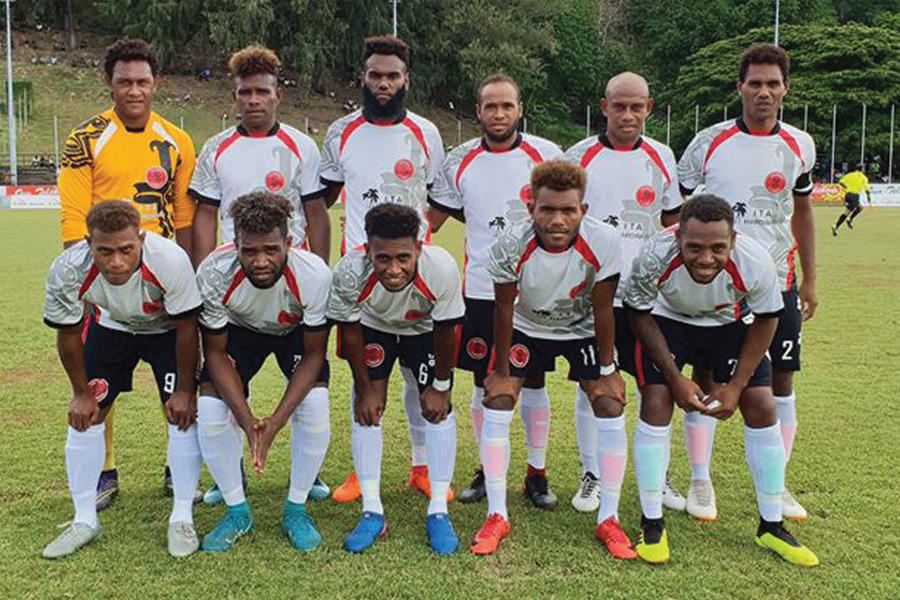
Warriors, Eels secure oceania spots

Solomon Warriors FC

BY ROMULUS HUTA

TELEKOM S-League defending champions Solomon Warriors and Henderson Eels have secured the country’s two Oceania Club Champions League spots next season.

This follows the turnout of results over the weekend.

The Sunday encounter between KOSSA and Real Kakamora which ended in a two-all draw facilitated for the early qualification of Eels, while Warriors’ place was already determined after marching on with the 10-1 thrashing of FC Guadalcanal in the earlier contest yesterday.

KOSSA was aiming for one of the allocated spots in the region’s premier club competition next season prior to the contest with Real Kakamora after they find themselves trailing in third place with 22 points. However, the two-all draw yesterday took out the fighting chance they have and allowed Eels to take the honour despite still having a match to spare.

With the two-coveted Oceania spots now occupied, the battle for the league’s title is still on between leaders Warriors and Eels, subjected to the results of this weekend’s final round of actions at Lawson Tama Stadium.

Winning the league comes with another opportunity and that is to host the Group D competition of the Oceania Champions League at home next year.

A win for the Moses Toata’s side in the final fixture against Malaita Kingz this Saturday will certainly hand the three-time TSL winners their fourth domestic title and also the opportunity to host the Group D competition.

The same goes for Eels where they will have to wait on the result between Warriors and Kingz, who are playing in the 2pm contest on Saturday to see if there is any slip-up by the defending champions before taking on KOSSA at Sunday 4pm.

Meanwhile, Warriors continue to dominate the table after bagging another three points against FC Guadalcanal. After 13 matches, they remain at the top with 29 points ahead of Eels, who trails in the second place with 27 points after recording a vital 6-2 win over Marist on Saturday, while KOSSA remain in third place with 23 points.

Malaita Kingz is in the fourth position with 20 points after seeing off Western United 2-1 on Saturday.

See TSL current standing below.

TSL updated Table as at

Pos. Club MP W D L GF GA GD Pts
1. Solomon Warriors 13 9 2 2 47 13 +34 29
2. Henderson Eels FC 13 8 3 2 43 21 +22 27
3. Kossa FC 13 6 4 2 29 17 +12 23
4. Malaita Kingz FC 13 6 2 5 26 25 +1 20
5. Western United 13 5 1 7 26 29 -3 16
6. Real Kakamora FC 13 4 4 5 25 37 -12 16
7. Marist FC 13 4 2 7 20 29 -9 14
8. FC Guadalcanal 13 0 1 12 12 57 -45 1


We only make recommendations for submissions: MOFT budget unit

0

BY LORETTA BRIGIDIA MANELE

“WE only make recommendations and Cabinet makes the decision.”

This was expressed by Supervising Deputy Director of Ministry of Finance and Treasury’s Budget Unit, Marcellina L. Iro to participants of the two day “Bringing the Budget Closer to Home” training that was held last week.

Moreover, speaking on ministry submissions, she said for new initiative programs, ministries are required to submit bids for additional funding.

Mrs Iro adds that whilst doing this, they also expect that they provide supporting documents and submissions with proper costs.

She said they also have budget templates where ministries are asked to insert their planned activities for the given year based on their annual work plan, associated costs, and key outputs of the activities they want to carry out.

After this is received, Iro says they carry out assessment on these submissions before they provide feedback which includes information like the total number of bids, why some bids were recommended and why other bids were not recommended.

She mentioned that the assessment criteria they use relates to government policies and priorities.

This includes things like whether a ministry which has submitted a bid for a project is the rightful ministry to implement that project or whether there is money or funds to cater for submissions made for new projects or continuing projects.

She emphasized that the Budget Unit only makes recommendations on these submissions while Cabinet has the final say.

“Every submission given we will make recommendations for before submitting it to the cabinet which makes the decision”, said Iro.

She stressed that there are also challenges they come across with one of them being ministries seeking approval from Cabinet before getting recommendations from them.

Iro furthers that this is one challenge where they are trying to address by communicating with ministries to make sure that any submissions or requests they have is brought to Finance first so they can see if there is funding for it before we can make recommendations to Cabinet.

Malaita Province to review staff instructions

0

BY SAMIE WAIKORI

AUKI

THE Human Resource Manager’s Office within the Malaita provincial administration is working towards reviewing its staff instructions.

This is one of the activities under the roadmap drawn by the HR office for the province as part of the strategy to reform the provincial administration.

Human Resource Manager for Malaita province, Mr Richard Misi said just recently they completed a management workshop gearing towards review of the MPSI.

He said the intention behind the review was so that it fits into the current face set of this age.

Misi said there was a staff instruction document in place which was drawn out of the general order of the public service and there are weaknesses identified with the instruction that needs reviewing.

“The idea behind that is for staffs under Malaita province, both direct and seconded staffs to have bible everyday to follow.

“Because the latest edition of the staff instruction was done in 2007 and needs to be reviewed.

“So as part of the roadmap we will review MPSI,” he said.

He said areas to review under the MPSI covers the direct staff code of conducts, their movements, holiday leave, sick leave and others.

Misi said the review will take certain stages of workshop including feasibility in substations and other provincial own institutions within the province.

He said his team already visited some institutions this year and the remaining ones are scheduled for next year.

Misi said the visit is purposely to obtain first hand data from those stationed there and see how the current MPSI affects them.

“Because inside the MPSI it stated the cost for allowance, travelling and other within it that needs reviewing.

“For example, the $50 touring allowance started within MPSI is no longer relevant at the moment, we need to get exact information and put it into the review of MPSI,” he said.

Misi added that MPSI also holds the disciplinary measure of MPG, that if staffs breach the rules or regulations they will subjected to MPSI where particular clause to deal with the offence concerned.

For instance, he said MPSI has the right to warn a particular staff three times if instructions are breached.

He said they believe the review of this MPSI will help to strengthen the workforce of the province.

Misi said they already launched a proposal on the review to the MPGIS, and the greenlight to carry out the programme next year was already given.

Budget briefs to raise the level of debate during discussions on the budget.

0

BY LORETTA BRIGIDIA MANELE

ACCORDING to Roland Sikua, national parliament’s Chief Research Officer for the Library and Research department, budget briefs aims to inform and raise the level of debate when it comes to discussions on the budget.

Sikua was speaking at “Bringing the Budget Closer to Home”, a two day training session co-hosted by Pacific Media Assistance Scheme (PACMAS) and the national parliament office for journalists and local media from Nov 29th -30th at the Paul Tovua Complex building in Honiara.

He said budget briefs are prepared by the parliamentary budget team which is headed by the Public Accounts Committee (PAC) secretary and consists of staff from the Committee Secretariat and staff from the Library, Research and Information services of the national parliament.

Sikua expressed that these brief documents which they prepare for members of the PAC and members of parliament contain information such as trends of a ministry’s budget over the past four years, relevant SIG policy areas concerning or relating to the ministry and issues raised by the ministry in relation to the budget.

Assisting with the inquiry of the budget by the PAC is another role of the parliamentary budget team.

He said this involves a rapporteur during the inquiry, in other words, someone assigned to report the proceedings of the inquiry.

Sikua adds that they also compile issues and recommendations made by the committee (PAC) that are to be included in their report.

UNDP and PEJN enhance journalists on climate early warning system reporting

0

BY JARED KOLI

In Nadi, Fiji

A weeklong workshop aimed at enhancing pacific journalists to report accurately on Climate Early Warning Systems (CLAW) and related issues kicks off in Nadi, Fiji today.

Held at the Tanoa International Hotel Convention Center, the workshop was a collaboration between the United Nation Development Program (UNDP) Pacific Office in Fiji, the Pacific Environment Journalists Network (PEJN), with support from the India-UN Development Partnership Fund.

The workshop designed at strengthening knowledge and empowering the ability of journalists from the Pacific Islands including those from the seven focus countries – the Cook Islands, Federated States of Micronesia, Kiribati, Nauru, Republic of the Marshall Islands, Solomon Islands and Tonga to report accurately and more regularly on Climate Early Warning Systems and related issues.

A concept note states it aims to improving networking and partnerships amongst Pacific Island reporters and regional climate change experts, ensuring a regular flow of information and post activity.

“Improved news content in Pacific Island media through the conceptualizing, discussion and development of a range of relevant news and in-depth stories over the duration of the activity/workshops highlighting Climate Early Warning Systems and related issues.

“The goal will be to inculcate amongst these regional journalists a sense that these issues can be prominently mainstreamed into their daily reporting activities, instead of one-off seasonal events such as a cyclone or torrential flooding,” it states.

It also aimed at improved relationships between the Pacific media and key partners such as UNDP, the Indian Government, PEJN and the Internews-Earth Journalism Network (EJN).

Facilitators include Climate Early Warning Systems and climate change science experts, Meteorology experts, and others include from Earth Journalism Network, PEJN and UNDP.

About 14 journalists, with a selection based on membership with the PEJN from focus countries – are attending the workshop.

They are joined by other seven journalists from the non-project focus countries, four journalism students from USP and five Fiji working journalists.

UNDP, PEJN and India-UN Development Partnership Fund have justified that as with any major project, generating and sustaining awareness and visibility is critical to its long-term success.

“This reflects the Partnership Funds vision to work closely with the media as vital development partners to help Pacific Island Countries’ boost their capacity for disaster preparedness and recovery, especially in the areas of national meteorology and hydrology services.”

It says for many of the workshop participants, this could also be the first time for them to be exposed to some of the concepts and practices associated with CLEWS.

“While climate change articles routinely feature in the media, there is not much discussion on CLEWS. Journalists there may not necessarily consider CLEWS as part of their core work and this training workshop hopes to change that by enticing them to integrate it into a cross cutting and all-encompassing issue.”

Updating news on the Solomon Islands Rural Development Programme 2008-2020 for an external audience

0

DEAR EDITOR, In early 2008 I read that up to $31.8 million was to be injected into the Solomon Islands Rural Development Programme in a joint investment initiative by the World Bank, Australia, the European Union, and the International Fund for Agricultural Development and the Solomon Islands Government.

The investment programme was aimed at raising the living standards of rural households by improving infrastructure and services, as well as helping the Ministry of Agriculture and Livestock to deliver advice and services to farmers.

Phase 2 of the intended programme would run from 2015 to 2020 and would ensure small scale village infrastructure projects in every ward of Solomon Islands, support alliances between the private sector and smallholder farmers and stimulate agribusiness activity in rural areas.

As Phase 2 is already 3 years into its programme, it would be helpful to know how the plan has worked out and what village infrastructure projects are already providing rural people with the income they need.

In addition, could it be said what is expected to see developed in support of Phase 2 in the next 2 years?

I am aware of the advice given to cocoa farmers and the increased crop yields that have added to exports.

Palm oil production has continued to be a contributor to agro-crop exports and I am hopeful that one might yet see local kava production and sales aid rural people.

With the very recent discovery of gem quality moisannite in East Kwara’ae, perhaps some attention might be devoted in the remaining years of Phase 2 to support the idea of a local cottage industry as envisaged by the Technical Institute of Malaita (TIM)

My website www.solomonislandsinfocus.com attracts a wide international audience and it would be of interest to be able to demonstrate the success of the jointly supported and financed Rural Development Programme.

Yours sincerely

Frank Short

The key to strengthening governance of Non-communicable Diseases in the Solomon Islands

0

DEAR EDITOR, Last week in Honiara, the Prime Minister, the Hon. Rick Hou, spoke at the round table meeting with the Ministry of Health and Medical Services and the World Health Organisation (WHO).

The PM outlined the fact that the Pacific Islands countries have the highest prevalence of ‘tobacco use’ than the global average of 23 percent.

In the Solomon Islands, Prime Minister Hou said the average prevalence of tobacco use was almost double the global average of about 44 percent.

The PM went on to say how the Pacific had been described as the epicenter of the global diabetes epidemic and the world’s capital of NCDs.

Referring to Non-communicable diseases (NCDs) the Prime Minister said it was “better late than never to tackle the problem” posed by NCDs.

Given that statistic show that 70 percent of all deaths in the Solomon Islands are attributed to NCD related illnesses such as diabetes, heart disease, cancer, stroke and chronic respiratory diseases, to give just a few examples, it is indeed a very sad irony that it is only now that the “penny seems to have dropped” to do something about tackling the killer disease that has cost so many lives already.

It is also, to my mind, a double irony because it is well documented that in July 2014, Pacific Health Ministers and Economic Ministers approved the Pacific NCD road map, to guide each country’s efforts to reverse the trend of the NCD epidemic in the region.

Sadly, however, 7 years after the declaration of the NCD crisis, and four years after the call to develop national NCD road maps to combat the NCD epidemic, very few countries have heeded the call.

In the Solomons what might now change to make things happen?

One has to comment, despite the excellent set of policy options contained in the NCD road map report, the fact remains that the MHMS is constrained by their lack of resources, including physical infrastructure, health workforce and sustainable financing.

Where health budgets are severely limited, as is the case in the Solomon Islands, the government may be forced to choose between treating people who are sick, and seeking to reduce the future burden of NCDs and associated expenditures.

Quoting an extract from a World Bank report in 2014, one reads:

“It is not surprising that the political imperative to direct limited resources towards those who are currently sick often wins out. For this reason, there is a strong case for governments to seek to expand their revenue base at the same time as they scale up their budget for NCD control, particularly by increasing taxes on those products that most contribute to NCDs, including tobacco, alcohol, and unhealthy foods and sugar‐sweetened beverages.”

“Despite this, raising taxes may be politically challenging for governments: ‘the [political] pain in raising taxes is now, [whereas] the public health gain is later”

One might say here that for all the reasons, the challenge Solomon Islands face it is not the lack of knowledge about the policies that could make a difference, but implementation: translating knowledge into actions at the country level.

Whether seeking to raise taxes, or to implement other regulatory responses the government would likely face resistance from tobacco, alcohol and processed food industries and potentially from other countries, including development partners.

What I see is required today is the political leadership and politicians who will become ‘issue champions, ‘ in pursuing a policy of strengthening health systems, re-focusing on primary care and getting greater regional and international cooperation to be sustained by accountable monitoring systems to measure progress.

Although urgent action on NCDs makes good economic sense for the Solomon Islands government the challenge of NCDs is more than just about responding to rising health expenditures, or the impoverishing impact of out‐of‐pocket payments on families.

The real key is the absolute obligation of the government to take action on NCDs which is enshrined in the right to health, a universal human right.

“All countries have ratified at least one international treaty that imposes obligations on government regarding the right to health.” (WHO 2014)


Yours sincerely

Frank Short

www.solomonislandsinfocus.com

Solomon Islands: A Member of Parliament, Mathew Wale, MP, has claimed health shortages are costing local lives

0

DEAR EDITOR, Friday, 30 November 2018, Radio New Zealand broadcast a news bulletin via its Pacific Service citing a Solomon Islands MP, Mathew Wale, as saying the Solomon Islands government’s failure to address drugs and equipment shortages in hospitals around the country was costing lives.

The news broadcast went on to say that “part of the reason for recent drug shortages was a change in the procurement procedure at the Ministry of Health.”

‘Take My Hands’ (TMH) my partner charity based in New Zealand and the very recent winner of the NZI Sustainable Business Award 2018, entered into a Memorandum of Understanding (MOU) agreement with the Solomons Ministry of Health and Medical Services and the National Referral Hospital (NRH) over three years ago to supply the NRH with regular shipments of containers with essential medical supplies and equipment such as hospital beds, mattresses, side tables, mobility aids, including wheel chairs and other basic needs, as assessed as being needed by the procurement personnel of the NRH.

The second phase payment needed to secure the continuation of such supplies has not been met by the MHMS/NRH and consequently the shipment of containers was suspended a year ago.

To meet an urgent need for hospital beds at the NRH and two provincial hospitals a donation of some $US,11,000 was given to TMH by the Solomons Forest Association (SFA) and this led to a container of 50 hospital beds and some wheel chairs being shipped and received in Honiara on 17 November.

A second 40 foot container with another 50 hospital beds and more wheel chairs is expected to leave Auckland soon for Honiara.

It might be recalled that earlier this year Radio New Zealand, in another broadcast, illustrated the shocking plight of many patients at the NRH sleeping on the floors in the corridors of the hospital because of a shortage of beds for them. Those images went around the world.

TMH has now kindly resorted to seeking donations from the public in New Zealand to help continue the service it has generously devoted to helping the Solomons MHMS in the absence of the MOU being paid- up in full.

The cost of the outstanding payment, $NZ 25,000, is considered a small amount compared with the benefits the continuation of the MOU could bring.

TMH recently highlighted the fact that well over NZ$370, 000 worth of equipment had been received by the MHMS/NRH since the inception of the joint agreement and more than 100,000 local people been the beneficiaries of the aid.

Yours sincerely,

Frank Short

Malaitans urge to work with CLOs

0

BY SAMIE WAIKORI

AUKI

UNDER Secretary for the Ministry of Provincial Government and Institutional Strengthening (MPGIS), Mr. George Eric has called on people in Malaita to work with their Community Liaison Officers (CLO).

Mr. George made the appeal during a recent interview with Island Sun and as well explained the role of CLOs in the communities.

He said the CLO programme comes under the Community Governance and Grievance Management Project which is supported by provincial governments and the MPGIS.

George said there are 15 CLOs who represent wards within Malaita province and are based at the community level to do the work.

He said in executing their work, they will liaise with community leaders to achieve two main objectives.

The objectives are to strengthen community governance and conflict and secondly, to link up communities with both provincial and national governments and the police.

George said they will become focal point of province and national ministries in their wards or communities.

He said CLOs to work with existing institutions in communities such as chiefs, church women groups and youth groups to achieve the two main objectives.

George said they will also be supporting ward development committees activities like MPA visits and activities in wards.

He said their other role is to track delivery of basic services in the communities and to provide province and national government with information on issues of concern by communities.

On the same note, Mr George also said communities hold significant roles in supporting CLOs carry out their work in the communities.

He said community leaders need to include CLOs in affairs of the community and also to support, supervise and monitor them.

George said communities are obliged to assist CLOs in enhancing their knowledge in traditional values and to assist them in conflict or problem resolution.

He said communities are also required to suggest to CLOs on information that needs to be brought forward to governments, both local and national governments, adding they will be liaising and coordinating with CLO and the Provincial Coordinator (PC) especially on monitoring the CLOs.

George said idea behind the programme is to work towards national peace and stability right at community levels in paving way forward for developments.

He said similar programme was already introduced to other provinces as Makira, Central and Renbel.

With the Malaita the latest, it will soon roll out to the remaining provinces.

Community leaders train to become peacebuilders

0
Ms Azusa Kubota, Country Manager of the UNDP Solomon Islands

BY LYNTON AARON FILIA

Ms Azusa Kubota, Country Manager of the UNDP Solomon Islands

THE United Nation Development Programme (UNDP) has trained nearly 60 community leaders on how to respond to violence and ways to maintain peacebuilding.

In a four-day workshop organized by Ministry of National Unity, Reconciliation and Peace (MNURP) 60 participants have learned about trauma, healing, basic counselling concepts and mediation services which are useful to victims when crisis arise.

UNDP Country Manager Ms Azusa Kubota said the approach applied in the workshop responds directly to the Sustainable Development Goals (SDGs).

She said in the UN they have facilitated a number of peacebuilding dialogues across the country, and common message is that without peace, there is no development.

She said, “Without development, there is no peace. In order to achieve 17 Sustainable Development Goals by 2030, we must engage with community leaders.”

Following the workshop on Traditional Governance Leaders Peacebuilding and Mediation last week, Ms Kubota said they are responding to SDG 16 which is to achieve peace, justice and strong institutions.

“Similarly, in support of SDG 5 which aims to achieve gender equality and empower all women and girls, we consider that women and girls not as victims but as active peacebuilders and agents for change, taking power of building peace back into their hands,” she adds.

Meanwhile, during the course of the four-day, group of community leaders comprises of men, women and youths have discussed the principles of Gender Equality, women’s role in mediation, and women’s role in peace and security.

Socio-economic development, political stability and social cohesion in Solomon Islands largely depend on the sustainable and inclusive development of provincial urban centers, where conflict is inherent.

Peacebuilding is a central theme in the UN’s work in Solomon Islands.

Currently, UNDP through Peacebuilding project, have been supporting community-led initiatives in close collaboration with the MNURP.

It is understood that conflict is an inherent part of urban and community life, involving interaction between business, local communities and language groups.

In the 2017 UN peacebuilding survey, over three-quarters (76.2 percent) of all respondents said they knew of a dispute that had occurred in the last 12 months.

The most common cause of disputes was alcohol and other substance abuse with 71.9 percent of respondents, followed by land disputes account to 50.3 percent and logging 20.5 percent.

Alcohol and other substance abuse were identified as the primary cause of conflict in Guadalcanal.

Youths were identified as the group most likely to cause disputes with 64.0 percent, followed by adult men 51.5 percent and tribes or clans 36.4 percent.

The most likely group to be victims of disputes was identified as children account to 70.4 percent, adult women 66.7 percent and youths 51.7 percent.

Following the report, youths were identified as group most likely cause disputes and at the same time victims of disputes as well.