Home Blog Page 1034

RSIPF warns communities of bomb blasting at Alligator Creek

0

The Royal Solomon Islands Police Force (RSIPF) Explosive Ordnance Disposal (EOD) Team will conduct a live demolition of bombs at Hells Point, in the Alligator Creek area East of Honiara tomorrow (Friday 16 October 2020).

Officer In-charge (OIC) of EOD, Inspector Clifford Tunuki says, “The Hells Point Demolition Range in Central Guadalcanal will be active as from 8am to 2pm tomorrow (16 October 2020).”

“Fishermen, farmers, hunters and the general public in the Henderson area, Alligator Creek and Tenaru School areas are kindly warned to keep out from Hells Point while the Operation is in progress. Safe evacuations of people and road blocks will be enforced within these areas from east Henderson to Tenaru School bus stop.”

“This is a normal EOD task aimed to reduce the amount of Unexploded Ordnances stored at the site to a minimum level,” says Inspector Tunuki.

He says, “The Air Traffic Control Tower at the Honiara International Airport will coordinate the firing of each serial. An EOD Operator/Technician from the RSIPF EOD Team will be posted at the control tower during this operation from the actual times of the demolition and completion time.”

-RSIPF Media

SI PASSPORT RENEWALS IN AUSTRALIA CONTINUES

0

Forty Solomon Islands Nationals residing in Australia will soon have new passports valid for the next 10 years.

Early this week, Chief Immigration Officer, Johnson Oge and Immigration Officer, Richard Manuroho were in Canberra to process passport renewals for Solomon Islands nationals.

The two officers, who are based at the Solomon Islands Consulate in Brisbane, were deployed to the Solomon Islands High Commission in Canberra to process new and valid passports for SI nationals in New South Wales, Australian Capital Territory (ACT), and South Australia.

Solomon Islands High Commissioner to Australia, Mr Robert Sisilo was instrumental in making the passport renewal process for our nationals.

Currently border restrictions are still in place between some states in Australia, making it difficult for SI nationals to fly or drive to Brisbane to renew their passports.

However, travel restrictions have been eased for those that live in New South Wales, Victoria and ACT. This makes it possible for them to have their passports processed at the Solomon Islands High Commission in Canberra early this week.

Sixty-four (64) nationals have already renewed their passports in Brisbane, bringing the total to 104. Many more, including those recruited under the Seasonal Workers Programme (SWP) and the Pacific Labour Scheme (PLS), are expected to renew their passports at the Solomon Islands Consulate in Brisbane in the coming weeks.

Nationals renewing their passports at the High Commission conveyed their appreciation and gratitude to the government for the timely deployment of the two immigration officials. The two immigration officials are now back in Brisbane to continue their work at the Solomon Islands Consulate Office.

CHINA DONATES PPE TO WESTERN PROVINCE

0

By EDDIE OSIFELO

WESTERN Province has deepened its relationship with China after it received 2,500 medical masks and other clothings in Honiara yesterday.

Premier David Gina took delivery of the gifts from Ambassador Li Ming.

“We will foster the friendship relations with Western province and provinces in China,” Ming said.

“Hhe Chinese embassy is now working on the sister-province relationship between Western province and Fujian province, a prosperous coastal province of China, which should be a showcase for our sub-national cooperation,” he added.

“We will support the pandemic response efforts by Western province.

“We understand the Western province is facing some challenges on that because of its geographical location.

“I am honoured to handover PPE to the people of Western province, including 2500 medical masks and other clothings.

“China honours its commitments and never pays lip service when it comes to mutual assistance.”

Ming said Western province is rich in forestry, fishery and other resources, China is the world’s second largest economy with huge middle-income population, and big market for the exports from Western province.

“Solomon Islands have already been granted ‘approved destination status’ for Chinese tourists, and Western province will certainly attract more visitors from China.

“The Chinese Embassy will encourage Chinese companies to participate in the infrastructure development of Western province.

“I hold a strong belief that the potential of our cooperation is huge, and the future of our cooperation is brilliant.

“I also look forward to opportunities to visiting Western province in the near future.”

Premier Gina said he was so grateful to get the gifts as part of the province’s preparedness and response to covid-19.

He added it is not a mistake to establish diplomatic relationship with China.

CLIMATE CHANGE ALTERS DIETS IN RENNELL

Garden sites at West Rennell are dug up by Bauxite Mining companies. What left are holes filled with water.

FOR over 25 generations, the people on Rennell Island located 209 kilometres South of Guadalcanal in the Solomon Islands depended on their land, forests and the surrounding sea for food and on the rain, springs and ground water and coconut trees for drinking. But the environment of the island has changed over the years, forcing most families to turn to imported food to meet their daily needs.

“The temperature level has increased significantly, and it has affected our gardens and sources of drinking water,” said Mrs. Christina Nasiu, a mother from West Rennell who has spent most of her life on the island.

Dry seasons now last longer, scorching their newly planted crops and garden soil. They believe these changes to the climate have led to poor harvests and worry what it means for their futures and the availability of local foods.

“Changes to our environment are worrying not only for me but for our communities because most of us rely on our environment for survival,” said Mrs. Nasiu.

Mr. John Tingi’ia, a father from Lavagu Village in West Rennell, said he witnessed the increasing trend of dry seasons in Rennell and some of these seasons lasted longer compared to previous years.

“There was this drought after Cyclone Nina in 1993 that remains in memories as the worst drought experienced in the island. This drought killed the trees and birds. There was also a new bird discovered here after this drought. Its features are similar to a hawk but it is smaller in size. It killed other creatures, like flying foxes,” said Mr. Tingi’ia.

Scientists from the United Nations Inter-Governmental Panel on Climate Change (IPCC) have found that droughts and heavy rains are made worse by climate change and that increasing temperatures are depriving soil and plants of much-needed water.

The Solomon Islands State of Environment Report (SISER) published in 2019 noted that climate change presents the single greatest threat to the livelihoods, security and wellbeing of the people of the Solomon Islands.

According to this report, the Solomon Islands are experiencing the effects of climate change through trends of increasing temperatures, decreasing precipitation, changing weather patterns, extreme weather events and accelerated coastal erosion due to rising sea levels.

The report stated these changes in climate have disrupted food availability by reducing production, which has impacted industries such as agriculture and fisheries and influenced how local people eat.

Already many land-based ecosystems and some of the services they provide have changed as the planet gets warmer, increasing the potential for species loss and extinction as well as the spread of invasive species, which are not native to the local ecosystem and can cause harm in these new environments.

The increase in global warming has also expose more people to poverty, with food and health systems no longer able to meet the needs of growing populations, making them at risk of food shortages.

Dr. Melchior Mataki, the permanent secretary of the Ministry of Environment, Climate Change, Disaster Management and Meteorology, says the effects of the changing climate on food security are evident by the increasing requests the Ministry’s National Disaster Management Office receives for food relief following extreme weather events like droughts or heavy rain.

“Climate change is an additional stress over existing non-climate change factors, such as changing food preferences for processed food, people not involved in agricultural food production, destruction of land suitable for agriculture by mining and logging and increasing population,” said Dr. Mataki.

SMALL ISLANDS BEAR THE BRUNT

Solomon Islands is ranked 4th among the top 15 countries in the 2019 world risk index published annually by the German relief organization Bundnis Entwicklung Hilft. This index analyzes disaster risks worldwide and indicates which countries have the greatest need to strengthen measures for coping with and adapting to extreme natural events.

The Solomon Islands’ vulnerability is exacerbated by its low socio-economic status placing it in on the UN list of Least Developed Countries.

Rennell and neighboring Bellona Island are located within an active cyclone zone exposing these small remote islands to the greatest number of natural calamities when compared to other parts of the country and the region.

Severe drought, slash and burn farming methods and logging and mining operations are stressing the fragile environment of Rennell.

The Solomon Islands Meteorological Service (SIMS) records show the temperature of the Solomon Islands is increasing in the range of 0.4 to 1.0 degree Celsius by 2030.

The SIMS noted that rainfall has declined in some parts of the country while increasing in intensity in other areas, causing severe flood damage to properties and the loss of lives. The report acknowledged that droughts are usually associated with the El Niño phenomenon.

Mrs. Nasiu said because dry weather now occurs more often and for longer periods throughout the year, households have altered how they prepare their gardens.

Families on Rennell traditionally prepare their gardens according to seasons, with planting occurring at the end of the year, said Mrs. Nasiu. By mid-year, gardens are typically ready for harvest and a second round of planting begins.

Some families in Rennell have attempted to ignore their gardening patterns in response to the changing weather by preparing their gardens outside the regular gardening months, she noted. But these gardens yield almost nothing during harvest.

In most cases, she says families then returned to their normal gardening patterns, even during dry weather. Yet the heat burned many of the newly planted crops and the ones that survived the heat are attacked by pests.

In some parts of Rennell, families believe their soil is no longer fertile.

Mr. Jorge Tauika, from East Rennell, said the size of taro and potato now are “very small” compared to past harvests.

“Some families have also given up on planting other crops, like yam, because it involves a lot of work but does not provide a good harvest,” said Mr. Tauika.

THE SHIFT TOWARD IMPORTS

Coconut trees are integral to the livelihoods of the people on Rennell, especially East Rennell. The people there depend on these trees for food and drink, while coconut leaves are used for shelter, weaved into baskets and for fishing.

In fact, the Rennell Island Tall, which has large and pointed fruits, is a renowned coconut variety that was discovered in East Rennell in 1964. This important tree is attacked by rhinoceros beetles and giant black rats – both pests new to the island.

Dr. Roland Bourdeix, who conducted research on the Rennell Island Tall, noted in his report that coconut trees in Rennell are in a dire state not only because of rhinoceros beetles, giant black rats and putative diseases but also due to mineral deficiencies. (His research does not establish a clear connection between mineral deficiencies and the changing environment.)

Hard works involved in gardening, decline in harvests, pest attacks and issues with soil fertility are issues that forced many families on the island to shift their reliance on staple foods grown locally to imports.

That worries Mr. Tauika, who says imported food forces people to depend on cash, which is difficult for them to access on an island that has traditionally operated as a subsistence economy, with most families household consumption reliant on backyard farming.

“Most families in the island are now becoming more concerned about their livelihoods over their environment,” said Mr. Tauika.

He fears that once people start relying on imported food, with their gardens not providing good harvests and their sources of drinking water affected, people will offer their forests and land to logging and mining [companies] in order to access money for their livelihoods.

This has already happened in West Rennell, where opposition to logging and mining operations broke down over time.

Mr. Tauika said an increased reliance on cash on Rennell is a clear indication that diets are mainly imported foodstuffs. The SISER report published last year noted an increase in the trend of families moving away from traditional diets to cereals such as rice and cheaper imported foods like noodles.

More than 80 percent of Mr. Tauika’s family’s own diet is made up of imported foods, he conceded, and he worries this diet exposes his family to illness.

Local experts have not yet drawn a clear connection between the changing environment and the impact potential dietary changes may have on people’s health. But the Solomon Islands National Adaptation Programme of Action (NAPA, 2008) explains some of the impacts climate change has on overall human health.

“In the Solomon Islands, specific diseases have been linked to climate and or weather patterns, including malaria, mental illness, malnutrition, diarrhea, acute respiratory infections, micronutrient deficiency, parasitic diseases due to poor sanitation, tuberculosis, leprosy and non-communicable diseases,” the NAPA report stated.

It went on to note that “… such changes to health and disease place additional burden on women and children” and that consideration of vulnerable communities and regions highlighted that existing health vulnerabilities are likely to be exacerbated by climate change.

–Story and Photos by MIKE PUIA, a Freelance Journalist and Media Consultant. This story was produced with support from Internews’ Earth Journalism Network (EJN)


PLAN TO SET UP A LANDLORD ASSOCIATION

0

BY BARNABAS MANEBONA

Former Member of Provincial Assembly (MPA) for Southwest Ngella Ward 5 and also a Tulaghi resident Mr John Visivisi is planning for a ‘Landlord Association’ to be set up at Tulaghi.

The establishment of this association according to Mr Visivisi is to tackle alleged corruption dealings over government lands at Tulaghi.

Through his experience, Mr Visivisi said that the landlord association is very important and should be established to protect the affairs of the title holders and new applicants, and other matters relating to the development of Tulaghi Township.

On that as it is understood a first consolidated meeting had already took place for this ‘association’, a second consultation meeting is expected to be convened sometimes next month November.

“Invitation must be sent out for all fix term owners and other interested person in Tulaghi Township. I call for all title holders to submit proposal and come forward,” said Visivisi.

National building code is a must: SICCI

0

The Solomon Islands Chamber of Commerce and Industry (SICCI) through its Building and Construction Working Group (BCWG) is committed to working in collaboration with the Ministry of Infrastructure Development (MID) and relevant stakeholders to ensure Solomon Islands has a National Building Code (NBC) that is enforced.

The enforcement of a National Building Code under the proposed Infrastructure Management Bill (IMB) safeguards proper building construction and safety standard.

As part of this effort, the BCWG, on behalf of SICCI, hosted a consultation meeting on the IMB for members of the private sector on Tuesday 13 October with the Deputy Secretary of MID, Mr. Jimmy Nuake and the Commissioner of Lands, Mr. Alan McNeil.

This consultation presented an opportunity for the private sector and representatives from State Owned-Enterprises (SOEs) to provide inputs and feedbacks on the NBC and recommendations for MID.

Mr. Nuake highlighted that the IMB will provide for the creation of Building Regulations, the adoption of the existing National Building Code (NBC) and the creation of powers necessary for the application and enforcement of the National Building Code.

“These are new concepts as there was nothing to this effect in the old law.

“This law (the proposed IMB) will improve the safety and suitability of buildings constructed, in line with the safety regulations in other countries,” he said.

Contributing to discussions, Commissioner of Lands, Mr. McNeil said while it is good the National Building Code will become law through the IMB, it is also important to have it linked to an application process which the draft IMB lacks at this stage.

“Currently there is no check against the building code, there is no check against the IMB as there is nothing about an application or compliance process in the IMB or the NBC for that matter.

“We have to link this to an application process, and rather than linking it to a whole new process, we have the Planning and Development Act and this is where the Ministry of Lands comes in,” he said.

The Lands Commissioner said the Ministry of Lands has the Physical Planning Division that looks after town planning in the country, and there is already a process of applying for and getting approval for developments through the Planning and Development Act.

“We can amend the Planning and Development Act to have small amendments to say that whatever is approved through the Planning and Development Board must also comply with the National Building Code as provided for under the IMB,” he said.

Mr. McNeil explained that Honiara and all the provinces each have their own Planning and Development Boards which make decisions on applications.

“We need to think about bringing the National Building Code into this process to ensure that anything that is approved by these respective boards must be in compliance with the National Building Code,” he said.

Mr McNeil also raised the fact that Honiara City including some provinces like Western, Choiseul and Malaita Province already have their own building ordinances.

“The recommendation is to remove these building ordinances because they will clash with the National Building Codes as they are old ordinances,” the Commissioner said.

MID Deputy Secretary, Mr. Nuake updated private sector representatives that the legal drafting team of the Attorney General Chambers is currently working on a re-draft of the IMB.

“MID is looking to update the necessary policy framework that is required to better shape the Bill for its intended purposes,” he said.

Mr. Nuake said the ministry will carry out more consultations nationally especially in the provinces with a target to bring the Bill to Parliament in the second quarter of 2021.

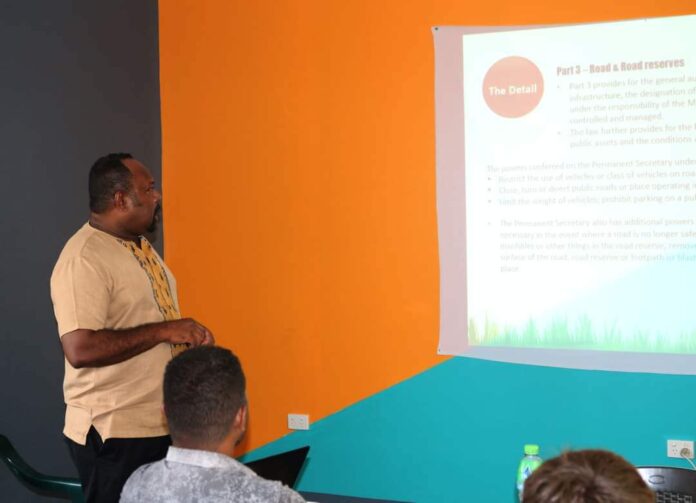
The Infrastructure Management Bill (IMB) once legislated will ensure that infrastructure in the country is properly managed by the Ministry of Infrastructure and Development (MID). The Bill will also highlight the standards in the National Building Code which MID can enforce in collaboration with the local or provincial governments.

–SICCI MEDIA

CHOISEUL FISHERIES ORDINANCE 2020 PASSED

0

BY BARNABAS MANEBONA

Choiseul Province Fisheries Management Ordinance 2020 has been passed.

After going through the whole committee of the Choiseul Provincial Assembly saw the ‘ordinance’ passing yesterday during the province Assembly meeting adjourned to continue today.

According to Choiseul Province Deputy Premier Hon Nerio Ulemiki, the ‘Choiseul Province Fisheries Management Ordinance 2020’ changes the ‘2011 Fisheries Ordinance’ that their province has been previously using.

“The Choiseul Province Fisheries Management Ordinance 2020 changes the 2011 fisheries ordinance that we have been using. This is what has been passed today [yesterday] after going through the whole committee of the house,” said Ulemiki.

A motion of ‘Sine Die’ is understood to be debated tomorrow Friday on the last day of the Choiseul provincial government Assembly meeting for this week focused on the ‘Revised Budget’ for 2019-2020.

NO BAIL FOR MAENU’U

0
The High Court of Solomon Islands. Photo by SIBC.

BY JENNIFER KUSAPA

CHIEF Magistrate Emma Garo has refused to grant bail for accused Junior Mostyn Maenu’u (PUFF).

Ms Garo yesterday said she accepts that bail is a right guaranteed by the constitution and also accepts that presumption of innocence until proven guilty beyond reasonable doubt favours the granting of bail unless one of exceptions to granting bail exists.

She said the prosecution objects to bail being granted.

“I remind myself that the burden to prove that the defendant should be refused bail lies on the prosecution,” Garo said.

“I also remind myself that the standard to prove that the defendant should be refused bail is one of on the balance of probabilities,” she added.

Maenu’u had been bailed since 26 March 26, 2020, but was revoked by the court on September 3, 2020 upon application from prosecution.

Garo said Maenu’u is charged with discharging of firearm contrary to section 44 of the firearms and ammunition Act Cap 80.
That on March22, 2020 at upper Tinge Ridge, Honiara, did have in his possession ammunition to wit 1x9mm PARA Dag without being the holder of a current firearm licence.

And two other counts of possession of firearm without a firearm Licence contrary to section (2) (a) of the firearms and ammunition Act cap 80.

When he first appeared in court for those offences, he was granted bail by the Deputy Chief Magistrate with strict conditions.
However, on April 2, 2020 Director of Public Prosecutions applied to have the bail revoked.

The case has been mentioned several times before the court and on August 11, 2020 other charges were again filed against the accused for criminal trespass and two counts of intimidation.
The new offences were allegedly committed by the accused on July 4 and 13, 2020.

The allegations are the subject to the proceedings in criminal case no. 763 of 2020 led to the revocation of his bail by the court in September 2020.

Garo said the accused did not appeal the decision of this court on September 3 on the bail revocation.

She said that no evidence had been properly put before the court to enable it to determine judiciously, which way this bail application should fall.

“The Constitution is a living document.

“The Principles enshrined and embedded in the constitution and the legal principles governing the law on bail, cannot be argued interpreted or applied in a vacuum.

“With no evidence properly placed before this court, inescapable conclusion that must be reached by this court is that, this court cannot be satisfied on the flawed or lack of evidence being properly presented, that the circumstances of the defendant had changed since his bail was revoked on September 3, 2020, to justify the granting of bail.

“I further find that no evidence had been properly presented to show a change of circumstances in favor of granting bail to the defendant,” Garo said.

Therefore, she refused the bail against the defendant and adjourned the case to October 20 for mention and setting of new trial date.

Opposition leader congratulates Suidani, calls for unity

0

Leader of Opposition and MP for Aoke Langalanga, Matthew Wale congratulates the Premier of Malaita Province, Daniel Suidani, on his success against the no confidence motion tabled against him.

“The victory clearly demonstrates the resounding confidence the majority of MPAs have in Premier Suidani’s leadership and his government’s performance to date, hence should be applauded.

“Everything else aside, the opportunity to move a motion of no confidence is a democratic process available to test leadership and political support and I am heartened to see the level of respect accorded by the MARA government to allow for the rule of law and due process to take their natural causes,” says the Opposition Leader.

Mr Wale says he is confident that Premier Suidani was aware of, and will learn from the challenges encountered heading into the motion.

“These are important lessons that can serve as good building blocks for harnessing strong, credible and competent leadership for the province.

“Thus while congratulating Premier Suidani I also encourage him to now take his leadership to the next level by fostering a governance culture that is rule of law based, transparent and all-embracing than divisive for Malaita Province,” the Opposition Leader adds.

–OPPOSITION PRESS

RISK OF VIRUS SPREADING IS LOW: RODGERS

0

RISK of the coronavirus spreading out to the communities is very low, says Secretary to Prime Minister Dr Jimmy Rodgers.

His observation, he said, was based on the assessment conducted in the quarantine centers in Honiara after the country recorded two covid-19 cases, where the patients are now isolated at the National Referral Hospital.

Speaking to the media yesterday, Dr Rodgers said firstly there are low risks for front line workers because they use personal protective equipment like masks.

As such, he said there is low risk for the virus to spread to the community but maybe in the quarantine centers.

Furthermore, Dr Rodgers said third tests have completed on Tuesday and results are expected last night or today.

Incident Controller, Dr Nemia Bainivalu said for high risk countries, occupants will undergo four tests.

The first test is carried out within 48 hours, followed by second test between five days to 10 days, third test between 12 days to 14 days and final test between 19 days and 21 days.

Dr Bainivalu said monitoring was done on daily basis after the second case was confirmed over the weekend.

He said they found some contact tracing, possible some interaction in Philippines, during flight and contact in quarantine center.
As such, he said they identified possible mixing, therefore there are some contacts.

Currently, there are seven patients at NRH, where two have positive cases, four negatives and one under investigation after admitted upon arrival.

Medical Superintendent, Dr John Hue said the isolation centers are out of bound from public.