Home Blog Page 457

MPG focuses on business, investment policies for Malaita Province

0
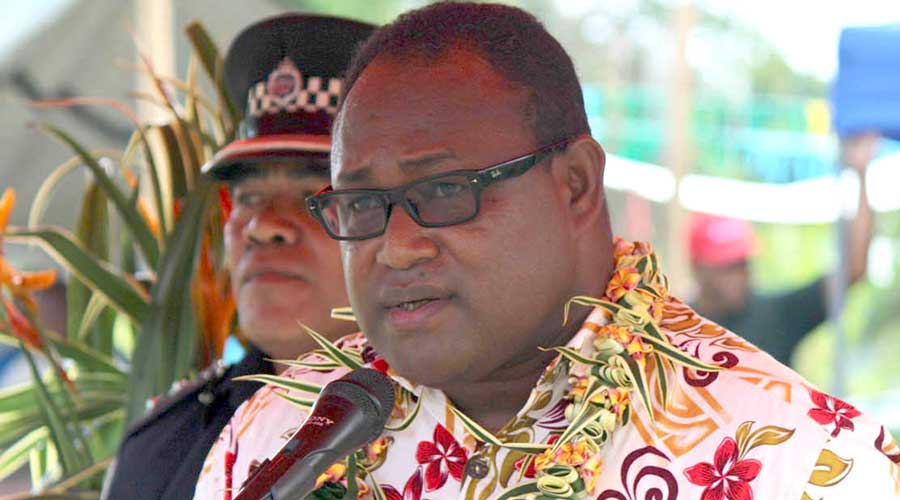
Premier of Malaita province, Elijah Asilaua.

BY SAMIE WAIKORI

The Malaita Provincial Government (MPG), under the leadership of Premier Asilaua, has announced its commitment to pursuing business and investment policies aimed at boosting trade and investment in Malaita Province.

In alignment with the Malaita Economic and Trade Growth (MECTG) redirection policy, the initiative will focus on the development of investment, sole trader, trade, industry, and local-foreigner partnership business policies.

This policy aims to establish principles and a procedural framework for guiding Malaita Province’s operations and achieving its objectives. It will serve as a roadmap for the Malaita Provincial Business Authority, providing clear and consistent direction for employees, management, and stakeholders in decision-making and operations.

The investment policy will act as a strategic guide for planning and implementing investment programs. It emphasizes good governance and accountability in asset allocation, risk management, and performance monitoring. The policy will also set guidelines for engaging internal and external investment managers while ensuring transparency through proper reporting.

This policy focuses on building Malaita’s economic capacity through sustainable trade and investment. It aims to promote human capital development, reduce poverty, and improve living standards in the province. The policy’s long-term impact includes wealth creation and increased employment opportunities for the people of Malaita and Solomon Islanders.

The trade policy is designed to manage the international exchange of goods and services between Malaita and national, regional, and international economies. It will regulate imports and exports while promoting export activities to strengthen Malaita’s role as an agent of the national government in global trade.

This policy emphasizes government support for businesses to reshape or enhance specific economic activities. It focuses on regulatory compliance and legal frameworks to support business growth, particularly for entities based on activity, technology, size, and location.

The partnership policy aims to establish strategic alliances between local and foreign investors. It leverages local knowledge of the business environment, customer preferences, cultural norms, and regulatory landscapes to help businesses navigate market complexities and make informed decisions.

The MPG, guided by the MECTG redirection policy, is committed to ensuring these business frameworks are in place to encourage trade, investment, and sustainable economic growth for the people of Malaita Province.

MID to bring vehicle policy to cabinet next year

0

By Loretta B Manele

Ministry of Infrastructure Development (MID) will bring their vehicle policy to cabinet next year.

Manasseh Maelanga, MID minister revealed this during the Sine Die Motion in parliament last week.

He said this is a very important policy they have worked on and hopefully it should reach cabinet next year.

Moreover, Maelanga stressed that today, G vehicles are being misused and urges all drivers to have a permit to drive G vehicles.

He said this applies to drivers of ministers, officials as well as public servants.

“Today I am calling on all who are using G vehicles, you have to have permit to drive G vehicles.

All drivers driving G vehicles whether officials or public servant must have a permit”

He pointed out that when the policy goes through, he will tell the police to do traffic check to see that those driving G vehicles have a permit and if not, the police will deal with them.

Maelanga said for drivers of G vehicles, you can get a permit from the Permanent Secretary of MID.

In relation, he also spoke about the dispose of vehicles which also comes under the vehicle policy.

Maelanga stated that when it comes to this, the issue is that when people from his ministry go to collect vehicles that are just laying about in other ministries, they are confronted by officials from those ministries who stop them from collecting the vehicles.

“These are things I am not happy about and that is why I must state that MID has the power and right to collect G vehicles”

He said it is not up to officials or heads of those ministries to tell MID officers not to get those vehicles.

Maelanga emphasized that MID has the power and right to come and get those vehicles that need to be disposed of.

He mentioned that these are some issues that contradict their work and they are not happy about.

“We must improve on these things”

Wale urges discipline

0

By Loretta B Manele

I only wish to say that 2024 has been a record year for overseas travel by parliamentarians.

Matthew Wale, Leader of Opposition made the statement in parliament when contributing to the Sine Die Motion on Thursday 19th Dec.

He expressed that our health system has lacked basic medicine and supplies throughout our islands yet a lot of money was spent on travel.

Wale told parliament that there is a need for discipline in the matter of overseas travel.

“Some criteria or tests should be used to determine if a minister should go on an overseas travel or not or if officials should go instead”

Wale also stated that the parliamentary entitlement commission should also reduce the overseas per diem to more reasonable rates because it is too high.

He added that this perhaps may be one of the reasons many are going on overseas travel.

Wale stressed that the size of delegations going overseas also continues to be an issue.

In this regard, he said large delegations as we know are rarely effective if anything other than perhaps sightseeing.

“This needs to change if we are serious about government challenges that we face and the cashflow situation that government continues to experience”

Wale noted that they must not forget that time away overseas is time away from work here at home and it will have an impact on the work of ministries that colleagues are in charge of.

MPG ON SEA CUCUMBER

0
Premier of Malaita province, Elijah Asilaua.

Plans to review beche-de-mer license and economic policies

BY SAMIE WAIKORI

The Malaita provincial government plans to review its beche-de-mer business licence and develop other policies to bolster economic empowerment among youths, women and encourage Small Medium entrepreneurship among its population in the province.

The plan forms an integral aspect of MPG’s business and investment policy intervention, which the premier Elijah Asilaua-led Malaita Economic, Cooperation and Transformative Government (MECTG) is working toward for Malaita province.

According to the policy, beche-de-mer also known as sea cucumber is currently being protected under the law of Solomon Islands.

“Only people have acquired beche-de-mer licence can be able to harvest and trade the sea cucumber at certain time within its approved calendar and schedules.

“The aim is for Malaita province to benefit from harvested beche-de-mer within its jurisdiction by discharging beche-de-mer licences and law development,” it says.

Still under its policy intervention for business and investment, MPG is looking at a policy to encourage small medium entrepreneurship in the province.

The development of the policy will support small medium private sector entrepreneurs.

It will also provide necessary environment for private sector dynamism, innovation and risk taking required for modern, sophisticated and rapidly growing economy on Malaita province.

Further to the business and investment intervention policy, MPG is pursuing a specific policy to encourage youth employment and entrepreneurship for Malaita province.

The policy will merge two distinct pathways to which entrepreneurship can address; youth empowerment and economic growth in Malaita and Solomon Islands.

This economic approach where entrepreneurship as an engine of economic growth and job creation aim at impacting the lives of youths in Malaita.

Moreover, MPG is also looking at an economic development policy for women in Malaita province.

The women economic development policy is a crucial goal toward achieving gender equality and the sustainable development goals (SDG).

The policy will align with the UN Women’s economic empowerment strategic plans aimed to enable women to be empowered and engage in economic activity.

The policy will address inequality, gendered division of care labour, gender-blind policies and promote equal rights, access to resources and addressing the importance of supporting girls to grow into women with economic power.

MID to bring building code bill next year

0

By Loretta B Manele

The Ministry of Infrastructure Development (MID) looks forward to bringing the Building Code Bill to parliament next year.

Manasseh Maelanga, MID minister revealed this when speaking at the second and final day of the Sine Die motion on Thursday last week.

He referred to the bill as an important one that is quite thick which they were supposed to bring to the honourable house this year but time did not allow.

Maelanga said the Building Code bill means we will have standard buildings in the country.

He stated that the standards in the bill are those of Australia and New Zealand thus if buildings are to be built in the capital or provinces it will be of those standards.

“So, we will see that our buildings in the capital and provinces are of those standards”

He added that under the bill, they are also looking at having standard materials to be used when constructing buildings.

“If we are to build a four-story building, we will have proper materials that will be tested to make sure they are the right materials”

Maelanga said looking down below from parliament you can see that there are a number of buildings that are quite old.

He noted that there are people from MID like architects and engineers who once the bill is passed will be qualified to go around and check on buildings and if those buildings are not qualified as stated, they will be demolished.

Looking at the federal state system the opposite way

0
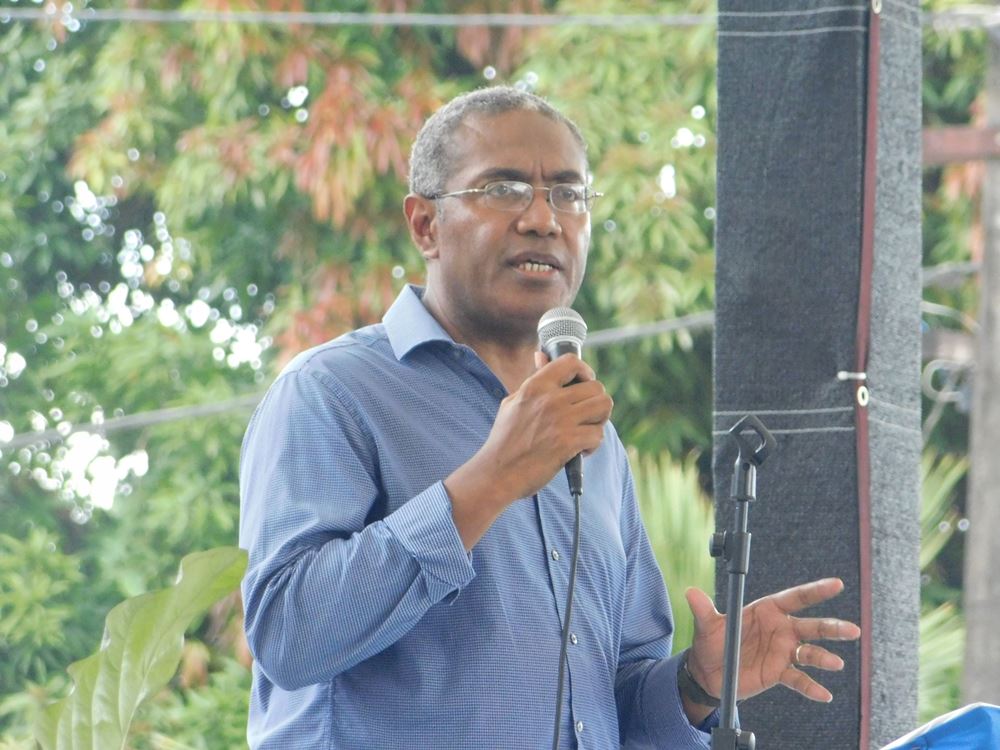
Peter Kenilorea Jnr

By Loretta B Manele

We’re looking at the federal system the opposite way, whereas the classical sense of federal system is that states cede power to a federal government.

Peter Kenilorea Junior, member of parliament for East Are’Are constituency and Leader of the Independent Group stated this at the debate of the Constitution Amendment, Constituent Assembly Sitting Bill 2024 in parliament on Tuesday 17th Dec.

He pointed out that for us, it is the central government giving back power to the provinces which is definitely the opposite of the classical definition of federal system.

Kenilorea Jr however mentioned that this is something that they have to discuss and continue to try and figure out how they can get to that stage.

Moreover, he spoke about the term “homegrown” and stated that during discussions prior to independence, homegrown was used.

“The word homegrown has been used. Sometimes we feel misused because we all know the systems that we have are already set as templates that we pick and choose.

It’s part of the system that we’re in. Sovereign governments, in we go communism or in we go state democracy. In we go federal or unitary”

He added that these are already cut out templates and the homegrown part of it is perhaps the consultation part and issues regarding land, particularly customary land and how we deal with it.

Kenilorea Jr said he explained to the people of his constituency that these systems which are already set in place is like that of a football game or soccer.

He stated that in soccer we don’t make the rules of the game but we love to play the game and when we play, we bring our own talents to the game.

“That’s the homegrown part of it. But otherwise, the systems are already in place”

He said the laws and system we adopted are already set in place and we definitely chose to go a certain path and there’s nothing wrong with that.

Kenilorea Jr expressed that these are things that should bring us comfort in terms of finding the best system for us, the best way we can adopt and tweak that will fit into the context and specifications of our country.

Parliament should not be bogged down in page-by-page discussions

0

By Loretta B Manele

Parliament should not be bogged down in a page-by-page consideration of the bricks, a document intended to guide the accountable offices to implement the budget allocations in their respective accounting heads.

Manasseh Sogavare, minister for finance and treasury voiced this during the first day of the Sine Die Motion which was on Wed 18th.

He said discussions on the consideration of bricks should be carried out and concluded by the Public Accounts Committee (PAC).

“Parliament says it should only be concerned about the recommendations made to it by the Public Accounts Committee”

Sogavare added that this is of course after PAC has scrutinized the various heads which are ministries, programs or departments and compare the amount of money allocated to these respective areas.

He emphasized that the important information for parliament is the recommendations from PAC.

“As a matter of fact, it is reasonable to conclude that the recommendations and all the issues that the Public Accounts Committee is concerned about in the appropriations hearing”

He stated that parliament should only be concerned about explaining policy intentions and voting the amounts assigned to the heads in the Bill, including consideration of any proposals to adjust the heads by the Public Accounts Committee, which should come in the form of motions.

Sogavare said there is still a certain consultation with the government hence it is his intention that the 2026 budget will be considered under the new procedures.

Despite challenges, ministry remains steadfast in mandate

0

By Loretta B. Manele

The Ministry of Mines, Energy, and Rural Electrification remains resolute in its mission to transform natural resources into opportunities for the people of Solomon Islands, despite facing numerous challenges.

Minister Bradley Tovosia expressed this commitment while updating parliament on the ministry’s progress during the Sine Die motion on Thursday, October 19.

Highlighting developments in the energy sector, Tovosia noted that the Tina Hydro project is advancing well, with access roads nearing 80% completion and major construction phases scheduled to begin next year. Once completed in 2028, the project is expected to meet 80% of Honiara’s energy needs, significantly reducing diesel consumption and greenhouse gas emissions.

He also emphasized strategic amendments to the Electricity Act, which aim to establish an energy regulator and enhance independent power producer (IPP) participation to ensure reliable, affordable, and clean energy.

The minister further shared that, in partnership with Australia, the UNDP, and other stakeholders, the ministry is implementing critical energy projects for underserved rural communities, improving lives while reducing carbon emissions.

In the areas of petroleum and ocean governance, Tovosia stated the ministry’s intent to explore the sustainable potential of hydrocarbons, ensuring sovereignty and equitable benefits for the nation’s people.

Tovosia also announced that nearly all ministry positions were filled in 2024. For 2025, a new Deputy Secretary Technical position has been created to strengthen the executive team and oversee the ministry’s five technical divisions.

He added that the ministry’s 2025–2028 Plans, a vital roadmap for implementing key reforms, are expected to be operationalized in the first quarter of 2025.

Minister Tovosia concluded by reaffirming the ministry’s unwavering commitment to its mandate, emphasizing alignment with sustainable development goals to secure a resilient and clean energy future for the Solomon Islands.

MPG values good governance and political stability to drive province

0
Premier of Malaita province, Elijah Asilaua.

BY SAMIE WAIKORI

The Malaita provincial government has said it sees good governance and political stability as critical for progress of the people and province of Malaita.

This is an integral strategic intervention of Premier Elijah Asilaua’s Malaita Economic, Cooperation and Transformative Government’s (MECTG) policy redirection.

MECTG is determined to support its governance system during this four year of leadership and economic development engagement.

This will happen through close cooperation with Ministry of Provincial Government and Institutional Strengthen for support in running the administration and political leadership of the province.

The appointment of Malaita’s Provincial Secretary in late 2023, and engagement of independent external consultants had largely supported MECTG on its redirection and fundamental alignment policy.

MPGIS has also supported MPG strengthened its administration capabilities to deliver along the policy line ministries of the new government.

The support came in staffing, resources, appropriate trainings and other important issues.

Meanwhile, MECTG hopes for political stability, so that its desired outcomes for Malaita province are achievable.

Political stability is crucial for unity and peace among the provincial leaders of Malaita. With that, MECTG is determines to sort out whatever grudges between the provincial leaders.

Another priority objective of the MECTG government is to maintain a peaceful and harmonious environment for police, churches, chiefs and other key stakeholders.

This will maintain peaceful environment for local businesses, foreign investors to operate and flourish, which will have positive impact on the economic development of the province.

Making a difference for People with Disabilities

    0

    BY JOHN HOUANIHAU

    Casper Fa’asala, Chief Executive Officer of the Disabled People’s Association of Solomon Islands (DPASI), has been passionately advocating for people with disabilities since taking on the role in 2021. Fa’asala, who previously served as the organization’s president and vice president, is committed to advancing the rights and opportunities of people with disabilities across the country.

    Promoting Disability Rights
    Fa’asala’s role involves advocating for better representation of people with disabilities to key stakeholders, including the government, private sector, and community leaders. Speaking recently to Island Sun, Fa’asala highlighted significant issues such as accessibility and stigmatization that continue to affect individuals with disabilities.

    “For example, attitudinal barriers and the stigmatization of people with disabilities remain widespread. My role is to advocate for their needs and help change mindsets,” said Fa’asala, who hails from Malaita Province.

    As CEO, Fa’asala also promotes a human rights-based approach, ensuring that people with disabilities have a voice in government policies and legislative decisions. His organization actively engages with government committees to express the concerns and aspirations of the disabled community.

    Achievements and Transformative Work
    Fa’asala takes pride in the changes he has helped implement within the organization and at the national level. Among his early tasks as CEO was leading a review of the Solomon Islands’ disability policy, resulting in the creation of the Solomon Islands National Disability Inclusive Development Policy, which takes a more holistic approach.

    “The revised policy now addresses broader areas such as climate change, disaster management, transportation, and communication, ensuring that it meets the diverse needs of people with disabilities,” Fa’asala explained.

    Advocating for Rights and Inclusion
    Fa’asala acknowledged that despite progress, challenges persist. Issues such as inadequate water supplies, lack of accessible housing, and insufficient attention to wage equity for disabled employees remain prevalent.

    “Many water supply projects do not cater to the needs of people with disabilities. Additionally, housing and shelter for disabled individuals in villages often fail to meet basic standards,” he noted.

    Fa’asala also highlighted the achievements of athletes with disabilities who brought home medals from the recent Pacific Games. However, he called for better access to training facilities and transportation, including accessible buses with wheelchair-friendly features.

    Changing Perceptions
    For Fa’asala, one of the biggest challenges is shifting public attitudes. “People with disabilities are not sick people. They are individuals with different abilities, and we need to focus on their skills and potential,” he said.

    He emphasized the importance of understanding impairments and recognizing that everyone has strengths that can be developed. “At the end of the day, people with disabilities can perform many tasks just as well as anyone else. It’s about creating opportunities and changing perspectives,” he concluded.

    Through his advocacy and leadership, Fa’asala continues to work toward a more inclusive Solomon Islands, where people with disabilities are empowered to thrive and contribute to society.