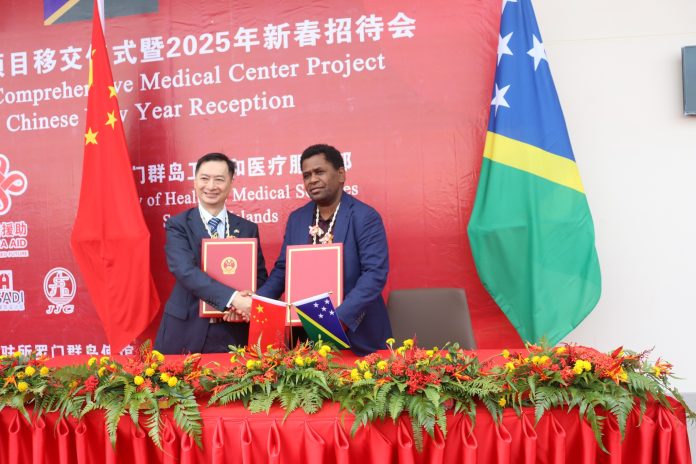
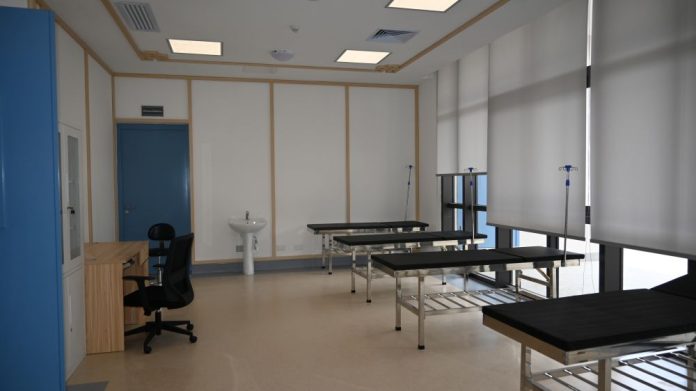
THE successful completion of the long-awaited Comprehensive Medical Center (CMC) has marked the fulfillment of major vision set out by the Ministry of Health and Medical Services (MHMS).
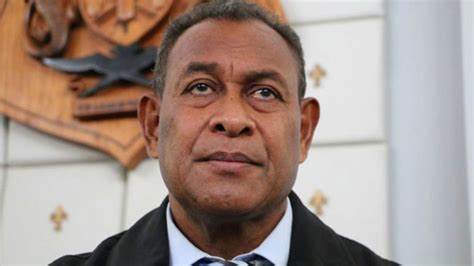
Minister Paul Bosawai expressed his satisfaction with the completion of the center, which has been a significant milestone in the country’s healthcare development.
“The new comprehensive health center…was that vision, which has now been all fulfilled today and I am very happy,” Minister Bosawai said.
The idea for the CMC was first developed in 2020, spearheaded by the MHMS Permanent Secretary and the senior executive management team.
The center was designed with three core visions in mind, which align with the broader National Health Strategy 2022-2031.
According to Minister Bosawai, these visions were:
Building a Facility for Specialized Care: To create a health center that offers highly specialized clinical services, is disability-friendly, and incorporates high standards for infection control and prevention.
Reducing Healthcare Costs: To provide specialized services domestically, thus reducing the need for patients to travel abroad for treatment, which in turn saves the government millions of dollars annually.
Creating a State-of-the-Art Work Environment: To develop a modern, clean, and safe facility that supports the well-being of doctors, nurses, and other healthcare professionals, fostering a productive and positive work environment.
Bosawai emphasized that the CMC plays a crucial role in strengthening the National Referral Hospital (NRH), boosting its capacity to serve as a leading healthcare provider and supporting the country’s ongoing efforts to achieve universal health coverage
“This is to ensure the best quality health services are accessible by our people,” he added.
The retrial of a teacher accused of embezzling $1.3 million from the Solomon Islands Government (SIG) in 2017 and 2018 is set to begin on April 14 and run through April 18, 2025.
During an interim mention last week, the prosecutor and defense counsel informed the court that they had no issues regarding the trial.
The matter has been adjourned to February 21 for the next interim mention. The accused, Cecilia Samani Tome, was excused from attendance, and her bail has been extended.
Tome was initially charged with one count of embezzlement to which she pleaded not guilty. Her first trial was conducted before Principal Magistrate Beneteti Tearo.
In the first trial, no witnesses were called, and the case was decided based on submitted documents. After the prosecution completed its case, the defense lawyer filed a no case to answer submission.
Magistrate Tearo ruled that Tome had no case to answer for the embezzlement charge and subsequently acquitted her of allegations related to the $1.3 million overpayment mistakenly deposited into her bank account.
The prosecution appealed Magistrate Tearo’s decision to acquit Tome, taking the matter to the High Court. After reviewing the appeal, Judge Leonard Maina remitted the case back to the Magistrate’s Court for a retrial before a different magistrate.
At the start of the retrial, Tome pleaded not guilty once again.
The prosecution alleges that in December 2017, two large payments totaling over $3 million were mistakenly deposited into Tome’s bank account. The error reportedly occurred due to a payroll staff member at the Ministry of Finance and Treasury (MOFT) entering a date in the payment system instead of the amount to be sent from the Ministry of Education. This mistake resulted in an overpayment of $3,806,297.77 into Tome’s personal salary account.
The prosecution further claims that Tome embezzled $1.3 million from the mistakenly deposited funds for her personal benefit.
The Crown is represented by John Wesley Zoze from the Office of the Director of Public Prosecution, while Ben Alasia from the Public Solicitor’s Office represents the accused, Cecilia Samani Tome.
The investigation into the case of two police officers, Gravis Afuga and Allen Noni, is still ongoing.
During a court mention last week, the prosecutor informed the court that police investigators are yet to collect one outstanding statement.
The prosecutor also confirmed that disclosures have been served to the duty defense counsel. However, the two accused officers failed to appear in court. It was suggested that their absence might have been due to confusion over the mention date, which was initially set for February 21 but was unexpectedly moved forward to yesterday.
The court has adjourned the matter to February 17, 2025, for a possible plea. Directions have been issued for the defense counsels to contact Afuga and Noni and update them on the new mention date.
The police were also directed to collect the outstanding statement, and the prosecution must serve full disclosures to the defense.
Officers Gravis Afuga and Allen Noni are jointly charged with bribery, contrary to Section 122(a) of the Penal Code, read with Section 21(a) of the Penal Code.
The charges stem from an investigation into the theft of gold ashes, which began on November 8, 2024.
Stride continued to witness on the preparation for the PRC funded million-dollar tar-seal project for Auki road network in Malaita province.
This is following the arrival of a consignment of building materials in Auki last Sunday, according to Premier Elijah Asilaua.
“The CCECC has on Sunday arrived with building materials for their campsite near Aligegeo school. Upon arrival, materials were transported to the site.
“The company is currently working on the camp and soon it expects to complete. The camp will host, workers, building materials and machineries for the project.
“As long as the camp completes, the company will begin transporting of materials for the project from Honiara to Auki,” he said.
Thereafter, the premier said actual implementation of the project will begin, which expect for late February or early Match this year.
He expressed the support of his executive and the full assembly behind the project, assuring commitment to work closely with PRC and SIG on it.
Asilaua also guaranteed the support and commitment of his government behind the Japanese funded project for Kilu’ufi hospital in Auki.
He said there are other projects such as the Australian funded emergency road upgrade on South Road, Malu’u market and World Bank funded infrastructure projects in the province.
Asilaua said MPG and its people are brace to work together to see the projects eventuate that will have significant impact on the life and the economy of Malaita province.
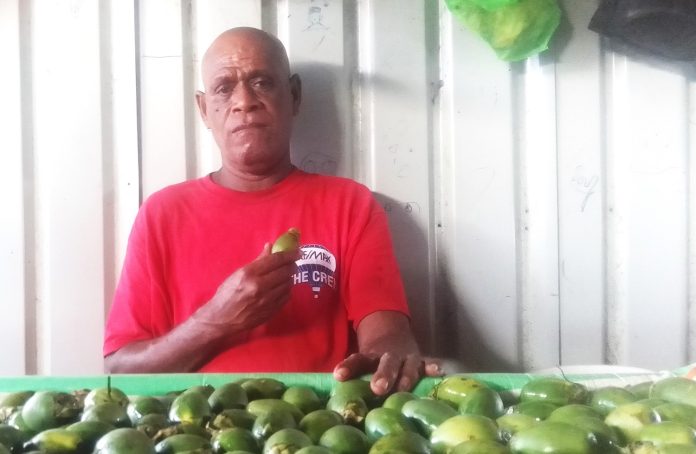
Erick Wabo terminated his employment as a police officer in 2017 and subsequently entered the informal sector by selling betel nuts, which he refers to as “green gold.”
At 58 years of age, Wabo hails from Temotu and has connections to Malaita, having spent nearly eight years in this line of work.
His venture into the informal sector as a betel vendor commenced in 2017.
Before establishing himself at the Maromaro betel nut market, Wabo operated a betel nut business in Chinatown.
Before transitioning to this trade, Wabo had a career with the Royal Solomon Islands Police Force (RSIPF), where he served from 1994 until his resignation in 2007.
“I have assigned a name to the betel nut, referring to it as green gold. I have embarked on a venture into the betel nut trade, recognizing its profit potential. Green gold represents the essence of wealth,” stated the father of four.
Mr. Wabo at his stall at Maromaro betel nut market.
The income he derives from this business is primarily allocated towards his children’s educational expenses and the sustenance of his family’s daily needs.
“In the past, financial resources were scarce. That was true during my youth. Back then, I struggled to hold onto even $10. When I attended school, my parents would provide me with just $10. However, today, I encounter money daily,” he said.
In contemporary times, individuals of all ages, including both the young and the elderly, engage in the sale of this fruit to earn an income, and many also consume it.
Wabo advised those who did not succeed in this year’s examination to consider engaging in the sale of betel nuts, often referred to as “green gold.”
“If each individual present contributes 10 bags and places them on the table, the task will be completed on the same day. Thus, one can observe daily earnings from what is referred to as green gold. “
“This is where I perceive financial opportunity,” said Wabo.
In addition to his betel nut sales, Wabo serves as a security officer for the USP Solomon Islands.
“I would like to emphasize to those who claim they do not engage in any work that selling betel nuts is a viable option. Engaging in this trade ensures that you will not face hunger. For those of us residing in urban areas, as long as you have a $50 initial investment to start your betel market, you will witness the benefits of this green gold. Even if the income generated from it appears modest, it can sustain you,” he remarked.
He highlighted a significant challenge he encounters when the price of betel nuts tends to rise.
“This is one of my major difficulties. For instance, when supply diminishes due to various factors, prices can escalate to as much as $1000,” he explained.
To mitigate this issue, Wabo has set aside capital specifically for betel nut transactions, which he does not utilize for other purposes.
“Thus, even when the price of betel nuts surges, I retain my capital reserves. After selling my inventory, I replenish the capital,” he stated.
58-year-old Wabo attended to a customer at his stall located in the Maromaro betel nut market.
He further noted, “When betel prices are elevated, I can acquire 15 20 kg bags, whereas, during periods of lower prices, I can purchase 10 bags,” said the father of four.
When the price reaches $200, it poses a significant risk for vendors like Wabo, as his sales fluctuate between 50 cents and $1.00 per betel nut.
“At that price point, you can expect a profit of around $1,000, whereas when the betel nut costs between $2 and $4, your profit can range from $1,500 to $1,800,” he explained.
Wabo typically operates his market stall, selling betel nuts daily from 7 am to 8 pm, and he usually earns over $3,000 each week.
The lowest price he has paid for betel nuts is $200 for a 20 kg batch.
“That is when you can observe prices of 50 cents to $1.00 per betel nut on display,” he noted.
Wabo indicated that when prices are elevated, the market vendors benefit more, while lower prices favour the customers.
“When the price per nut is 50 cents or $1.00, it can take a considerable amount of time to sell out, sometimes even up to three months,” he remarked.
Wabo sources his fresh betel nut from Guadalcanal, where harvesting occurs today, allowing for immediate sales, unlike the provinces where the process can take two to three days.
He appreciates his role as a betel vendor in the informal sector, finding it more fulfilling than his previous position with the RSIPF.
“In the formal sector, I only received my earnings on payday and I often relied on credit for daily necessities. If food was scarce at home, I had to borrow money to purchase it. However, this situation changed once I began selling this valuable product.”
Wabo allocates $60 daily for stall fees at Maromaro.
“Initially, it was challenging, but I have since adapted to the routine of paying my fees.”
He has also acquired a plot of land in Tuvaruhu, Honiara, with plans to construct a house.
Before his involvement in the betel nut trade, Wabo sold cigarettes and tobacco in Auki, Malaita province.
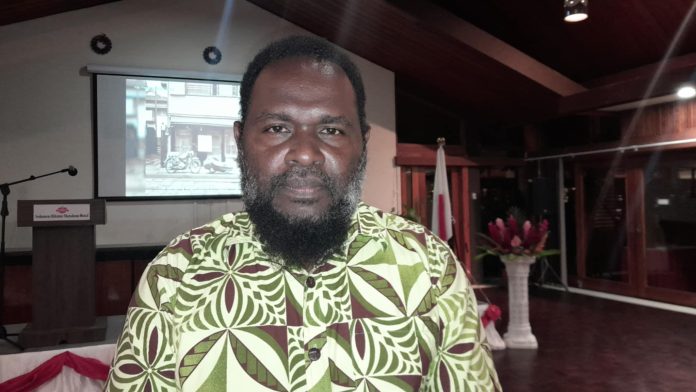
Patrick Kekea, hailing from Guadalcanal province, is a distinguished theatre scriptwriter and performer.
After completing his education, he joined the Solomon Islands Development Trust (SIDT).
Following several years of successful administrative duties and community involvement, the 65-year-old founded the Isi Akson Theatre.
Established in 1990, this organization has focused on promoting educational awareness through theatre drama.
Kekea plays a crucial role in administration and outreach, seeking potential funding to support the initiatives of the Akson Theatre.
The Isi Akson Theatre comprises a team of eight volunteer dramas who are available as needed, depending upon funding.
“This is a youth-led organization, and I was a youth when I started the group,” Kekea recalled.
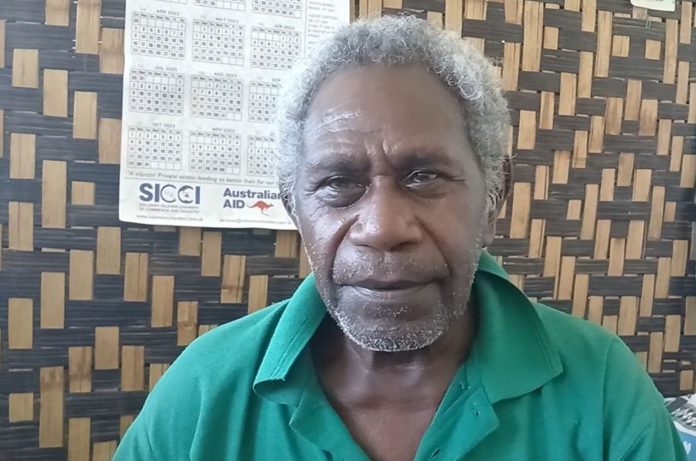
Mr Kekea during a conservation with a community elder
He has been at the helm of the group for nearly 45 years.
“Our activities involve educational awareness through drama activities, and we also conduct participatory workshop training,” he added.
Since its inception, the Isi Akson Theatre has collaborated with various organizations, including SIDT and World Vision Solomon Islands, to implement programs in local villages.
“We collaborate with the Solomon Island Development Trust, which serves as the umbrella organization for various NGOs, including World Vision and others that require support in disseminating information within rural communities through the use of Drama. Our efforts extend beyond the Guadalcanal province to other regions such as Malaita, Isabel, and Choiseul, reaching as far as Temotu province,’’ said Passionate Kekea.
“There are a select few individuals I rely on when assistance is needed, primarily youths, as we actively encourage young people to engage in this work,” Kekea said.
The messages conveyed through the theatre address a range of social issues, including health, environmental concerns, economic challenges, and spiritual matters.
“I typically conduct research to gather relevant information, draft scripts, prepare the Drama, and then proceed to educate the community,’’ he said.
One of the significant challenges faced by the organization, according to Kekea, is securing funding to support its initiatives.
As the founder, he has been diligently working to ensure the organization’s sustainability.
“A persistent challenge I encounter is accessing financial resources, as we are a village-based group lacking specialized personnel. We struggle to obtain funding for our activities. Currently, we do not have qualified individuals to assist with our efforts. Therefore, I manage this challenge to the best of my ability to ensure the organization continues to operate,” Kekea explained.
Mr Kekea Isi Akson Theater Founder.
This year, the Isi Akson Theatre will not only continue its drama activities but will also advance the tree planting initiative that commenced in 2013, with the backing of UNDP.
The organization is eager to initiate several projects this year, focusing on tree planting, agriculture, and conservation efforts.
“We began our tree planting efforts in 2013 after obtaining funding from UNDP. Our goal is to plant additional trees; however, funding remains a significant challenge, as I have previously mentioned. We have worked diligently to reach this point,” he stated.
A notable achievement from the tree planting initiative was the transformation of grassland into a forest in Kolokisu at Aruligo.
“Historically, trees did not grow in that area, so we took the initiative to create a forest. What was once grassland has now become a thriving forest. Through our planting efforts, we have introduced over 6,000 trees, including Eclipta, mahogany, Malayan, and various other local species.”
“Women in the region faced considerable difficulties in sourcing firewood, but now they can easily obtain it from the trees or fallen branches,” Kekea said.
“Trees are vital for absorbing carbon dioxide from the atmosphere and providing us with the oxygen we need. They serve as a carbon sink, which is essential,” he said.
The Isi Akson Theater Group, with the support of Irelan, will embark on a project focused on biodiversity conservation, particularly about Weather costs this year 2025.
“We aim to protect two fish species that are on the brink of extinction. Our goal is to conserve the habitat where these species thrive in the river. The species are freshwater snapper and the mullet fish,” he stated.
The founder of Isi Akson also offered valuable guidance to the youth of today.
“You are shaped by your experiences. Pursue your passions. If you possess even a small skill, nurture it. Through this, you can achieve your desires. Continuous practice is essential. You have the potential to succeed. Any knowledge you acquire can be cultivated, serving as a means to generate income that can support you, your family, and your community,” he advised.
Final design for the PRC funded Auki tar-seal road project has completed.
Premier of Malaita province, Elijah Asilaua made the statement yesterday after being informed by the team responsible for the design of the project.
“Just recently my office was informed on the arrival of the design team from Beijing in Honiara and the completion of the final design for the project.
“This is the second visit of the team after their first visit, where they carried out assessment on roads in Auki.
“Now, the team is back, and they’re here with the final design for the project. Soon my executive will meet with them in Auki to brief us on the design.
“The completion of the design also signals positive progress on the project. Soon the design will unveil follow by ground breaking of the project,” he said.
Asilaua added after that the actual implementation of the project will begin.
The premier assured the commitment of his government to partner with PRC and SIG on this major infrastructure project for the province.
He said the completion of the project will stimulate economic activities that will have positive impact on the livelihood of Malaitans.
Asilaua added that it will also provide access to boost social sectors in the province.
The Solomon Islands Electoral Commission (SIEC) has received a special award from the Solomon Islands Chamber of Commerce and Industry (SICCI).
The award was part of SICCI’s 8th Business Excellence Awards, successfully hosted in November last year.
SIEC was presented with the Business Excellence Application Award in recognition of its successful implementation of the first-ever joint election.
SIEC CEO Jasper Anisi accepted the award, expressing gratitude to SICCI for the recognition. He reflected on the critical role played by private sector service providers in ensuring the success of the joint election. SIEC commended the private sector for its contributions, including logistics, transportation, and professional services.
In response, SICCI emphasized the need to review the voting system to enable out-of-constituency voting.
This improvement would allow eligible voters employed in both the private and public sectors easier access to participate in the election process. SICCI noted that such a system would eliminate the need for voters to travel long distances to cast their ballots, thereby minimizing disruptions to business operations caused by large-scale population movement during elections.
SIEC CEO Jasper Anisi acknowledged SICCI’s concerns and stated that this suggestion would be considered for future elections.
THE new Comprehensive Center, located east of the National Referral Hospital (NRH), will offer a range of specialized medical services, including a unit dedicated to Chinese traditional medicine.
Once fully operational, the center will provide patients access to treatments such as acupuncture-a form of traditional Chinese medicine where thin needles are inserted into specific points on the body to promote healing and balance.
At the facility’s opening, Prime Minister Jeremiah Manele highlighted the importance of incorporating Chinese traditional medicine, noting that it offers an alternative, effective, safe, and culturally acceptable approach to healthcare.
Manele explained that the Ministry of Health and Medical Services, along with the National Referral Hospital, has been closely monitoring the benefits of traditional Chinese medicine, including acupuncture, as an alternative treatment.
“The findings have been very encouraging. It is a cost-effective method of treatment,” he said.
The Prime Minister also emphasized that the integration of advanced medical technologies in the new facility, alongside the continued presence of the Chinese medical team, will help enhance specialized skills, drive technological innovation, and improve service quality.
“This will be achieved through the strengthening of staff professionalism and a focus on greater patient satisfaction,” Manele added.
CHIEF Justice Albert Palmer says the local court is struggling with significant backlogs, primarily due to insufficient funding.
Speaking at the opening of the legal term earlier this week, Palmer stressed that the court remains the country’s underperforming institution, with 457 cases still pending nationwide.
“This sadly continues to be the under-performing court in the country with a huge backlog of 457 cases pending throughout the country,” Palmer said. “The rate of disposal is very low,” he added.
Palmer said that the backlog is not due to a lack of effort but rather a shortage of funds.
“This is however not for want of trying but more due to constraints in adequate funds being made available. As provided in the report to me, only 2 circuits were able to be conducted with the limited funds provided and 25 cases disposed of.”
Despite the ongoing challenges, the Chief Justice remains hopeful that the situation will improve.
“We are hopeful however, for better things this year with an increased budget being provided and more circuits expected to be conducted,” he said.
Palmer also stressed the importance of adequate funding for the courts, emphasizing their critical role in the government.
“The courts are a vital component as the third branch of government; therefore, it is imperative that they receive the necessary support to operate effectively,” he added.