Work on the country’s first cocoa processing plant is nearly done, with the building completed recently at Kirakira, Makira-Ulawa provincial capital.
Premier Stanley Siapu confirmed yesterday [April 1], “yes, the building structure for the cocoa factory has completed”.
Mr Siapu says this is a milestone accomplishment for Makira-Ulawa province (MUP) and the country.
Siapu said the next stage is the instalment of processing machines, which is expected this year.
He said machines will be funded by the national government through the Ministry of Agriculture and Livestock (MAL) and partners.
“Machines to be funded by MAL this year after finalising business partnership arrangements especially with MUPG, owner and other potential partners,” Siapu said.
The project is supported by national government through three of its line ministries; Ministry of National Development Planning and Aid Coordination (MNDPAC), Ministry of Commerce, Industry, Labor and Immigration (MCILI) and Ministry of Agriculture and Livestock.
In an earlier interview, Premier Siapu said the cocoa factory project will be the answer to the hardworking cocoa farmers in MUP and thecountry.
Adding the project is significant to stabilise the economy of the country.
He emphasised it will curb cocoa buying prices to farmers, create employment opportunities and provide specialist training, skills and knowledge transfer for locals.
Siapu furthered the project would enable the factory to produce cocoa products and other bi-products for both internal and external market.
In the meantime, he appealed to cocoa farmers in the province and across the country to prepare for the project.
Siapu said MUPG planned to work with farmers to rehabilitate cocoa and coconut farms in the province.
He assured the commitment of his government to partner with national government and donor partners to ensure the project materialize and benefit by boosting the economy of the country.
The Makira-Ulawa provincial government has shown progress in its PCDF execution, after coming back from several years of disqualification from the SIG and donor-funded programme.
MUP Minister for Finance and Treasury, Silas Wagatora highlighted this in his assembly speech, at MUP full assembly meeting held in Kirakira last week.
He said under MUP capital budget, all projects from the 2024/2025 revised budget attached to the PCDF qualified amount have been carried forward to the 2025/2026 financial year.
“Most of these projects have been tendered; however, the province is still awaiting the PCDF qualified funds as announced earlier this year.
“Once received in the MUPG–PCDF account, contractor’s engagements, contracts, mobilization and actual construction work will commence promptly.
“Some of the projects are already out on tenders, pending PTB’s decisions, whilst few are yet to be tendered.
“The province will tender more projects, after reports are submitted to the Provincial Secretary by specialists as required by donors, procurement process will commence,” Wagatora said.
Meanwhile, the finance minister said while MUP is facing delay of funding release from national government, it also raises alarm on the release of the PCDF funding.
“The delays of funding release will not threaten us, but trigger issues required for the release of PCDF funding, which is currently dealt with by the administration,” he said.
Wagatora said MUP is trying to stay on top of the matter, guaranteeing the dedication of the province to maintain its status on the PCDF programme.
He also mentioned that MUP’s capital budget also incorporates new indicative figures for SIG-PCDF, LoCAL PCDF, and IEDCR-PCDF.
Wagatora said the figures remain subject to the 2023/2024 assessment results. Hence, the overall fiscal performance of the 2025/26 budget is contingent upon the timely receipt of the PCDF funding.
Today, people may experience structural drivers of conflict without actually knowing they are.
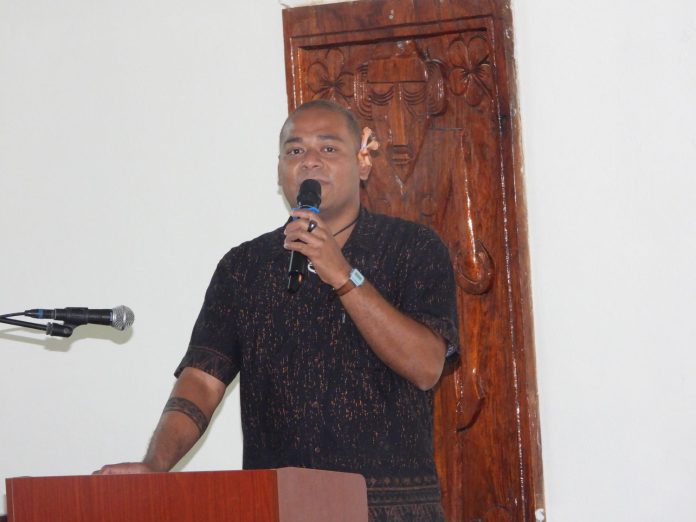
Raki Tuiloma, programmes assistant for Transcend Oceania shared his experience at the “Peacebuilding and Security Dialogue”, funded by UK-Integrated Security Fund and facilitated by Transcend Oceania and Conciliation Resources late last month at the King Solomon Hotel.
Speaking of “structural drivers” of conflict, he said this involves things like uneven distribution of resources, differing values, perceived threats, poor communication and social inequalities.
Tuiloma added that these situations can lead to a conflict as groups of people fight for control.
He took the opportunity to share his own experience with participants at the dialogue.
Tuiloma said for him, he originally came from a village located up in a mountain called “Mount Washington”, also the second largest mountain in Fiji.
“So, just right at the side of the mountain, that’s where my ancestors first settled.”
Tuiloma went on to explain how life was when things were being colonized back then.
He said when colonization occurred, the structure of how they were living also changed.
Tuiloma expressed that during this time, they were asked to move to a village located at the bottom of where the mountain is located.
After that move, life was not the same.
He said living in a new village, when they would do or say things they were told to keep quiet because they weren’t from that village.
Tuiloma mentioned that they weren’t even allowed to say anything during village meetings.
“So, sometimes it’s became a challenge for us.”
Tuiloma pointed out that situations like this is an example of structural conflict.
He emphasized that when there is social inequality, significant disparities in wealth, power and opportunity, this can lead to create sentiment and fuel conflict with lack of social mobility.
Premier of Makira Ulawa province, Stanley Siapu says his government is planning to revitalise the public service commitment, aimed at strengthening the work performance of its staff.
The undertaking is to counter the inconsistencies in commitment among public officers that continue to become a stumbling block for the province.
“We are launching a radical overhaul of our accountability frameworks, setting higher standards, and ensuring that excellence is both recognised and enforced.
“By revitalising the spirit of public service, we will inspire every officer to dedicate themselves wholeheartedly to transforming our province and driving forward the wave of change.
“The level of commitment from certain officers has been inconsistent, impacting the effectiveness of our service delivery mechanisms.
“We must strengthen accountability and ensure that every officer upholds their duty with integrity and diligence,” he said.
Siapu furthered that persistent inefficiencies and outdated practices have also long chained the potential of the province.
“We are committed to dismantling these barriers through strict reforms, technological innovation, and a renewed culture of accountability.
“Every public servant will be expected to operate with unyielding responsibility, transforming our governance into a lean, agile engine of progress.
“Despite our best efforts, we face governance and operational challenges, particularly in ensuring that all officers remain committed to their roles and responsibilities,” he said.
Siapu emphasized that while MUP is celebrating some of its groundbreaking achievements, it is also vital to confront the challenges threaten to impede the progress of the province.
As languages in the Solomon Islands face threats of dying out, initiatives are working to keep them alive.
One such is the work of Solomon Islands Translation Advisory Group (SITAG) for the Aiwoo language of Reef islands, Temotu province.
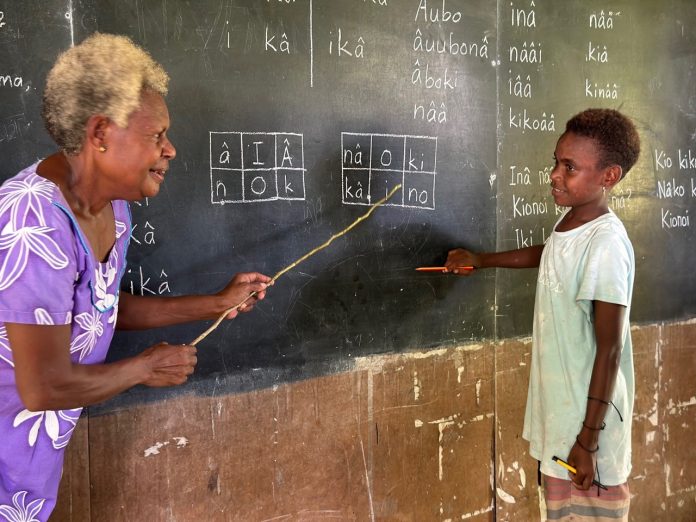
Recognising the need for Aiwoo speakers to learn to read and write their own language, SITAG supported local group Mikilinuave Aiwoo Translation Ministry to hold a teacher training workshop March 17-28 in Ngamane village.
Photo credit-Martha Matzke
Church leaders from the five districts in the Aiwoo-speaking community identified the participants who came to be trained in using a reading primer for the Aiwoo Language, SITAG statement this week said.
Led by SITAG’s literacy specialist Martha Matzke, assisted by Timothy Matzke, the participants were taught basic Aiwoo phonics, reading and writing.
Photo credit-Martha Matzke
Photo credit-Martha Matzke
As part of the training, the teachers visited and practised their newly acquired skills with students at Gauwa Primary School.
Within the first morning of instruction, the children began to read and write Aiwoo, to the amazement and delight of the teaching staff, SITAG said.
Teachers reported that children who were not able to read English, demonstrated they could read and write in their first language, Aiwoo.
Photo credit-Martha Matzke
Photo credit-Martha Matzke
Gauwa Primary School head teacher Emily Bolami said, “I see that the students are progressing. They can easily write a story, make a sentence, in language and it will be easy for them to turn those sentences and stories into English. I think the Ministry of Education should consider this programme.”
Explaining this phenomenon, senior Linguistics lecturer at the University of the South Pacific (USP) Dr Fiona Willans said “The reason why the children find it easy to read their own language is because they already know what the words mean orally.
“It is easy to teach someone how to pronounce different letters, and how to put them together as words, but then you also need to teach them what these words mean.
Photo credit- Martha Matzke
“So I can teach you how to sound out ‘p – i – g’ and how to put these sounds together to pronounce the word ‘pig’. If you already know how to speak English, then you will immediately recognise that this word ‘pig’ refers to that animal running around. However, if your language has a different word for that animal, such as ‘vuaka’ in Fijian, or ‘boe’ in North-East Ambae (Vanuatu), then you will not know what the English word ‘pig’ means even when you read it aloud correctly.
“The reason why the children at Gauwa school should then be able to transfer their new reading skills from their first language into English is because they will have already mastered the process of sounding out letters and forming words and sentences.
“They will need to learn a few new pronunciation and spelling rules for English, but they will then quickly be able to read the language quite fluently. To read English with meaning, they will simply need to learn the new vocabulary and grammar, so that they understand what they are reading.”
Photo credit- Martha Matzke
Meanwhile, at the end of the training the newly trained literacy teachers met in district groups to plan for literacy awareness and to identify potential people (groups) who could benefit from literacy classes such as school drop-outs, adults, youth and children.
In the closing programme many expressed a desire to reach Aiwoo speakers who have not learnt to read their language.
This literacy training was made possible thanks to funding provided by donors in New Zealand through Wycliffe Bible Translators.
The Mikilinave Translation Ministry hopes to see literacy classes begin in the near future.
Photo credit- Martha Matzke
Dorothy Aliko, a member of the translation team, said that the newly trained teachers are determined to see that no Aiwoo speaker is left behind and they hope everyone will be able to read Aiwoo Scriptures.
Emotional drivers of conflict are feelings that can lead or contribute to conflict and violence.
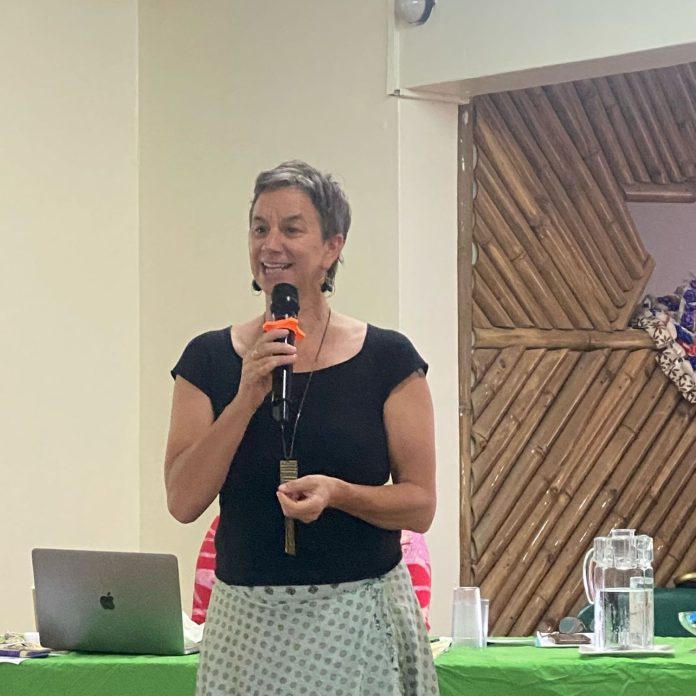
Johanna Podlesak, director of Pacific Programmes for South-East Asia and Pacific, Conciliation Resources stressed on the above at the “Peacebuilding and Security Dialogue” last week at King Solomon Hotel.
She pointed out that “frustration” and “anger” are often feelings that contribute to conflict and violence and people may feel this way for many reasons.
Podlesak however stated that what this boils down to is people either feeling unheard, ignored or powerless.
“So, it’s important to understand ourselves and how we feel in any kind of conflict situation. Fear and anxiety are also very strong human emotions.”
Podlesak said when we don’t have economic certainty, equal rights or equal opportunities or security of a future, this can lead to fear and anxiety.
She stated this is why understanding people’s needs are really important and why a lot of reconciliation processes really need to take into account the feelings of people as well as the problem.
Podlesak expressed that this is primal because from the day when human beings evolved, we have the sense of having to belong in order to survive.
“We are communal beings. It’s very hard for us to survive alone. So, if we are thrown out of our tribe, if we don’t belong somewhere, this feels like death. It feels like we cannot survive this situation.”
Peacebuilders in Solomon Islands have been encouraged to bring forth their message to the upcoming Pacific Islands Forum (PIF) Leader’s meeting.
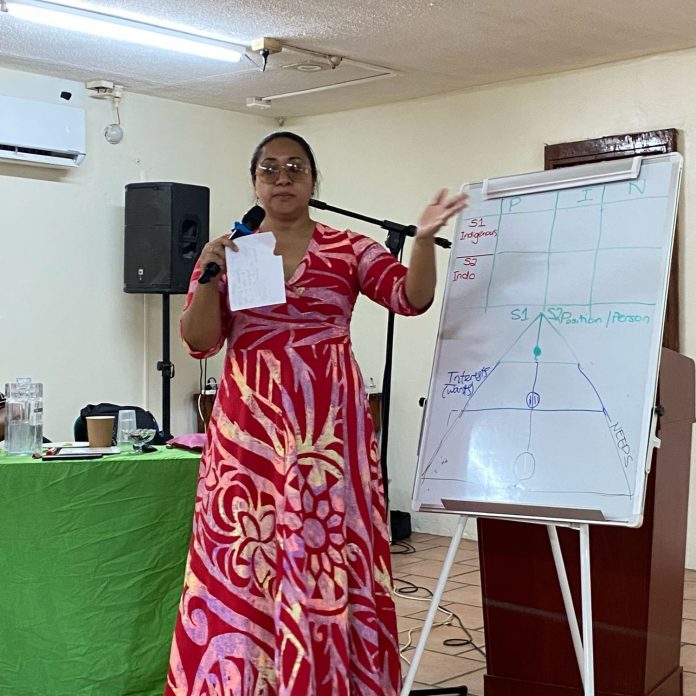
Adi Litia Nailatikau, Pacific programme manager for Fiji and Solomon Islands, Conciliation Resources spoke to participants of a recent “Peacebuilding and Security Dialogue” about this.
She said there will be a PIF meeting in September in Honiara of which PIF leaders will come to sign a notion of peace and by the trend, it will likely be called the “Honiara Agreement”.
Nailatikau stressed that this can be the opportunity for peacebuilders to put forward what they would like to be included in the Honiara agreement.
“Maybe the first thing can be a message towards PIFs leaders, on what you advise, from your backgrounds of which should be within that Honiara agreement.”
Nailatikau emphasized that looking at traditional peace building methods, they are the experts in the room and not the military or the police.
She raised that at the moment, the sway is starting to go back towards traditional security and defence.
“If you’re going to call it a notion of peace, you don’t want that.
You essentially want the traditional peace building methods, the ones that you’ve been practicing, the ones that you’ve experienced.”
Nailatikau said what they can do now as peacebuilders is to collectively come up with a message they would like to put forth to the upcoming meeting.
“One thing you can start doing together is talk story and put a message forward as a collective.”
Nailatikau urged the peacebuilders to also utilize media platforms and their network.
“You have media in the room, utilize that, utilize your network. And then even if the formalities come later, your message can get there first.”
The Solomon Islands National University (SINU) will be hosting a two-day flea market starting tomorrow [April 3].
SINU’s Senior Marketing & Promotions Officer, Renee Bisili, confirmed to Island Sun that the event will take place at SINU Village (formerly known as FOPA Village), located at Panatina Campus.
According to Bisili, the flea market will feature a variety of stalls offering clothes, home goods, handmade items, crafts, food, and entertainment.
She emphasised that the event is scheduled to run from 10am to 8pm for the next two days.
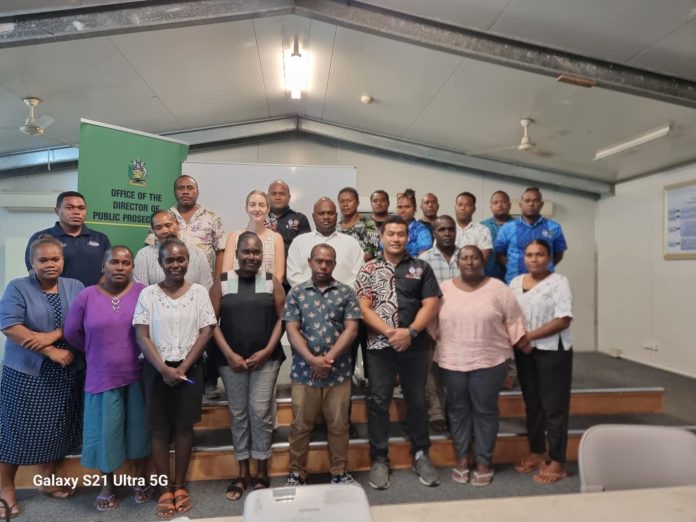
The Office of Director of Public Prosecution (ODPP) has held its second training with the Royal Solomon Islands Police Force (RSIPF) in supporting vulnerable sexual offence witnesses throughout the prosecution process.
Director of Public Prosecution Office Andrew Kelesi highlighted the importance of the training as his office receives almost 50 to 60 percent of sexual offences cases each year.
“This training will help you equip you to produce quality statements when obtaining statement from the vulnerable victims from sexual offences cases,” Kelesi said.
“Every victim whether children or adult they should be treated equally and with respect.”
Kelesi thanked the Australia Solomon Islands Partnership in Justice (ASIPJ) for their continued support to the ODPP.
The purpose of the training was to broaden participant’s knowledge on sexual offences in Solomon Islands, to understand how to correctly select charges, to understand the ODPP Police on Selection of Charges, to ensure consistent approach for charging sexual offences and to understand how to particularise sex offences.
The training also highlighted guidelines for use of the ODPP pikinini video series created by the Office of Director Public Prosecution, to assist police officers who work with child witnesses, including victims of sexual and gender-based violence.
ODPP Principal Legal Officer Letiara Pellie and Hellen Bennett, senior witness support officer who conducted the training, also highlighted in their presentation the importances of the Pikinini Video which their office created as it helps provides the important information’s to children about the court process, including an explanation about safeguards that are available for when a child gives evidence in court.
Ms Pellie and Ms Bennett added, the video allows for important information to be communicated to child witnesses in a clear, consistent and child-friendly way. They are also important resources for parents, family members so that everyone understands what to expect during the court process.
“The video helps as a guideline to assist prosecutors, witness support officers, police officers and others working with children,” Pellie said.
The training was held at Police Headquarter Conference at Rove, attended by a representative of DFAT, Director of Public Prosecution Office and officers from the Sexual Assault Units within the RSIPF.
MID to address Honiara’s chronic road congestions by improving two bypass roads for CBD
BY IRWIN ANGIKI
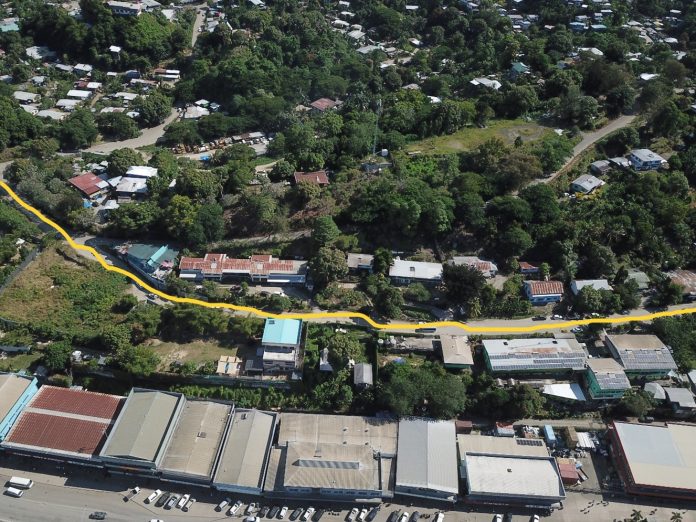
In a bid to address the chronic traffic problem in Honiara, the Ministry of Infrastructure Development (MID) is targeting the CBD’s bypass roads to lift pressure off the main road.
Bypass roads in Honiara’s CBD are Town Ground – Pt Cruz Hotbread and the road passing the Vavaya Ridge – Chiefs House – ITA Hardware shop also known as Lekaboli street, a MID statement yesterday said.
MID is also reportedly eyeing creating a back road for Honiara city, a long-term plan which needs a multi-sectoral approach.
With the Pt Cruz CBD being the centre, the traffic stretches kilometres both east and westwards during the day, worse during peak hours in the morning and late afternoons.
Major road works starting from the roundabout at the HP Hotel entrance going all the way along West Honiara highway for the Land and Maritime Connectivity project is a main contributor to the traffic.
MID said upon completion of improvement and expansion, the bypass roads will better serve as alternative routes, effectively connecting traffic to Chinatown and providing access to areas heading east.
“Aim is to reduce congestion, particularly as the road upgrade works will continue along the main Town Ground roundabout to the Central Market commencing in coming months.
“Upgrading these bypass roads is essential in addressing the immediate challenge of traffic congestion within the Honiara central business district as witnessed to facilitate smoother traffic flow while the main highway undergoes road upgrades,” MID said.
In addition to these immediate plans, MID is also exploring a long-term initiative to establish a back road for Honiara city, the statement said.
“It will require a multi-sectoral approach, involving collaboration among various stakeholders, including the the Ministry of Lands, Housing and Survey, Guadalcanal Province, the government legal team, resource owners, local communities, and other key partners.
“However, this plan may take time to realize since it will need a wider consultation,” MID said.
“As Honiara’s population continues to grow, the demand for additional roads and transportation solutions has become increasingly apparent.
“We are dedicated to implementing strategies that enhance the city’s transportation system like the Japan International Cooperation Agency- funded Honiara urban transportation management project which is in consultation stage,” MID said.