Home Blog Page 1624

MFMR Asian list

Bech-de-mer saga

No locals in fish ministry’s beche-de-mer exporters list, plus one de-registered company

BY BEN BILUA

ASIAN businesses have choked out all local companies vying to be one of the four beche-de-mer export licence-holders for this open season.

The ministry of fisheries (MFMR) yesterday released its official list of the four permit holders for beche-de-mer export – and they are all Asian.

MFMR explained that out of 19 applicants, indigenous Solomon Islanders who applied were unable to meet the requirements, and the four successful ones were selected on the basis of criteria approved by Cabinet.

“These criteria were already published in Solomon Star in the recent past and those that did not meet the criteria were rejected,” the MFMR statement says.

The statement says that ministry of fisheries gave equal treatment to all the applicants, both local and foreign.

Commenting to the media early this month, ministry of fisheries claimed that most local businesses were unable to meet the requirement and the licence fee worth SBD200,000.

Details of the four companies according to online Company Haus registry are as follows:

(1) Solomon FVC New Processes Import & Export Limited is a private company owned by a Mr Frank Sheng Song CI, registered on November 14, 2013 and incorporated on the same date (Nov 14, 2013). There is no record of Mr Frank’s nationality.

However, the company was de-registered on September 1, 2015 due to failure to submit its annual returns. There are no records of it being re-registered thereafter.

The company has one Director with 100 shareholders, and its main business sector is fisheries.

(2) RK Marine Products Limited is a private company registered on June 24, 2013 and incorporated on the same date (June 24, 2013) operating under the fisheries sector.

This company has one director, Mr Pan XIAOBO – a Chinese national, with 10,000 shares.

Its last annual return was filed on August 9, 2017.

(3) Oceanic International Limited was first incorporated on January 26, 2007 as private, but was then re-registered on June 28, 2011 under a Mr Matthew Sauseru. It has one director, Mr Qiang XU – a Chinese national, and with a total of 100,000 shareholders.

Other shareholders are Qiang XU, Bao Gui MEI and Zhuming HUANG – all Chinese nationals.

Its main business sector is fisheries, and its last annual return was filed on May 21, 2017.

(4) Chen Zhen Company Limited – a private company first registered on August 27, 2010 and incorporated the same day under Mr Peter ZHANG – a Chinese national who is also the sole director of the company.

The company has 100 shares from three Chinese nationals – Mr Liang JUNXIONG, Mr Chen GUAN and Ms Chen MALING.

Main Business Sector – Other, and last annual return filed on August 28, 2017.

RSIPF forensics boosted with fingerprint training

0
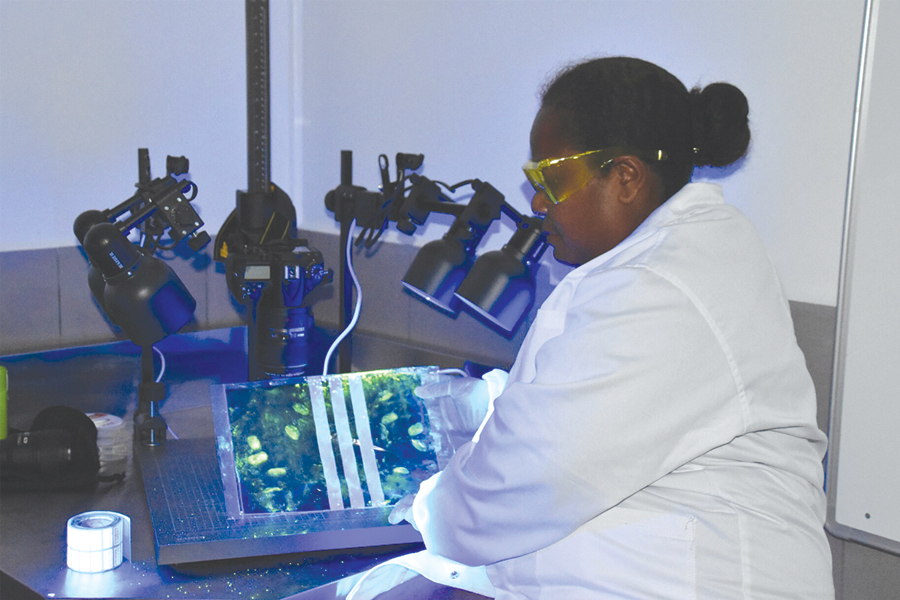
RSIPF Forensic Officer trained using the new equipments
RSIPF Forensic Officers, Advisor and UK Trainer

THE capability of Forensics officers in the Royal Solomon Islands Police in the use of fingerprint technology to strengthen evidence has been boosted with the completion of a two-day training workshop on new fingerprint technology.

The training held October 12-13 was conducted by a trainer from United Kingdom specialised in operating equipment called MVC 3000 fingerprint development Supa Glue chamber.

“The new current forensic lab at the Rove Police Headquarters has a highly sensitive fingerprint development chamber to develop fingerprint on exhibits using vaporised Supa Glue,” says Acting Assistant Police Commissioner, Crime, Vincent U’upwe.

“The methodology increases the quality and success rate of fingerprint development compared to the traditional powder application.

“It also enables RSIPF trained fingerprint experts to chemically develop fingerprint on paper and on surface that have trace of blood on them.

“These new forensic evidence techniques will increase the capability of the RSIPF to investigate crime and provide reliable science based physical evidence to our judicial system.

“We also have the ability to search digital fingerprint data base and provide rapid identification that will assist investigators with vital intelligences and evidence.

“With the current facilities that we have in the new Forensic complex here at the Rove Police Headquarters, our forensic capability is up to the standards in the South Pacific Region.”

The two-day training programme is one of several being planned to familiarise staff of the Forensic Department of the RSIPF with the new technology introduced with the completion of the new Forensic lab constructed with assistance of the Regional Assistance Mission to Solomon Islands (RAMSI) which ended in June this year.

–POLICE MEDIA

Japan’s NYK shipping lines eyes cooperation with SIPA to develop our seaports and cargo volume

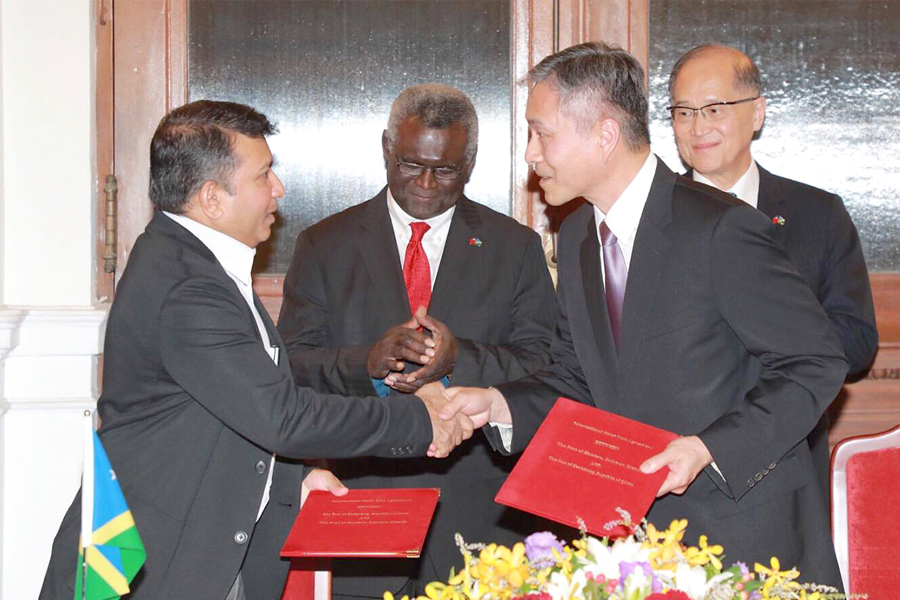
PM Sogavare (second left) applauds signing of MOU between SIPA and Kaohsiung Port. SIPA CEO Eranda Kotelewala (far left) shakes on the agreement with vice-president and CEO of Kaohsiung Port, Taiwan International Ports Corp, Shao-Liang Chen (second right).

By Alfred Sasako


JAPAN’s Nippon Yusen Kabushiki Kaisha (NYK) Shipping Line, one of the oldest and largest shipping companies in the world and Carpenters are discussing increased cooperation with Solomon Islands Ports Authority (SIPA).

The move could see Honiara become a hub for future transhipment of vehicles to other ports in the Pacific.

NYK’s senior representative Yasutada Kobayashi-san and Carpenters General Manager PNG-Solomon Islands, Perba Sivalingam visited SIPA last week exploring possibilities, Chief Executive Officer, Eranda Kotelawala, told Island Sun yesterday.

The visit enhances SIPA’s own plans to turn Honiara Port into a vehicle transhipment point to the rest of the Pacific.

“SIPA is planning transhipment of vehicles via the Port of Honiara and transform it into a regional transhipment hub in future,” Mr Kotelawala said.

He said last week’s discussion with NYK and Carpenters focussed on the way forward to improve volume and increased calls to Solomon Islands down the line.

NYK is one of the oldest and largest shipping companies in the world, boasting of some 800 ships.

It is a member of the Mitsubishi keiretsu and is headquartered in Chiyoda, TokyoJapan. The company has a fleet of about 800 ships, which include, containershipstankers, bulk and woodchip carriers, Ro-Ro car carriers, reefer vessels, Liquidified Natural Gas (LNG) and cruise ships.

“Mr Kabayashi-san was here in Honiara with the new agent in Solomon Islands, Carpenters Shipping to explore possibilities of further cooperation with SIPA for increased volume through the Port of Honiara and Noro,” Mr Kotelawala said.

“This is revenue and employment for Solomon Islands. We’ve just got to prepare ourselves to take these challenges head-on,” he said.

Mr Kotelawala last week announced that Solomon Islands Ports Authority (SIPA) had embarked on a multi-million-dollar infrastructure development plan, designed to lay the foundation for economic growth at the nation’s seaports over the next 50 years.

Part of the plan, which will see the expansion of Noro wharf in Western Province, involves a tripartite partnership arrangement with MAERSK, the world’s largest shipping line, and Tri-Marine.

The parties are expected to sign a Memorandum of Understanding (MOU) in Honiara tomorrow (Wednesday). A site visit to Noro follows on Thursday, October 19.

SI economy highly vulnerable to credit negative shocks

0

BY CAROL-ANNE SULEGA

SOLOMON Islands’ very small economy (nominal GDP of $1.1 billion in 2016) offers limited scope for diversification of economic activity and leaves the sovereign highly vulnerable to credit negative shocks.

This is according to Moody’s Investor Services.

Such potential shocks include Solomon Islands’ exposure to climate change, which poses significant economic and fiscal risks.

At the same time, resilience is low on account of the country’s low level of development, reflected in very low incomes, low quality of infrastructure and weak institutions.

These characteristics, Moody adds, are somewhat mitigated by low government debt levels that provide room for expansionary fiscal policy, if necessary, and the potential for physical assistance and financial support from international partners.

The economic base is narrow, reliant on agricultural and forestry production for around 30 percent of GDP.

The economy’s dependence on forestry resources — which are depleting at a sustained pace — and goods exports to China — which account for a sizeable 26 percent of GDP — raise the sovereign’s susceptibility to sector and market -specific shocks.

The Medium-Term Development Strategy 2016-2035 aims to bolster the economy’s resilience through new sources of growth and revenues, though the effectiveness of these measures has yet to be revealed.

Constraints on access to finance are a hurdle to strengthening economic output.

Moody adds that although banks are adequately capitalised, highly liquid and profitable, a potential further reduction in correspondent banking services could hinder the flow of credit to trade and investment sectors.

Incomes, with GDP per capita around $2,000 in 2016 at purchasing power parity, are very low relative to other B-rated sovereigns, despite more than doubling over the past decade.

“Furthermore, most economic and policy institutions are nascent.

“Solomon Islands’ rankings on Worldwide Governance Indicators, particularly government effectiveness and the rule of law, are low.

“Perceptions of corruption have the potential to hinder the implementation of key investment projects and stymie progress on economic development,” the released document states.

Lack of transparency, it adds, on parts of government funding and spending weighs on the operation of and reporting of the budget, particularly given the emphasis donors have placed on adherence to fiscal reforms.

Moody’s Investor Services then added that the country’s very small size constrains the effectiveness of institutions by subjecting Solomon Islands to factors beyond the control of domestic policymakers.

Landowner group in Temotu Province claim logging is underway on their land without consent

0
DEAR Editor,
RADIO New Zealand International (RNZI) today, Monday 16 October 2017, reported there are three logging camps in operation at Nende allegedly without the required permits.
 
Quoting RNZI this was the full report –
 
According to locals on Temotu’s largest island Nende there are three logging camps in operation there without the required permits.
 
The logging company, Malaysia-based Xiang Lin, earlier claimed to have permission from a former Temotu Provincial executive to operate on Nende.
 
However, no environmental impact assessments were reported to have been submitted, nor any timber rights hearings completed.
 
Dudley Mali of the Nende Resource Development Association said landowners were not happy that early logging activity has begun without their consent.
 
“The Temotu Provincial executive has rejected the timber rights, so we see it as illegal logging by that company. Now we are filing restraining orders on some of the blocks.”
 
Yours sincerely
 
Frank Short

Gov’t cash drops

0

SIG cash balance falls this year, revenue lower than expected: Moody

BY CAROL-ANNE SULEGA

MOODY’s Investors Services has admitted that the Government’s cash balance has fallen to low levels this year, revenues have come in below expectations, but still expects the Government to maintain its ongoing commitment to ensuring robust public finances.

“Solomon Islands’ successful graduation from an IMF programme in 2016 has helped strengthen fiscal management through the Public Financial Management Act, the introduction of a multiyear budget framework and enhancements to debt management,” the released document states.

The recently launched tax review, which includes examining the consumption tax, sales tax, income tax and other taxes such as gambling tax, would raise prospects for government revenue receipts if successfully implemented.

Moody adds that at this stage and given the likely implementation lags and potential narrowing of the scope of the fiscal reforms, it does not factor a significant broadening of the tax base in our projections.

Larger borrowing to fund key development projects such as the Tina River Hydro project will be done on concessional terms and include grants.

“We also expect Australia to continue to provide aid to Solomon Islands, which will help to maintain the sovereign’s low borrowing needs and high debt affordability.

“Overall, interest payments on government debt will remain below 0.5 percent of government revenues, a very low level compared to other rated sovereigns.

“Beside financial assistance, Australia provides technical support that contributes to the smooth functioning of the Solomon Islands’ government institutions,” it further adds.

Technical advisors are seconded to help strengthen the Solomon Islands’ capacity to undertake core state functions.

Although an escalation of domestic political and social tensions could have a high credit impact by threatening the continuity of donor support and hampering the effectiveness of policies and economic growth, Moody’s Investor Services thinks it is a low probability risk.

There has been some progress on restoring law and order in the past decade through the Regional Assistance Mission to Solomon Islands (RAMSI), which Moody’s Investor Services expects to persist.

“We expect Australia’s technical and financial engagement with Solomon Islands to continue following the conclusion of RAMSI.

“Australia will continue to provide development support for justice and governance, education, health and police development through its bilateral aid investment program.

“Australia provides about 70 percent of Solomon Islands’ total aid, equal to around 28% of the government’s revenue or 12 percent GDP.

“The signing of a security treaty in August 2017 underscores the continued engagement on security issues between the two countries,” it further adds.

Moody’s Investor Services then elaborated that low incomes, narrow economic base and weak institutions constrain shock absorption capacity.

Lau lagoon to COP23 Germany

0
One of Mr Filia’s photo to be exhibited in COP23 Gallery
Island Sun reporter Lynton Aaron Filia

MASI member, Island Sun’s reporter, Lynton Aaron Filia says he is humbled and honoured to contribute towards the COP23 through his photo stories on climate change issues in the Solomon Islands.

Filia’s photograph was selected from a number of entries from photographers and reporters from the Pacific in a photo competition by the host country, Fiji.

As the Solomon Islands are under threat because of climate change he said he believed his picture would help portray the plight of Solomon Islands people, especially the Northern Region of Malaita province where his pictures were captured.

“I am just an amateur journalist and a reporter who is passionate about youth issues,” he said.

“My interest is in environmental issues and I encourage other young journalists to be passionate about these issues as well as it is time that we lead the change we want for the interest of our community and country.”

As a young journalist and a reporter passionate about youth issues, Mr Filia said he was excited that his picture had been selected to be showcased at the biggest climate change gathering.

The competition had called for submissions on photographs that showed the human or environmental impact of climate change and/or how individuals and groups are mobilising to counter the threat posed by climate change.

Filia also commended Island Sun newspaper for giving him the opportunity to unleash his passion and getting exposure at a higher level.

MASI Secretariat on this occasion congratulates Mr Filia for his achievements and wishes him well in his career.

Filia’s work will be displayed at COP23 in Bonn, Germany.

COP23 is informal name for the United Nations Climate Change Conference to be held in Bonn this year. The United Nations Climate Change Conference is held every year to assess progress in dealing with climate change.

–MASI Newsletter

Taiwan’s support of health issues in the Solomon Islands

0
I write this letter to your newspaper consciously trying not to appear overtly political because it is not my intention in writing about concerns I care about deeply, the health and welfare of Solomon Islanders, by implying anything of Taiwan’s foreign policy.
On the global stage, Taipei’s health cooperation has been viewed as relatively uncontroversial and pragmatic in engaging in international relations and reducing its diplomatic isolation.
In the Solomon Islands where diplomatic relations exists with Taiwan the government in Taipei has always supported local health initiatives to protect and promote health.
It is within the spirit of that bond of cooperation that I appeal to the Taiwanese Government to consider aiding the Solomon Islands Ministry of Health and Medical Services (MOHMS) by providing the funds to re-build and re-equip the now derelict Rehabilitation Workshop at the NRH with the aim of ensuring the 400 or more limbless former patients of the National Referral Hospital (NRH) are able to be given prosthetic limbs to enhance their life opportunities and job prospects.
If the Rehabilitation Workshop could be rebuilt and equipped with the necessary tools to again function as it once did, I really believe it will be possible for one or more charitable organizations in Australia and New Zealand to offer custom made prosthetics to those awaiting limbs.
What has prompted this letter at this time?   There are several answers to the question which I will explain.
Firstly, the SI Prime Minister recently paid a historic and successful visit to Taiwan where he hailed the relationship between his country and Taiwan.
There was further warm words on the existing diplomatic relationship this week during the ‘Double Tenth’ celebrations held in Honiara when His Excellency, the Taiwanese Ambassador announced, what I have long advocated, the establishment of a factory in Honiara to generate employment and to aid the economic prosperity of the Solomon Islands.
I am not alone in having raised concerns regarding the need for better oversight and auditing of the money the Taiwanese Government gives, annually, to advance constituency development and projects.
The promise of a factory to ensure job creation locally is, at least to me, a very sound and tangible initiative that has the potential to silence those who might have implied that there is little being seen, to-date, with the money allocated for constituency projects.
Some years ago there was much talk of a ‘bottoms-up’ approach to rural development but nothing materialized.  Taiwan’s direct creation of rural enterprises, even if initially on a small scale would bring about a real change to the lives of communities.
.
In returning to my plea to the Taiwanese Government, I would earnestly request that my request is met with approval and some hope can be offered very soon to those less fortunate in society.
Yours sincerely
Frank Short

Thailand has much to offer the Solomon Islands on successful sustainable development

0
AS the Solomon Islands still seeks to grow its economy and provide a meaningful sustainable development policy to accommodate its growing population and at a time of increasing  local concern over the effects on climate change, I would recommend the Solomon Islands Government to examine Thailand’s success story on sustainable development.
First some facts.
Thailand sits in the centre of Southeast Asia.  It has a total area of 513,000 km (198,000 sg mi); a population of 69 million and the unitary state is subdivided into 76 provinces.
The country is a constitutional monarchy.
Soon after the late and much loved King Bhumibol took the throne in 1946, His Majesty toured the whole country and became acutely aware of the many hardships then facing the rural people, particularly the poor farmers.  At that time the, per capita GDP was about US$200.
The King took a keen interest in rural development, devoted his whole life to helping the rural impoverished and instituted many royal projects which led to the sufficiency economy philosophy policy now pursued with growing success by the Thai Government.
The sustainable economy approach has been introduced and adopted in more than 23,000 villages across Thailand, raising prosperity and economic standards to higher levels by stages.
Thailand’s sufficiency economy concept as sustainability at its very core and is now seen as an important contributor to the UN’s international development goals.
The Thai governmental organisation most responsible for implementing the sufficiency economy is the  National Economic and Social Development Board
The ECSDB’s primary tool for mobilising action is the excellent, graphically illustrated publication of theNational Economic and Development Plan.  A copy can be accessed by using your browser to search –
 
Yours sincerely
 
Frank Short

West Areare voters demand truth about $4 million shipping grants: Charles Karaori

0

By Alfred Sasako


WEST Are Are community leader Charles Karaori has congratulated the Constituency MP, John Maneniaru, on his promotion to head the Ministry of Finance and Treasury.

Hon Maneniaru, formerly of the Ministry of Fisheries and Marine Resources, and Hon Snyder Rini swapped ministries in August this year. But the transition was delayed until last week as a result of intervention by the Party executives of the DCC Coalition.

In his congratulatory message, Mr Karaori warned that while the promotion was a gain for West Are Are, thousands of voters are demanding answers on a number of issues relating to the use of funding grants for the Constituency in the last three years.

“For example, the voters want the truth about the $4 million in shipping grants Hon Maneniaru received in 2016. They want to know what he spent the money on as to this day, West Are Are voters have not seen a constituency boat,” Mr Karaori said.

“All the people know through other sources is that their MP has requested an additional $5 million from the shipping grants this year, a request former minister for the Ministry of Infrastructure Development (MID) had turned down because the initial grant of $4 million was never retired,” Mr Karaori said.

He said shipping is not a priority in West Are Are because the Constituency is well served by existing shipping operators.

“What the voters are quite angry about is that their MP never told them he had received $4 million in shipping grants last year. Hon Maneniaru had an opportunity to inform his voters during his recent tour of the Constituency, but he never did,” Mr Karaori said.

“I think there are a lot of angry voters out there,” he said.

Mr Karaori said while Hon Maneniaru’s promotion to the Minister of Finance was a proud moment for the people of West Are Are, the ramifications could be dire for the DCC Government.

“I said this because of the fact that there absolutely is nothing to speak of in terms of tangible development in West Are Are. I guess the same is true of other provinces, despite tens of millions of dollars that Members of Parliament received on behalf of their constituencies,” he said.

“I guess one way of describing it is that while the move is a gain for West Are Are, it is suicidal for the government.”

Mr Karaori said a recent assessment of the MP’s performance in terms of project delivery showed only iron roofing was donated – all without nails and Louvre glasses.

“How do you expect a village man or woman to buy materials to complete their houses, when the bulk of the cost of completing their houses has been left to the poor people?”

“Members of Parliament, particularly those in government, are on the priority list of receiving annual grants of $7 million each in what is popularly known as the Constituency Development Fund (CDF).

“This means that each Constituency would have received $28 million in CDF grants by the end of their four-year term. But there is more that they get as extras that we all don’t know about,” Mr Karaori said.