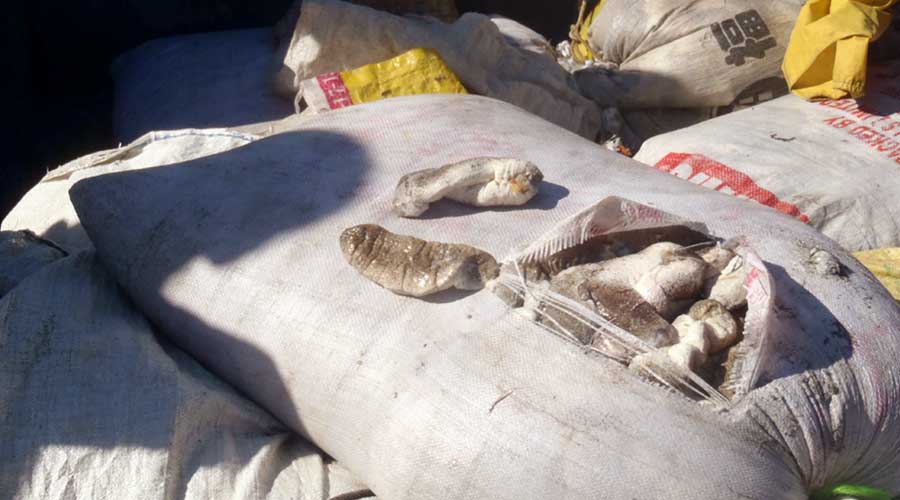
All activities relating to fishing or harvesting of sea cucumber (beche-de-mer) will cease as of midnight of January 31, 2018, says the Ministry of Fisheries and Marine Resources in a statement issued yesterday.
It says the five months ‘Open Harvest Period’ will end at midnight on Wednesday and no further extension will be given, therefore, those involved in the beche-de mer trade are reminded to take heed.
The Ministry of Fisheries and Marine Resources opened the beche-de-mer fishery on September 1, 2017 following approval from the cabinet.
The fishery was supposed to close at the end of November 2017, however, an extension was required because of delays in issuing of export licence so MFMR decided to extend the open harvest period to January 2018 to make up for the lost time.
The Director of Fisheries will enforce an order under section 22(2) of the Fisheries Management Act 2015 on February 1, 2018 prohibiting fishing or possession of sea cucumber or beche-de-mer.
There will be a grace period for licensed exporters to export products that they have already purchased from fishers.
MFMR says data collected by the Ministry of Fisheries shows that there have been fewer high grade beche-de-mer species purchased by exporters in the current open period compared to previous open periods.
“The majority of beche-de-mer harvested has been of low value. This is a strong indication that the high grade beche-de-mer species have been overexploited and their recovery was slow in spite of two years of closure before the lifting of the ban.
“The decline is of great concern to the Ministry of Fisheries. However, MFMR is committed to improve the management of beche-de-mer fishery to ensure its sustainability into the future.”
Tanito in action Madang last weekend in the PNG NSL.
BY ROMULUS HUTA
SOLOMON Islands international Tutizama Tanito has been described as ‘livewire’ by the PNG media.
Tanito was given the description following his electrifying pace in the PNG national soccer league.
The lad from Western Province is currently playing for Lae City Dwellers known as Toti FC in the PNG’s top flight soccer league.
Dwellers coach Peter Gunemba told the PNG media that Tanito has been very sharp since joining the club three weeks ago scoring three goals in two matches.
“The livewire from Solomon Islands has been very sharp since his arrival this month.”
Gunemba said he arrived two days before the second game against Buang FC and they did not waste him, thus bringing him into the second half in the game against Buang FC.
According to other reports, Tanito impressed the coach and the crowd with his speed and footworks where he terrorizes the Buang FC defence in his debut for Toti City FC.
He assisted 2 goals and scored himself one.
Last weekend, in the game against Madang FC, the coach opted to use him in the first 11 and he scored his second goal by stepping up to get a penalty.
“Tutizama now commomly called by team mates and local fans as “Totizama” is a silent achiever and well known in PNG since his days with former NSL club Hekari United FC,” a statement from the club said.
Meanwhile, another Solomon Islander and defender Andrew Rarangia is also playing alongside Tanito at the same club.
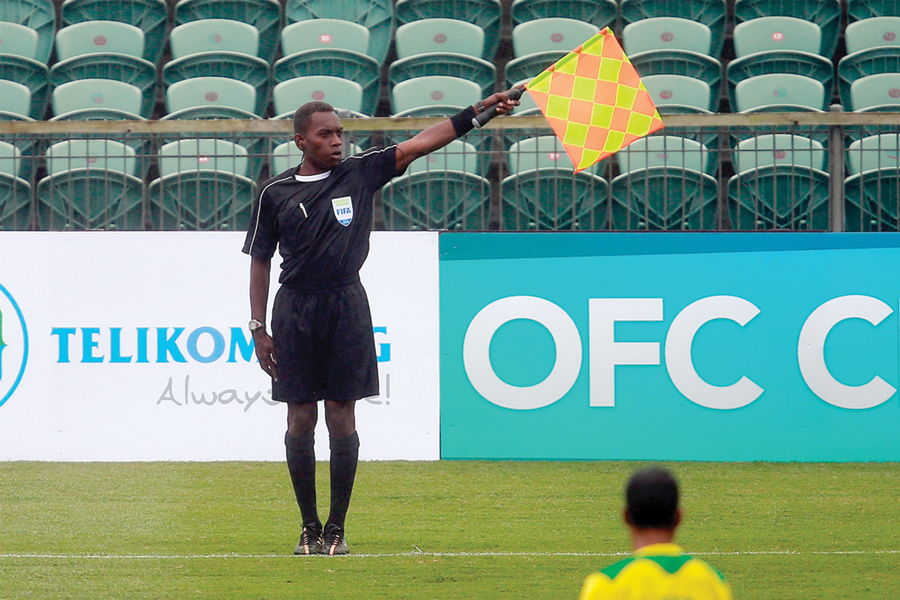
Bernard Mutukera is one of the FIFA badge referees for this year 2018. Last year he also officiated in the FIFA Under-20
World Cup held in India.
BY ROMULUS HUTA
A total of 10 referees across all football codes from Solomon Islands have been accredited with FIFA badges for this year.
This is for all three football codes namely conventional 11-aside, futsal and beach soccer.
The total figure this year is a reduction by two from the total of number of Solomon Islands referees accredited with FIFA badges last year. Last year there were a total of 12 referees.
The list this year saw two referees dropped from being accredited with FIFA badge. They are Simon Kwaimani for beach soccer and veteran famous soccer referee Nelson Sogo for the conventional 11-aside.
Due to aging purposes, Sogo has retired and his name will go down as one of the longest-serving FIFA referees from Solomon Islands.
The FIFA-badge accreditation allows referees to be eligible to officiate in top level football matches across the globe.
Like the 2017 list, no female referees receive FIFA-badge accreditation for this year.
The Solomon Islands soccer referees body paced in a submission for one of the female referees to the FIFA Referees Committee last year but was turned down.
The names of the FIFA referees for this year were approved last year and their appointments came to be effective as of January 1, 2018.
The 2017 FIFA badge holders cease to be valid after December 31.
Meanwhile, Nelson Poloso of Solomon Islands extends his term as a member of the FIFA Referees Committee for another year.
See below are names of the 2018 FIFA badge holders.
REFEREES:
George Time (International since 2010)
ASSISTANT REFEREE
ERICK Johnny (International since 2013)
METE Douglas (International since 2013)
MUTUKERA Bernard Alu Paekera (International since 2015)
SENIGA Stephen (International since 2010)
SOLODIA Jeffrey Asipara (International since 2015)
Christian Karmbeu, a member of France’s World Cup 98 winning team will
accompany the FIFA World Cup Trophy to Honiara.
BY ROMULUS HUTA
Christian Karmbeu, a member of France’s World Cup 98 winning team will accompany the FIFA World Cup Trophy to Honiara.
THE historic visit of the FIFA world cup trophy to Solomon Islands will be accompanied by former French national footballer and New Caledonian Christian Karembeu.
The trophy will touch down at Henderson International Airport in Honiara early Thursday morning.
Karembeu was a key member of the France world cup 1998 winning squad which thrashed Brazil 3-0 in Paris in the grandfinal to win the most coveted and prestigious soccer prize for the first time.
Other members of Karembeu’s world cup winning line-up include legendary Zinedine Zidane, Fabian Barthez, Emmanuel Petit, Thiery Henry, Lilian Thuram, David Trezeguet and Youri Djorkaef.
The former Real Madrid and Nantes dreadlocked-holding midfielder hails from Lifou in New Caledonia and that was where he began his lavishing soccer career.
Lifou is the largest of the Loyalty Islands found off New Caledonia’s east coast.
At the age of 17, Karembeu left his homeland to attend the Nantes Football Academy in France where he won the French Championship in 1995 with the Nantes senior team. Three years later, he won another trophy, the UEFA Champions League with Real Madrid and followed by the world cup.
Two years after winning the World Cup™, Karembeu won the European Championship before announcing his international retirement in 2002 with 53 caps and one goal scored.
France players celebrate with the World Cup trophy after defeating Brazil in the final of the 1998 world cup. Lying down with the trophy is Karembeu.
Reflecting on the lengthy colourful soccer career of Karembeu, the participation at the World Cup 1998 was a special one in the footballing history for New Caledonia and OFC.
Even if the Oceania Confederation didn’t have any teams representing it at the FIFA World Cup™ France 1998, it did have one player born and raised in the Pacific doing the region proud. With the whole of the Pacific behind him, Christian Karembeu helped hosts France lift the World Cup™ trophy.
Meanwhile, global beverage company Coca-Cola is sponsoring the globe-trotting trip of the trophy.
The Honiara leg will take three hours before it is flown to its next destination.
The ceremony to welcome the trophy in Honiara will be held at the Henderson Airport.
There are two scenarios being put in place by organisers. The scenarios depend very much on the weather conditions.
If it is sunny then the trophy will make its way out onto the tarmac for the people to get a glimpse of it. If it rains, the trophy will not be taken outside but remain on the plane.
Karembeu of France trying to stop Brazil’s Ronaldo as Rivaldo looks on from behind during the 1998 FIFA World Cup grandfinal. France thrashed Brazil 3-0 to win the world cup.
No one is allowed to touch the trophy except the head of state.
There will be tight security deployed at the airport during the arrival of the iconic solid-gold trophy.
Solomon Islands is one of the three countries in the Pacific the trophy will visit. The other two are Tonga and PNG.
Meanwhile, the 2018 World Cup Trophy Tour started in Russia – the host of the tournament — on Sept 9 2017 and travels to 51 countries covering 126,000 kilometres before the journey ends in Russia on June 7.
The Russia 2018 World Cup will be held June 14 to July 15 with 32 countries competing to be crowned the world‘s best football team.
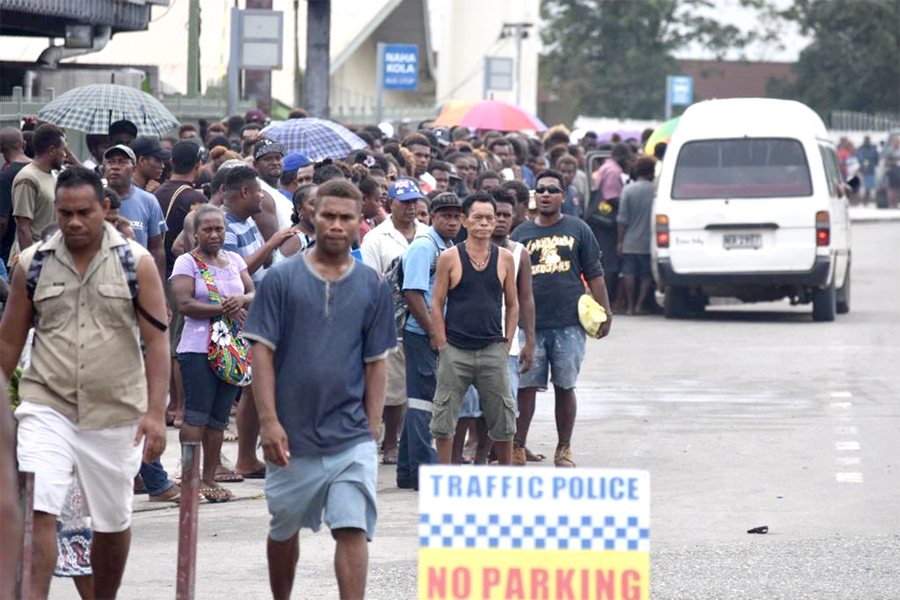
Passengers waiting eagerly for bus as Honiara Central market bus stop crowded with people. Photo by JARED KOLI
Standing at the bus-stop for hours on end has commuters questioning HCC’s new bus routes
BY JARED KOLI
THREE weeks after being implemented, the reality of Honiara City Council’s (HCC) long bus routes is kicking in.
People are lining up the bus-stops located between Central Market and White River, more so between the Central Market and KGVI.
While some are lucky to catch a ride after a few minutes, others are reported to wait for more than an hour before getting a lucky space.
It is obvious that buses are full from the main market right up to KGVI or White River – leaving the intending passengers in bus-stops along the way to be at the mercy of their lucky stars.
A long-time cab driver who was once a bus driver, Mr Hendry Bosa, said he “feels sorry” for these passenger having to wait for long to catch a bus to their destination.
“This has become an issue and if it continues as what we have witnessed, it could have a huge effect on our students who travel to school daily by bus.
“Students will be arriving late for classes, or they could not make it in time for important programmes such as school assembly and so forth.
“Nearly every bus stop remain full with passengers wanting to travel to their destination from mid-morning till late in the evening.”
Bosa was at the Honiara Central Market waiting to transport friends to Lungga when he was approached by Island Sun on Monday this week. He owns three cabs.
“People ask me to transport them to Lungga for $15 each, because they could not stand at bus stops for hours,” he told this paper in an interview besides his parked cab.
This paper during a visit to Panatina yesterday observed that a good number of people waiting at the Panatina Campus bus stop had to catch a bus to Lungga in order to find free seats on buses destined for Central Market, which the writer also did yesterday.
Some had even walked from Panatina to Pt Cruz as a result of the difficulties faced.
In the meantime, Bosa said HCC should reconsider the long bus routes it had imposed.
“It seems HCC does not care for these people,” he protested.
A bus driver in an impromptu interview yesterday, said it would be wise if HCC considers partitioning the main highway from White River to KGVI into three stops – the added point could be from Central Market to Kukum, and from there to KGVI.
HCC Communication Bureau was contacted yesterday on the matter. An official response should be given in due course.
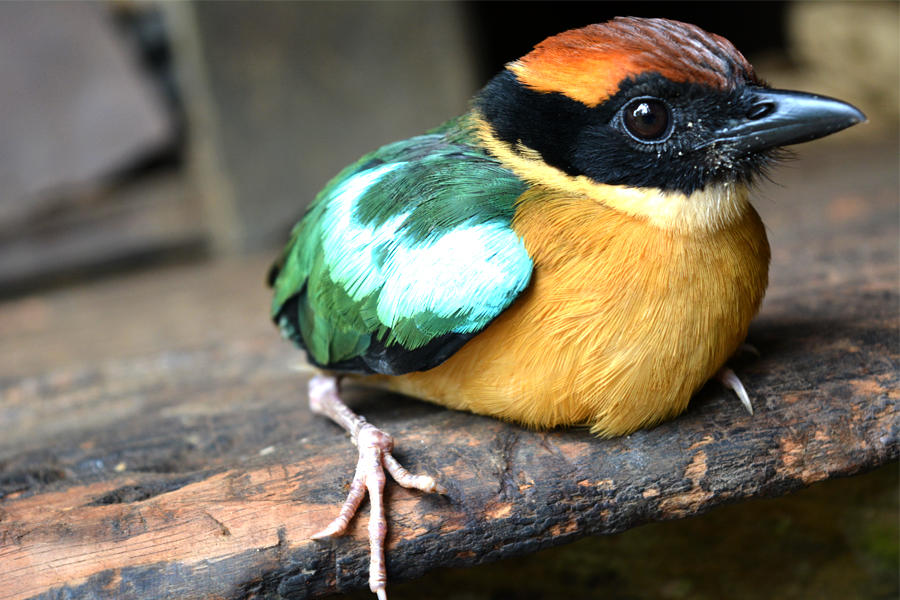
Black-faced Pitta is endemic to Isabel, Choiseul and Bougainville
BY PRIESTLEY HABRU
Black-faced Pitta is endemic to Isabel, Choiseul and Bougainville
TIROTONA village, located just a few kilomteres inland and uphill from Isabel Provincial township of Buala is fast becoming a hub of bird watching in Solomon Islands.
The major drawcards for tourists are the rare species of birds like Black-faced Pitta, Solomons Frogmouth, Fearful Owl, Imitator Goshawk and Sanford’s Sea-eagle.
Other birds tourists want to see are Woodford Rail, Solomon Boobook and Myzomela according to owner of Mae Holo Bird Watching Roger Manehage.
Mae Holo and Bubuli Bird Watching owned by Gerard Kidia are currently the two bird-watching ventures at Tirotonga Village with two more establishments expected soon.
Both Mae Holo and Bubuli bird watching businesses provide accommodation and cheap packages that include pick up at the Fera Airstrip to food, accommodation and trips inland to watch the colourful birds.
Tirotonga Village, visible from the air is the hub of birdwatching on Isabel
One of the sought after birds to watch is the elusive Black-faced Pitta which is only endemic to Isabel and Choiseul islands in the Solomon Islands and Bougainville which is part of Papua New Guinea.
According to the 2016 International Union for Conservation of Nature (IUCN) Red List of Threatened Species, the Black-faced Pitta was once reasonably common, at least on Bougainville. Forty specimens were collected there before 1938. But since then it was not recorded until 1994 when three birds were heard calling at Tirotona on Santa Isabel. Searches and interviews on Choiseul and Bougainville were unsuccessful until it was recorded on Choiseul in 2014.
In its latest assessment, IUCN stated that the conservation status of this species is not well understood: It is categorised as ‘Vulnerable’ on the basis of its very small known population, but if research shows its population is falling, this would warrant the bird being reclassified in a higher threat category.
More than 10 tourists have come to the hilltop village of Tirotona so far this year either through Mae Holo or Bubuli birdwatching arrangements.
Apart from these two bird watching businesses, fellow villager Freda Pooti has a descent accommodation with four rooms, kitchen and laundry facilities for tourists and guest alike who wish to visit Tirotona Village.
A still photo from an aerial video showing Buala Town on the bottom left and nearby coastal villages and Tirotonga Village visible at the top left corner
Situated along the mountain range above Buala Town and surrounding coastal villages toward the east, Tirotona Village is a picturesque home with mostly sago-palm thatched houses and few iron-roofing hamlets overlooking Maringe Lagoon that includes Fera Island which hosts the local airstrip toward the western tip.
The Maringe Lagoon which consists of Jhokau, Tasia, Fera and Sulei islands are surrounded by beautiful coral reefs, mangroves and a few pockets of white sandy beaches especially at around Fera Airstrip.
Traditional ‘Visi’ Fishing Technique
Whilst in Buala Town or watching bird at Tirotonga Village, tourists can listen to stories, experience or even witness a traditional fishing technique still practised by nearby coastal village of Nareabu.
No tourists or guests have actually been invited to see this fishing technique let alone document or film ‘visi’ as it’s called, but by paying a courtesy visit to chief and elders of Nareabu Village, you can be allowed to see the preparation and might even be invited to the actual fishing method that only uses traditional vines and coconut leaves.
Reuben Tatemana, left and Godfrey Tafolehe, right, are among Nareabu elders who organise ‘visi’ expeditions.
Narebau Village Chairman and Chief Reuben Tatemana said ‘visi’ is a fishing technique that has been passed down from their ancestors and can only be done on special occasions such as a huge church gathering, wedding or during Christmas.
Tatemana said preparation for the ‘visi’ usually takes place three to two weeks before the actual fishing expedition.
“Men, women, young people and basically the whole Nareabu community partake in the preparation on an allocated day as agreed by the elders. What happen is that we will sew the fresh coconut leaves along a 200 to 300 metres vine using ropes extracted from a local tree,” he explained in his local ‘Cheke Holo’ language of Isabel Province.
Whilst the coconut leaves are sewn into the long vine strip, women and girls are not allowed to step or stand over it as was the tradition.
He said up to two or three 200m-300m fishing net-like coconut leaves would have been prepared before the ‘visi’ fishing day takes place where only men and boys are allowed to perform.
Freda Pooti outside her accommodation lodge.
One the selected day for the ‘visi’ one or two canoes with outboard motor powered engine would load the traditional net and transports it to the preferred location within the reefs of Maringe Lagoon. It can only be done on certain periods of the day and night when it is between low and high tides.
A person referred to as ‘jahoi’ would pull the first end of the vine, whilst the other end is tied to a canoe and the rest of the men would help in pulling the traditional net starting from the deep end of the reef toward the shallow part.
At the shallow part, a group of men and boys would be standing with a ready-made hand woven net made from local vines to block the fish been chased ashore and surrounded by the coconut leaves net-like been pulled at both ends and in the middle by the rest of the men.
Roger Manehage’s Accommodation.
Both ends of the traditional coconut leaves net would be pulled closer and closer so as to narrow the gap for the school of fish to be caught in the middle, blocked also by the woven net held steadfast by the other party in the shallow part of the reef.
A variety of fish would be trapped inside the small space as the nets have been narrowed to shut off any space. The men would then pick the fish trapped inside the space surrounded by both the net-like coconut leaves and the woven net.
Fish caught through the ‘visi’ are actually terrified by the sound of the coconut fronds been pulled ashore and trapped as the men pulled and narrowed the long vine with coconut leaves toward the shallow reef.
The first canoe load of fish back to Nareabu Village would be shared amongst fellow villagers. The ‘visi’ would continue two or three times into the day even during the night and the early hours of the morning. These later catches would then go toward the stock of feeding hundreds or even thousands of people coming for that special occasion they have organised at Nareabu.
Part of Tirotonga Village.
A pre-dominantly Anglican Church followers on Isabel Province means Nareabu Village celebrates Saint Barnabas as its Patron Saint around June each year, so you might be lucky to see the preparation of ‘visi’ or experience it yourself if you seek the permission of Chief Tatemana.
A Kaqe was constructed during the Choiseul Province Second Appointed Day
at Ogho village, Choiseul Province on 24th February 2017
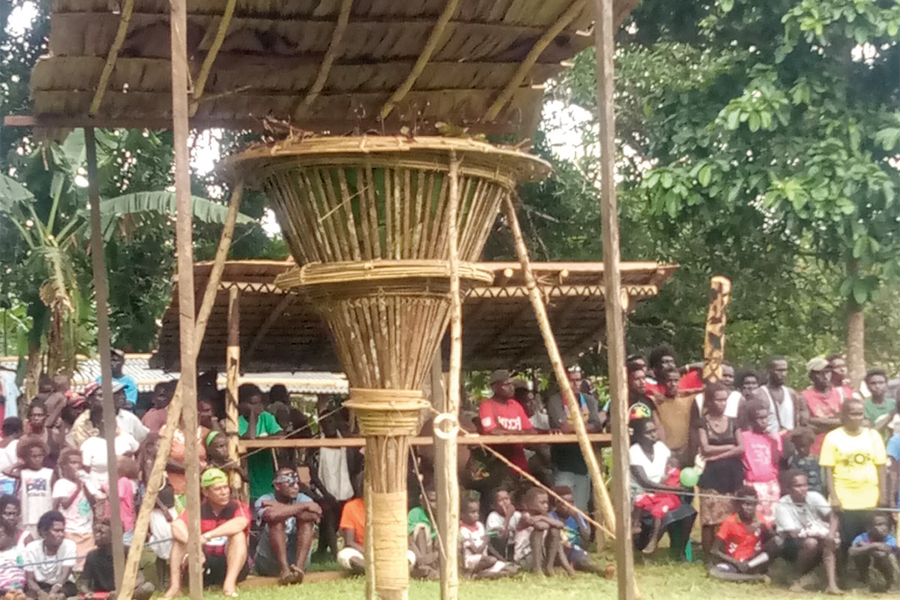
A Kaqe was constructed during the Choiseul Province Second Appointed Day at Ogho village, Choiseul Province on 24th February 2017
A traditional ceremony still practised today in Choiseul (Lauru) Province called ‘kelo’ is to bring peace, unity and strengthen relationships.
During the head hunting era before Solomon Islands was colonised by Europeans, Kelo was the last event that bought about peace in Lauru and the significance of this ceremony has been upheld and passed down over the years.
The Kelo ceremony can happen when a feud has to be settled to restore peace between rival tribes and groups. It can also be performed during event such as laying of tombstone for a dead relative.
It is mainly to strengthen relationships.
The recent one I witnessed was at Ogho village during the Choiseul Province’s Second Appointed Day on 24th February 2017.
Women dancers on the giving party (Givers of the Kaqe) ready to welcome the Party to receive the giftsWarriors guarding the Kaqe on the background to receive the incoming party
By the end of the kelo ceremony a harmonious atmosphere and absence of tension would bring happiness between the warring parties and that’s when a huge platform of food is built called kaqe.
When and if the kaqe is erected then that is supposed to be the end of the enmity.
When fighting happened, pig is put on top of the Kaqe which is a sign that the hostility is over and there is peace.
Kaqe is built by selected few who have acquired the skills from their forefathers and over the years have passed on the knowledge to this generation.
It is prohibited for people to stay underneath the kaqe during the kelo ceremony as doing so would result in fatality such as getting sick and eventually die. The kaqe is a sacred symbol of peace that must be respected according to Lauru peoples’ custom.
The guilty or the losing party in a conflict would be the ones who would organise the kelo ceremony and this cultural tradition is still respected and practised around the island of Lauru today.
Left to Right: Hon. David Tome Minister of Provincial Government and Choiseul Province Premier Hon. Jackson Kiloe after the Premier chop down the Kaqe before they receive the gifts on behalf of the Government of Solomon IslandsLeft to Right: Chief Gideon Panisaga of Bangara village, Chief Francis Kavakesa of Voruvoru village with white shell on forehead and two other warriors getting ready to escort party to receive gift from the Kaqe.
MALU’U clinic and Killu’ufi hospital in Malaita province will carry out investigations following rumours of drugs being sold to patients at the Takwa clinic.
Kilu’ufi hospital were only made aware from Island Sun publication and discussions in Lau/Mbaelelea forum that the community at large is facing difficulties in accessing free medical services especially drugs.
Patients of the clinic had recently come out to voice their concerns over why they had to pay for drugs which came from government services.
This then sparked a hot debate in the local Facebook forum.
Island Sun contacted Kilu’ufi hospital and they relayed to the paper plans of sending a team to the clinic to investigate reports this week.
Kilu’ufi supervising Director of Nursing Mr Richard Maegerea said concerning Takwa clinic’s issue they will start investigations this week, and it will be led by special team from the Malu’u clinic.
He said they depend entirely on the report that will be compiling before making any decision.
Maegerea said if practice of selling of drugs for patients at Takwa clinic is true it will be deal seriously which will results in severe penalties or terminate instantly.
According to Lau/Mbaelelea forum, they are calling for thorough investigation from authorities, and this clinic were only Lau/Mbaelelea constituency clinic that serve them.
They also suggest committee manned the clinic should consider this issue as well and work closely with authority responsible.
Malu’u clinic cannot be reached for comment because they don’t have any landline telephone.
LACK of respect to public vicinity at the Commonwealth Street in Point Cruz, Honiara has prompted calls for public to respect the area.
The Island Sun yesterday paid a visit to the Commonwealth Street and caught up with three Solomon Islands Ports Authority (SIPA) auxiliary workers busy cleaning up all sorts of wastes, including plastic bottles, betelnut stains and cigarette butts.
One of the workers, William Kere said they are faced with huge pile of rubbish every day.
“I want to appeal for the public to have respect for this area. We must change our attitude and respect public properties that are made for us,” Mr Kere said.
He said the area should be kept clean all the time, because it is the first place cruise tourists visiting Honiara would set their eyes on.
“This is a gateway to the capital so it must be kept clean all the time. We should appreciate what others have done for us and respect it by throwing wastes in bins provided.
“Currently, vendors also use this spot for selling betelnut and cigarette, some even sell bottle of mineral water here for as low as $3.00, this should be stopped immediately,” he said.
Mr Kere called on the Honiara City Council (HCC) to do routine check on the vicinity and apprehend betelnut and cigarette vendors.
Central Islands Provincial Government will be liaising with the Ministry of Education and look into the budget within the Provincial government for the goal of more Forms Six and Sevens.
CIP’s Premier Hon Patrick Vasuni said they will have consultations with CIP schools Administrations and also check on areas such as land dispute that would disturb developments.
According to the Premier, the Provincial Government has already assisted McMahon Community High School’s (CHS) new form six with five new laptops during the end of last year.
Additional laptops and school materials for learning will be handed over to McMahon’s form six this coming March.
Siro, Yandina and Paibeta CHS’s in the province are the targets of a three year plan according to CIP’s Executive Government.