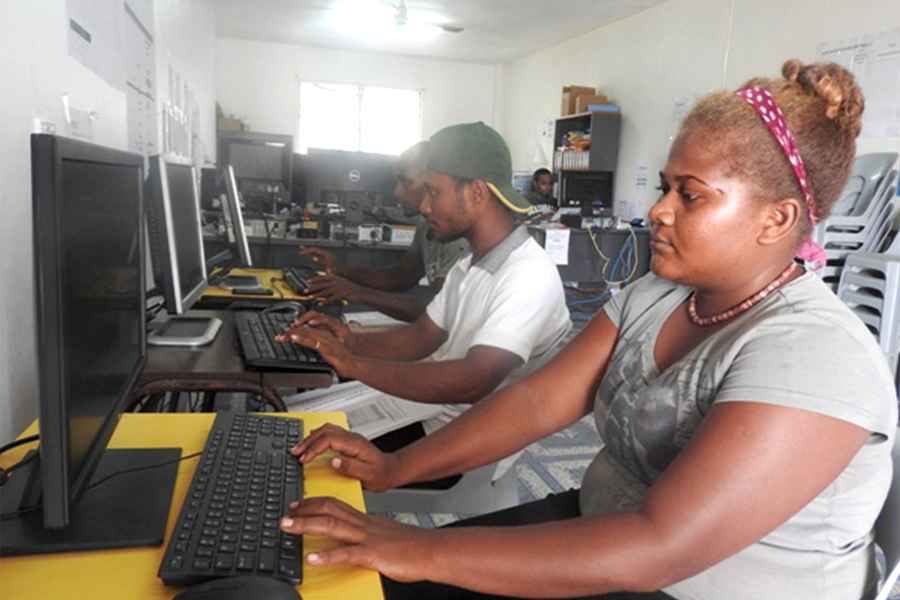
YOUTHS under the internship training from the Youth@work office in Auki are pleased to be involved in computer training at the Y@w office in Auki.
Joshua Wane an intern from Y@w Auki said, services and programmes organised by Y@w are really helpful in broadening their knowledge and skills.
“This week we are being trained on how to use computers especially on how to work with Microsoft word amongst other things.”
He said, the he had never worked with a computer in his life.
“But when joining the youths@work programmes I have broader knowledge on computers which will help me in any future job that I will be applying for.
“In the future our developing world will change in its technology and we must be trained to understand new technology systems.
“I urge other youths in our rural areas to come and be part of the youth @work programmes this year rather than staying back in our homes doing nothing,” he said.
DEAR EDITOR, quoting Radio New Zealand International – March 12, 2018 “Tonga is the first Pacific nation to have a legal aid centre providing free services for survivors of domestic violence.
“The Family Protection Legal Aid Centre opens today in Nuku’alofa and was established by the local Ministry of Justice and will operate within the Ministry’s compound.
“The Ministry’s assistant secretary, ‘Aunofo Aholelei, said the centre was a response to gaps found by key stakeholders of the Family Protection Act 2013.
“Ms Aholelei said there had been no free legal services on offer to assist victims of domestic violence and there was a lack of services available for those living in the outer islands.
“She said the centre was a way forward in addressing those gaps.
“The objective of the project is that survivors of domestic violence have increased access to justice for domestic violence and other family protection matters and the Ministry noted that this objective was direct aligned with the Ministry’s mandate,” Ms Aholelei said.
“The Tongatapu-based centre will also provide an after-hours telephone service to those living in the outer islands.
“The centre’s legal officer, Fitilagi Fa’anunu, said as well as providing the legal advice and representation, her team would also be able to make referrals for clients who may need urgent medical assistance.
“The centre is a major step forward by the government to respond to address the issue of domestic violence and this will no doubt will empower those who are most vulnerable, to have increase access to the justice system,” Ms Fa’anunu said.
“She said in order to be eligible for the free legal service, someone must be a survivor or victim of domestic violence as defined under the Family Protection Act 2013.” Copyright: RNZI (All Rights Reserved)
DEAR EDITOR, quoting Radio New Zealand International – March 12, 2018, “Filtering out a portion of sunlight from entering the Earth’s atmosphere is being explored as a way of reducing some of the impacts of climate change.
“It’s a theoretical proposal known as Solar Radiation Management or SRM, and is referred to as solar geo-engineering, climate engineering and climate intervention.
“The SRM Governance Initiative is looking at its potential as a weapon in the climate change mitigation arsenal particularly for countries at the forefront of climate change.
“The initiative is a partnership between the Royal Society, The World Academy of Sciences, and the Environmental Defence Fund.
“The initiative’s project director Andy Parker says it’s a conversation climate communities in the Pacific should start having.” Copyright: RNZI (All Rights Reserved)
The question what is Solar Radiation Management and could SRM provide a solution to global warming had me thinking and I found some of the information I needed by looking at the GeoEngineering Monitor website which said (quote)
“Solar Radiation Management describes a suite of proposed technologies that aim to reflect sunlight back into space before it warms the earth’s climate. These proposed technique would achieve this in one of a number of ways: by spraying sulphur dioxide or hydrogen sulphide into the stratosphere (the upper reaches of the atmosphere), by launching a 300 km2 barrier into heliosynchronous orbit, by making the albedo (reflectivity) of clouds, or by launching billions of reflective balloons into the stratosphere.
“As a rapidly warming world manifests heat waves, floods, droughts and hurricanes, geoengineering – large-scale manipulation of the Earth’s natural systems – is being presented as a strategy to counteract, dilute or delay climate change without disrupting energy- and resource-intensive economies. Alarmingly, current debates about this big techno-fix are limited to a small group of self-proclaimed experts reproducing undemocratic worldviews and technocratic, reductionist perspectives. Developing countries, indigenous peoples, and local communities are excluded and left voiceless.
“Proposed geoengineering technologies are claimed to threaten people and ecosystems. Holistic assessments of the technologies also show that if deployed they are highly likely to worsen rather than mitigate the impacts of global warming.”
Reading the foregoing there is clearly no easy and, perhaps, safe way yet to having the answer to mitigating the impacts of global warming.
DEAR EDITOR, quoting Radio New Zealand International – March 12, 2018, “Monash University’s World Mosquito Programme says wolbachia bacteria can stop mosquitoes from spreading dengue and other diseases like chikungunya and zika.
“The programme director of impact assessment, Professor Cameron Simmons, said wolbachia was a naturally occurring bacteria and once transmitted to the aedes aegypti mosquito it stopped them getting the infections and spreading them among humans.
“He said the not-for-profit agency had already proven the use of wolbachia is successful in far northern Queensland and he is confident it will eliminate the dengue threat in the Pacific.
“The experience from North Queensland is that so far, in communities where wolbachia has been established they have been dengue free for the last 6 or 7 years.
“And so our expectations are very high that once established our technology is going to provide years of protection for communities in the Western Pacific from these viral diseases.” Copyright: RNZI (All Rights Reserved)
IN my capacity as Chief Magistrate, I wish to formally respond, on behalf of the magistracy, to the article on the front page of Saturday March 10, 2018 edition of the Solomon Star entitled, “DPP fires back”.
The article quotes the DPP as follows “If it appears to any person that there is no control mechanism within the management of cases in the office then I am afraid, it reflects on an erroneous assumption, or perhaps inexperience or ignorance to say the least”. In this quote the DPP is referring to comments made in court by Principal Magistrate Fatima Taeburi in a case in which two police officers were acquitted of charges of assault occasioning actual bodily harm.
The Magistrates Court takes great exception to these comments which are unwarranted, unfounded, and inappropriate and way out of line.
Madame Taeburi is an experienced and accomplished Magistrate who strives to manage her cases appropriately.
I wish to point out that it is the duty of all Magistrates to take control of the management and handling of cases that come before them, in order to ensure that there are no unnecessary delays and ensure the best use of court time.
In this regard, if a magistrate has concerns about the conduct of any party or their counsel it is perfectly appropriate to voice those concerns in the court room.
Everyone must be aware what is expected of them, and that the Magistrate’s Courts in this country will no longer tolerate unnecessary adjournment, delays and the avoidable waste of its time.
I do not propose to discuss the precise details of this case and Madam Taeburi’s judgment.
I will just say that madam Taeburi was fully justified in raising her genuine concerns in court.
And if the DPP has concerns over her comments, then he is perfectly aware that such issues can be raised with either my-self or the Chief Justice, or alternatively he can make a formal referral to the Judicial and Legal Services Commission through the Registrar of the High Court.
What is totally unacceptable is to bypass all the official and transparent complaints procedures (which would allow considered deliberations on the issues and provide the Magistrate with a right to respond) in order to lambast a Magistrate’s conduct and accuse her of “inexperience” and “ignorance” through the media.
CENTRAL Islands Province (CIP) Premier Hon Patrick Vasuni reminds CIP that though they passed the budget of $10,447,703 during their Provincial Assembly last week, it will depend on the funding given by the National Government.
Hon Vasuni said this after learning from report circulating that the National Government will be cutting the funding too for provincial governments this time round.
The province last week held its Provincial Assembly meeting at the new provincial Chamber in which $10,447,703 was passed for the service of the province for this financial year of 2018/2019.
However according to CIP’s Premier despite of the good news for the province, he said it will depend on the funding given through the Ministry of Provincial Government and Institutional Strengthening (MPGIS) from the National Government.
“We are worried because information circulating around is that the National Government will be cutting the funding too for provincial governments,” said the Premier.
“If such really happens then I call on my good people of CIP to work hard together in order to ensure that we continue to maintain sustainability in the province because reducing the funds is similar to funds not having impacts at all.
“Let us now only humbly wait and see what the National Government will be offering for us this time round.”
It is understood that provincial budgets are first passed this time round before the national budgets are passed.
THE new Provincial Chamber built for Central Islands Province (CIP) at Tulaghi will cut costs for the provincial government compared to the past when they had to hire venues to hold provincial meetings.
Central Province now has a place to hold meetings to make decisions for its people after the Provincial Chamber of the Office was officially opened on the 3rd of March.
The first meeting to take place in it was CIP’s Provincial Assembly during the whole of last week.
“Not only have we secured a place to hold meetings but we will now have a proper place to store Provincial Assembly records,” said the Premier.
“Many of our past Assembly records have been lost because of no proper place to store them in the provincial government.”
CIP’s Provincial Government and citizens are now looking forward for the new Provincial Chamber to serve the province into the future.
MCILI PS Mr Riley Mesepitu and MAL PS Mr Jimmi Saelea posed for a photo session after the Pacific Coconut
workshop on Monday
BY LYNTON AARON FILIA
MCILI PS Mr Riley Mesepitu and MAL PS Mr Jimmi Saelea posed for a photo session after the Pacific Coconut workshop on Monday
MINISTRY of Commerce and Ministry of Agriculture and Livestock are planning to set priority on coconut re-planting in Solomon Islands with local farmers.
In a presentation conducted about high demand of coconut production globally, it motivates the Ministry of Commerce, Industries, Labour and Immigration and Ministry of Agriculture and Livestock to venture in coconut tree re-planting.
MCILI’s Permanent Secretary Mr Riley Mesepitu said Ministry of Commerce will proceed in carrying out activities focusing on coconut industry, and it is an area to look at seriously and aggressively this year.
“I think there is also a need to look at re-planting as number of our coconut tree is declining, and I am really willing to work closely with the MAL along with CEMA,” Mesepitu said.
Mesepitu said now coconut industry is very important area for economic development of Solomon Islands.
So through MCILI’s marketing and industry division and commercial division Mesepitu said they will take the matter seriously and aggressively.
To focus on coconut industry development, Mesepitu said they are planning to recruit a coconut Secretariat, someone who could really lead the sector.
MAL permanent secretary Mr Jimmi Saelea said in the area of re-planting, it is very critical to Solomon Islands.
He said that is one area MAL try to look at how best they can address such issue of re-planting.
Saelea said over the years Ministry have been trying but can’t go anywhere because it’s something needs more capability to do the work.
He also explained our farmer needs a lot of education in terms re-planting coconut, and it is other area local farmers require which government and relevant stakeholders need to look at seriously.
Managing of ocean resources needs more, said Mr David Ward British, High Commissioner to Solomon Islands, in a statement yesterday at the commemoration of the Commonwealth Day in Honiara.
He said managing of resources could be further elaborated as protecting them from pollution, especially plastics pollution.
Mr Ward said many plastic bags end up at sea after being used on average for 12 minutes and can last for thousands of years which is expected of one tonne pollution for every three tonnes of fish by 2025.
He explained this cannot be sustained and it has already been agreed upon nations across the world.
“Thanks to Solomon Islands for taking up actions, however, more action still needed to be done,” Ward said.
He said this year it is expected Heads of government in London will look especially at the importance of the marine environment under this last theme.
Group photo of the ICC participants at the Mendana Hotel on Monday. Photo by Barnabas Manebona
BY LYNTON AARON FILIA
THE Asia and Pacific Coconut Community (APCC) held an impressive presentation with officials of the government and private sectors in coconut industry yesterday at Mendana Hotel.
The Pacific Coconut Community workshop is about coconut development and innovation with an aim to collaborate for sustaining coconut sector in Solomon Islands.
Outcome from yesterday’s event put Ministry of Commerce, Industries, Labour and Immigration, Ministry of Agriculture and Livestock and relevant stakeholders a way forward for re-considering coconut industry here.
MCILI’s Permanent Secretary Mr Riley Mesepitu said presentation from the workshop gives significant insights for motivation to do better for Solomon Islands in terms of coconut industry.
He said on country’s policy level there is a gap need to fill-up which require proper coordination and collaboration from Government and relevant stakeholders.
“I would suggest after this meeting when budget approve in parliament we will organize a stakeholders forum in coconut in collaboration with MAL so can we can see look into our commitment and engagement in coconut industry,” Mesepitu said.
Mesepitu said now they will look at strengthening the local farmer’s level to policy level.
Group photo of the ICC participants at the Mendana Hotel on Monday. Photo by Barnabas Manebona
Permanent Secretary for MAL, Mr Jimmi Saelea said coming of APCC to Solomon Islands has given re-direction and encourage coconut sectors to do something seriously about coconut industry.
Saelea said development of coconut industry in Solomon Islands is a serious matter for country to address its challenges faced over the years.
“We have coconut out there but production is quite low compare to other countries and that area we need to work on as well,” PS Saelea said.
The workshop is organise by MCILI and facilitated by Dr Uron Salum, Director General of the APCC.
The APCC now changed to International Coconut Community (ICC) is an intergovernmental organisation of coconut producing countries organized in 1969 under the aegis of the United Nations Economic and Social Commission for Asia and the Pacific (UN-ESCAP).
The ICC Secretariat is located in Jakarta, Indonesia and is headed by an executive director.
ICC has 18 coconut producing member countries accounting for over 90 percent of world coconut production and exports of coconut products.
Member countries include Federated States of Micronesia, Fiji, India, Indonesia, Kiribati, Malaysia, Marshall Islands, Papua New Guinea, Philippines, Samoa, Solomon Islands, Sri Lanka, Thailand, Tonga, Vanuatu, and Vietnam.